

U0129 on 2021 Dodge Charger: Lost Communication With Brake Module Causes and Fixes
This code means the Brake System Control Module (BSCM) has stopped communicating with other vehicle systems. This is a serious fault that disables ABS and stability control. Common causes include wiring issues, a faulty BSCM, or a software glitch requiring a dealer update as noted in a manufacturer TSB. In many cases, this code appears with a cluster of other communication codes, pointing strongly toward the software issue.
- Code U0129 on a 2021 Dodge Charger means a critical communication failure with the Brake System Control Module, disabling ABS and stability control.
- Before starting any physical repairs, check with a dealer if TSB #1801222 applies to your vehicle, as a simple software update may be the only fix needed.
- If software is not the issue, the most common causes are faulty wiring/connectors to the ABS module or a failed module itself.
- This is a safety-critical fault; driving the vehicle is not recommended.
- Diagnosis is complex and best left to a professional with CAN bus diagnostic tools.
What's Unique About the 2021-2021 Dodge CHARGER
For the 2021 Dodge Charger, this code is specifically mentioned in Technical Service Bulletin (TSB) #18-012-22. The TSB notes that U0129 can appear alongside a large number of other communication loss codes, and the prescribed fix is a software update for the Powertrain Control Module (PCM). This suggests that many instances of this code on this specific vehicle may be due to a software anomaly that makes the PCM overly sensitive to network fluctuations, rather than a physical hardware failure.
Diagnostic Flowchart
Tap your situation to follow the diagnostic path that matches what you're seeing on this vehicle.
Symptoms You May Notice
- Anti-lock Brake System (ABS) warning light is on
- Electronic Stability Control (ESC) or Traction Control warning light is on
- Brake warning light is illuminated
- Cruise control is disabled
- A "Service ABS System" or similar message may appear on the instrument cluster
- Loss of Engine Start/Stop (ESS) functionality.
- Vehicle may go into "limp mode" with reduced power.
- In rare cases, a no-crank/no-start condition can occur if the BSCM is shorting the CAN bus network. 🎬 Watch: Diagnosing a no-start caused by ABS module communication failure.
- Replacing the Brake System Control Module when the actual problem is a simple wiring issue, a blown fuse, or a software glitch that requires a PCM reflash.
- Assuming a single faulty part when low battery voltage is causing multiple modules to report communication errors simultaneously.
Most Likely Causes
- Software Anomaly in Powertrain Control Module (PCM) 🔴 High Probability A specific TSB (#18-012-22) was issued by Dodge for 2021 Chargers built on or before October 14, 2021, indicating that a PCM software update is the fix for a cluster of communication codes, including U0129. The update likely improves the PCM's ability to handle network communication interruptions.
How to confirm: A Dodge dealership or a qualified shop with access to OEM software (like wiTECH) can check the current PCM software version against the latest available version mentioned in the TSB. The presence of multiple other communication codes listed in the TSB (like U0101, U0140) makes this cause more likely.
Typical fix: Reprogramming the Powertrain Control Module (PCM) with the latest software. This is a non-mechanical repair that involves flashing the module.
Est. part cost: $0-$250 (Dealer labor charge for flashing the module) - Wiring or Connector Issues 🟡 Medium Probability The CAN bus wiring harness is susceptible to damage from vibration, moisture, or physical impact, leading to corroded pins, loose terminals, or broken wires. On Dodge platforms, the connector at the ABS module itself can be a failure point, with pins becoming corroded or bent.
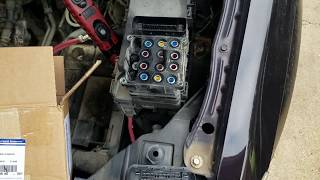
How to confirm: Visually inspect the wiring harness and the large electrical connector at the Brake System Control Module (located on the ABS hydraulic unit in the engine bay, near the windshield washer reservoir) for damage. A multimeter can be used to check for power, ground, and CAN bus signal integrity at the module's connector. A severely damaged connector may be obvious upon unplugging it.
Typical fix: Repairing the damaged section of the wiring harness or cleaning/replacing the connector pigtail.
Est. part cost: $10-$150 - Failed Brake System Control Module (BSCM) 🟡 Medium Probability
How to confirm: If wiring, power, ground, and CAN bus signals are all verified as good at the module connector, and the PCM software is confirmed to be up-to-date, but the module still won't communicate with a scan tool, the module itself has likely failed internally. A professional scan tool can show the network topology and confirm the ABS module is offline.
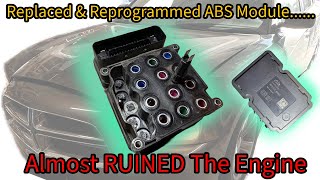
Typical fix: Replacing the Brake System Control Module. The new module will need to be programmed to the vehicle's VIN and configuration.
Est. part cost: $687-$900 for the part alone. - Low Battery Voltage or Poor Grounds ⚪ Low Probability Modern vehicles with multiple control modules are highly sensitive to voltage fluctuations. A weak or failing battery can cause a cascade of communication error codes as modules fail to initialize properly.
How to confirm: Test the battery voltage with a multimeter (should be ~12.4-12.6V with engine off, ~13.7-14.7V with engine running). Load test the battery to confirm its health. Inspect and test the main battery ground and chassis ground connections for tightness and corrosion.
Typical fix: Charging or replacing the battery, or cleaning/tightening ground connections.
Est. part cost: $0-$250
Rare But Worth Checking
- Blown Fuse for ABS Module:
Diagnosis Steps
- Connect a professional OBD-II scanner (like wiTECH or AlfaOBD) capable of reading all vehicle modules. Check for other DTCs. Note if other communication codes listed in TSB #18-012-22 are present, which strongly suggests the software issue.
- Check the battery and charging system. Ensure voltage is stable and above 12.4V engine-off and that the battery passes a load test.
- Inspect all main power and ground connections for tightness and corrosion.
- Locate the Brake System Control Module (BSCM), typically mounted to the ABS hydraulic unit in the engine bay, often near the driver's side firewall/strut tower. Visually inspect its large electrical connector and nearby wiring for any signs of damage, corrosion, or looseness.
- Using the advanced scan tool, check the CAN bus network topology to see which modules are offline. Attempt to communicate directly with the BSCM.
- If communication fails, use a digital multimeter to verify that the BSCM is receiving proper power (check relevant fuses like F5, F6, 36, 39) and has a good ground at its connector.
- If power and ground are present, check the CAN High and CAN Low circuit voltages at the BSCM connector. They should typically be around 2.5V each when the network is idle. Total resistance across the two CAN lines should be approximately 60 ohms. 🎬 See this guide on how to troubleshoot CAN BUS faults.
- If all wiring, power, and grounds are good, contact a dealer to verify if the PCM software update from TSB #18-012-22 has been performed. If not, this is the next logical step.
- If the software is up to date and all other checks pass, the BSCM itself is the most likely culprit and requires replacement and programming.
Parts You'll Likely Need
- Brake System Control Module / ABS Module
(OEM #68399772AG (supercedes previous numbers, but always verify with VIN))— If wiring and software are ruled out, the module itself may have an internal failure preventing it from communicating on the network.
Trusted brands: Mopar
OEM price range: $800-$1200.
Aftermarket price range: $400-$800 (Remanufactured)
Related Codes That Often Appear With This One
- U0101 — Lost Communication With TCM. Both are listed in TSB #18-012-22 as being part of a larger software-related communication issue.
- U0128 — Lost Communication With Park Brake Control Module. Also listed in TSB #18-012-22.
- U0140 — Lost Communication With Body Control Module. Also listed in TSB #18-012-22.
- U0418 — Implausible Data Received From Brake System Control Module 1. This is another code related to the BSCM, also mentioned in TSB #18-012-22.
Technical Service Bulletins (TSBs) & Recalls
- 18-012-22: Flash: Powertrain Control Module (PCM) Updates, which lists U0129 as a code that can be resolved by a software update for 2021 Chargers with the 3.6L engine.
Platform-Specific Known Issues
- Dodge Technical Service Bulletin (TSB) #18-012-22 (NHTSA TSB #10222992) addresses an issue on 2021 Chargers (built on/before Oct 14, 2021) where a Malfunction Indicator Lamp (MIL) can be triggered by U0129 and numerous other communication DTCs. The official remedy is to reprogram the Powertrain Control Module (PCM) with updated software, which suggests the original software was too sensitive to minor network disruptions.
Mechanic-Grade Diagnostic Values
- CAN C Bus Resistance — expected: ~60 Ω across CAN C High and CAN C Low pins at the DLC or module connector (with battery disconnected).. Failure: A reading of ~120 Ω indicates an open circuit or a missing terminating resistor. A reading significantly lower than 60 Ω (e.g., near 0 Ω) indicates a short between the CAN lines.
- CAN C Bus Voltage (Key On, Engine Off) — expected: CAN High: ~2.6V, CAN Low: ~2.4V, measured with a multimeter to chassis ground. An oscilloscope will show CAN High switching between 2.5V and 3.5V, and CAN Low switching between 2.5V and 1.5V.. Failure: Voltages stuck at 0V, battery voltage, or identical values on both lines indicate a short to ground, short to power, or short between the lines.
- BSCM Power Supply Voltage — expected: 12.0 ± 0.5 V at the module's power pin with the ignition on.. Failure: Low or no voltage indicates a blown fuse, faulty relay, or wiring issue.
- BSCM Ground Resistance — expected: Below 0.1 Ω between the module's ground pin and a clean chassis ground.. Failure: High resistance indicates a corroded or loose ground connection, which can cause the module to drop offline.
Scan Tool Commands That Help
- wiTECH (OEM Dealer Tool): Proxy Configuration Alignment — This procedure is mandatory after replacing the ABS module or certain other CAN bus modules. It synchronizes the vehicle's configuration list across all modules. Failure to perform this can result in a flashing odometer and persistent communication codes.
- wiTECH (OEM Dealer Tool): ABS Initialization / ABS Routines — After installing a new or used ABS module, this function programs the VIN, calibrates the G-sensor, and performs other necessary setups. It may include sub-functions like 'Brake Pedal Calibration' and 'Longitudinal G-Sensor Calibration'.
- AlfaOBD (Aftermarket): Proxy Alignment — A powerful aftermarket tool that can perform the mandatory Proxy Alignment after module replacement, which is often a dealer-only function. It is accessed under the 'Body Computer' section.
- wiTECH (OEM Dealer Tool): Network Topology View / Bus Check — During initial diagnosis, this function provides a visual map of all control modules on the network and shows which ones are not communicating (often highlighted in red), immediately confirming the U0129 is due to the ABS module being offline.
Wiring & Ground Locations
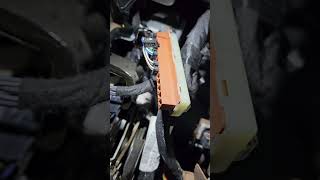
- BSCM Connector (C135) — Plugged into the electronic portion of the ABS hydraulic unit, located in the engine bay, often near the driver's side strut tower or behind the front bumper/fender liner area.. This is the primary connection point for all power, ground, and CAN bus signals to the module. Corrosion, moisture, or pushed-out pins here are a direct cause of communication loss.
- ABS Module Ground (G105) — A chassis ground point located in the engine bay, to which the ABS module's ground wires are connected.. A loose or corroded G105 ground will starve the ABS module of a proper electrical reference, causing it to malfunction and drop off the CAN network, directly triggering U0129.
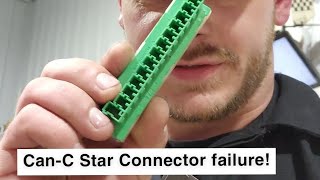
- CAN C Bus Wires — A twisted pair of wires (typically White/Light Blue for CAN C+ and White/Orange for CAN C-) running from the Star Connector/Gateway to the BSCM connector.. These two wires are the physical data link. A short or open in either wire will sever communication with the ABS module.
Real Owner Repair Stories
- YouTube video by 'Fixing a u0129 code on a 2014 corolla. Super easy' (2014 Toyota Corolla (Note: Different vehicle, but demonstrates a universal root cause for U-codes)) — Multiple warning lights including ABS, stiff power steering, and a cluster of communication codes.
❌ Tried (didn't work) Checked all fuses., Inspected the ABS module connector for corrosion or bent pins.
✅ What actually fixed it The ground wire for the ABS module was found to be completely severed near its chassis connection point. Temporarily holding the broken wire to a ground point made all the warning lights disappear and restored normal function. The final fix was to properly repair the broken ground wire. - YouTube video by 'No Crank No Start ABS codes U0129...' (Chrysler/Dodge vehicle (specific model not stated)) — No-crank, no-start condition. Scan tool showed U0129 and the ABS module was red (offline) in the network topology view.
❌ Tried (didn't work) Initial assumption was a starter or battery issue.
✅ What actually fixed it The main electrical connector at the ABS module was found to be severely melted and corroded, causing a short that brought down the entire CAN C bus, preventing the vehicle from starting. The fix required replacing the destroyed connector pigtail.
OEM Part Supersession History
68399772AA, AB, AC, AD, AE, AF→68399772AG— Part revisions to improve reliability or address known failure modes. Using the latest part number is always recommended.
Heads up: While older versions may physically fit, the latest version (AG) is the correct service part for replacement.
Model Year Variations Within This Range
- 2021 (built on or before October 14, 2021): Vehicles built before this date may have PCM software that is overly sensitive to network fluctuations, making the TSB #18-012-22 software update the most likely fix for a cluster of communication codes including U0129.
Helpful Videos
We Have This Part in Stock



The information in this article is provided for general reference and educational purposes only. Vehicle specifications, procedures, and part compatibility can vary by production date, trim level, and region. Always consult your vehicle's factory service manual and verify part numbers before purchasing or performing repairs. Safety-critical components such as airbags, seat belts, and braking systems should be installed by a qualified professional.
- Dodge CHARGER:
- 🎬 Helpful Videos
- 🛍️ Shop This Part
- What's Unique About the 2021-2021 Dodge CHARGER
- Diagnostic Flowchart
- Symptoms You May Notice
- Most Likely Causes
- Rare But Worth Checking
- Diagnosis Steps
- Parts You'll Likely Need
- Related Codes That Often Appear With This One
- Technical Service Bulletins (TSBs) & Recalls
- Platform-Specific Known Issues
- Mechanic-Grade Diagnostic Values
- Scan Tool Commands That Help
- Wiring & Ground Locations
- Real Owner Repair Stories
- OEM Part Supersession History
- Model Year Variations Within This Range
- 🎟️ Get 5% Off