

OBD-II Code U0126: Lost Communication With Steering Angle Sensor Module
The Ultimate 2026 Guide to Diagnosing and Fixing U0126
- Code U0126 disables critical safety systems like ABS and Electronic Stability Control because the main computer lost communication with the Steering Angle Sensor.
- Do not replace the sensor immediately; over 70% of U0126 codes stem from damaged CAN bus wiring, corroded connectors, or a weak 12V battery.
- Test the CAN bus network resistance at the OBD-II port (Pins 6 and 14) with the battery disconnected; a healthy network must read exactly 60 ohms.
- Replacing the Steering Angle Sensor requires a mandatory software calibration using a $300+ bi-directional scan tool to reset the steering zero-point.
What Does U0126 Mean?

Code U0126 means your car's main computer lost its connection to the Steering Angle Sensor (SAS) module. This sensor tells other safety systems the precise angle and direction of the steering wheel. This data is essential for Electronic Stability Control (ESC), ABS, traction control, and advanced driver-assist systems. When the Controller Area Network (CAN bus) communication link breaks, these safety systems disable as a precaution, illuminating their dashboard warning lights.
Technical definition: Lost Communication With Steering Angle Sensor (SAS) Module. This generic network trouble code indicates the SAS module is not receiving or transmitting messages on the Controller Area Network (CAN) bus. The code sets when a supervising module (like ABS, Power Steering, or Gateway) misses the expected message from the SAS module within a calibrated time frame, often as short as 600 milliseconds.
Can I Drive With U0126?
Yes, But With Caution. Driving is technically possible but strongly discouraged. Your primary safety systems—Anti-Lock Brakes (ABS) and Electronic Stability Control (ESC)—are disabled. This increases the risk of losing control during emergency maneuvers or on slippery surfaces. Stopping distances increase, and the vehicle will not automatically correct for skids. In vehicles with electric power steering, the steering becomes heavy and difficult to turn, posing a direct safety hazard at low speeds.
Common Causes

- Damaged Wiring, Connectors, or Water Intrusion (Very Common) — This is the most frequent culprit. Wires in the steering column, under the dash, or exposed under the vehicle chafe, pinch, or corrode, breaking the CAN bus communication link. Moisture from leaking windshields or road spray seeps into connectors, causing shorts. On GM vehicles, the X411 connector under the rear is a notorious weak point.
- Low Battery Voltage or Bad Ground (Common) — Control modules require stable voltage. A weak battery, failing alternator, or a corroded ground wire (like the G218 ground on GM trucks 🎬 Watch: How to locate and clean the G218 ground point.) causes intermittent power loss to the SAS module, triggering communication faults.
- Blown SAS Module Fuse (Common) — A blown fuse for the SAS module or a related control circuit cuts power entirely, preventing network communication.
- Faulty Steering Angle Sensor (SAS) / Clock Spring (Less Common) — The sensor module or its housing (clock spring) fails internally. Only conclude this after proving all wiring, power, and ground inputs are fully functional.
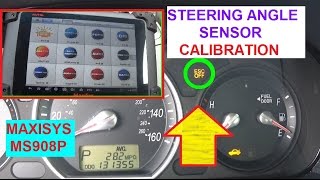
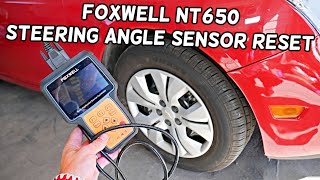
- Corrupted Software or Failed Programming (Less Common) — Module software corrupts after a significant voltage drop or incomplete programming attempt. Some modules require a dealer software update to clear the code even after a physical repair. 🎬 Watch: How to reset and calibrate the steering angle sensor.
- Aftermarket Device Interference (Rare) — Poorly installed aftermarket clock springs, OBD-II insurance dongles, or remote starters disrupt the CAN bus network and cause communication loss.
Symptoms

- ABS and Traction/Stability Control (ESC) Lights On — The most immediate symptom. These systems depend on steering angle data and disable instantly when the signal drops.
- Loss of Power Steering Assist — In vehicles with electric power steering (EPS), the steering becomes heavy and difficult to turn at low speeds as the system enters a default failure mode.
- Driver-Assist Systems Disabled — Features like lane-keep assist, adaptive headlights, and park assist turn off and display fault messages on the instrument cluster.
- Check Engine Light On — The Malfunction Indicator Lamp (MIL) illuminates to alert the driver of the stored network fault.
- Steering Wheel Jitter — The steering wheel exhibits a brief, irregular twitch as the power steering system attempts to interpret erratic data from the failing network.
- SAS Module Offline in Scan Tool (scan-tool only — no driver-felt sign) — The Steering Angle Sensor module does not respond or disappears from the communicating modules list on a diagnostic scanner.
Diagnostic Flowchart
Tap your situation to follow the diagnostic path that matches what you're seeing on this code.
Common Fixes & Costs
- Repairing Damaged Wiring or Connectors
— Parts: $10-$50, Labor: $100-$300, ~1.5 hr book time
(Intermediate)
Chevrolet Equinox / GMC Terrain: OEM - Replacing a Blown Fuse or Cleaning a Ground Connection — Parts: $1-$20, Labor: $0-$100, ~0.5 hr book time (DIY)
- Replacing the Steering Angle Sensor / Clock Spring
— Parts: $150-$600, Labor: $150-$300, ~1.5 hr book time
(Professional)
Chevrolet Equinox (2013-2017): OEM
Chevrolet Silverado (2014-2018): OEM
Honda Civic (2016-2021): OEM - Updating or Reprogramming a Control Module — Parts: $0, Labor: $100-$200, ~1 hr book time (Professional)
- Replacing a Faulty Control Module (BCM, EBCM, etc.) — Parts: $400-$1200, Labor: $150-$300, ~1.5 hr book time (Professional)
Used vs. New Parts: Buying Guide
When a used part is worth it: Buying a used Steering Angle Sensor is risky due to sensitive electronics and wear-prone ribbon cables. It only makes sense if the vehicle is very old, the part is discontinued, and the donor vehicle has low mileage with no collision damage.
Donor-vehicle mileage cap: roughly under 50000 miles for the part to have meaningful remaining life.
Donor quality checklist:
- Verify the donor vehicle was not in a front-end collision, which damages the clock spring.
- Ensure the part number is an exact match; incompatible parts will not communicate.
- Avoid parts from flood-damaged vehicles due to internal corrosion risk.
Decision logic:
- If The part is a sensitive electronic sensor integral to a safety system (like the SAS) → Strongly favor a new OEM or high-quality aftermarket part.
- If Vehicle is over 15 years old and budget is the primary concern → A used part from a reputable salvage yard with a short-term warranty is a possible but risky option.
- If The failure is in the clock spring's ribbon cable, a known wear item → Buy new. A used part has unknown remaining life and fails quickly.
Warranty tradeoff: Used parts offer a 30-90 day warranty. New aftermarket parts offer a 1-year to limited lifetime warranty. New OEM parts carry a 1-2 year warranty.
Worst-case if a used part fails: $300-$500 if a used part fails quickly, requiring repeat labor for diagnosis and replacement.
What Happens If You Wait — Timeline
- Immediate: Code U0126 sets. ABS, Traction Control, and Stability Control warning lights illuminate. These safety systems disable. Power steering assist reduces or fails. (MPG impact: 0%% · Added cost: $0)
- 1-3 months: Driving without stability control leads to uncorrected skids, causing uneven tire wear. Heavy steering causes driver fatigue. The underlying electrical fault worsens. (MPG impact: 0%% · Added cost: $50-$200 (potential tire wear))
- 3-9 months: The initial fault degrades further, affecting other modules on the same CAN bus. This causes new, unrelated symptoms like flickering lights or radio issues. (MPG impact: 0-5%% · Added cost: $200-$500 (diagnostic time increases))
- 9+ months: The wiring fault becomes a permanent short, bringing down the entire CAN bus network. This causes a no-start condition or damages expensive control modules like the BCM. (MPG impact: N/A (vehicle may not start)% · Added cost: $1000-$2500+)
Cost of Not Fixing It
- Immediate: Disabled ABS, Traction Control, and Stability Control systems, significantly increasing the risk of an accident in emergency maneuvers or on slippery roads. (Added cost: N/A)
- 0-3 months: Abnormal tire wear due to disabled stability systems not correcting for minor skids. Heavy steering causes driver fatigue. (Added cost: $50-$200)
- 3+ months: An underlying wiring short worsens, shorting out other modules on the CAN bus, leading to a complex no-start or multi-system failure. (Added cost: $500-$2500+)
Diagnosis Steps
- Perform a Global DTC Scan & Live Data Check
Use an advanced OBD-II scanner to perform a full vehicle scan and view the 'Steering Wheel Angle' live data PID. If U0126 appears alongside U0121 or U0131, it proves a network-wide issue rather than an isolated SAS failure. If the angle data is frozen or absent, communication is lost.
Tools: Advanced Bi-directional Scan Tool (Beginner) - Check Battery, Fuses, and Grounds
Ensure the battery rests above 12.4 volts and the alternator charges at 13.7-14.7 volts. Visually inspect and test all SAS and ABS fuses. Locate and clean known problematic grounds, like G218 on GM trucks.
Tools: Multimeter, Fuse Puller, Wire Brush (Beginner) - Perform a Detailed Visual Inspection
Inspect wiring harnesses around the steering column, under the dashboard, and at known TSB locations (e.g., X411 connector on GM Equinox). Look for chafed wires, loose connectors, or water intrusion.
Tools: Flashlight, Trim Removal Tools (Intermediate) - Verify Power and Ground at the SAS Module
Using a wiring diagram, identify the power and ground pins at the SAS connector. With the key on, confirm the module receives 12.0-12.6V. Check the ground pin for less than 0.1 ohms of resistance to a known good chassis ground.
Tools: Multimeter, Vehicle Wiring Diagram (Advanced) - Test CAN Bus Network Resistance
With the key off and battery disconnected, measure resistance between Pin 6 (CAN High) and Pin 14 (CAN Low) at the OBD-II port. A healthy network reads 60 ohms. A 120-ohm reading indicates an open circuit; near 0 ohms indicates a short.
Tools: Multimeter (Advanced) - Check CAN Bus Voltages
With the key on, back-probe the SAS module connector. CAN High (Pin 6) should read ~2.6V and CAN Low (Pin 14) ~2.4V at rest. If voltages are stuck at 0V or 5V, you have a hard wiring fault on the bus.
Tools: Multimeter, Back-probe Kit (Advanced) - Isolate the Shorted Module
If the CAN bus is shorted (0 ohms), unplug modules one by one. If unplugging the SAS module returns the network resistance to 60 ohms, the SAS module has an internal short and requires replacement.
Tools: Multimeter, Basic Hand Tools (Professional)
When This Code Triggers (Freeze-Frame Conditions)
- Vehicle Speed: 15-50 mph (Logged when the vehicle is in motion during normal driving.)
- Engine RPM: 1200-2500 RPM (Sets during steady-state driving or turning maneuvers, not typically during high-revving acceleration.)
- Battery Voltage: 11.5-14.5V (Triggers if voltage drops low intermittently or if a fault occurs while the charging system is active.)
- Ignition Status: On / Run (The communication check that triggers U0126 performs continuously while the ignition is on.)
Related Codes
- U0131 — Lost Communication with Power Steering Control Module (PSCM). Often appears with U0126 because both share the high-speed CAN bus. Indicates a shared wiring or network-wide issue.
- U0121 — Lost Communication With Anti-Lock Brake System (ABS) Control Module. The ABS module relies on steering angle data. Seeing U0121 and U0126 together proves a wider CAN bus wiring fault affecting multiple modules.
- C0051 — Steering Wheel Angle Sensor. More specific than U0126. C0051 indicates an internal sensor failure or calibration loss, whereas U0126 points strictly to a communication line failure.
- U0155 — Lost Communication With Instrument Panel Cluster (IPC) Control Module. The IPC acts as a gateway routing messages. If the IPC loses communication, it prevents the SAS from talking to other modules. Diagnose U0155 first.
Climate & Environmental Factors
- High Humidity, Rain, and Road Salt: Moisture and salt spray penetrate unprotected connectors (like the GM X411) or seep past firewall seals, causing rapid corrosion on CAN bus pins. This increases resistance and severs communication.
- Extreme Temperature Cycles: Repeated temperature swings cause wires and connectors to expand and contract, loosening connections. In extreme cold, wire insulation becomes brittle and cracks, creating entry points for moisture.
How to Talk to a Mechanic About This Code
Say this: "I have a U0126 code with ABS and stability control lights on. Please instruct the technician to follow a logical diagnostic path, starting with checking for TSBs, verifying power, ground, and CAN bus network integrity at the Steering Angle Sensor before condemning the sensor itself."
This signals you are an informed consumer. It directs them toward proper diagnosis for a network code, preventing a costly misdiagnosis where you pay for a new sensor when the real issue was a simple wiring fault.
Avoid saying:
- 'My stability control light is on, can you fix it?' (Too vague, invites guesswork).
- 'I think I need a new steering angle sensor.' (Don't diagnose the car for them; you pay for a part you don't need).
- 'Just do whatever it takes to fix it.' (A blank check for unnecessary repairs).
Questions to ask before authorizing the repair:
- What were the results of the power, ground, and network tests at the sensor connector?
- Did you measure the CAN bus resistance? What was the reading in ohms?
- If recommending a new sensor, can you confirm all wiring and power inputs to the old sensor tested good?
- Does the repair estimate include the mandatory steering angle sensor calibration?
Where to Take It: Dealer vs Independent vs Chain
- Dealer:
A strong, reliable option, especially for newer cars or software issues. They have the exact tools, but you pay a premium.
Best for: Vehicles under warranty., Complex, manufacturer-specific electrical issues or when a software update is required., Vehicles with well-known TSBs for this issue (e.g., GM, Ford).
Downsides: Highest labor rates., Quick to recommend module replacement over intricate wiring repair. (Typical cost: +50% vs. baseline) - Independent Shop:
The best choice if you find the right shop. Look for a shop that advertises 'electrical diagnostics' and has ASE-certified technicians.
Best for: Out-of-warranty vehicles where cost is a major factor., Finding a shop that specializes in electrical diagnostics or your specific car brand.
Downsides: Shop quality varies widely. A general mechanic lacks the specific tools or experience with CAN bus networks. (Typical cost: +0% vs. baseline) - Chain Shop:
AVOID. Complex network diagnosis is not suited for chain shops. The likelihood of paying for unnecessary parts is very high.
Best for: Simple, high-volume jobs like tires, brakes, and oil changes.
Downsides: Technicians lack advanced diagnostic training for complex electrical faults., Business model encourages quick parts replacement over detailed diagnosis. (Typical cost: -10% vs. baseline)
When to Walk Away From the Repair
If the estimated repair cost for the U0126 fault exceeds 40-50% of your car's current private-party market value, seriously consider selling or trading it in.
- Car worth $3500, fix is $1800: Walk away. The repair cost is over 50% of the car's value. Sell it as a 'mechanic's special' or trade it in.
- Car worth $10000, fix is $850: Fix it. The repair cost is well under the threshold and restores critical safety features, preserving value.
- Car worth $5000, fix is $2200: Borderline, but likely walk away. Get a second opinion to confirm the diagnosis and cost.
What Scan Tool You Need for This Code

Minimum: A bi-directional scan tool capable of reading codes from all modules and performing the 'Steering Angle Sensor (SAS) Calibration/Relearn' function.
A basic $20 code reader only tells you the code exists. It cannot view live steering angle data, and most importantly, cannot perform the mandatory SAS calibration required after replacing the sensor.
Budget: BlueDriver Bluetooth Pro (~$100) — Excellent for reading codes and viewing live data. However, it lacks the SAS calibration function needed to complete the repair.
Mid-range: Innova 5610 or Foxwell NT809 (~$350) — The sweet spot for a serious DIYer. Offers full system diagnostics, live data, and crucial bi-directional controls, including the SAS calibration/relearn procedure.
Professional: Autel MaxiCOM MK808S (~$450) — Provides professional-level diagnostics with extensive vehicle coverage for SAS calibration and detailed live data graphing to diagnose intermittent wiring issues.
Rent vs buy: Rentals from auto parts stores are basic code readers and are NOT sufficient for this repair. You must buy a capable bi-directional tool or take the vehicle to a professional shop.
How to Clear the Code After You Fix It
- Use a professional OBD-II scan tool to clear the U0126 code from all modules.
- Perform the Steering Angle Sensor calibration/relearn procedure as required by the manufacturer.
- Perform a test drive that includes several left and right turns to confirm the fix and ensure no warning lights return.
Drive cycle (~20 minutes): After clearing the code, start the engine and idle for 2 minutes. Drive for 10-15 minutes, including city and highway conditions. Perform several turns. Park and shut off the vehicle. Restart to confirm warning lights remain off.
Readiness monitors affected: This is a network code and does not directly affect emissions readiness monitors like the Catalyst or O2 sensor monitors.
Before emissions retest: drive at least 50 miles to fully set monitors.
Watch out for:
- Disconnecting the battery does not clear this code from all modules and does not perform the necessary SAS calibration.
- If the root cause (e.g., a chafed wire) remains unfixed, the code returns immediately.
- Forgetting to calibrate the new sensor prevents the system from working correctly and sets new codes.
Will This Fail Emissions / State Inspection?
Yes — this code typically fails an OBD-II emissions inspection.
- California: An illuminated ABS or safety system light due to U0126 is grounds for a safety inspection failure, preventing registration.
- New York: The NYS inspection includes an ABS light check. If the light is on due to U0126, the vehicle fails the safety portion.
- Texas: In counties requiring a safety inspection, an illuminated ABS warning light results in an automatic failure.
Most Commonly Affected Vehicles
- Chevrolet Equinox / GMC Terrain (2010-2017) — Extremely prone to corrosion in the X411 electrical connector under the vehicle's rear. Documented in GM TSB #PIT5427B and #PIT5171C.
- Chevrolet Silverado / GMC Sierra (2014-2019) — Known for pinched wiring harnesses behind the instrument panel (TSB #PIT5288H), chafed harnesses under door sill plates (TSB #PIT5457D), and a poor Body Control Module (BCM) ground at G218 (TSB #18-NA-161).
- Honda Pilot / Civic / Odyssey (2016-2022) — Often caused by an open wire in the F-CAN lines. Rodent damage to the EPS harness is a common, overlooked cause that mimics internal sensor failure.
- Ford Focus / F-150 (2011-2020) — Related to CAN bus wiring faults or issues within the Electric Power Steering Assist (EPSA) system. Water intrusion into the main body harness connector in the driver's side footwell is a known issue.
- Hyundai Santa Fe / Tucson / Elantra (2009-2016) — Often related to CAN communication line faults between the 4WD ECU and the SAS module. The SAS is integrated into the clock spring assembly, which frequently fails.
- Chevrolet Volt (2011-2015) — Caused by a wiring fault on the 'Chassis bus' network or a weak 12V auxiliary battery that cannot provide stable voltage to the modules. TSB #PIT5076E applies.
- Lexus IS / RX models (2006-2013) — Issues frequently arise after steering wheel removal when an incompatible or poor-quality aftermarket clock spring assembly is installed, which the vehicle's network rejects.
- Toyota Corolla / Prius / Tacoma (2013-2017) — Presents with U0073 (Control Module Communication Bus Off) in high-heat conditions. The code also appears after a battery jump-start, requiring a hard reset or recalibration.
Manufacturer-Specific Notes
- General Motors (GM): Notorious for wiring issues. TSB #PIT5427B covers corroded X411 connectors on Equinox/Terrain. TSB #18-NA-161 covers poor BCM ground G218 on Silverado/Sierra. Always check wiring before replacing a GM sensor.
- Ford: U0126 links to faults in the Electric Power Steering Assist (EPSA) wiring. Water intrusion into driver-side kick panel connectors and clock spring failures are frequent culprits.
- Honda: Often accompanied by C0051-96. Rodent damage to soy-based wiring insulation on the EPS rack harness perfectly mimics a sensor failure. Check harnesses before replacing the sensor.
- Hyundai / Kia: The steering angle sensor is integrated into the clock spring assembly. A clock spring failure takes the sensor offline. Use exact OEM replacements to avoid network rejection.
Real Owner Stories
2014 Chevrolet Equinox - The Obvious Fix is Wrong
Owner experienced 'Service StabiliTrak' light and multiple communication codes, including U0126 and U0074 (Bus B Off).
What they tried:
- Initial diagnosis pointed towards a failure of multiple modules on the chassis expansion bus.
Outcome: A diagnostic technician found the wiring harness chafed through on the rear subframe. The break was in the CAN bus wires running through the X411 connector. Repairing the broken wires restored communication and cleared all codes.
Lesson: On GM vehicles known for wiring issues, thoroughly inspect known problem areas (like the X411 connector) before replacing expensive modules, even if multiple 'U' codes are present.
2014 Chevrolet Silverado - The Intermittent Ground Nightmare
At slow speeds, the power steering failed, dash lights flickered, and the truck occasionally died. The issue was intermittent.
What they tried:
- Took the truck to a dealership, which 'tightened a ground' but could not replicate the fault.
Outcome: The issue was traced to a poor connection at the G218 ground on the driver's A-pillar, where sound insulation gets trapped under the ground nut. Properly cleaning and securing this ground connection resolved the symptoms.
Lesson: Intermittent electrical chaos is a classic sign of a bad ground. Research TSBs for your vehicle's specific ground locations (like GM's G218) as they are often the hidden culprit.
2013 Honda Accord - A Simple Wiring Fault
Vehicle presented with intermittent U0126 codes and associated warning lights, but no obvious symptoms otherwise.
What they tried:
- Initial checks of the module and connectors did not reveal an obvious cause.
Outcome: The problem traced back to a single frayed wire within the harness connecting to the steering control module. The $100 repair resolved the communication issue completely.
Lesson: A simple, single-wire fault takes the entire module offline. A thorough visual inspection of the harness is a critical and cost-effective diagnostic step.
Lexus LS430 - Code Appears After Previous Repair
A low-mileage LS430 suddenly displayed VSC and TRAC OFF lights with code U0126.
What they tried:
- The owner recalled the telescoping steering motor was replaced 5,000 miles prior.
Outcome: Given the recent steering column disassembly, the cause was a disturbed connector or slightly damaged clock spring from that service. The owner cleared the code, suspecting a temporary glitch from the prior work.
Lesson: If a fault code appears after a related component was serviced, the prior repair is a primary suspect. Connectors may not be fully seated, or components inadvertently damaged.
How to Prevent This Code From Triggering
- Apply Dielectric Grease to Critical Connectors (During any related service, or once every 3-5 years in harsh climates.) — Dielectric grease blocks moisture and oxygen from reaching connector pins. Applying it to the seals of connectors prevents the corrosion that causes communication failures.
- Perform Regular Battery Terminal and Ground Point Cleaning (Annually) — Corrosion on battery terminals or chassis ground points creates unwanted resistance. Keeping these connections clean ensures stable power delivery to all modules.
- Inspect and Secure Wiring Harnesses (During routine maintenance like oil changes.) — Many U0126 faults are caused by harnesses rubbing against sharp metal edges. Periodically inspect harnesses in known trouble spots for signs of wear.
- Address Water Leaks Promptly (As needed.) — A leaking windshield or door seal allows water to drip onto fuse boxes or harness connectors inside the cabin, leading to severe corrosion and network failures.
- Avoid Untrusted OBD-II Port Devices (Daily habit.) — Cheap aftermarket devices plugged into the OBD-II port disrupt CAN bus communication by 'chattering' on the network, leading to random communication codes.
Frequently Asked Questions
What is the most common misdiagnosis for a U0126 code?
The most common mistake is immediately replacing the Steering Angle Sensor. The root cause is usually a cheaper issue like a corroded wire, bad ground, blown fuse, or weak battery.
Why do the ABS and traction control lights come on with U0126?
Modern safety systems require the steering wheel's exact angle to function. When the SAS stops communicating, ABS and ESC lose critical data and shut down as a safety precaution, illuminating their warning lights.
Can I fix a U0126 code myself?
Simple checks like inspecting fuses, testing the battery, and visual wiring inspections are DIY-friendly. Diagnosing network faults or replacing the sensor requires vehicle-specific diagrams and a professional scan tool for calibration, requiring a professional.
Will the U0126 code go away on its own?
If caused by a temporary voltage drop, the code clears after a few drive cycles once the battery charges. A persistent code indicates a hard fault like a broken wire or failed module requiring repair.
How much does it cost to fix a U0126 code?
A simple wiring repair costs $150-$350. Replacing the steering angle sensor costs $300-$900 including parts, labor, and calibration. Failed control modules exceed $1,000.
What is a steering angle sensor calibration?
After installing a new sensor or performing an alignment, the sensor requires calibration. A professional scan tool programs the sensor's new 'zero point' so stability control systems receive accurate data.
Can a bad wheel alignment cause a U0126 code?
A bad alignment does not cause a U0126 communication loss code. However, a U0126 code appearing immediately after an alignment means the technician likely damaged the clock spring or left a connector unplugged.
Can a dead or new battery cause a U0126 code?
Yes, a dead or weak battery causes low voltage, disrupting module communication and triggering U0126. Perform a hard reset by disconnecting the battery for 30 minutes to clear logic glitches after a jump-start.
Key Takeaways
- Code U0126 disables critical safety systems like ABS and Electronic Stability Control because the main computer lost communication with the Steering Angle Sensor.
- Do not replace the sensor immediately; over 70% of U0126 codes stem from damaged CAN bus wiring, corroded connectors, or a weak 12V battery.
- Test the CAN bus network resistance at the OBD-II port (Pins 6 and 14) with the battery disconnected; a healthy network must read exactly 60 ohms.
- Replacing the Steering Angle Sensor requires a mandatory software calibration using a $300+ bi-directional scan tool to reset the steering zero-point.
Helpful Videos

![How To Test CAN BUS With A Multimeter [CAN Bus Resistance Check] Mechanic Mindset](https://img.youtube.com/vi/JPE42HSJxAk/mqdefault.jpg)



The information in this article is provided for general reference and educational purposes only. Vehicle specifications, procedures, and part compatibility can vary by production date, trim level, and region. Always consult your vehicle's factory service manual and verify part numbers before purchasing or performing repairs. Safety-critical components such as airbags, seat belts, and braking systems should be installed by a qualified professional.
- 🎬 Helpful Videos
- What Does U0126 Mean?
- Can I Drive With U0126?
- Common Causes
- Symptoms
- Diagnostic Flowchart
- Common Fixes & Costs
- Used vs. New Parts: Buying Guide
- What Happens If You Wait — Timeline
- Cost of Not Fixing It
- Diagnosis Steps
- When This Code Triggers (Freeze-Frame Conditions)
- Related Codes
- Climate & Environmental Factors
- How to Talk to a Mechanic About This Code
- Where to Take It: Dealer vs Independent vs Chain
- When to Walk Away From the Repair
- What Scan Tool You Need for This Code
- How to Clear the Code After You Fix It
- Will This Fail Emissions / State Inspection?
- Most Commonly Affected Vehicles
- Manufacturer-Specific Notes
- Real Owner Stories
- 2014 Chevrolet Equinox - The Obvious Fix is Wrong
- 2014 Chevrolet Silverado - The Intermittent Ground Nightmare
- 2013 Honda Accord - A Simple Wiring Fault
- Lexus LS430 - Code Appears After Previous Repair
- How to Prevent This Code From Triggering
- Frequently Asked Questions
- What is the most common misdiagnosis for a U0126 code?
- Why do the ABS and traction control lights come on with U0126?
- Can I fix a U0126 code myself?
- Will the U0126 code go away on its own?
- How much does it cost to fix a U0126 code?
- What is a steering angle sensor calibration?
- Can a bad wheel alignment cause a U0126 code?
- Can a dead or new battery cause a U0126 code?
- Key Takeaways
- 🎟️ Get 5% Off