

U0121 on 2008-2014 Cadillac CTS: Lost Communication with ABS Module Causes and Fixes
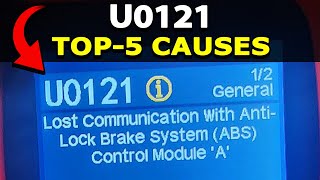
This code means your Cadillac CTS has lost communication with the Anti-Lock Brake (ABS) module. Before suspecting a bad module, inspect the transmission's X1 electrical connector for loose or corroded pins, a known issue on this platform that can trigger this code. This is a high-priority TSB-documented fix.
- U0121 means the ABS/StabiliTrak module is offline, disabling these safety features.
- **First, inspect the transmission's main electrical connector (X1) for loose pins.** This is a known GM issue (TSB PIC4740F) and a very likely cause.
- Do not immediately assume the expensive ABS module has failed; wiring and connector issues are common and should be ruled out first.
- Driving is possible, but with reduced safety. Repair is strongly recommended.
- If the ABS module is replaced, it will require professional programming to work with your vehicle.
What's Unique About the 2008-2014 Cadillac CTS

On the second-generation Cadillac CTS, a U0121 code is frequently linked to a specific, documented wiring problem. A General Motors Technical Service Bulletin (TSB #PIC4740E, later superseded by PIC4740F) points to loose or poorly fitting terminals in the X1 electrical connector at the transmission. This single connector issue can cause a cascade of communication failures across the vehicle, including the loss of connection to the ABS module. 🎬 Watch: A quick breakdown of the U0121 communication code. Owners should investigate this known weak point before considering more expensive repairs like replacing the ABS module itself.
Diagnostic Flowchart
Tap your situation to follow the diagnostic path that matches what you're seeing on this vehicle.
Symptoms You May Notice
- ABS warning light is on
- "Service StabiliTrak" or traction control (TC) warning light is on
- Check Engine Light is on
- Brakes may lock up during hard braking
- Cruise control may be inoperative
- Message on dash displaying "Service Traction Control" or "Service StabiliTrak".
- Scan tool cannot communicate with the EBCM/ABS module.
- Replacing the ABS module when the fault is in the transmission X1 connector.
- Replacing wheel speed sensors, which are typically associated with C-codes (e.g., C0035), not a U-code communication failure.
Most Likely Causes

- Loose or Corroded Transmission X1 Connector Terminals 🔴 High Probability This is a documented issue in GM Technical Service Bulletin #PIC4740E and its successor, PIC4740F, for this platform. The connector's location on the transmission makes it susceptible to vibration, heat, and moisture over time, leading to poor pin contact.
How to confirm: Locate the large X1 electrical connector on the transmission. Disconnect it and check for any pins that are loose, pushed back (unseated), corroded, or show signs of poor contact. TSB PIC4740F advises to carefully tug on each wire to ensure the pins are fully seated, as a side load can create a false positive lock.
Typical fix: Repair or replace the affected terminals within the connector. This may involve re-seating the pin, cleaning the contacts, or replacing the terminal with a new one. Ensure the connector is fully seated and the lock is engaged upon reassembly. In some cases, a connector pigtail may be needed if the housing or multiple wires are damaged.
Est. part cost: $10-$50 for connector terminals or a pigtail kit. - Failed Electronic Brake Control Module (EBCM / ABS Module) 🟡 Medium Probability Like any electronic module, the EBCM can fail internally due to age, heat cycles, or moisture intrusion. However, it is often misdiagnosed when the real issue is wiring or power supply. An internal short in the module can also cause a parasitic battery drain.
How to confirm: After confirming all power, ground, and CAN bus wiring to the module are intact and the transmission X1 connector is good, the module itself becomes the primary suspect. A professional scan tool will show no communication with the EBCM. You can also check for power and ground at the EBCM connector with a multimeter.
Typical fix: Replace the ABS control module. The new module will require programming to the vehicle's VIN. Some companies offer repair services where you send in your original module.
Est. part cost: $250-$600 for a remanufactured module (like Dorman 599-739), $700+ for a new OEM part (like ACDelco 20803608). - CAN Bus Wiring or Power/Ground Circuit Fault ⚪ Low Probability Wiring harnesses can become damaged from chafing against the chassis or engine components, road debris, or improper repairs. Ground connections, particularly those on the frame or engine block, can corrode over time, creating high resistance. Sunroof drain leaks have also been reported to cause water damage to interior wiring and modules, leading to network faults.
How to confirm: Use a digital multimeter to check for 12V power and a solid ground connection at the EBCM connector. Test the resistance between the CAN High and CAN Low wires at the vehicle's DLC (Pin 6 and Pin 14) with the battery disconnected; it should be ~60 ohms. A reading of ~120 ohms indicates a missing termination resistor or an open circuit, while a reading below 60 ohms suggests a shorted wire.
Typical fix: Identify and repair the damaged section of the wiring harness. Clean or repair the faulty ground connection by removing corrosion and ensuring a tight, metal-to-metal contact.
Est. part cost: $5-$100 for wiring repair supplies.
Rare But Worth Checking
- Faulty Wheel Speed Sensor (WSS) or Wiring: A GM TSB for other models (PIT4056H) notes that a shorted wheel speed sensor or its wiring can sometimes bring down the entire EBCM, causing a U0121. While not specific to the CTS, it's a plausible, though rare, cause if other diagnostics fail. This is an exception, as WSS issues usually set C-codes.
- Low Battery Voltage: A weak or failing battery can cause a drop in system voltage during startup, leading to a variety of communication codes, including U0121. Before diving into complex diagnostics, ensure the battery is fully charged and passes a load test.
Diagnosis Steps
- Scan all vehicle modules for codes. Note all 'U' codes present, as multiple communication codes strongly point to a network-wide issue like the X1 connector.
- Check battery voltage and charging system. Ensure the battery is healthy and voltage is stable (above 12.4V engine off, ~14V engine on). A weak battery is a common cause of communication faults.
- Inspect the ABS and EBCM related fuses in the underhood fuse block. A blown fuse means there is no power to the module.
- Crucially, locate and inspect the transmission X1 electrical connector as per TSB #PIC4740F. The connector is on the transmission body. Disconnect it and check for any loose, corroded, or backed-out pins. Gently tug each wire to confirm it's securely seated.
- If the connector is fine, locate the EBCM (usually attached to the ABS hydraulic block in the engine bay). Inspect its connector for power, ground, and any signs of corrosion or damage.
- Test the CAN bus network integrity. With the battery disconnected, measure resistance between Pin 6 (CAN-H) and Pin 14 (CAN-L) at the Data Link Connector (DLC). A healthy network will read approximately 60 ohms.
- If all wiring, connectors, and power/grounds are good, the EBCM is the likely failed component. An advanced scan tool can attempt to directly communicate with the module to confirm it's unresponsive.
- Check for signs of water intrusion inside the cabin, particularly if the vehicle has a sunroof. A Reddit user with a 2008 CTS reported a cascade of communication codes (U0100, U0101, U0140) after a sunroof leak drenched the interior.
Parts You'll Likely Need

- Electronic Brake Control Module (EBCM)
(OEM #20803608 (ACDelco))— This is the module that has lost communication. It is the cause if all wiring and connectors are confirmed to be good.
Trusted brands: ACDelco, Dorman (Remanufactured, e.g., 599-739)
OEM price range: $500-$800.
Aftermarket price range: $250-$600 (Often remanufactured). - Connector Terminals / Pigtail
(OEM #88988938 (Example connector, verify specific application))— Needed to repair the known issue at the transmission X1 connector as identified in TSB PIC4740F. Individual terminals or a full pigtail may be required depending on the damage.
Trusted brands: ACDelco, Dorman, Mouser Electronics
OEM price range: $5-$15 per terminal
Aftermarket price range: $20-$60 for a pigtail kit.
Related Codes That Often Appear With This One
- U0073 — Control Module Communication Bus 'A' Off
- U0100 — Lost Communication with ECM/PCM
- U0101 — Lost Communication with TCM
- U0140 — Lost Communication with Body Control Module
- C0561 — System Disabled Information Stored. This is often set alongside communication codes to indicate the stability system is off.
- P0700 — Transmission Control System (TCM) Malfunction. Often appears when the transmission connector is the root cause.
Technical Service Bulletins (TSBs) & Recalls
- PIC4740F: (Supersedes PIC4740E) States that multiple communication DTCs (C0242, C0561, U0121, U0100, U0101, U0140 etc.) can be stored due to a poor fit of terminals in the transmission X1 connector. Also notes potential harness chafing points on the CTS.
- PIC4740E: The original TSB identifying the transmission X1 connector as a primary cause for a host of communication DTCs, including U0121.
Platform-Specific Known Issues
- TSB #PIC4740F (superseding PIC4740E) explicitly calls out that various communication codes, including U0121, can be caused by a poor terminal fit in the transmission X1 connector. This should be the first point of inspection. The TSB instructs technicians to
Mechanic-Grade Diagnostic Values
- CAN Bus Network Resistance — expected: ~60 Ohms. Failure: ~120 Ohms (indicates an open circuit or a missing terminating resistor) or <60 Ohms (indicates a short between CAN lines).
- CAN High Voltage to Ground — expected: ~2.6V (Key On, Engine Off). Failure: Voltage significantly different from expected, or 0V, indicates a wiring fault.
- CAN Low Voltage to Ground — expected: ~2.4V (Key On, Engine Off). Failure: Voltage significantly different from expected, or 0V, indicates a wiring fault.
- EBCM Power Supply — expected: >12.0V (Key On). Failure: Voltage is low or absent, indicating a blown fuse or a fault in the power supply circuit.
- EBCM Ground Circuit Resistance — expected: < 5 Ohms. Failure: Resistance is higher than 5 Ohms, indicating a poor ground connection (corrosion, loose bolt).
Scan Tool Commands That Help
- GM Techline Connect (SPS2): Replace and Reprogram — This specific function must be used when programming a used (junkyard) EBCM to the vehicle. Simply selecting 'Program' will likely fail. This process writes the vehicle's VIN and configuration data to the replacement module.
- GM Tech2 / GDS2: Automated Bleed / ABS Motor Test — After replacing the EBCM or hydraulic unit, this procedure is required to bleed air from the ABS pump. It can also be used as a bidirectional test to confirm the scan tool can command the ABS motor to activate, which helps verify communication is restored.
Wiring & Ground Locations

- G110 — On the right frame rail, near the ABS module in the engine compartment.. This is a primary ground point for the Electronic Brake Control Module (EBCM). Corrosion or a loose connection at this point can cause a loss of power to the module, triggering a U0121 code.
- G101 — On the left front strut tower in the engine compartment.. This ground serves multiple components, including the Engine Control Module (ECM) and Transmission Control Module (TCM). While not the direct ground for the EBCM, a fault here can disrupt the entire CAN bus network, leading to multiple communication codes including U0121.
- EBCM Connector — Plugged into the Electronic Brake Control Module, which is attached to the ABS hydraulic block in the engine bay.. This is the main connector for all power, ground, and communication signals to the ABS module. It must be inspected for corrosion, pushed-out pins, or damage, especially after checking fuses and grounds.
- Transmission X1 Connector — A large, multi-pin connector located on the side of the transmission housing.. As per TSB PIC4740E, this specific connector is a known weak point. Poor terminal fit within this connector can interrupt CAN bus signals that pass through it, causing a loss of communication with the ABS module and setting a U0121 code.
Real Owner Repair Stories
- Reddit user in r/Cadillac (2008 Cadillac CTS) — Dashboard lit up with 'Stabilitrak off' and 'Service Stabilitrak' messages, ABS light on/off, traction control light on, and very slow acceleration (limp mode).
❌ Tried (didn't work) Disconnecting and reconnecting the battery only temporarily stopped the warning chimes.
✅ What actually fixed it The root cause was severe water intrusion from a clogged sunroof drain that drenched the vehicle's interior. This moisture damaged wiring and/or modules, leading to a cascade of communication failure codes including U0100 (Lost Comm with ECM), U0101 (Lost Comm with TCM), and U0140 (Lost Comm with BCM), which are often seen with U0121. The fix required drying out the interior and repairing the affected wiring/modules.
OEM Part Supersession History
20803608→19435403— Part number has been updated by GM. The new part number replaces the old one.
Heads up: When replacing the EBCM, the new module (whether new or used) requires programming with GM's SPS2 software to match the vehicle's VIN and options. Failure to program will result in continued warning lights and codes.
Model Year Variations Within This Range
- 2008-2010 (3.6L LLT Engine): Early second-generation models with the 3.6L LLT engine were prone to premature timing chain stretch. While not directly related to U0121, a failing timing chain can cause erratic engine performance and potentially trigger other electrical issues or codes as the engine's health degrades. It's a key point of inspection for these specific model years.
Helpful Videos

Used OEM Parts in Stock


New Aftermarket Parts Available

The information in this article is provided for general reference and educational purposes only. Vehicle specifications, procedures, and part compatibility can vary by production date, trim level, and region. Always consult your vehicle's factory service manual and verify part numbers before purchasing or performing repairs. Safety-critical components such as airbags, seat belts, and braking systems should be installed by a qualified professional.
- Cadillac CTS:
- 🎬 Helpful Videos
- 🛍️ Shop This Part
- What's Unique About the 2008-2014 Cadillac CTS
- Diagnostic Flowchart
- Symptoms You May Notice
- Most Likely Causes
- Rare But Worth Checking
- Diagnosis Steps
- Parts You'll Likely Need
- Related Codes That Often Appear With This One
- Technical Service Bulletins (TSBs) & Recalls
- Platform-Specific Known Issues
- Mechanic-Grade Diagnostic Values
- Scan Tool Commands That Help
- Wiring & Ground Locations
- Real Owner Repair Stories
- OEM Part Supersession History
- Model Year Variations Within This Range
- 🎟️ Get 5% Off