

U0109 on 2007-2014 Cadillac Escalade ESV: Lost Communication With Fuel Pump Control Module Causes and Fixes
On a 2007-2014 Escalade, U0109 almost always means the Fuel Pump Control Module (FPCM) has failed, usually due to corrosion from its exposed location on the frame rail. A pre-programmed replacement module costs about $80-$200 and is a straightforward DIY fix. Aftermarket solutions also exist to relocate the module to a more protected area.
- U0109 on a 2007-2014 Escalade means the Fuel Pump Control Module (FPCM) isn't communicating, which will likely cause a no-start or stalling condition.
- Before buying any parts, locate the FPCM on the driver's side frame rail and inspect it and its connector for heavy corrosion, which is the most common cause of failure.
- Do not mistakenly replace the in-tank fuel pump; this code points specifically to the control module or its wiring.
- When replacing the FPCM, save time and money by purchasing a 'pre-programmed' or 'plug-and-play' module that does not require an expensive trip to the dealer for software flashing.
What's Unique About the 2007-2014 Cadillac ESCALADE ESV
On the GMT900 platform, which includes the 2007-2014 Escalade, GM mounted the Fuel Pump Control Module (FPCM) on a frame crossmember, typically above the spare tire. This exposed location makes the module and its connectors highly vulnerable to corrosion from road salt, water, and debris, especially on vehicles used in winter climates or launched at boat ramps. As a result, outright failure of the FPCM is a far more common cause for a U0109 code on these trucks and SUVs compared to other vehicles where the module might be located inside the trunk or cabin.
Diagnostic Flowchart
Tap your situation to follow the diagnostic path that matches what you're seeing on this vehicle.
Symptoms You May Notice
- Engine cranks but will not start.
- Sudden engine stalling while driving.
- Hesitation or stumbling during acceleration.
- Reduced engine power or 'limp mode'.
- Check Engine Light is illuminated.
- The characteristic 'hum' or 'whine' from the fuel pump is absent when the key is turned to the 'ON' position.
- Replacing the in-tank fuel pump. The symptoms of a failed fuel pump and a failed FPCM are very similar (crank-no-start, stalling). However, U0109 specifically points to an electrical communication problem with the control module, not a mechanical failure of the pump itself. Many owners replace the pump only to find the problem persists.
Most Likely Causes
- Failed Fuel Pump Control Module (FPCM) 🔴 High Probability The module is mounted on the exterior frame rail, exposing it to moisture and road salt, which leads to internal corrosion and failure. The design allows water and debris to become trapped between the module and the frame, accelerating corrosion.
How to confirm: Visually inspect the module, located on the driver's side frame rail near the spare tire, for heavy corrosion, a swollen case, or physical damage. After confirming power and ground are present at the connector, the module is condemned if communication is still absent. Codes P069E and U0109 together are a strong indicator of FPCM failure.
Typical fix: Replace the Fuel Pump Control Module. It is highly recommended to use a pre-programmed module for a plug-and-play repair.
Est. part cost: $80-$250 - Corroded Wiring or Connector at the FPCM 🟡 Medium Probability The same exposed location that damages the module also damages the electrical connector and nearby wiring. The downward-facing pins can trap moisture.
How to confirm: Unplug the FPCM connector and inspect the pins on both the module and the harness side for green or white corrosion, or backed-out pins. Check the wiring leading to the module for chafing or breaks.
Typical fix: Clean the connector terminals carefully with a terminal cleaning tool and electrical contact cleaner. If corrosion is severe, a new connector pigtail may need to be spliced in. Repair any damaged wires and apply dielectric grease to the connector before reassembly to seal out moisture.
Est. part cost: $15-$50 - Corroded Underhood Fuse Box / Blown FPCM Fuse ⚪ Low Probability The underhood fuse box on GMT900 trucks can be susceptible to water intrusion, leading to corrosion on the fuse terminals and internal connections.
How to confirm: Check the fuse box under the hood for a fuse labeled 'FPCM', 'FSCM', or 'Fuel Pump' (often fuse #21). Inspect the fuse and its terminals for green or white corrosion. A visual inspection may not be enough; pull the fuse and check the legs. If the fuse is corroded, the entire fuse box may have internal damage.
Typical fix: Replace the blown or corroded fuse with one of the same amperage. If the fuse legs were corroded, clean the fuse holder terminals. If multiple fuses show corrosion, the entire underhood fuse block may need to be replaced to ensure a reliable repair.
Est. part cost: $1-$5 for a fuse, $200-$400 for a fuse box. - Poor FPCM Ground Connection ⚪ Low Probability The ground wire for the FPCM attaches directly to the steel frame, which is prone to rust over time, creating a poor connection and preventing the module from powering on.
How to confirm: Locate the ground wire from the FPCM harness to the chassis. Unbolt it and check for rust or corrosion between the terminal and the frame. Perform a voltage drop test on the ground circuit to confirm its integrity.
Typical fix: Remove the ground bolt, clean the contact surfaces of the wire terminal and the frame down to bare metal using a wire brush or sandpaper, and re-secure the connection. Apply dielectric grease or a corrosion inhibitor to prevent future rust.
Est. part cost: $1-$5
Rare But Worth Checking
- General CAN Bus Network Fault: As mentioned in TSB #08-07-30-021H, other issues like a fault in a major harness connector (like the transmission X1 connector) can disrupt the entire data network, causing multiple 'Lost Communication' codes, including U0109. This is less likely than a direct FPCM failure but should be considered if multiple U-codes are present.
Diagnosis Steps
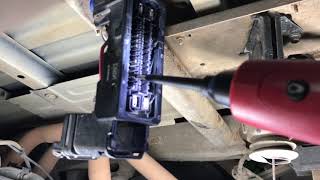
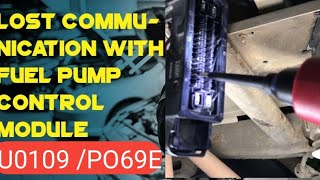
- Scan for Codes: Read all stored diagnostic trouble codes. Note if U0109 appears alone or with other codes. The presence of P069E strongly suggests an FPCM fault. 🎬 Watch: Troubleshooting U0109 and P069E codes on a Cadillac.
- Check Fuses First: Before going under the truck, inspect the FPCM fuse (often #21) in the underhood fuse box. Check for blown fuses and, more importantly, for signs of corrosion on the fuse legs and terminals.
- Locate and Inspect the FPCM: Find the FPCM on the driver's side frame rail, usually above the spare tire. Visually inspect the module and its connector for obvious signs of heavy corrosion, a swollen plastic case, or physical damage.
- Test Power and Ground: Disconnect the FPCM connector. Using a multimeter and a wiring diagram, verify that the module is receiving battery voltage on the correct pin (often a red/white wire) and has a solid ground connection on its ground pin. A voltage drop test is recommended for the ground circuit. 🎬 Watch: Step-by-step diagnosis of the Fuel System Control Module.
- Inspect CAN Bus Wires: Check the communication wires (typically a twisted pair of Tan and Tan/White wires) at the FPCM connector for damage. With the battery disconnected, you can check for continuity on these lines back to the ECM.
- Condemn the FPCM: If the module has good power and ground, the fuse is good, and the wiring appears intact, the FPCM itself is the most likely cause of failure, especially if it shows heavy external corrosion.
- Replace the FPCM: Replace the Fuel Pump Control Module. To avoid extra cost and hassle, purchase a pre-programmed module that matches your vehicle's VIN for a plug-and-play installation.
Parts You'll Likely Need
- Fuel Pump Control Module (FPCM)
(OEM #20964304)— This module is the computer that controls the fuel pump. Due to its exposed mounting location on the Escalade's frame, it is extremely prone to failure from corrosion, making it the most common fix for U0109.
Trusted brands: ACDelco (GM Genuine), Dorman OE Fix
OEM price range: $150-$250
Aftermarket price range: $80-$180
Related Codes That Often Appear With This One
- P069E — This code means 'Fuel Pump Control Module Requested MIL Illumination'. The FPCM has detected an internal fault or a problem with the fuel pump circuit and has asked the main computer to turn on the Check Engine Light. It is very commonly seen with U0109 and strongly points to the FPCM itself being the root cause.
- U0073 — This code means 'Control Module Communication Bus A Off'. If there is a major network-wide failure, you may see this code alongside U0109 and other communication codes, as noted in TSB #08-07-30-021H.
Technical Service Bulletins (TSBs) & Recalls
- 08-07-30-021H: Mentions that communication DTCs including U0109 can be set due to network issues, causing a wide range of electrical symptoms.
- NHTSA #14V614 (GM Campaign #14515): A safety recall was issued for some GMT900 vehicles for a defective FPCM that could cause stalling. While the recall may not cover all model years in this range, it highlights the known issue with this component.
Platform-Specific Known Issues
- TSB #08-07-30-021H notes that U0109 can be set along with a host of other communication codes due to a general network issue, which can cause symptoms like door lock cycling, various warning lamps, and the transmission not shifting.
- The external mounting of the FPCM on the frame rail above the spare tire is a known design weakness on this platform, leading to a high failure rate from environmental exposure.
- Aftermarket FPCM relocation kits are available. These kits provide a longer wiring harness to move the new module from the exposed frame rail to a more protected location, such as inside the rear quarter panel or another body cavity, to prevent future corrosion issues.
Mechanic-Grade Diagnostic Values
- FPCM Connector Pin 32 (Red/White wire) to Ground — expected: Battery Voltage (12V+). Failure: Low or no voltage indicates a problem with the power supply from the underhood fuse box (Fuse 21).
- FPCM Connector Pin 1 (Black wire) to chassis ground — expected: Less than 0.1V (Voltage Drop Test). Failure: Higher voltage indicates a poor ground connection at the frame (G305/G402).
- FPCM Connector Pin 13 (Dark Green/White wire) — expected: Pulsing voltage or steady voltage for 2-3 seconds with key-on, engine-off.. Failure: No voltage signal indicates a wiring break between the FPCM and the ECM (at ECM Pin 50) or a failed ECM driver.
- Fuel Pressure (commanded via scan tool) — expected: 345-690 kPa (50-100 psi) with pump commanded ON, engine OFF.. Failure: Pressure below this range (with good power/ground to FPCM) suggests a weak fuel pump or clogged filter. Pressure above this range suggests a restriction or failed regulator in the pump assembly.
- CAN Bus Resistance (at OBD-II Port) — expected: Approximately 60 Ω between Pin 6 (CAN High) and Pin 14 (CAN Low) with battery disconnected.. Failure: 120 Ω indicates a break in the CAN circuit or a missing terminating resistor (one of the modules is offline). 0 Ω indicates a short between the CAN High and Low wires.
Scan Tool Commands That Help
- GDS2 (GM Global Diagnostic System 2): FPCM Fuel Pump ON/OFF — This is a bidirectional control used to manually activate the fuel pump to verify its operation and to perform fuel pressure tests without starting the engine. It isolates the pump and FPCM from the rest of the starting sequence.
- GDS2 (GM Global Diagnostic System 2): Fuel Pump Driver Control Module Configuration — This function is required after replacing the Fuel Pump Control Module. It programs the new module to the vehicle's specific VIN and configuration, allowing it to communicate correctly with the ECM and other modules. Failure to perform this step will result in the new module not working.
- GDS2 (GM Global Diagnostic System 2): Vehicle DTC Information — This function scans all modules on the network for trouble codes. For a U0109, it is critical to see if other modules are also reporting communication loss (e.g., U0100, U0101), which would point to a network-wide issue rather than just an FPCM problem.
Wiring & Ground Locations
- FPCM Connector (X411) — On the Fuel Pump Control Module, located on the driver's side frame rail, typically above the spare tire.. This is the primary connection point for all power, ground, and communication signals for the module. Key pins for testing are Pin 32 (Battery Power), Pin 1 (Ground), and Pin 13 (ECM command signal).
- G305 / G402 — These are chassis ground points located under the vehicle, often near the B-pillar (G305) or in the rear cargo area (G402).. The FPCM relies on a clean chassis ground to operate. The ground wire from the FPCM connector (Pin 1) attaches to one of these frame grounds. Corrosion at this point creates high resistance, preventing the module from powering on and causing a U0109.
- ECM Connector Pin 50 — In the black connector at the Engine Control Module (ECM) in the engine bay.. This is the origin of the 'turn-on' command signal (on the Dark Green/White wire) sent to the FPCM. If there is no signal at FPCM Pin 13, a technician must check for a signal here to determine if the fault is in the wiring or the ECM itself.
- Underhood Fuse Block - Fuse 21 — In the main fuse box in the engine compartment.. This 20A fuse provides the main battery power to the FPCM via the Red/White wire. A blown fuse or, more subtly, corrosion on the fuse terminals within the block, can cut power to the module and trigger a U0109.
Real Owner Repair Stories
- YouTube channel 'walosauto repair' (2007 Chevrolet Silverado (Same GMT900 platform and FPCM system)) — Crank no start, U0109 code stored. A new FPCM had already been installed but did not fix the issue.
❌ Tried (didn't work) Replacing the Fuel Pump Control Module (FPCM)
✅ What actually fixed it The root cause was a poor connection for the FPCM fuse (Fuse 22 in this specific truck) inside the underhood fuse box. The mechanic measured only 3V at the FPCM power wire. The fuse itself wasn't blown, but the terminals in the fuse box were corroded and not making good contact. The long-term, correct repair was to replace the entire underhood fuse box.
OEM Part Supersession History
25967325→20759945— Part consolidation and potential design/component updates by GM.
Heads up: The new part number 20759945 also replaces many other previous part numbers (e.g., 13501024, 15213110, 25866052). Regardless of the part number used, the replacement module must be programmed to the vehicle's VIN using GDS2 or a similar tool to function correctly.
Model Year Variations Within This Range
- 2007-2014: The primary change was the introduction of the FPCM-based returnless fuel system with the GMT900 platform in 2007. While the core failure mode (corrosion of the frame-mounted FPCM) is consistent across the 2007-2014 range, GM issued safety recall #14V614 for this issue, which specifically covered 2008-2014 Escalade models, but not 2007. Owners of 2007 models may have the same defect but are not covered by the recall.
Helpful Videos
Used OEM Parts in Stock


New Aftermarket Parts Available



The information in this article is provided for general reference and educational purposes only. Vehicle specifications, procedures, and part compatibility can vary by production date, trim level, and region. Always consult your vehicle's factory service manual and verify part numbers before purchasing or performing repairs. Safety-critical components such as airbags, seat belts, and braking systems should be installed by a qualified professional.
- Cadillac ESCALADE ESV:
- 🎬 Helpful Videos
- 🛍️ Shop This Part
- What's Unique About the 2007-2014 Cadillac ESCALADE ESV
- Diagnostic Flowchart
- Symptoms You May Notice
- Most Likely Causes
- Rare But Worth Checking
- Diagnosis Steps
- Parts You'll Likely Need
- Related Codes That Often Appear With This One
- Technical Service Bulletins (TSBs) & Recalls
- Platform-Specific Known Issues
- Mechanic-Grade Diagnostic Values
- Scan Tool Commands That Help
- Wiring & Ground Locations
- Real Owner Repair Stories
- OEM Part Supersession History
- Model Year Variations Within This Range
- 🎟️ Get 5% Off