

U0102 on 2007-2014 Chevrolet Tahoe: Lost Communication With TCCM Causes and Fixes
On a 2007-2014 Tahoe, code U0102 means the Transfer Case Control Module (TCCM) is offline. This is most often caused by a broken ground wire on the driver's side of the engine block, a chafed wiring harness under the driver's side dash or near the underhood fuse box, or a blown fuse. Check these common, simple fixes before replacing the TCCM itself.
- U0102 means the Transfer Case Control Module (TCCM) is offline.
- Before replacing any parts, thoroughly inspect all 4WD-related fuses and the engine ground wires on the driver's side of the block.
- A group of 'U' codes (e.g., U0100, U0101, U0121) strongly indicates a wiring or network problem, not a single bad module.
- The TCCM is located under the driver's side dash; check its connectors for corrosion.
- If you must replace the TCCM, some aftermarket versions do not require expensive dealer programming.
What's Unique About the 2007-2014 Chevrolet TAHOE

The GMT900 platform, which includes the 2007-2014 Tahoe, is notorious for electrical issues related to communication networks, as documented in GM Technical Service Bulletin #08-07-30-021H. These trucks are particularly susceptible to poor ground connections and wiring harness problems. A frequently cited failure point is a broken ground wire at the front of the driver's side cylinder head. The wire corrodes and breaks inside the ring terminal crimp, causing intermittent communication loss that can be difficult to trace. Another common issue is chafing of the wiring harness near the underhood fuse box, which can cause a short and blow the 4WD fuse.
Diagnostic Flowchart

Tap your situation to follow the diagnostic path that matches what you're seeing on this vehicle.
Symptoms You May Notice
- "Service 4WD System" message on the Driver Information Center (DIC).
- Check Engine Light (Malfunction Indicator Lamp) is on.
- Indicator lights on the 4WD selector switch are off, do not change, or flash and then go out.
- Inability to shift into or out of four-wheel-drive.
- Vehicle may be stuck in its last known setting (e.g., 2WD or 4WD).
- Intermittent stalling, especially when shifting into reverse, if the issue is caused by a bad ground connection.
- Other warning lights, like ABS or Traction Control, may illuminate due to the network fault.
- Gauges on the instrument cluster may fluctuate or drop out intermittently.
- Replacing the transfer case encoder motor or the entire transfer case when the issue is purely electrical/communication-based.
- Replacing the 4WD selector switch on the dashboard, which rarely fixes a U0102 code.
- Replacing the TCCM without first thoroughly checking for bad grounds or blown fuses, which are more common and cheaper to fix.
Most Likely Causes

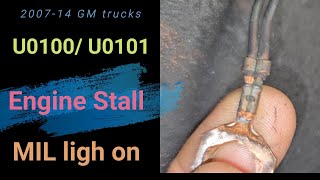
- Poor or Broken Ground Connection 🔴 High Probability Wiring harnesses on the GMT900 platform are known to have issues with ground wires breaking inside the crimp of the ring terminal. The primary ground point for many modules is a stud on the front of the driver's side cylinder head. Vibration and corrosion cause the wire strands to fatigue and break, often with no visible external damage.
How to confirm: Locate the main engine ground wires on the driver's side of the engine block, near the front. Vigorously wiggle the wires at the ring terminals while the engine is running; if the symptoms change, the gauges flicker, or the truck stalls, you've found the problem area. A voltage drop test on the TCCM ground circuit should show less than 100-200mV; anything higher indicates a problem.
Typical fix: Repair the ground by cutting back the wire to clean copper, crimping on a new, high-quality ring terminal, and securely reattaching it to a clean metal surface on the engine block.
Est. part cost: $1-$10 - Damaged or Corroded Wiring/Connector 🟡 Medium Probability The TCCM is located inside the cabin, but its wiring harness runs along the frame and through the firewall. A common chafing point is where the harness passes near the underhood fuse box, which can short the power wire for the TCCM and blow the fuse. Connectors for the TCCM under the dash can also become loose or corroded.
How to confirm: Visually inspect the wiring harness leading to and from the underhood fuse block for signs of chafing or rubbing against sharp edges. Inspect the connectors at the TCCM under the driver's side dash for green corrosion, chafed wires, or backed-out pins.
Typical fix: Repair the chafed wire with a splice and heat shrink tubing. Protect the harness from future damage using electrical tape and convoluted loom. Clean corroded connectors with electrical contact cleaner and apply dielectric grease.
Est. part cost: $10-$150 - Failed Transfer Case Control Module (TCCM) 🟡 Medium Probability
How to confirm: This is a process of elimination. If all fuses, power, ground, and CAN bus network wiring have been tested and confirmed to be good with a multimeter, the TCCM itself is the likely point of failure. A scan tool showing the TCCM as 'offline' while other modules are communicating points to a module-specific failure.
Typical fix: Replace the TCCM. Many aftermarket modules (like Dorman) are advertised as plug-and-play, but may require a manual relearn procedure. OEM units or modules for certain RPO codes may require programming by a dealer or a qualified shop using your vehicle's VIN.
Est. part cost: $150-$400 - Blown Fuse ⚪ Low Probability
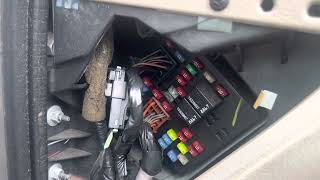
How to confirm: Check the fuse panel under the hood for fuses related to the four-wheel-drive system. On many Tahoes, this is fuse #67 (TREC). Use a multimeter or test light to verify the fuse has power on both sides with the ignition on. A blown fuse often indicates an underlying short circuit in the wiring.
Typical fix: Replace the blown fuse. If it blows again immediately, there is a short circuit in the TCCM power circuit that must be diagnosed and repaired.
Est. part cost: $1-$5
Rare But Worth Checking
- Incorrect Software/Programming: In some cases, a failed or incorrect software update at a dealership has been reported to cause this code. If the problem started immediately after a service visit involving programming, this could be the cause. One owner reported a tech installed the wrong software, causing U0102.
- Faulty 4WD Selector Switch: While a bad switch can cause 4WD issues, it's less likely to cause a U0102 communication code. However, owners sometimes replace it first as it's an easy and inexpensive part, often with no success in fixing the U-code.
Diagnosis Steps
- Scan for all DTCs in all modules. Note any other 'U' codes, as a group of them points to a network-wide problem, likely a bad ground or power feed.
- Check the 4WD/TREC fuse (often fuse #67) in the underhood fuse block. If it's blown, suspect a short in the power wire.
- Inspect the main engine ground connections on the front, driver's side of the engine block/cylinder head. Physically pull and wiggle the wires at the ring terminal to check for intermittent connections hidden inside the crimp.
- Inspect the wiring harness around the underhood fuse box for any signs of chafing or rubbing against the body or brackets.
- Locate the TCCM under the driver's side of the dashboard, to the left of the steering column. It is a small black box with electrical connectors.
- Inspect the connectors at the TCCM for corrosion or loose pins. Ensure they are fully seated.
- Using a multimeter, verify battery voltage (12V+) and a solid ground (less than 0.2 ohms to chassis) at the TCCM connector pins with the key on.
- If possible, test the CAN bus resistance between pins 6 and 14 at the OBD-II port (key off). It should be approximately 60 ohms. A reading of 120 ohms indicates an open circuit; a reading below 60 ohms suggests a shorted wire.
- If all wiring, power, and grounds are confirmed good, the TCCM is the most likely failed component.
Parts You'll Likely Need
- Transfer Case Control Module (TCCM)
(OEM #24249095 (cross-references many others like 24252878, 24261367))— This module can fail internally, causing a total loss of communication on the network. This should only be replaced after confirming power, ground, and network wiring are intact.
Trusted brands: ACDelco (OEM), Dorman (Aftermarket)
OEM price range: $250-$400
Aftermarket price range: $150-$250 - Wire Ring Terminal — Used to repair the common issue of a broken ground wire at the engine block. A high-quality, crimp-on terminal is essential for a lasting repair.
OEM price range: $1-$5
Aftermarket price range: $1-$5 - Dorman 599-192 — This is a specific aftermarket part number for the TCCM for this vehicle range, often cited as a plug-and-play replacement.
Trusted brands: Dorman
OEM price range: N/A
Aftermarket price range: $180-$220
Related Codes That Often Appear With This One
- U0073 — Control Module Communication Bus 'A' Off - This is a general network code often set alongside more specific module communication faults.
- U0100 — Lost Communication with ECM/PCM - Indicates a wider network problem, often pointing to a shared power or ground issue.
- U0101 — Lost Communication with TCM - Indicates a wider network problem, often pointing to a shared power or ground issue.
- U0121 — Lost Communication with ABS Control Module - Often set with other U-codes when a major ground is lost.
- U0140 — Lost Communication with Body Control Module - Another indicator of a systemic network or power/ground fault.
Technical Service Bulletins (TSBs) & Recalls
- 08-07-30-021H: Addresses intermittent no-crank, warning lamps, and communication DTCs including U0102. It points to repairing terminals, open/shorted LAN circuits, and poor connections as likely solutions, covering a wide range of GM trucks and SUVs from this era.
- PIT4853C: Specifically for Hybrid models, but references checking ground G102 and TSB 08-07-30-021 for high-speed LAN communication issues, reinforcing the focus on grounds and wiring.
Platform-Specific Known Issues
- Per TSB #08-07-30-021H, these vehicles are prone to intermittent GMLAN
Mechanic-Grade Diagnostic Values
- GMLAN High-Speed Bus Resistance — expected: 60 Ω (Ohms) +/- 5 Ω. Failure: A reading of ~120 Ω indicates an open circuit or a missing terminating resistor. A reading less than 60 Ω indicates the CAN bus wires are shorted together. The measurement should be taken between pins 6 and 14 of the DLC with the battery disconnected.
- GMLAN Bus Voltage (Key On) — expected: Approximately 2.5V on both CAN High and CAN Low lines at rest.. Failure: When communicating, CAN High should go up to ~3.5V and CAN Low should go down to ~1.5V. A line stuck near 0V or 5V indicates a short to ground or power.
- TCCM Ground Circuit Voltage Drop — expected: Less than 100-200 mV (0.1-0.2V). Failure: A reading higher than 200mV indicates excessive resistance in the ground circuit, which is a common problem on these vehicles. This test must be performed while the circuit is under load (key on).
Scan Tool Commands That Help
- GDS2/Tech2 or equivalent professional scanner: Range Actuator Learn Procedure / Motor Learn Procedure — This function must be performed after replacing the TCCM or the transfer case encoder motor to allow the new module to learn the positions of the actuator. Failure to do this can result in a C0569 code and prevent the system from working even with new parts.
- Manual Procedure (for some aftermarket modules): Manual Relearn Procedure — After installing some aftermarket TCCMs (like Dorman), a specific manual relearn may be required. One procedure involves turning the ignition off for 30 seconds, placing the transmission in Neutral with the parking brake on, turning the 4WD switch to 2WD for 5 seconds, then turning and holding the switch past 4WD Low for 30 seconds until an audible noise is heard from the transfer case motor. However, many users report this fails and professional programming is still needed.
Wiring & Ground Locations

- G104 — The left (driver's) rear corner of the engine, mounted to the cylinder head. A ground strap often runs from this point to the firewall.. This is the most commonly cited failure point. The ground wires for multiple modules, including those on the GMLAN bus, attach here. The wires, particularly the smaller gauge ones, are known to fatigue and break inside the ring terminal crimp, causing intermittent communication loss for the TCCM and other modules.
- G103 — On the front of the right (passenger) side cylinder head.. This is another primary engine-to-chassis ground point that can cause widespread electrical and communication issues if loose or corroded.
- Fuse #67 (TREC) — In the underhood fuse block.. This fuse provides power to the Transfer Case Control Module. A common failure is for the wiring harness running underneath the fuse block to chafe against the body, causing a short circuit that repeatedly blows this fuse.
- TCCM Connectors — Under the driver's side dashboard, typically to the left of the steering column.. These are the direct connection points to the module. Check for backed-out pins, corrosion from water intrusion, or loose connections. A 'tug test' on the wires can reveal a poor pin-to-wire connection.
- Splice Pack SP205 / JX306 — SP205 is located under the driver's side dash; JX306 is under the passenger seat.. These splice packs bundle multiple data lines together. Corrosion or a bad connection inside one of these packs can take down a segment of the GMLAN network, causing communication codes for multiple modules, including the TCCM.
Real Owner Repair Stories
- YouTube channel 'Michigan Heating Guy' (2014 Chevrolet Suburban) — U0102, Service 4WD message, no 4WD operation.
❌ Tried (didn't work) Initial diagnosis pointed to a power/ground issue.
✅ What actually fixed it The owner found fuse #67 (TREC) was blown. After replacing it, slamming the fuse box cover caused sparks. Investigation revealed the power wire from the fuse #67 terminal had chafed through its insulation where the harness runs under the fuse box, shorting to the vehicle body. The fix was to repair the wire and re-insulate the harness. - YouTube channel 'WillPowered Garage' (2007-2014 GM Truck (Tahoe/Suburban platform)) — Intermittent U0100, U0101, U0102 codes. Gauges dropping, volt meter fluctuating, intermittent stalling.
❌ Tried (didn't work) Chasing oil pressure issues and other symptoms individually.
✅ What actually fixed it The root cause was a broken ground wire at the G104 location on the driver's side of the engine block. One of the smaller gauge wires in the ground lug had all of its copper strands broken inside the crimp, with no visible external damage. Wiggling the harness caused the truck to stall. The fix was to cut the old lug off, strip the wires back, and install a new ring terminal. - AutoZone.com Reviewer 'ANTHONY' (2009 Chevrolet Tahoe) — U0102, needed to replace TCCM.
❌ Tried (didn't work) Installing a Dorman 599-192 aftermarket TCCM and attempting the provided manual relearn procedure.
✅ What actually fixed it The aftermarket 'plug and play' module would not communicate and the manual relearn procedure failed. The vehicle had to be taken to a mechanic to have the new module professionally flashed (programmed) to the vehicle's computer. This highlights that even when advertised as 'no programming required', these modules often still need it.
"I Checked Everything" — The Actual Cause
- A visual inspection of the ground wire at the driver's side cylinder head (G104) may show it is tight and clean, but the actual failure is internal. The copper wire strands break inside the ring terminal's crimp from vibration and corrosion over time. The only way to confirm is by performing a voltage drop test under load or by physically pulling on the individual wires going into the terminal, which will often pull right out if broken.
OEM Part Supersession History
Multiple, including 24249095, 24252878→24261367 (common OEM replacement), Dorman 599-192 (common aftermarket)— Part evolution, potential internal design improvements.
Heads up: Many aftermarket TCCMs, like the Dorman 599-192, are advertised as 'plug-and-play' but often require professional programming with a tool like a Tech2 to function correctly. User reviews frequently state the included manual relearn procedure is ineffective. Always verify the correct part by VIN and RPO code (e.g., NQH) before purchase.
Model Year Variations Within This Range
- 2007-2014: The primary variation is not by year, but by the transfer case option (RPO code) installed in the vehicle, such as NP8 or NQH. Different transfer cases may require a specific TCCM part number. It is critical to match the replacement module to the vehicle's VIN and RPO codes, which can be found on the silver sticker in the glove box.
Helpful Videos
Used OEM Parts in Stock


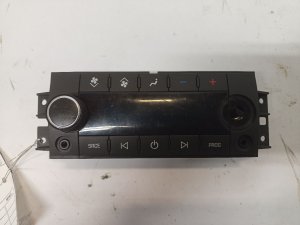


New Aftermarket Parts Available
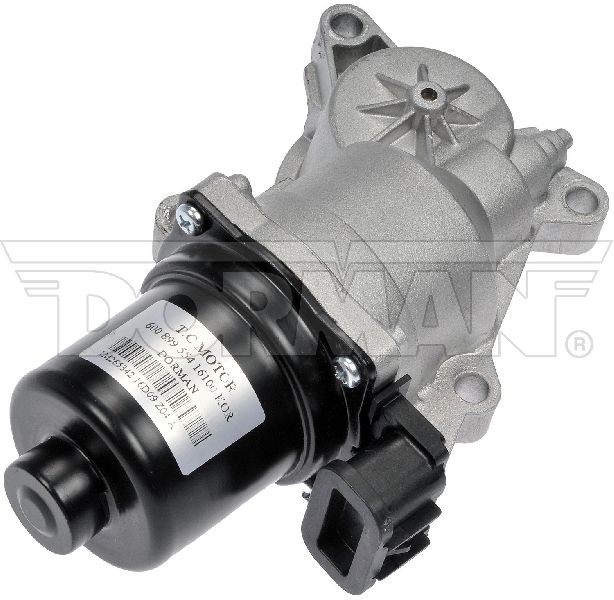

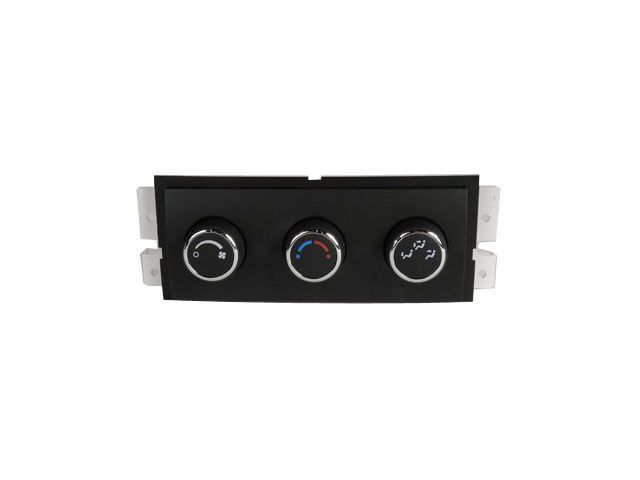

The information in this article is provided for general reference and educational purposes only. Vehicle specifications, procedures, and part compatibility can vary by production date, trim level, and region. Always consult your vehicle's factory service manual and verify part numbers before purchasing or performing repairs. Safety-critical components such as airbags, seat belts, and braking systems should be installed by a qualified professional.
- Chevrolet TAHOE:
- 🎬 Helpful Videos
- 🛍️ Shop This Part
- What's Unique About the 2007-2014 Chevrolet TAHOE
- Diagnostic Flowchart
- Symptoms You May Notice
- Most Likely Causes
- Rare But Worth Checking
- Diagnosis Steps
- Parts You'll Likely Need
- Related Codes That Often Appear With This One
- Technical Service Bulletins (TSBs) & Recalls
- Platform-Specific Known Issues
- Mechanic-Grade Diagnostic Values
- Scan Tool Commands That Help
- Wiring & Ground Locations
- Real Owner Repair Stories
- "I Checked Everything" — The Actual Cause
- OEM Part Supersession History
- Model Year Variations Within This Range
- 🎟️ Get 5% Off