

U0102 on 2007-2014 Chevrolet Suburban: Lost Communication With Transfer Case Fixes
This code means the Transfer Case Control Module (TCCM) has stopped communicating on the vehicle's network. Before replacing the module, check for a blown 'TREC' fuse, chafed wiring under the underhood fuse block, and corroded ground connections, which are common faults on this platform. The TCCM is located inside the cabin behind the driver's side dash, not under the vehicle. A replacement TCCM costs between $150 and $300 and requires programming.
- U0102 means the Transfer Case Control Module (TCCM) is offline.
- Before buying any parts, check the 'TREC' fuse in the underhood fuse block. This is a simple but common fix.
- Thoroughly inspect the wiring and connector at the TCCM, which is located under the truck, for any signs of corrosion or damage.
- If the fuse and wiring are good, the TCCM has likely failed and will need to be replaced and possibly programmed.
What's Unique About the 2007-2014 Chevrolet SUBURBAN

The GMT900 platform, which includes the 2007-2014 Suburban, is known for communication issues stemming from wiring and network problems, as noted in GM's own service bulletins. While the TCCM can fail, it's often an external issue like a blown fuse, a poor ground connection (specifically grounds G102 and G300), or a chafed wiring harness under the vehicle or fuse block that causes the module to drop off the network. Owners often report these issues appearing intermittently, especially in cold weather, before becoming a constant problem.
Diagnostic Flowchart
Tap your situation to follow the diagnostic path that matches what you're seeing on this vehicle.
Symptoms You May Notice

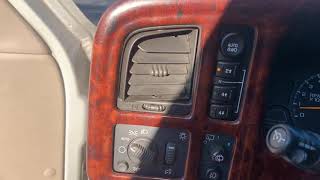
- "Service 4 Wheel Drive" message on the driver information center (DIC).
- 4WD selector switch lights are off or flash without engaging the system.
- Inability to shift into or out of 4WD modes.
- Vehicle may be stuck in 2WD.
- Check Engine Light is illuminated.
- Transmission may not shift into passing gear correctly, especially under heavy acceleration.
- Intermittent door lock cycling or chimes may occur, as mentioned in a related TSB. [2, ⭐]
- Replacing the transfer case shift motor when the problem is a lack of communication with the control module.
- Replacing the 4WD selector switch on the dashboard, which rarely causes a U0102 code. A dead switch is usually a symptom of the TCCM being offline, not the cause.
Most Likely Causes

- Blown Fuse for TCCM 🔴 High Probability A short circuit in the wiring harness, particularly under the underhood fuse block, can cause the fuse protecting the TCCM circuit to blow, cutting all power to the module.
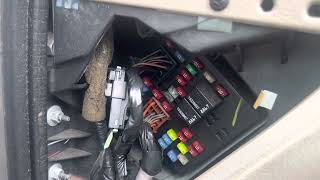
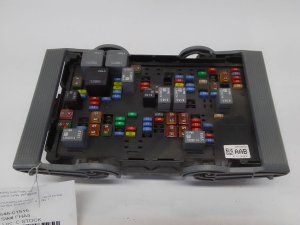
How to confirm: Check the fuse labeled 'TREC' (often a 30A fuse in the underhood fuse block) for the TCCM. A YouTuber with a 2014 Suburban identified this as the cause, noting that slamming the fuse box lid caused sparks, indicating a short in the wiring harness directly underneath the fuse box against the vehicle body.
Typical fix: Replace the blown fuse. If it blows again, you must find and repair the short circuit in the wiring harness. This often requires removing the underhood fuse block to access and repair the chafed wire(s) below it.
Est. part cost: $1-$5 - Corroded or Damaged TCCM Connector/Wiring 🟡 Medium Probability Though the TCCM is inside the cab, wiring harnesses that pass under the vehicle are exposed to moisture, road salt, and debris. TSB 08-07-30-021H specifically calls out checking for chafed wiring near the transmission and corrosion in various control module connectors.
How to confirm: Visually inspect the wiring harness and electrical connector at the Transfer Case Control Module, located behind the driver's side lower dash. Also inspect harnesses routed near the transmission and underbody for chafing or damage. Look for green/white corrosion, backed-out pins, or broken wires.
Typical fix: Clean any corroded connectors with electrical contact cleaner and apply dielectric grease. If the connector or wiring is damaged, it will need to be repaired or replaced.
Est. part cost: $10-$50 - Failed Transfer Case Control Module (TCCM) 🟡 Medium Probability Internal electronic failure of the module can occur over time, causing it to stop communicating on the network. This was noted as a more common issue on early (2007) models. A GM Preliminary Information bulletin also notes that voltage spikes from improperly installed aftermarket accessories can permanently damage the TCCM's internal circuits, causing it to backfeed voltage and create battery drain issues.
How to confirm: This is diagnosed by exclusion. If the TCCM has proper power (12V) and ground, and the CAN bus communication wires are intact (testing for ~60 ohms across the bus), but the module still won't communicate with a scan tool, the TCCM itself has likely failed.
Typical fix: Replace the Transfer Case Control Module. A new or remanufactured module MUST be programmed to the vehicle's VIN and specific equipment (e.g., transfer case RPO code). Some aftermarket suppliers sell pre-programmed modules, while others like Dorman provide a specific relearn procedure that can sometimes be done without a dealer scan tool.
Est. part cost: $150-$300 - Poor Ground Connection ⚪ Low Probability Frame grounds are susceptible to rust and corrosion, which can create high resistance and prevent the module from operating correctly. GM has bulletins that point to poor grounds as a cause for various communication issues.
How to confirm: Locate the primary ground points for the network, such as G102 and G300, often found on the frame rail under the driver's door area. Check for tightness and corrosion. Test the ground circuit resistance with a multimeter; it should be less than 0.1 ohms.
Typical fix: Remove the ground bolt/screw, clean the contact surfaces on the frame and the wire terminal down to bare metal, re-secure it tightly, and apply a corrosion inhibitor.
Est. part cost: $0-$5
Diagnosis Steps
- Scan for all DTCs in all modules. Note any other 'U' codes, as they point to a network-wide issue rather than an isolated module failure.
- Check the 'TREC' fuse (usually a 30A fuse in the underhood fuse block). If it's blown, suspect a short in the harness, especially under the fuse block itself.
- If the fuse is good, locate the TCCM. It is inside the cabin, behind the lower dashboard to the left of the steering column. Inspect its electrical connectors and nearby wiring for being loose, corroded, or damaged.
- With a multimeter, verify the TCCM has 12V power and a solid ground at its connector pins. A ground resistance reading should be under 0.1 ohms.
- Check key grounds on the frame and engine, particularly G104 (rear of driver's side cylinder head) and G300 (driver's side B-pillar floor), for corrosion and tightness.
- Disconnect the battery and measure the resistance between pins 6 (CAN High) and 14 (CAN Low) of the OBD-II port. A healthy High-Speed GMLAN bus should read approximately 60 ohms. A reading of 120 ohms indicates an open circuit or a missing terminating resistor (often inside a module), while a reading near 0 ohms suggests a short between the two CAN wires.
- If power, ground, and network resistance are all correct, but you still cannot communicate with the TCCM using a capable scan tool, the module itself is the likely failure point.
Parts You'll Likely Need

- Transfer Case Control Module (TCCM)
(OEM #24241970, 24261367, 24252878, 24243084)— If power, ground, and wiring are confirmed to be good, the module's internal electronics have likely failed. Replacement requires VIN programming to function correctly.
Trusted brands: ACDelco (OEM), Dorman (Remanufactured)
OEM price range: $200-$300
Aftermarket price range: $150-$250 - Mini/J-Case Fuse — A short circuit in the TCCM power feed wire, often under the fuse box, can blow the 'TREC' fuse and cut power to the module.
Trusted brands: Bussmann, Littlefuse
OEM price range: $1-$5
Aftermarket price range: $1-$5
Related Codes That Often Appear With This One
- U0073 — This is a general code for 'Control Module Communication Bus 'A' Off,' indicating a broader network problem that is causing the TCCM to lose communication. It is frequently cited alongside U0102 in GM service bulletins. [2, ⭐]
- U0100 — Lost Communication with ECM/PCM. This can be set by other modules when the network is unstable, often due to the same root cause affecting the TCCM. [2, ⭐]
- U0101 — Lost Communication with TCM. The transmission module is on the same network and its loss is often related to the same underlying wiring or network issue. [2, ⭐]
- U0140 — Lost Communication with Body Control Module. A failing BCM or related wiring can disrupt the entire communication network, causing other modules like the TCCM to drop offline. [2, ⭐]
Technical Service Bulletins (TSBs) & Recalls
- 08-07-30-021H: A comprehensive bulletin for 'Loss of High Speed GMLAN Communications' that includes U0102. It directs technicians to inspect for chafed wiring (especially near the transmission), poor terminal connections, and corrosion before condemning any control module. [2, ⭐, 25]
Platform-Specific Known Issues
- A well-documented issue involves the wiring harness under the underhood fuse block chafing against the vehicle body, causing a short circuit that blows the TCCM ('TREC') fuse.
- GM Technical Service Bulletin #08-07-30-021H addresses intermittent communication issues on this platform, listing U0102 as a possible code resulting from network faults caused by chafed wiring or poor connections, and advises checking these before replacing modules. [2, ⭐, 25]
Mechanic-Grade Diagnostic Values
- TCCM Power Pin Voltage — expected: 12V ± 0.5V. Failure: Voltage below 11.5V or absent indicates a power supply issue (fuse, wiring).
- TCCM Ground Circuit Resistance — expected: < 0.1 Ohms. Failure: Resistance higher than 0.1 Ohms points to a corroded or loose ground connection.
- CAN Bus Resistance (Key Off, Battery Disconnected) — expected: ~60 Ohms (±5 Ohms) between Pins 6 and 14 of the OBD-II port.. Failure: A reading of ~120 Ohms indicates an open circuit or a missing terminating resistor. A reading near 0 Ohms indicates a short between the CAN High and CAN Low wires.
- CAN Bus Voltage (Key On) — expected: CAN High and CAN Low lines should both be ~2.5V (between 2.0V and 3.0V).. Failure: A line stuck near 0V or 5V indicates a hard fault (short or open) on that wire.
Scan Tool Commands That Help
- GDS2 / Tech2: Range Actuator Learn — This procedure is required after programming a new TCCM to teach the module the physical positions of the transfer case actuator. It involves setting the parking brake and putting the transmission in neutral before initiating the learn process with the scan tool.
Wiring & Ground Locations

- G103 — On the front of the passenger side cylinder head.. This ground is shared by multiple modules. While not the primary TCCM ground, poor connections here can introduce electrical noise and instability to the overall vehicle network.
- G104 — On the left rear corner of the driver's side cylinder head, near the firewall.. A factory service manual indicates this ground serves some transfer case controls, making it a relevant point to inspect for corrosion or looseness when diagnosing communication issues.
- G300 — On the floor near the B-pillar, behind the driver's seat.. This is a major interior ground point. While not directly for the TCCM, it grounds various driver controls and modules that share the network, and a poor connection can cause widespread issues.
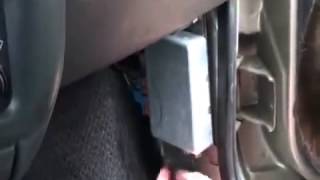
- TCCM Connector — Inside the cabin, mounted to a bracket up and to the left of the steering column, behind the lower dashboard trim.. This is the main connection point for the module. All power, ground, and communication lines must be verified here. It typically has two or three separate harness connectors.
Real Owner Repair Stories
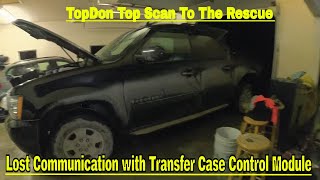
- YouTube channel 'MIHeatingGuy' (2014 Chevrolet Suburban) — "Service 4WD" message, U0102 code stored in the brake module, no communication with TCCM.
❌ Tried (didn't work) Initially reading codes and identifying the loss of communication.
✅ What actually fixed it The owner found the 'TREC' fuse (Fuse 67 in the underhood fuse block) was blown. After replacing it, slamming the fuse box lid caused sparks. He removed the fuse block and found a wire in the harness underneath had chafed through on the vehicle body, causing a direct short to ground. Repairing the chafed wire and replacing the fuse permanently resolved the issue.
OEM Part Supersession History
24252878→24261367— Part was discontinued and replaced by a newer revision.
Heads up: The new part number should be a direct replacement, but VIN programming is always required for the module to function in the vehicle's network.
Model Year Variations Within This Range
- 2014: A specific recall (NHTSA Campaign #14V374000) was issued for 2014 models where an electrical short could cause the TCCM to shift the transfer case into neutral unexpectedly. The fix was a dealer-installed software update for the TCCM, not a hardware replacement. This highlights a known software vulnerability in later models of this generation.
Helpful Videos
Used OEM Parts in Stock


New Aftermarket Parts Available

The information in this article is provided for general reference and educational purposes only. Vehicle specifications, procedures, and part compatibility can vary by production date, trim level, and region. Always consult your vehicle's factory service manual and verify part numbers before purchasing or performing repairs. Safety-critical components such as airbags, seat belts, and braking systems should be installed by a qualified professional.
- Chevrolet SUBURBAN:
- 🎬 Helpful Videos
- 🛍️ Shop This Part
- What's Unique About the 2007-2014 Chevrolet SUBURBAN
- Diagnostic Flowchart
- Symptoms You May Notice
- Most Likely Causes
- Diagnosis Steps
- Parts You'll Likely Need
- Related Codes That Often Appear With This One
- Technical Service Bulletins (TSBs) & Recalls
- Platform-Specific Known Issues
- Mechanic-Grade Diagnostic Values
- Scan Tool Commands That Help
- Wiring & Ground Locations
- Real Owner Repair Stories
- OEM Part Supersession History
- Model Year Variations Within This Range
- 🎟️ Get 5% Off