

U0100 on 2022-2024 Subaru BRZ: Lost Communication with ECM Fixes
On a 2022-2024 Subaru BRZ, code U0100 indicates a loss of communication with the Engine Control Module (ECM). While this can be a standard network or wiring fault, it is often linked to engine timing codes P0011 and P0012 per Subaru TSBs. Diagnosis should start by checking for these additional codes, as well as verifying battery voltage, as low power is a common trigger for communication faults.
- On a 2022-2024 BRZ, U0100 is not just a simple communication code; it is officially linked by Subaru to engine timing faults (P0011/P0012).
- Always check for other codes first. If timing codes are present, they must be diagnosed and fixed before addressing the U0100.
- Do not drive the vehicle. A U0100 code indicates a critical failure that can cause the engine to stall at any time.
- Before suspecting an expensive ECM failure, thoroughly check the battery, all related wiring, and address any engine timing codes.
- This is not a beginner-friendly DIY repair. Diagnosing network issues is complex and best left to a professional with the right diagnostic tools.
What's Unique About the 2022-2024 Subaru BRZ
For the second-generation (ZD8) Subaru BRZ and its platform-mate, the Toyota GR86, the U0100 code has a unique and documented relationship with engine performance codes. Subaru has issued Technical Service Bulletins (#09-128-24R and #09-128-24) indicating that U0100 often appears alongside P0011 ('A' Camshaft Position - Timing Over-Advanced Bank 1) and P0012 ('A' Camshaft Position - Timing Over-Retarded Bank 1). This suggests that a specific engine timing fault—potentially related to the Oil Control Valves (OCVs)—can trigger a network code in the ECM's software, or a related wiring issue is affecting both systems. Unlike a typical U-code diagnosis that focuses solely on network wiring, on this specific vehicle, investigating engine timing systems is a critical first step.
Diagnostic Flowchart
Tap your situation to follow the diagnostic path that matches what you're seeing on this vehicle.
Symptoms You May Notice
- Check Engine Light is on
- Multiple other warning lights may illuminate, including ABS, traction control, and hill start assist
- Vehicle will not start or has difficulty starting
- Engine stalls while driving or at idle
- Reduced engine power and performance ('limp mode')
- Poor fuel economy
- Instrument cluster lights may flicker or behave erratically
- Replacing the ECM immediately without checking for wiring, power/ground issues, or the associated timing codes cited in the TSBs.
- Ignoring a weak battery because the car still starts. Low voltage can cause communication faults long before it causes a no-start condition.
Most Likely Causes
- Associated Engine Timing Fault (P0011/P0012) 🔴 High Probability Subaru TSBs #09-128-24R and #09-128-24 directly link U0100 with these camshaft timing codes for the 2022 BRZ. The root cause is often low/dirty oil, a faulty Oil Control Valve (OCV), or debris in the OCV filter screens, which affects the variable valve timing system.
How to confirm: Scan for additional trouble codes. If P0011 or P0012 are present, diagnose them first. 🎬 Watch: Understanding P0011 causes and how to fix them. Check engine oil level and condition. Test the OCVs by checking resistance or swapping them between banks to see if the code follows.
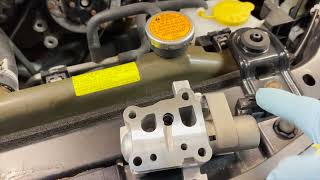
Typical fix: Address the root cause of the timing codes. This can range from an oil change with the correct 0W-20 synthetic oil, to cleaning OCV filter screens, to replacing a faulty OCV. 🎬 See this walkthrough on replacing a Subaru oil control valve.
Est. part cost: $50-$500 - Low or Faulty Battery 🟡 Medium Probability Modern vehicles like the BRZ are highly sensitive to voltage. A weak battery can cause unpredictable communication errors between modules before causing a no-start condition. Forum users frequently report that low voltage is a primary cause for a variety of electrical gremlins, including communication codes.
How to confirm: Test the battery with a multimeter. A healthy, fully charged battery should read approximately 12.6 volts with the engine off. Check for corrosion on the battery terminals and ensure connections are tight.
Typical fix: Clean battery terminals and charge or replace the battery.
Est. part cost: $150-$350 - Damaged Wiring or Poor Connections 🟡 Medium Probability The CAN bus network relies on intact wiring. A chafed, corroded, or loose wire/pin at the ECM connector, OBD-II port, or in the main engine harness can interrupt communication. A user on ft86club reported multiple communication codes after engine bay fire damage required harness replacement, highlighting the sensitivity of these circuits.
How to confirm: Visually inspect the wiring harness leading to the ECM for any signs of damage, corrosion, or loose connections. Pay close attention to grounds. Check the pins in the connectors for a secure fit. A technician would use a multimeter or oscilloscope to check for continuity and proper signal on the CAN High and CAN Low lines.
Typical fix: Repair the damaged section of the wiring harness or clean/tighten the affected connector.
Est. part cost: $5-$200 - Faulty Engine Control Module (ECM) ⚪ Low Probability ECM failure is rare but possible. It is almost always the result of an external issue like a voltage spike or water intrusion.
How to confirm: This is a last resort after all other possibilities (wiring, power, grounds, other modules, and associated TSBs) have been exhaustively tested and ruled out by a professional.
Typical fix: Replace the ECM and program it to the vehicle's VIN and immobilizer system.
Est. part cost: $800-$1500
Rare But Worth Checking
- Faulty OBD-II Port or Aftermarket Device: A poorly made or malfunctioning OBD-II device (like a cheap scanner, tracker, or insurance dongle) can sometimes interfere with the CAN bus network by 'chattering' or shorting pins, causing communication codes. A user on ft86club traced U0100 and U0122 to a loose Bluetooth OBD-II adapter. If a device is plugged in, remove it and see if the code clears.
- Faulty Alternator: While less common than a bad battery, a failing alternator can produce inconsistent voltage or electrical noise (AC ripple), which can disrupt module communication and trigger a U0100 code.
Diagnosis Steps
- Scan for all stored trouble codes. Pay close attention if P0011 or P0012 are present alongside U0100.
- If P0011/P0012 are present, begin diagnosis for those codes first. Check engine oil level and condition. Low or dirty oil is a common cause for VVT faults. Ensure the correct 0W-20 oil is being used.
- If no other codes are present, check the battery and charging system. Test battery voltage (should be ~12.6V engine off, ~14.0-14.7V engine on). Inspect terminals for corrosion and tightness.
- Remove any aftermarket devices from the OBD-II port. Clear codes and re-test.
- Inspect the ECM connectors and the main engine wiring harness for any visible damage, chafing, or corrosion. Check major ground connections in the engine bay to ensure they are clean and tight.
- Check fuses related to the ECM/PCM to ensure they are not blown.
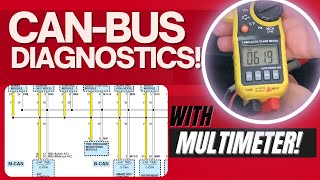
- (Professional) Use a multimeter to check for 60 ohms of resistance across CAN High (Pin 6) and CAN Low (Pin 14) at the OBD-II port (with the battery disconnected). 🎬 Watch: How to test CAN bus resistance with a multimeter. This verifies the integrity of the network's terminating resistors.
- (Professional) Use an oscilloscope to check for a clean, square waveform on the CAN bus lines. This can identify data corruption or interference from sources like a faulty alternator.
- If all wiring, power, and ground circuits are confirmed to be good, the ECM itself may be the issue. This should be the final step in diagnosis.
Parts You'll Likely Need
- Oil Control Valve (OCV) / VVT Solenoid
(OEM #10921AA231 (Supersedes older versions))— A common cause for the related P0011/P0012 codes. A sticking or failing OCV can disrupt cam timing and may be the underlying trigger for the U0100 code on this platform. There are four identical valves on the engine.
Trusted brands: Subaru (OEM), Denso
OEM price range: $100-$180
Aftermarket price range: $50-$120 - Battery — Low voltage from a weak or failing battery is a frequent cause of network communication errors across all modern vehicles. This is often the first and easiest part to check.
Trusted brands: Interstate, DieHard, Subaru (OEM)
OEM price range: $200-$350
Aftermarket price range: $150-$250 - Engine Control Module (ECM)
(OEM #22765AH230 (Example for 2022-2023 AT, part is VIN specific))— This is the part that has lost communication. It is only replaced after all other potential causes like wiring, battery, and associated engine codes are ruled out. Must be programmed by a dealer or specialist.
Trusted brands: Subaru (OEM)
OEM price range: $800-$1500
Aftermarket price range: N/A
Related Codes That Often Appear With This One
- P0011 — As per Subaru TSB #09-128-24R, this code for 'Camshaft Position - Timing Over-Advanced Bank 1' is frequently seen with U0100 on this vehicle.
- P0012 — As per Subaru TSB #09-128-24R, this code for 'Camshaft Position - Timing Over-Retarded Bank 1' is also frequently seen with U0100 on this vehicle.
- P0700 — Indicates a fault in the Transmission Control Module (TCM). If the TCM cannot communicate with the ECM, it may set this code along with the ECM setting U0100. This is more common on automatic transmission models.
Technical Service Bulletins (TSBs) & Recalls
- 09-128-24R: Links U0100 with P0011 and P0012 codes for the 2022 BRZ. This TSB implies that if these codes are present together, the diagnostic focus should be on the cause of the P-codes.
- 09-128-24: An earlier version of the TSB linking U0100 with P0011 and P0012.
Platform-Specific Known Issues
- Subaru Technical Service Bulletins #09-128-24R and #09-128-24 directly link U0100 with P0011 and P0012, making diagnosis of the engine timing system a critical first step before focusing on typical network troubleshooting.
Mechanic-Grade Diagnostic Values
- CAN Bus Network Resistance — expected: Approximately 60 Ω. Failure: A reading of 120 Ω indicates an open circuit or one of the terminating resistors is offline. A reading significantly lower than 60 Ω (e.g., 40-45 Ω) could indicate a short or an unintended third resistor on the network.
- Oil Control Valve (OCV) / VVT Solenoid Resistance — expected: 6.9 to 7.9 Ω at 68°F (20°C). Failure: No reading (open circuit) or a reading outside this specific range indicates a faulty solenoid.
- CAN Bus Voltage (Key On, Engine Off) — expected: CAN High (Pin 6 to ground): ~2.6V, CAN Low (Pin 14 to ground): ~2.4V. Failure: Voltages that are stuck high or low, or do not mirror each other, indicate a short to power, short to ground, or a faulty module pulling the bus voltage down. An oscilloscope is required for proper waveform analysis.
- ECM/PCM Ground Circuit Resistance — expected: Less than 0.1 Ω. Failure: Higher resistance indicates a poor ground connection, which is a common cause of communication failures.
Scan Tool Commands That Help
- Subaru Select Monitor (SSMIII or SSM4): All Systems Diagnosis — This function performs a comprehensive check of all control modules on the network, displaying their fault status on one screen. It is the primary dealer-level step to quickly identify which modules are and are not communicating.
- Subaru Select Monitor (SSMIII or SSM4): Each System Check — After identifying a non-communicating module, this function allows for in-depth diagnosis of a specific system, viewing its input/output data, and accessing freeze-frame data for stored codes.
- Subaru Select Monitor (SSMIII or SSM4): Reprogram — This function is used to update control unit software or to program a new ECM to the vehicle after replacement.
Wiring & Ground Locations
- Engine Control Module (ECM) — Located in the passenger footwell, behind and above the glove box.. This is the primary module that has lost communication. Checking its connectors for security and corrosion is a critical step.
- Main Engine Ground Straps — There are three primary engine grounds: one on each side of the front of the engine connecting to the frame rail, and one from the top-rear of the passenger side of the transmission/engine to the transmission tunnel.. A loose or corroded main engine ground can cause a variety of electrical issues, including communication faults between the ECM and other modules. The ground on the passenger side near the transmission is often forgotten during clutch jobs.
- ECM Main Ground — On later model Subarus, the ECM's main ground lug is typically bolted to the intake manifold, near the throttle body.. This is the direct grounding point for the ECU itself. A poor connection here can directly cause U0100 and other ECU-related faults.
- CAN Junction Connector (D43) — While the exact location on the 2nd gen BRZ requires a service manual, on the 1st gen it served as a central CAN hub. It's a likely point of failure if multiple modules are offline.. This connector acts as a hub for CAN bus wiring. A fault at this single point can disrupt communication for multiple systems, including the ECM.
- Interior Ground Point — There are multiple grounding bolts on the metal frame under the dashboard, near the interior fuse panel on the driver's side.. The ECM and other interior modules rely on clean chassis grounds. These points are relevant when checking for ground integrity inside the cabin.
Real Owner Repair Stories
- ft86club.com user Bianc_203 (2015+ Scion FR-S (Gen 1, but relevant principle)) — Recurring P0011 check engine light.
❌ Tried (didn't work) Initial code reset, but it returned as a pending code after 8 miles.
✅ What actually fixed it As a last resort, the user performed a full ECU/ECM reset. After the reset and a few drive cycles, the pending code did not return over 260 miles of varied driving, including stop-and-go and spirited driving. - ft86club.com user (First Generation BRZ/FR-S) — P0011 and P0021 codes appeared after a clutch replacement where the battery was disconnected for about two weeks.
❌ Tried (didn't work) Replacing all four cam position sensors after swapping them confirmed the code did not follow the sensors.
✅ What actually fixed it The user's issue was complex and led to an engine pull for a full timing check. This highlights that major mechanical work (like a clutch job) preceding the fault is a critical diagnostic clue, pointing away from simple sensor failure and towards potential wiring damage or timing issues introduced during the repair.
OEM Part Supersession History
Older OCVs prior to mid-2017→OCVs with a production lot number starting with '17159' or higher.— The newer design addresses issues, including oil leaking into the wiring harness connector, which can cause DTCs related to the AVCS system.
Heads up: While externally identical, if oil is found in the harness connector, the affected OCV should be replaced with the newer part number to prevent recurrence.
Helpful Videos
Used OEM Parts in Stock

New Aftermarket Parts Available


The information in this article is provided for general reference and educational purposes only. Vehicle specifications, procedures, and part compatibility can vary by production date, trim level, and region. Always consult your vehicle's factory service manual and verify part numbers before purchasing or performing repairs. Safety-critical components such as airbags, seat belts, and braking systems should be installed by a qualified professional.
- Subaru BRZ:
- 🎬 Helpful Videos
- 🛍️ Shop This Part
- What's Unique About the 2022-2024 Subaru BRZ
- Diagnostic Flowchart
- Symptoms You May Notice
- Most Likely Causes
- Rare But Worth Checking
- Diagnosis Steps
- Parts You'll Likely Need
- Related Codes That Often Appear With This One
- Technical Service Bulletins (TSBs) & Recalls
- Platform-Specific Known Issues
- Mechanic-Grade Diagnostic Values
- Scan Tool Commands That Help
- Wiring & Ground Locations
- Real Owner Repair Stories
- OEM Part Supersession History
- 🎟️ Get 5% Off