

U0100 on 2012-2016 Ford Focus Electric: Lost Communication Causes and Fixes
On a 2012-2016 Ford Focus Electric, code U0100 indicates a critical loss of communication with the Powertrain Control Module (PCM). This is a serious fault that can cause a no-start condition, stalling, or the "Stop Safely Now" message. The issue is often related to the PCM itself or the associated wiring, as highlighted in Ford's Technical Service Bulletin TSB 16-0129, which specifically covers this fault pattern.
- U0100 on a Ford Focus Electric is a critical fault indicating a loss of communication with the main powertrain computer (PCM).
- Driving is not recommended, as the vehicle may stall or fail to start.
- Common symptoms include a flashing gear selector, the 'Stop Safely Now' message, and no-start conditions.
- Ford has issued TSB 16-0129 for this specific issue, which should be the primary reference for diagnosis.
- While the PCM is a common cause, always diagnose the 12V battery, fuses, grounds, and wiring harness connectors first, as these are simpler and cheaper fixes.
- This is not a DIY repair for most owners. Diagnosis and repair require professional tools and expertise in vehicle network systems.
What's Unique About the 2012-2016 Ford FOCUS ELECTRIC

Unlike its gasoline-powered counterpart which has a well-known issue with the Transmission Control Module (TCM) causing U0100, the Focus Electric's architecture is different. For the Electric model, this code points directly to a communication breakdown with the central powertrain computer (PCM). Ford recognized issues on this platform by releasing TSB 16-0129, which groups U0100 with other communication codes and points towards a specific diagnostic path for intermittent power loss, no-start conditions, and flashing gear selector lights. While the TSB also mentions the DPS6 transmission found in gas models, the symptoms and associated PCM-related codes are directly applicable to the Focus Electric's fault pattern.
Diagnostic Flowchart
Tap your situation to follow the diagnostic path that matches what you're seeing on this vehicle.
Symptoms You May Notice

- Vehicle will not start or has a no-crank condition.
- "Stop Safely Now" message displayed with a red triangle warning light.
- Flashing gear selector light (PRNDL/S) on the instrument cluster.
- Intermittent loss of power while driving.
- Check Engine Light is on (may be intermittent).
- Warning messages such as "Hill Start Assist Not Available" or "Parking Aid Malfunction".
- Complete shutdown of the vehicle while in motion.
- Instrument cluster displays multiple warning lights simultaneously.
- Gear selector indicator on dash does not show the selected gear (e.g., all letters are white, none are orange).
- Replacing the Transmission Control Module (TCM). While U0100 is linked to the TCM on gasoline Focus models with the DPS6 transmission, the Focus Electric does not have the same TCM. The fault on the electric model is almost always related to the PCM or its network.
- Replacing other modules on the CAN network. Because U0100 signifies a loss of communication with the PCM, other modules may store codes indicating they can't hear the PCM. This does not mean they are the faulty part.
Most Likely Causes

- Powertrain Control Module (PCM) Fault 🔴 High Probability TSB 16-0129 specifically includes DTC P0606 (PCM Processor Fault) as a common related code, pointing to internal PCM failure as a primary cause on this platform. This can sometimes be caused by corrupted software, which a dealer reflash might fix, but often indicates a hardware failure.
How to confirm: After ruling out wiring and power issues, a technician will use a specialized scan tool (like Ford's IDS) to attempt communication with the PCM. If the module is unresponsive and has proper power and ground, it is likely faulty. A reflash of the PCM software may be attempted before replacement.
Typical fix: Replace the Powertrain Control Module and program the new unit to the vehicle using dealer-level software. In some cases, a software reflash of the existing PCM can resolve the issue.
Est. part cost: $800-$1500 - CAN Bus Wiring or Connector Issue 🟡 Medium Probability Wiring harnesses can be susceptible to damage from vibration, moisture, or rodent activity, leading to open or short circuits in the communication network. Owners have reported issues with pins backing out of large harness connectors, particularly at the fuse box, after other service work.
How to confirm: A visual inspection of the wiring harness between key modules (PCM, ABS, Instrument Cluster) is the first step. A technician will then use a multimeter or oscilloscope to test for correct voltage (around 2.5V on CAN High and CAN Low) and resistance (around 60 ohms between CAN_H and CAN_L pins at the DLC with the battery disconnected). 🎬 See how to test CAN bus resistance with a multimeter
Typical fix: Repair the damaged section of the wiring harness or replace a corroded connector. This can be as simple as re-seating a loose pin in a connector.
Est. part cost: $20-$200 - Weak or Faulty 12V Battery ⚪ Low Probability Low system voltage from a failing 12V auxiliary battery can cause unpredictable behavior in electronic modules, leading them to drop off the communication network. While the Focus Electric has a high-voltage battery, its 12V system powers all the control modules, computers, and networks. An owner on the Ford Focus Club forum noted that a U0100 code appeared after battery issues but would not clear, indicating it can be a trigger.
How to confirm: Test the 12V battery with a multimeter or a dedicated battery tester. A healthy, fully charged battery should read at least 12.4-12.6 volts with the vehicle off. Any reading below 12.2V warrants a recharge and re-test.
Typical fix: Recharge or replace the 12V auxiliary battery.
Est. part cost: $150-$300
Rare But Worth Checking
- Faulty Fuse or Relay: A blown fuse or a failing relay for the PCM can cut power to the module, making it appear as if it has failed. This is a simple but crucial check before condemning an expensive module. A user on a Ford truck forum found a broken female pin in the under-hood fuse box for a critical relay caused identical symptoms.
- Poor Ground Connection: A corroded or loose ground strap for the PCM or a main chassis ground can create high resistance and cause a variety of electrical issues, including communication faults. On some Focus models, the ground point behind the battery is a known spot for corrosion.
Diagnosis Steps
- Check the health of the 12V auxiliary battery. Ensure it is fully charged (12.4V+ at rest) and terminals are clean and tight. A weak 12V battery is a common cause of network communication errors.
- Perform a full vehicle scan with a diagnostic tool capable of reading codes from all modules (e.g., FORScan or Ford IDS). Document all stored DTCs and which modules are reporting them. Note any codes with failure type bytes, such as U0100:00-8B.
- Inspect all fuses and relays related to the PCM in the under-hood fuse box (Battery Junction Box). Check for pushed-out or corroded pins in the fuse box itself.
- Consult Ford TSB 16-0129, which provides a specific diagnostic procedure for this set of codes.
- Visually inspect the main PCM wiring harness and its connectors for any signs of damage, corrosion, or loose connections. The PCM is located in front of the driver's side front wheel, accessible by removing the fender liner. 🎬 Watch this video to find the exact PCM location
- Perform a CAN bus network test. Disconnect the 12V battery. At the DLC (OBD-II port), measure the resistance between Pin 6 (CAN-H) and Pin 14 (CAN-L). The reading should be approximately 60 Ohms. If it's 120 Ohms, one of the two terminating resistors (often in the PCM and instrument cluster) is offline. If it's near 0 Ohms, there is a short between the CAN lines.
- Verify that the PCM has proper power and ground connections using a wiring diagram and a multimeter. Check for voltage at the designated power pins and for low resistance (less than 1 Ohm) on the ground pins to the chassis. Key PCM grounds are G100, G102, G104, and G105, located on the left side of the motor compartment.
- If wiring, power, grounds, and the 12V battery are all confirmed to be good, the PCM is the most likely failed component. A software reflash may be attempted before replacement.
Parts You'll Likely Need
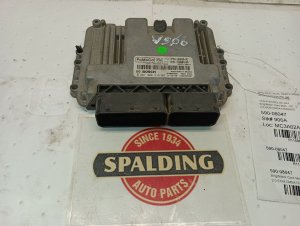
- Powertrain Control Module (PCM)
(OEM #EM5A-12A650-PA (Example for 2014 model, verify by VIN))— If wiring and power supply are intact, the PCM itself is the most likely point of failure, especially when code P0606 is also present.
Trusted brands: Motorcraft (OEM), Flagship One (Remanufactured)
OEM price range: $800-$1500
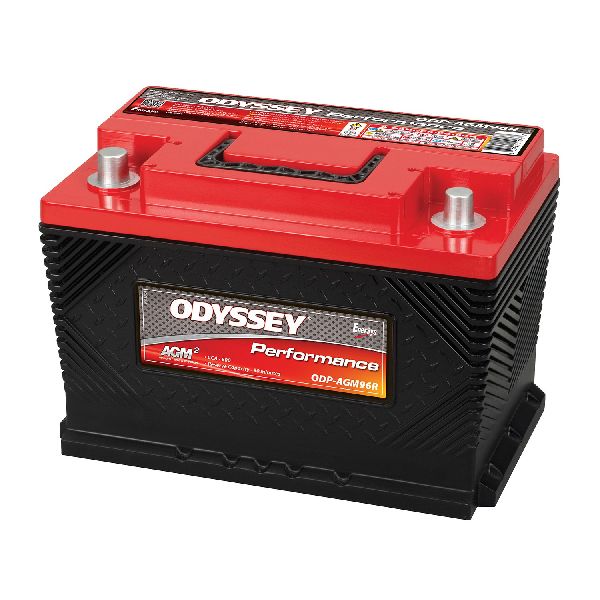
Aftermarket price range: $400-$1000 - 12V AGM Battery — A weak or failing 12V battery is a frequent and simple-to-fix cause for various communication codes, including U0100.
Trusted brands: Motorcraft, Interstate, Duralast
OEM price range: $200-$350
Aftermarket price range: $150-$300
Related Codes That Often Appear With This One
- U0101 — Lost Communication with TCM. TSB 16-0129 lists these codes together as part of the same potential fault pattern, even on the electric model where the 'TCM' functions are integrated differently.
- U1013 — Invalid Internal Control Module Monitoring Data Received. This code is also cited in TSB 16-0129 and indicates data corruption on the network.
- P0606 — ECM/PCM Processor Fault. This code, mentioned in TSB 16-0129, strongly indicates that the PCM itself has an internal failure.
Technical Service Bulletins (TSBs) & Recalls
- TSB 16-0129: Addresses intermittent no-start, loss of power, or flashing gear selector accompanied by DTCs U0100, U0101, U1013, and/or P0606.
Platform-Specific Known Issues
- Ford Technical Service Bulletin TSB 16-0129 directly addresses the symptoms and diagnostic trouble codes U0100, U0101, U1013, and P0606 on the 2012-2016 Focus. It outlines a service procedure for intermittent no-start, loss of power, and flashing gear selector lights caused by this communication failure.
- Unlike the gas Focus, where U0100 often points to a faulty TCM, on the Focus Electric this code is a strong indicator of a PCM, wiring, or power supply issue. The diagnostic path should not focus on a separate TCM.
Mechanic-Grade Diagnostic Values

- HS-CAN Bus Network Resistance — expected: ~60 Ohms. Failure: 120 Ohms indicates one terminating resistor is offline. ~0 Ohms indicates a short between CAN High and CAN Low wires.
- CAN Bus Voltage (Key On, Engine Off) — expected: CAN High and CAN Low should both be approximately 2.5V.. Failure: A line stuck near 0V or battery voltage indicates a short to ground or power.
- 12V Auxiliary Battery Voltage (Vehicle Off) — expected: 12.4V - 12.6V. Failure: A reading below 12.2V indicates a discharged battery that can cause network communication faults.
Hidden / Shadow Codes Worth Checking
- U0100:00-8B: This is a Ford-specific format. The ':00' is a Failure Mode Identifier, indicating 'No Sub Type Information' (a general failure). The '-8B' is a hexadecimal occurrence counter that increments each time the fault conditions are met during a drive cycle. (see via Advanced scan tools like FORScan or Ford's IDS can display these extended trouble codes.)
Scan Tool Commands That Help
- FORScan / Ford IDS: On-Demand Self Test — Run this test for the PCM (and other modules). It commands the module to check its own inputs and outputs. Hearing relays click and fans run (or not) can help confirm if the module is powered and partially functional, even if it's not communicating properly on the network.
- FORScan / Ford IDS: Programmable Module Installation (PMI) — This function is required after replacing the PCM. It copies the vehicle's VIN, security information (PATS), and other configuration data from the old module (if possible) or from Ford's servers to the new module, allowing it to work in the vehicle.
Wiring & Ground Locations

- PCM — Located in the front of the driver's side wheel well, underneath the headlight. It is accessible by removing the fender liner and a protective cover.. This is the module that has lost communication. Its connectors and nearby wiring are primary inspection points for damage or corrosion.
- G104 / G105 — G104 is on the left front of the motor compartment. G105 is on the left side of the motor compartment.. These are primary ground points for the PCM. A corroded or loose connection at these locations can interrupt power to the PCM, causing it to drop off the network and trigger a U0100 code.
- Battery Junction Box (BJB) — The main fuse and relay box located in the engine compartment, next to the 12V battery.. This box contains the main power relays (like KL15 / R8) and fuses for the PCM. A fault within this box, such as a bad relay or a broken internal pin socket, can cut power to the PCM.
Real Owner Repair Stories
- Ford Truck Enthusiasts forum user '1Kurgan1' (2013 Ford F-250 6.2L (Note: Not a Focus Electric, but symptoms and code are identical)) — No crank, no start. Gear indicator lights were all white with no gear selected. 'Service Advancetrack' message. Code U0100:00-8B was stored.
❌ Tried (didn't work) Checking firewall connections and grounds., Wiggling and re-seating large electrical connectors under the dash.
✅ What actually fixed it The root cause was a broken female pin socket for a relay inside the under-hood fuse box (BJB). The pin had pushed down into the box, creating a poor connection for the relay that powered the PCM.
Model Year Variations Within This Range
- 2012-2013 (built on or before Feb 6, 2013): These early models are subject to Technical Service Bulletin (TSB) 13-6-27 for an inoperative instrument cluster at startup. The fix is a software update (reprogramming) of the cluster. This is relevant to U0100 as a failing cluster can disrupt CAN bus communication.
Helpful Videos
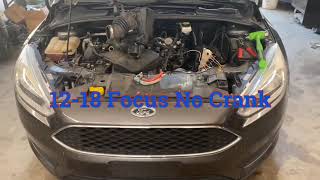

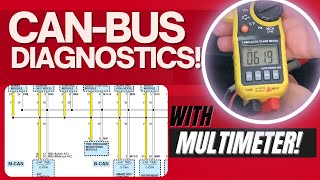
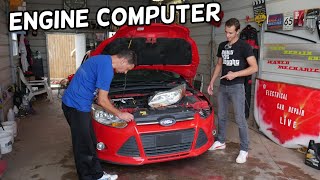
Used OEM Parts in Stock


New Aftermarket Parts Available

The information in this article is provided for general reference and educational purposes only. Vehicle specifications, procedures, and part compatibility can vary by production date, trim level, and region. Always consult your vehicle's factory service manual and verify part numbers before purchasing or performing repairs. Safety-critical components such as airbags, seat belts, and braking systems should be installed by a qualified professional.
- Ford FOCUS ELECTRIC:
- 🎬 Helpful Videos
- 🛍️ Shop This Part
- What's Unique About the 2012-2016 Ford FOCUS ELECTRIC
- Diagnostic Flowchart
- Symptoms You May Notice
- Most Likely Causes
- Rare But Worth Checking
- Diagnosis Steps
- Parts You'll Likely Need
- Related Codes That Often Appear With This One
- Technical Service Bulletins (TSBs) & Recalls
- Platform-Specific Known Issues
- Mechanic-Grade Diagnostic Values
- Hidden / Shadow Codes Worth Checking
- Scan Tool Commands That Help
- Wiring & Ground Locations
- Real Owner Repair Stories
- Model Year Variations Within This Range
- 🎟️ Get 5% Off