

U0100 on 2012-2016 Ford Focus: Lost Communication Causes and Fixes
On a 2012-2016 Ford Focus, code U0100 almost always indicates a failure of the Transmission Control Module (TCM) for the DPS6 automatic transmission. This is a very common and well-documented issue caused by internal circuit failure. The fix is replacing the TCM, which can be costly but may be covered by Ford's extended warranty program (14M02) that covers the part for 10 years or 150,000 miles, and for some vehicles, offered a one-time replacement through June 30, 2025.
- Code U0100 on a 2012-2016 Focus with an automatic transmission is almost certainly caused by a failed Transmission Control Module (TCM).
- Symptoms are severe and can include a no-start condition, sudden loss of power, and jerky or failed shifting.
- This is a known, widespread issue. Before paying for a repair, contact a Ford dealer with your VIN to check for eligibility under the extended warranty program 14M02.
- Do not drive the vehicle. The risk of it stalling or losing power in traffic is high.
- The repair requires replacing and programming the TCM, which should be performed by a qualified professional.
What's Unique About the 2012-2016 Ford FOCUS

The 2012-2016 Ford Focus uses a DPS6 "PowerShift" dual-clutch automatic transmission which is known for a high failure rate of its externally mounted Transmission Control Module (TCM). This is not a typical communication error caused by random wiring issues; it's a systemic problem due to the TCM's design. The original design used compliant pin connections for critical internal components which can loosen over time from heat and vibration, leading to cracked solder joints and electrical circuit failures. Ford acknowledged this by issuing Technical Service Bulletins (TSBs) and Customer Satisfaction Program 14M02, which extended the warranty on the TCM to 10 years or 150,000 miles.
Diagnostic Flowchart

Tap your situation to follow the diagnostic path that matches what you're seeing on this vehicle.
Symptoms You May Notice 🎬 Watch: Common symptoms of a failing PowerShift TCM

- No-start or intermittent starting issues.
- Complete loss of power while driving.
- Transmission will not engage into gear.
- Flashing gear selector lights (PRNDL/S) on the instrument cluster.
- "Transmission Malfunction Service Now" warning on the dash.
- "Hill Start Assist Not Available" warning message.
- Harsh, jerky, or delayed gear shifts.
- Engine revs high but the car barely moves.
- Car may get stuck in a gear and will not shift.
- Replacing the Powertrain Control Module (PCM). While U0100 technically means 'Lost Communication with PCM', on this vehicle, the fault almost always originates from the other end of the line—the TCM going offline.
- Replacing the entire transmission. The internal mechanical parts of the DPS6, like the clutches, can also fail, but the U0100 code specifically points to an electronic communication failure, which is characteristic of the TCM, not the mechanical clutch pack.
Most Likely Causes

- Failed Transmission Control Module (TCM) 🔴 High Probability The DPS6 transmission's TCM is known for widespread failures due to poor solder joints and compliant pin connections that fail from thermal cycles and vibration, leading to internal electrical circuit faults. The module is mounted directly to the transmission, exposing it to significant stress.
How to confirm: A professional scan tool will show U0100 along with other codes like U0101 (Lost Communication with TCM) and P0606 (PCM Processor Fault). A key diagnostic step is attempting to communicate directly with the TCM using the scan tool; if the module is unresponsive (offline) but has proper power and ground, it has failed.
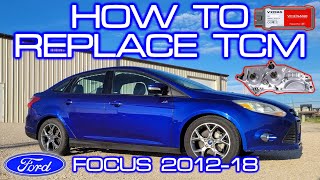
Typical fix: Replace the Transmission Control Module. The new module must be programmed to the vehicle's VIN and undergo a clutch adaptive learning procedure. 🎬 Watch: TCM replacement and adaptive learning programming walkthrough
Est. part cost: $300-$900 - Wiring Harness or Connector Issues ⚪ Low Probability While less common than TCM failure, the main harness can be damaged. Wires can become brittle from heat near the engine and transmission, or get chafed from rubbing against components. Rodent damage is also a possibility.
How to confirm: Visually inspect the wiring harness leading to the TCM on the side of the transmission. Check for chafed wires, loose connections, or corrosion on the connector pins. Perform a continuity and resistance test on the CAN bus wires (often a twisted pair of wires) between the PCM and TCM connectors.
Typical fix: Repair the damaged section of the wiring harness or clean/replace the faulty connector. This can involve soldering and heat-shrinking wires.
Est. part cost: $20-$150 - Poor Battery Health or Ground Connection ⚪ Low Probability Low system voltage from a weak battery or a corroded ground strap can cause unpredictable communication errors between modules. The main chassis ground strap on the Focus, often located under the battery tray, is a known point for corrosion because it is often bolted to a painted surface from the factory.
How to confirm: Test the battery voltage; it should be above 12.4 volts with the engine off. Perform a load test on the battery. Inspect and clean the main battery terminals and the chassis ground connections, especially the one from the negative terminal to the chassis and the strap from the chassis to the transmission housing.
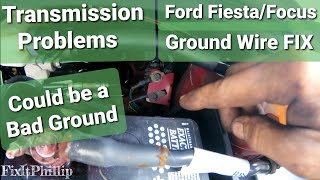
Typical fix: Recharge or replace the battery. Clean or replace corroded ground straps, ensuring a clean metal-to-metal connection by sanding away paint at the contact point. 🎬 See how to properly clean and fix ground connections
Est. part cost: $10-$250
Diagnosis Steps
- Scan all vehicle modules for Diagnostic Trouble Codes (DTCs). Prioritize codes U0100 and U0101.
- Check battery voltage and perform a load test. Ensure the battery is healthy (above 12.4V engine off) and terminals are clean.
- Inspect the main chassis and engine ground connections for corrosion or looseness. A critical ground point is located on the chassis frame rail, often under or near the battery tray.
- Locate the Transmission Control Module (TCM) on the side of the transmission case, under the airbox/battery. Visually inspect its two large connectors and the surrounding wiring harness for any signs of physical damage, melting, or corrosion.
- With a professional scan tool, perform a network test or attempt to communicate directly with the TCM. If the module is offline and does not respond, it has likely failed.
- If the TCM is offline, verify it is receiving power and has a good ground at its connector pins. Check for battery voltage at the power input pins and check for continuity to ground on the ground pins.
- If power and ground to the TCM are good, check the CAN bus network integrity. With the key off and the network asleep, measure the resistance between pins 6 and 14 of the OBD-II port. A reading of approximately 60 ohms indicates the network terminating resistors are intact.
- If all wiring, power, and grounds are confirmed to be good, and the TCM is unresponsive, the TCM is the faulty component and requires replacement.
Parts You'll Likely Need
- Transmission Control Module (TCM)
(OEM #AE8Z-7Z369-F)— This is the root cause of the U0100 code in the vast majority of cases for this vehicle due to a well-documented history of manufacturing and design flaws. The 'F' revision is considered the most updated version. Superseded part numbers include AE8Z-7Z369-B, AE8Z-7Z369-D, and AE8Z-7Z369-E.
Trusted brands: Motorcraft (OEM), Dorman (Remanufactured)
OEM price range: $600-$900
Aftermarket price range: $300-$500 (Remanufactured)
Related Codes That Often Appear With This One
- U0101 — This code means 'Lost Communication with TCM'. It is a more specific version of U0100 and almost always appears alongside it, confirming the issue is with the transmission module.
- P0606 — This code indicates an 'ECM/PCM Processor Fault'. When the TCM fails, it can cause communication disruptions that lead the main computer to report this internal error.
- U1013 — This code means 'Invalid Internal Control Module Monitoring Data Received' and is often stored when the TCM begins to fail and sends corrupt data before failing completely.
- P090C — This code relates to 'Clutch B Actuator Control Circuit Low'. A failing TCM often loses the ability to properly control the clutch actuators, triggering this code.
Technical Service Bulletins (TSBs) & Recalls
- TSB 16-0129: This bulletin supersedes a previous TSB and directly links symptoms like no-start, loss of power, and flashing PRNDL lights with DTCs U0100, U0101, U1013, and/or P0606. It provides the service procedure for diagnosing and replacing the TCM.
- TSB 16-0044: An earlier TSB that also addresses no-start, no engagement, or loss of power with DTCs U0100, U0101, U1013, U3003, and/or P0606, pointing to a TCM issue as the cause.
Platform-Specific Known Issues
- Ford Customer Satisfaction Program 14M02: Ford acknowledged the high failure rate of the DPS6 TCM and extended the warranty coverage to 10 years or 150,000 miles from the vehicle's warranty start date. For vehicles that exceeded those limits, a supplement to the program offered a one-time TCM replacement through June 30, 2025. Owners should always check with a Ford dealer with their VIN to verify eligibility, even if they believe they are outside the original limits.
- Owner Repair Story: TCM Failure and Warranty Claim: A user on the FocusFanatics forum (username 'E_g_b_e_r_t') described a classic failure scenario: their 2014 Focus intermittently failed to start and displayed a 'Transmission Fault' message. After multiple occurrences, the car eventually refused to start entirely. The dealer diagnosed a failed TCM and initially quoted a high repair cost. However, after the owner referenced the known TCM issues and warranty extensions, the dealer confirmed the vehicle was covered under the 14M02 program, and the TCM was replaced at no cost.
Mechanic-Grade Diagnostic Values
- CAN Bus Network Resistance — expected: ~60 Ohms. Failure: A reading of 120 Ohms indicates an open circuit or one of the two terminating resistors is offline. A reading significantly lower than 60 Ohms suggests a short between the CAN High and CAN Low wires.
- CAN Bus Voltage (Key On, Engine Off) — expected: CAN High (Pin 6): ~2.6V to 2.7V. CAN Low (Pin 14): ~2.4V to 2.3V.. Failure: Voltages that are identical, stuck at 0V, or stuck at battery voltage indicate a short to each other, ground, or power, respectively.
- TCM Clutch Touch Points (During Adaptive Learn) — expected: 10mm - 13mm. Failure: Values outside this range may indicate a failure of the adaptive learning process or a mechanical issue with the clutch actuators.
Hidden / Shadow Codes Worth Checking
- U3003-16: Battery Voltage - Circuit Voltage Below Threshold. This indicates the TCM or another module has detected system voltage that is too low to operate correctly, often pointing to a bad ground or failing alternator. (see via Often requires a dealer-level scanner like Ford IDS or a high-end professional scan tool. It may be stored in the BCM (Body Control Module) or other modules when the TCM goes offline.)
- U3003-17: Battery Voltage - Circuit Voltage Above Threshold. This indicates a voltage spike or over-voltage condition was detected. While less common, it can point to a faulty alternator voltage regulator. (see via Requires a dealer-level scanner like Ford IDS or a high-end professional scan tool.)
Scan Tool Commands That Help
- Ford IDS (or equivalent): TCM Adaptive Learning — This is a mandatory procedure after replacing the TCM. It allows the new module to learn the specific mechanical tolerances of the transmission's shift drums and clutch actuator touch points. Failure to perform this will result in harsh shifting, no shifting, or further DTCs.
- Ford IDS (or equivalent): Reset KAM (Keep Alive Memory) — This function should be used before performing the adaptive learning procedure. It clears all previously learned adaptive values from the module's memory, ensuring a clean slate for the new learning process.
- Ford IDS (or equivalent): Programmable Module Installation (PMI) — This is used when installing a brand new, blank TCM from Ford. It downloads the correct software and calibration for the vehicle's specific VIN into the new module.
Wiring & Ground Locations
- Main Battery Ground Point(s) — Located on the driver's side chassis frame rail, underneath the air filter box. On many Focus models, there are two separate ground wires bolted in this area.. This is the primary ground path for the vehicle's electrical system. From the factory, these points are often bolted directly onto a painted surface, leading to poor conductivity over time. A weak ground here can cause low voltage and communication errors across multiple modules, including the TCM.
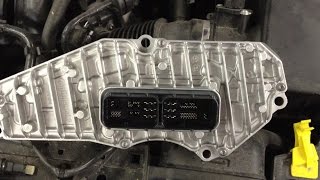
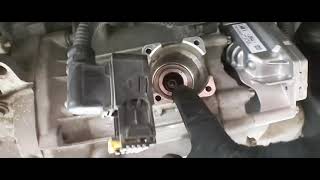
- TCM Connectors — The TCM has two large multi-pin connectors and is bolted to the front-facing side of the transmission case, accessible after removing the airbox.. These are the direct interface for power, ground, and CAN bus signals to the TCM. Checking for power and ground at these connectors is a critical step to confirm if the module has failed or if it's a wiring issue upstream.
- PCM Connector C175T — This is one of the main connectors at the Powertrain Control Module (PCM).. The CAN bus wires from the TCM eventually lead here. If you suspect a wiring break between the TCM and PCM, checking for continuity on the CAN lines between the TCM connector and connector C175T at the PCM is a valid diagnostic step.
Real Owner Repair Stories
- YouTube channel 'Ford Focus U0100 no communication problem DESTOYED by the ULTIMATE CANBUS tester' (Ford Focus, year not specified but within the affected generation.) — No communication with the engine computer (PCM/ECM), no-start condition.
❌ Tried (didn't work) Initial assumption was a failed PCM or a break in the CAN bus wiring.
✅ What actually fixed it The root cause was a corroded 15A fuse in the engine bay fuse box that supplied power to the PCM. Although the fuse was not blown, the corrosion caused a significant voltage drop (from 12V to ~10V) at the PCM power pin, which was insufficient for the module to power on and communicate. Cleaning the fuse terminals and reseating the fuse restored full voltage and fixed the problem. - Reddit user 'Indianb0y017' in r/FordFocus (Multiple Ford Focus vehicles with DPS6 transmission.) — Poor shifting quality, jerky behavior.
❌ Tried (didn't work) Relying on software updates alone.
✅ What actually fixed it Adding a supplementary ground wire (often called the 'ground mod') helped mitigate poor shifting performance. The user notes that this is not a cure-all, especially if the transmission seals are bad or the TCM is already failing, but it improves the consistency of shifts by providing a more stable ground for the control solenoids. - YouTube channel 'Phillips Vision' (2014 Ford Focus with 38,000 miles.) — Intermittent no-start, 'Transmission Fault' warning on the dash, delayed/harsh downshifts.
❌ Tried (didn't work) The video is a direct diagnosis.
✅ What actually fixed it The scan tool revealed codes for 'Internal VRAM failure of the TCM' and 'Loss of communication with the TCM'. The diagnosis was a definitive internal failure of the Transmission Control Module. The fix was to replace the TCM, which the video notes is covered under Ford's extended warranty program until 2025 for a one-time replacement.
"I Checked Everything" — The Actual Cause
- In one documented case, a no-communication fault (U0100) was caused by a corroded fuse supplying power to the PCM. A simple continuity test of the fuse would show it as 'good', and a visual inspection might miss the subtle corrosion on the terminals. The actual problem was a voltage drop across the corroded connection, preventing the module from receiving the stable 12V needed to operate. The fault was only found by measuring voltage directly at the module's power pin, which read low (~10V), and then tracing that circuit back to the fuse box.
OEM Part Supersession History
AE8Z-7Z369-B, AE8Z-7Z369-D, AE8Z-7Z369-E→AE8Z-7Z369-F— Internal design and component improvements to address the high failure rate from heat and vibration.
Heads up: A new OEM AE8Z-7Z369-F module is shipped blank and MUST be programmed to the vehicle using Ford's IDS software via the 'Programmable Module Installation' function. It is not a plug-and-play part.
Model Year Variations Within This Range
- 2012-2014 vs 2015-2018: The transmission calibration and the physical shims on the input shaft speed sensors are different between these year groups. 2012-2014 models use thicker shims (~3.5mm), while 2015-2018 models use thinner shims (~2.0mm). Installing a TCM or complete transmission from the wrong year range without reprogramming the TCM with the correct calibration to match the hardware will result in shifting problems.
Helpful Videos

We Have This Part in Stock




The information in this article is provided for general reference and educational purposes only. Vehicle specifications, procedures, and part compatibility can vary by production date, trim level, and region. Always consult your vehicle's factory service manual and verify part numbers before purchasing or performing repairs. Safety-critical components such as airbags, seat belts, and braking systems should be installed by a qualified professional.
- Ford FOCUS:
- 🎬 Helpful Videos
- 🛍️ Shop This Part
- What's Unique About the 2012-2016 Ford FOCUS
- Diagnostic Flowchart
- Symptoms You May Notice
- Most Likely Causes
- Diagnosis Steps
- Parts You'll Likely Need
- Related Codes That Often Appear With This One
- Technical Service Bulletins (TSBs) & Recalls
- Platform-Specific Known Issues
- Mechanic-Grade Diagnostic Values
- Hidden / Shadow Codes Worth Checking
- Scan Tool Commands That Help
- Wiring & Ground Locations
- Real Owner Repair Stories
- "I Checked Everything" — The Actual Cause
- OEM Part Supersession History
- Model Year Variations Within This Range
- 🎟️ Get 5% Off