

U0077 on 2011-2015 Chevrolet Camaro: Chassis Communication Bus Failure Causes and Fixes
Code U0077 on a 2011-2015 Camaro means there's a complete communication failure on the chassis network, disabling systems like StabiliTrak, ABS, and power steering. The most common cause is a damaged wiring harness on the passenger side of the engine bay, which melts from contact with aftermarket headers. The fix is usually repairing the wire, not replacing expensive modules. Diagnosis requires checking for 60 ohms of resistance between pins 12 and 13 of the OBD-II port.
- U0077 means a critical failure of the chassis communication network; do not drive the vehicle until it is repaired.
- The cause is almost always a wiring problem (chafed, melted, or corroded wire), not a bad computer module.
- If you have aftermarket headers, the first place to look for damage is the wiring harness near them.
- Diagnosis is complex and best left to a professional with experience in CAN bus diagnostics.
- Do not replace any modules until the wiring harness has been proven to be 100% intact.
What's Unique About the 2011-2015 Chevrolet CAMARO
On the 5th generation Camaro, code U0077 is frequently linked to wiring harness issues rather than module failure. A notable, platform-specific cause is the installation of aftermarket exhaust headers. The passenger-side engine wiring harness can sag or be improperly secured, allowing it to rest on the hot header tubes and melt the insulation, causing a short circuit. Multiple owners have documented this exact failure, making a visual inspection of the harness near the passenger-side exhaust manifold a critical first step that is not mentioned in generic repair guides.
Diagnostic Flowchart
Tap your situation to follow the diagnostic path that matches what you're seeing on this vehicle.
Symptoms You May Notice
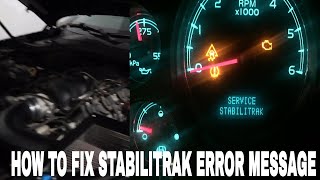
- "Service StabiliTrak" message on the instrument cl 🎬 Watch: How to troubleshoot the StabiliTrak error message.uster
- "Service Power Steering" message
- ABS and Traction Control warning lights illuminated
- Loss of power steering assist, making the wheel very hard to turn
- Speedometer and tachometer may stop working
- Vehicle may enter a 'limp mode' and not shift correctly
- Key may get stuck in the ignition intermittently
- Replacing the Electronic Brake Control Module (EBCM) without checking the wiring first.
- Replacing the Power Steering Control Module (PSCM) when the fault is in the harness.
- Replacing the Body Control Module (BCM) when it is not the source of the communication loss.
Most Likely Causes
- Damaged or Melted Wiring Harness 🔴 High Probability The routing of the main engine harness on the passenger side is very close to the exhaust manifold/headers. After installing aftermarket headers or other engine work, the harness can be left unsecured, allowing it to sag and make direct contact with a hot header tube, melting the wire insulation.
How to confirm: Visually inspect the main wiring harness on the passenger side of the engine bay, specifically where it runs near the #2 and #4 exhaust header primary tubes. Look for melted black plastic conduit, exposed copper wires, or signs of burning. This is a very common failure point documented by numerous owners.
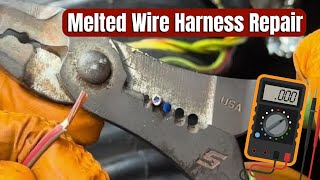
Typical fix: Carefully separate the melted wires, cut out the damaged sections, and splice in new wire using solder and heat shrink tubing. Protect the entire repaired section with high-temperature wire loom or heat-resistant wrap. 🎬 Watch: See how to repair and protect a melted harness. Secure the harness firmly away from the exhaust using high-temp zip ties.
Est. part cost: $15-$75 - Poor Ground Connection 🟡 Medium Probability Several key ground points on the chassis and engine block are known to become loose or corroded, causing intermittent electrical and communication issues.
How to confirm: Check the main ground points. Key locations include grounds on the back of each cylinder head, a small wire on the driver's side of the block, and a major ground strap on the passenger side block near the starter that is notoriously difficult to access and can be loose from the factory. Ensure they are clean, tight, and free of corrosion.
Typical fix: Disconnect the battery, then remove, clean the ground point and connector with a wire brush, and re-secure it tightly. Adding a supplementary ground strap is a common owner modification.
Est. part cost: $0-$20 - Low or Unstable Battery Voltage ⚪ Low Probability Like many modern cars, the Camaro is highly sensitive to battery voltage. A failing battery can cause numerous, seemingly unrelated electronic gremlins, including module communication dropouts during startup.
How to confirm: Test the battery voltage with the car off (should be ~12.6V) and running (should be 13.7-14.7V). A weak battery can cause modules to fail their startup communication sequence. Many owners report that strange electrical issues were solved simply by replacing an aging battery, even if it still started the car.
Typical fix: Charge or replace the vehicle's battery.
Est. part cost: $150-$300
Rare But Worth Checking
- Failed Control Module (EBCM, SDM, PSCM): This is a rare cause and is often misdiagnosed. A module should only be replaced after all wiring and network integrity tests have been performed and passed. A module can fail internally and short out the entire bus, which can be diagnosed by unplugging modules one by one.
- High Resistance in Communication Enable Circuit (5986): As described in TSBs for similar GM platforms like the Cadillac SRX, a problem in the 'wake-up' circuit from the BCM (often a purple wire) can prevent chassis modules from turning on, triggering U0077. This could occur due to corrosion under door sill plates or in a connector, and requires advanced electrical diagnosis to confirm.
Diagnosis Steps
- Scan for all DTCs in all modules. Note which modules are not communicating.
- Perform a thorough visual inspection of the passenger-side engine wiring harness, specifically looking for contact with the exhaust headers. Also check harnesses under the dash and door sill plates.
- Check and verify battery voltage and the integrity of major ground connections, especially the ones at the back of the cylinder heads and the main block ground near the starter.
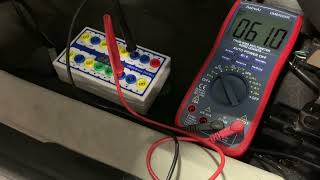
- Disconnect the battery. Using a multimeter, measure the resistance between Pin 12 (CAN Low, Tan/Black) and Pin 13 (CAN High, Tan) of the OBD-II port. A healthy chassis bus should read approximately 60 ohms. 🎬 Watch: A quick guide to testing CAN bus resistance.
- Interpret the resistance reading: A reading of ~120 ohms indicates an open circuit or a problem with one of the terminating resistors. A reading near 0 ohms indicates a short between the two wires.
- If the resistance is 120 ohms, the bus is open or one of the terminating modules is offline. The terminating resistors are in the EBCM and the SDM (Airbag Module). Unplug the EBCM; if the reading stays at 120 ohms, the break is in the wiring between the DLC and the EBCM. If the reading goes to OL (Open Loop), the EBCM resistor is good and the problem lies towards the SDM. This process helps isolate the location of the break.
- If the resistance is near 0 ohms (short circuit), unplug modules on the chassis bus (EBCM, PSCM, SDM) one by one. When the shorted module is unplugged, the bus resistance should jump to 120 ohms (the value of the single remaining terminating resistor). The module that was just unplugged is the one causing the short.
- If wiring, grounds, and resistance are all correct, the issue may be a faulty module that only fails when powered on. This requires a professional scan tool or oscilloscope to isolate the non-responsive module.
Parts You'll Likely Need
- Wiring Harness Repair Supplies — The most common cause is a damaged wire that needs to be spliced and repaired, not a part that needs replacement. This includes high-temp wire, solder, heat shrink, and high-temp wire loom.
Trusted brands: 3M, Delphi, DEI
Aftermarket price range: $15-$75 - Electronic Brake Control Module (EBCM)
(OEM #22932433, 20908753 (Varies by year/trim, VIN verification required))— In the rare event that the EBCM itself has failed and is causing the network to go down (either by not communicating or by shorting the bus internally), it will need to be replaced. This is a last resort after confirming all wiring is intact.
Trusted brands: ACDelco
OEM price range: $500-$800
Aftermarket price range: $300-$600 - Engine Wiring Harness
(OEM #22897085 (Example for 2013, VIN verification required))— If the harness is severely melted in multiple locations, a spot repair may not be feasible, and a complete harness replacement might be necessary.
Trusted brands: ACDelco
OEM price range: $300-$500
Related Codes That Often Appear With This One
- U0121 — This code means 'Lost Communication with Electronic Brake Control Module', which is one of the key modules on the chassis bus that goes offline when U0077 is set.
- U0131 — This code means 'Lost Communication with Power Steering Control Module'. Since the PSCM is on the chassis bus, its communication is lost when the bus goes down.
- U0126 — This code means 'Lost Communication With Steering Wheel Angle Sensor Module', another device on the chassis bus.
- U0151 — This code means 'Lost Communication with Inflatable Restraint Sensing and Diagnostic Module'. The SDM (Airbag Module) is a terminating module on the chassis bus, so its loss is common with U0077.
Technical Service Bulletins (TSBs) & Recalls
- PIT5076E: Advises technicians that when U0077 is present with other chassis codes, the primary diagnostic step is to investigate the Chassis CAN bus itself for faults.
Platform-Specific Known Issues
- The provided TSB #PIT5076E directly applies to the 2011-2015 Camaro and points to diagnosing the chassis bus for code U0077, especially when seen with other U-codes or symptom code 71 in the EBCM or PSCM.
Mechanic-Grade Diagnostic Values
- Chassis CAN Bus Resistance — expected: ~60 Ω between Pin 12 (Tan/Black) and Pin 13 (Tan) at the DLC with battery disconnected.. Failure: ~120 Ω indicates an open circuit or one missing terminating resistor. ~0 Ω indicates a short between the two CAN wires.
- GMLAN Voltage - Recessive State (Bus Idle) — expected: Both CAN High and CAN Low wires should be at approximately 2.5V.. Failure: Significant deviation from 2.5V on either line when the bus should be at rest.
- GMLAN Voltage - Dominant State (Transmitting Data) — expected: CAN High (Pin 13) rises to ~3.5V, and CAN Low (Pin 12) drops to ~1.5V.. Failure: Voltages not reaching these levels, or one line being stuck, indicates a bus fault (short to ground/power or faulty module).
Wiring & Ground Locations
- Chassis CAN at DLC — Pins 12 (Tan/Black wire) and 13 (Tan wire) on the OBD-II Data Link Connector (DLC) under the driver's side dash.. This is the primary access point for testing the entire Chassis Expansion Bus resistance and voltage without disassembly.
- EBCM Connector — On the Electronic Brake Control Module, located in the right front of the engine compartment.. The Chassis CAN wires (Tan/Black and Tan) terminate here. It is one of the two modules with a 120-ohm terminating resistor. Checking for signal/resistance at this connector helps isolate faults.
- SDM (Airbag Module) — Under the center console, bolted to the vehicle floor/transmission tunnel.. The SDM is the second terminating module on the Chassis CAN bus. A failure of this module or its wiring can take down the entire network. Its location is critical for advanced diagnostics.
- G103 — On the cowl at the left rear of the engine compartment, above the brake booster.. This ground serves the BCM, Instrument Panel Cluster (IPC), and the DLC itself. A poor connection here can cause widespread communication issues.
- G201 — Behind the left kick panel in the driver's footwell.. This is a major interior ground point. A loose or corroded G201 can cause various intermittent electrical faults within the cabin, potentially affecting modules on the bus.
- Engine Block Grounds — Small ground wires on the back of each cylinder head, and a larger ground strap on the passenger side of the block near the starter.. Poor engine-to-chassis grounds can create voltage differentials that disrupt sensitive module communications. These are frequently reported as being loose or corroded.
Real Owner Repair Stories
- CAMARO6 forum user (6th Gen Camaro (similar architecture, relevant issue)) — Multiple communication codes including U0077, ABS light, and loss of power steering assist.
❌ Tried (didn't work) Dealer had the car for over 30 days and could not diagnose the issue.
✅ What actually fixed it Owner found the wiring harness running to the BCM was touching the exhaust headers, burning a hole through the loom. Protecting the wires with heat wrap resolved most issues, and a full harness repair by Chevrolet was the final fix.
Model Year Variations Within This Range
- 2012: A specific software issue in the Sensing and Diagnostic Module (SDM) could cause the airbag warning light to illuminate. GM issued program #12070 to reprogram the SDM. While not directly causing U0077, a faulty SDM (which is a terminating module) can impact bus stability.
- 2015 vs 2014: The MyLink backup camera for 2015 models gained on-screen guidance lines, which were not present in 2014. The navigation option also saw a price reduction. These are infotainment changes and do not directly affect the U0077 diagnosis but note a refresh occurred.
Helpful Videos
Used OEM Parts in Stock


New Aftermarket Parts Available


The information in this article is provided for general reference and educational purposes only. Vehicle specifications, procedures, and part compatibility can vary by production date, trim level, and region. Always consult your vehicle's factory service manual and verify part numbers before purchasing or performing repairs. Safety-critical components such as airbags, seat belts, and braking systems should be installed by a qualified professional.
- Chevrolet CAMARO:
- 🎬 Helpful Videos
- 🛍️ Shop This Part
- What's Unique About the 2011-2015 Chevrolet CAMARO
- Diagnostic Flowchart
- Symptoms You May Notice
- Most Likely Causes
- Rare But Worth Checking
- Diagnosis Steps
- Parts You'll Likely Need
- Related Codes That Often Appear With This One
- Technical Service Bulletins (TSBs) & Recalls
- Platform-Specific Known Issues
- Mechanic-Grade Diagnostic Values
- Wiring & Ground Locations
- Real Owner Repair Stories
- Model Year Variations Within This Range
- 🎟️ Get 5% Off