

U0074 on 2011-2015 Chevrolet Volt: Chassis Bus Communication Failure Causes and Fixes
U0074 on a 2011-2015 Chevy Volt indicates a complete communication failure on the Chassis CAN Bus. This is a serious issue, often caused by wiring problems near the brake control module, a faulty control module, or connector corrosion. Diagnosis is complex and professional service is strongly recommended as it disables key safety systems.
- U0074 on a 2011-2015 Volt is a critical network failure on the Chassis CAN bus.
- Do not drive the vehicle, as essential safety systems like ABS, StabiliTrak, and power steering are likely disabled.
- The cause is most often a wiring/connector issue or a failed control module (like the EBCM or PSCM).
- Diagnosis is complex and should be performed by a qualified technician with the proper diagnostic tools.
- Always check the 12V auxiliary battery first, as low voltage can cause false communication codes.
What's Unique About the 2011-2015 Chevrolet VOLT
The Chevrolet Volt is a complex plug-in hybrid with multiple control modules that must constantly communicate. A network failure like U0074 can be particularly disruptive. The provided NHTSA Technical Service Bulletin (TSB) #PIT5076E specifically mentions that U0074 can appear alongside various chassis-related codes, pointing technicians directly to diagnose the Chassis bus, which is a known area for communication faults on this platform. The high-voltage systems add complexity, but this code typically relates to the conventional 12V-powered communication networks.
Diagnostic Flowchart
Tap your situation to follow the diagnostic path that matches what you're seeing on this vehicle.
Symptoms You May Notice
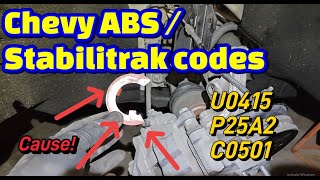
- Service StabiliTrak warning light 🎬 See how to fix common ABS and Stabilitrak warnings.
- Service Power Steering warning light or loss of power steering assist
- ABS warning light
- Check Engine Light
- Multiple other warning lights appearing simultaneously
- Vehicle may not start or may shut down while driving
- "Reduced Propulsion Power" message may appear
- Replacing individual sensors without diagnosing the network. Since multiple systems fail at once, it can be tempting to replace a wheel speed sensor or steering angle sensor, but these are symptoms of the network failure, not the cause.
Most Likely Causes
- Wiring Harness or Connector Fault 🔴 High Probability Wiring harnesses can be susceptible to chafing against the chassis or other components, and connectors can accumulate moisture and corrode over time, interrupting network signals. On similar GM platforms, the harness near the Electronic Brake Control Module (EBCM) is a common area for chafing and intermittent connection issues.
How to confirm: A technician will perform a detailed visual inspection of the Chassis CAN bus wiring. They will also use a multimeter to check for continuity, shorts to ground, and proper resistance (approximately 60 ohms) on the network. A wiggle test on the harness, especially near the EBCM, can reveal intermittent faults.
Typical fix: Repairing the damaged section of the wire or cleaning/replacing the corroded connector. Dielectric grease is often applied to protect the connection from future moisture intrusion.
Est. part cost: $10-$100 - Failed Control Module 🟡 Medium Probability Any module on the Chassis bus can fail internally and disrupt the entire network. The TSB specifically mentions the Electronic Brake Control Module (EBCM) and Power Steering Control Module (PSCM) as potential areas of concern. The EBCM is a common failure point on many GM vehicles that can bring down the bus.
How to confirm: This is an advanced diagnostic step. A technician will disconnect modules from the bus one by one. If communication is restored when a specific module is unplugged, that module is identified as the source of the fault.
Typical fix: Replacement of the failed module. Most control modules, such as the EBCM or BECM, must be programmed to the vehicle's VIN after installation.
Est. part cost: $300-$1500 - Poor Ground Connection ⚪ Low Probability Ground connections for control modules can become loose or corroded, leading to a wide range of unpredictable electrical issues, including network faults.
How to confirm: Inspect and test the main ground points for the modules on the Chassis bus. A voltage drop test can confirm a poor ground.
Typical fix: Cleaning the ground connection point and the terminal, then securely tightening it.
Est. part cost: $0-$5
Rare But Worth Checking
- Improperly Installed Aftermarket Accessories: If a remote starter, alarm, or audio system was spliced into the vehicle's wiring, it could interfere with CAN bus communication and trigger a U0074 code.
Diagnosis Steps
- Verify Battery Health: Ensure the 12V auxiliary battery is fully charged (above 12.4V) and terminals are clean. Low voltage can cause numerous communication errors.
- Scan All Modules: Use a professional scan tool capable of communicating with all vehicle modules (BCM, EBCM, PSCM, etc.). Note which modules are not responding.
- Prioritize U0074: As per GM guidance, communication codes like U0074 should be diagnosed before any other codes that may be symptoms of the network failure.
- Inspect Wiring and Connectors: Visually inspect the wiring harness for the Chassis CAN bus. Look for any signs of chafing, pinching, or corrosion, paying close attention to where the harness runs near sharp edges or moving parts, especially around the EBCM.
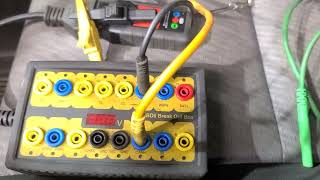
- Check Network Resistance: With the battery disconnected, measure the resistance between the two CAN bus wires (CAN High and CAN Low) at the OBD-II port or a known-good module. A healthy network should read approximately 60 ohms. A reading of 120 ohms indicates a break in the circuit or a missing termination resistor. A reading near 0 ohms indicates a short between the two wires.
- Check Network Voltage (Advanced): With the key on, a healthy high-speed CAN bus should show approximately 2.6V on CAN High and 2.4V on CAN Low relative to ground.
- Isolate Modules: If the resistance is incorrect or the fault is intermittent, disconnect modules on the Chassis bus one at a time and re-check resistance. When the reading returns to normal, the last module disconnected is likely the source of the fault.
- Perform a Wiggle Test: Gently wiggle the wiring harness and connectors for the Chassis bus, particularly near the EBCM, while monitoring the network status on a scan tool or an oscilloscope to find intermittent open circuits or shorts.
Parts You'll Likely Need
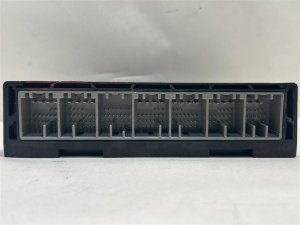
- Electronic Brake Control Module (EBCM) — The EBCM is a key module on the Chassis bus. A failure within this module can take the entire network down, as noted in TSB #PIT5076E. Part numbers are VIN-specific and must be matched carefully before ordering.
Trusted brands: ACDelco
OEM price range: $400-$800
Aftermarket price range: $250-$500 - Power Steering Control Module (PSCM) — Also a critical module on the Chassis bus mentioned in TSB #PIT5076E. Its failure can cause the U0074 code and a loss of power steering. Part numbers are VIN-specific.
Trusted brands: ACDelco
OEM price range: $300-$600
Aftermarket price range: $200-$450 - Wiring Harness Connector or Pigtail — If corrosion or damage is found at a specific connector, replacing the connector pigtail is often more effective than trying to repair individual pins.
Trusted brands: ACDelco
OEM price range: $40-$100
Aftermarket price range: $20-$60
Related Codes That Often Appear With This One
- U0077 — Another Chassis CAN bus communication code, often set with U0074.
- U0125 — Lost Communication With Yaw Rate Sensor Module.
- U0126 — Lost Communication With Steering Angle Sensor Module.
- C0186 — Lateral Accelerometer Circuit Malfunction.
- C0196 — Yaw Rate Circuit Malfunction.
Technical Service Bulletins (TSBs) & Recalls
- PIT5076E: Addresses multiple diagnostic trouble codes, including U0074, and directs technicians to diagnose the Chassis bus when these codes are set and will not clear.
Platform-Specific Known Issues
- TSB #PIT5076E points to the Chassis bus as the primary area to diagnose when U0074 is present, especially if accompanied by codes like U0077, U0125, U0126, C0186, C0196, or C0287.
- The 'Reduced Propulsion Power' message is a common warning on the Volt that can be triggered by a wide variety of issues. While often related to the high-voltage battery or EGR system, a severe electrical network fault like U0074 can also be a potential underlying cause, as it disrupts communication between critical powertrain modules.
Mechanic-Grade Diagnostic Values
- CAN Bus Network Resistance — expected: ~60 Ω across CAN High (Pin 6) and CAN Low (Pin 14) at the DLC with battery disconnected.. Failure: A reading of ~120 Ω indicates an open circuit or a missing terminating resistor. A reading near 0 Ω indicates a short between the CAN High and Low wires.
- CAN Bus Baud Rate — expected: 500 kbit/s. Failure: N/A - this is a configuration parameter for diagnostic tools.
- EBCM Ground Circuit Resistance — expected: Less than 10 Ω between the ground circuit terminal at the EBCM connector and a known-good chassis ground.. Failure: A reading of 10 Ω or greater indicates a poor ground connection that can cause communication issues.
Hidden / Shadow Codes Worth Checking
- U0074 00: The '00' is a symptom byte indicating a general 'Bus Off' state. GM uses these 2-digit hex codes to provide more specific fault information than the DTC alone. (see via A professional GM-specific scan tool like a Tech2 or software like GDS2 is required to view symptom bytes.)
Scan Tool Commands That Help
- GDS2 (GM Global Diagnostic System 2): Vehicle DTC Information — This is a primary step to query all possible control modules on the vehicle. It will generate a list of which modules are communicating and which are 'NOT COMMUNICATING', helping to isolate the source of the network failure.
- GDS2 / TIS2Web: Service Programming System (SPS) — Used to reprogram control modules like the EBCM or HPCM2. This may be necessary if the fault is caused by corrupted software or if a module is replaced. This is an advanced procedure requiring a subscription to GM's TIS2Web and a J2534 pass-thru device.
- GDS2: Clear Secured High Voltage DTCs — For some specific, persistent high-voltage related codes that can accompany network issues, this special function is required. However, it may not clear all faults, sometimes necessitating a full SPS reprogram.
Wiring & Ground Locations
- Chassis CAN Bus Terminating Resistors — High-speed CAN networks like the one for the chassis have two 120-ohm terminating resistors. One is typically integrated into a major control module (like the ECM). The second can be another module or a standalone resistor plugged into the harness, often at the opposite end of the vehicle (e.g., near the rear axle on some GM trucks).. If one of these resistors is missing or has failed, the total bus resistance will read 120 ohms instead of 60, causing signal reflections and communication failure (U0074).
- G103 — Located on the front of the left frame rail in the engine compartment.. This is a major ground point for several front-end modules. A poor connection here can cause various electrical faults, including communication issues.
- G202 — Located behind the right side of the dashboard.. This is a key interior ground point. The Body Control Module (BCM), which acts as a gateway between different CAN buses, is located under the right side of the dash and may use this ground.
- EBCM (Electronic Brake Control Module) Connector — The EBCM is located near the brake master cylinder in the engine compartment. Its main harness connector is a known point for corrosion and wiring strain.. As a primary module on the Chassis bus, any fault at the EBCM connector (corrosion, backed-out pin, chafed wire) can bring the entire network down, triggering U0074.
Real Owner Repair Stories
- YouTube channel 'Global Commerce CA' (2023 Chevrolet Silverado) — U0074, U0103, no communication with multiple modules, check engine light, radio not working, no reverse.
❌ Tried (didn't work) Initial scanning showed multiple lost communication codes.
✅ What actually fixed it The technician diagnosed the CAN bus and found 59 ohms instead of 120 ohms on one leg of the split bus, indicating a problem toward the engine computer. The root cause was a poor connection at a large wiring harness connector located under the passenger seat. Re-seating this single connector restored communication and resolved all issues. - Reddit user in r/volt (2017 Chevrolet Volt (Gen 2) with 94k miles) — 'Service StabiliTrak' message with ABS and check engine lights (a 'Christmas tree' of warnings).
❌ Tried (didn't work) Rebooting the vehicle did not clear the lights.
✅ What actually fixed it The codes pulled were P25A2 (Brake System Control Module Requested MIL Illumination) and C0501 (related to wheel speed sensor). The user correctly identified the likely cause as the well-known Gen 2 Volt issue where a broken 'anti-click' washer on the axle hub grinds into and destroys the wheel speed sensor. The fix is to remove the broken washer pieces and replace the damaged wheel speed sensor.
"I Checked Everything" — The Actual Cause
- In the context of network codes, the equivalent of a 'smoke test clean' scenario is when all wiring (resistance, shorts, opens) and connectors test perfectly, yet the code persists. In some cases for GM vehicles, the root cause is not hardware but corrupted module software. For a persistent high-voltage code on a Volt that would not clear with standard scan tool commands, the ultimate fix was to use the GM Service Programming System (SPS) to completely re-program the Hybrid Powertrain Control Module 2 (HPCM2).
When the Usual Fixes Don't Work
- While the most common causes for U0074 are physical wiring or module hardware failures, it's critical to not overlook software. In one documented case for a Chevy Volt with a persistent, non-clearing high-voltage system fault (P1FFF), the final solution was not replacing any parts, but re-flashing the Hybrid Powertrain Control Module 2 (HPCM2) using dealer-level software. This demonstrates that some communication-related faults can be stored 'securely' and can only be resolved by reprogramming the module, even if the underlying physical cause has been fixed.
OEM Part Supersession History
Varies by VIN→Varies by VIN— Control modules like the EBCM are frequently updated by the manufacturer to fix hardware vulnerabilities or software bugs.
Heads up: It is critical to use a VIN to look up the correct and most current part number. Using a part from another vehicle, even if it looks identical, may result in incompatibility. For example, on other GM vehicles, EBCM part numbers like 20842710 have been superseded multiple times to numbers like 22910018 and 23137198. Always verify the latest part number for the specific Volt being repaired.
Helpful Videos

We Have This Part in Stock



The information in this article is provided for general reference and educational purposes only. Vehicle specifications, procedures, and part compatibility can vary by production date, trim level, and region. Always consult your vehicle's factory service manual and verify part numbers before purchasing or performing repairs. Safety-critical components such as airbags, seat belts, and braking systems should be installed by a qualified professional.
- Chevrolet VOLT:
- 🎬 Helpful Videos
- 🛍️ Shop This Part
- What's Unique About the 2011-2015 Chevrolet VOLT
- Diagnostic Flowchart
- Symptoms You May Notice
- Most Likely Causes
- Rare But Worth Checking
- Diagnosis Steps
- Parts You'll Likely Need
- Related Codes That Often Appear With This One
- Technical Service Bulletins (TSBs) & Recalls
- Platform-Specific Known Issues
- Mechanic-Grade Diagnostic Values
- Hidden / Shadow Codes Worth Checking
- Scan Tool Commands That Help
- Wiring & Ground Locations
- Real Owner Repair Stories
- "I Checked Everything" — The Actual Cause
- When the Usual Fixes Don't Work
- OEM Part Supersession History
- 🎟️ Get 5% Off