

U0073 on 2006-2016 Mercedes-Benz: Control Module Communication Bus 'A' Off
This is a complex network error indicating a communication breakdown between essential computer modules. It is not a DIY-friendly fix. The cause is often a single faulty module (like the ABS or ECU), a wiring problem due to corrosion or damage, or a failing Central Gateway Module. Professional diagnosis with a Mercedes-specific scanner is required to isolate the fault.
- U0073 on a Mercedes-Benz indicates a severe network communication failure, not a problem with a single mechanical part.
- This is not a DIY repair. Diagnosis requires expensive, specialized tools and a deep understanding of automotive networks.
- The most common causes are a single bad computer module dragging the whole network down, or a wiring issue from corrosion (often caused by water leaks).
- Do not start replacing expensive modules like the ECU or TCU without a definitive diagnosis. The fault could be elsewhere.
- Ensure your battery is fully charged and healthy before beginning any diagnosis, as low voltage can cause this code.
What's Unique About the 2006-2016 Mercedes-Benz Various
Mercedes-Benz was a pioneer in using CAN bus systems in production vehicles, starting with the W140 S-Class in 1991. The 2006-2016 model years feature a complex architecture with multiple CAN buses (e.g., CAN B for interior, CAN C for engine/chassis) connected by a Central Gateway (CGW/ZGW) module. A failure on one bus can trigger a cascade of communication errors, making diagnosis complex. Water intrusion and subsequent corrosion at CAN bus distribution blocks (often located in footwells or under seats) are common failure points on many models from this era, like the E-Class (W211) and ML/GL-Class (X164). These distribution blocks, such as the X30/4 and X30/7 connectors in the passenger footwell, are notorious points of failure due to clogged sunroof or A/C drains.
Generation note: This range covers numerous Mercedes-Benz platforms like the W204 C-Class, W211/W212 E-Class, W221 S-Class, and X164 ML/GL-Class. While the fundamental cause is always a network failure, the specific modules on the bus and the common locations for wiring faults (e.g., water intrusion points, harness routing) can vary significantly between these different models and generations.
Symptoms You May Notice
- Vehicle will not start or cranks but does not fire
- Multiple warning lights on the instrument cluster, such as Check Engine, ABS, ESP, SRS/Airbag.
- Transmission is stuck in one gear or will not shift ('limp mode').
- Loss of power steering assist
- Instrument cluster gauges and displays behave erratically or go blank
- Inability to communicate with the vehicle's computers using a standard OBD-II scanner.
- Various electronic features suddenly stop working (e.g., wipers, turn signals, radio).
- Replacing the ECU or TCU without proper diagnosis. While these modules can be the cause, it's just as likely that another module on the network or a wiring issue is the true culprit. Unplugging modules one by one is a critical step.
Most Likely Causes
- Faulty Control Module 🔴 High Probability A single module (e.g., ABS, ECU, TCU, or even a less critical one like a door control module) can internally short and bring down the entire CAN bus network. The ABS/ESP module is a particularly common failure point.
How to confirm: Using a Mercedes-specific scan tool, a technician will identify which modules are not communicating. They will then physically disconnect suspect modules one by one. If communication is restored after disconnecting a specific module, that module is the culprit.
Typical fix: Replace the faulty control module. The new module will require programming/coding (SCN coding) to the vehicle with a specialized tool.
Est. part cost: $300-$2000+ - CAN Bus Wiring Damage or Corrosion 🔴 High Probability CAN bus wiring often runs under carpets and through areas susceptible to water intrusion (e.g., from clogged sunroof drains or cowl vents). Connectors and distribution blocks (like the X30/4 connector in the W211 passenger footwell) can corrode, causing high resistance or short circuits on the network.
How to confirm: Visual inspection of known problem areas for water damage, or green/blue corrosion on connector pins. A technician will use a multimeter and oscilloscope to test the resistance and signal integrity of the CAN high and CAN low wires at various points in the harness.
Typical fix: Repair the damaged section of the wiring harness and clean or replace corroded connectors. The source of any water leak must also be identified and repaired.
Est. part cost: $50-$500 - Faulty Central Gateway Module (CGW/ZGW) 🟡 Medium Probability The CGW is the central hub that connects the different CAN networks. Like any electronic module, it can fail internally, preventing communication between critical vehicle systems. It is also often located in areas prone to water damage, such as under the dash near the A-pillar.
How to confirm: This is typically a process of elimination. If all modules and wiring on the individual CAN buses check out, the CGW is the most likely remaining cause. Diagnosis requires a high-level scan tool to check communication with the gateway itself.
Typical fix: Replace and program the Central Gateway Module. A used module may require special tools to clone data from the old unit.
Est. part cost: $400-$900 - Low Battery Voltage or Faulty Alternator ⚪ Low Probability Mercedes-Benz vehicles from this era are highly sensitive to battery voltage. A weak or dying battery can cause numerous, seemingly unrelated electronic glitches and communication codes.
How to confirm: Test the battery's state of health and voltage (should be above 12.4V at rest). Test the alternator's output under load.
Typical fix: Charge or replace the battery. Replace the alternator if it is not charging correctly.
Est. part cost: $200-$800
Rare But Worth Checking
- Faulty Aftermarket Equipment: Poorly installed aftermarket alarms, remote starters, or audio equipment can interfere with the CAN bus network, causing communication errors.
Diagnosis Steps
- SAFETY FIRST: Disconnect the battery before inspecting or disconnecting any modules or wiring.
- Perform a full system scan with a Mercedes-Benz specific diagnostic tool (like XENTRY/DAS) to see which modules are reporting a fault and which are not communicating at all.
- Check and confirm battery voltage is stable and above 12.4V. Test the charging system.
- Inspect all fuses related to control modules.
- Locate the CAN bus distribution blocks (often in the driver or passenger footwell/kick panel, e.g., X30/4 on a W211). Visually inspect for any signs of water intrusion or corrosion (green crust).
- If a specific module is suspected, disconnect it from the network. Clear codes and see if communication with other modules is restored. If so, the disconnected module is faulty.
- If wiring is suspected, use a multimeter to check for 60 ohms of resistance across CAN High (Pin 6) and CAN Low (Pin 14) at the OBD-II port with the battery disconnected. This confirms the terminating resistors are intact.
- With the key on, use a multimeter to check for voltage on the CAN lines. CAN High should be ~2.7V and CAN Low should be ~2.3V. A short to ground or power will show incorrect voltages.
- Use an oscilloscope to check for a clean, mirror-image signal on the CAN High and CAN Low wires. This is the definitive way to diagnose network signal integrity issues.
- If all else fails, the Central Gateway Module (CGW) may be at fault.
Parts You'll Likely Need
- ABS Control Module
(OEM #A2115404445 / Bosch 0265109531 (Example for W211 E-Class))— The ABS module is a common failure point that can short the CAN bus. Its location in the engine bay exposes it to heat and vibration.
Trusted brands: Bosch, ATE
OEM price range: $800-$1500
Aftermarket price range: $400-$900 (remanufactured) - Central Gateway Module (CGW/ZGW)
(OEM #A2129004724 (Example for W212 E-Class))— As the network hub, its failure will cause a total communication loss. It is often the culprit if individual modules and wiring check out.
Trusted brands: Mercedes-Benz OE
OEM price range: $400-$900 - Engine Control Unit (ECU/ME) — Less common, but a failure of the main engine computer can certainly bring down the powertrain CAN bus.
Trusted brands: Bosch, Siemens
OEM price range: $1200-$2500
Aftermarket price range: $600-$1200 (remanufactured)
Related Codes That Often Appear With This One
- U0100 — Lost Communication With ECM/PCM
- U0121 — Lost Communication With Anti-Lock Brake System (ABS) Control Module
- U0101 — Lost Communication with TCM
- U0140 — Lost Communication With Body Control Module
Platform-Specific Known Issues
- Water intrusion into the passenger footwell is a primary cause. Clogged A/C evaporator drains or sunroof drains allow water to soak the carpet and corrode the CAN bus distribution block (X30/4) located there, taking the entire network down.
- The Rear SAM (Signal Acquisition Module) located in the trunk is susceptible to water damage from leaking trunk seals or tail light gaskets. A faulty Rear SAM can disrupt CAN bus communication and cause a host of electrical issues.
- Similar to other platforms, water leaks are a known problem. Additionally, the CAN distribution block located under the passenger seat is a common failure point due to moisture.
Mechanic-Grade Diagnostic Values
- CAN Bus Resistance (Battery Disconnected) — expected: ~60 Ω across CAN High and CAN Low (e.g., at OBD port pins 6 & 14).. Failure: A reading of ~120 Ω indicates one of the two terminating resistors is missing or the circuit to it is open. A reading near 0 Ω indicates a short between the CAN High and CAN Low wires.
- CAN Bus Voltage (Key On, Engine Off) — expected: CAN High: ~2.5V to 3.5V. CAN Low: ~1.5V to 2.5V. The two voltages should be mirror images and their sum should be approximately 5V.. Failure: Voltages that are stuck high (short to power), stuck low (short to ground), or not mirroring each other indicate a wiring fault or a module pulling the bus down.
- CAN Bus 'Sleep' Voltage (CAN B specific) — expected: On some sleeping networks (e.g., CAN B on a 230 chassis), CAN Low can read ~11V and CAN High ~0.025V.. Failure: If the bus does not enter this sleep state, it indicates a module is keeping the network 'awake', which can lead to battery drain.
Hidden / Shadow Codes Worth Checking
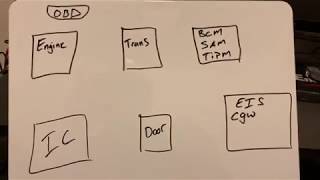
- N/A (Event-based, not a specific code): Mercedes-Benz does not typically use hexadecimal 'shadow codes'. Instead, the dealer-level Xentry/DAS system displays a network topology map (a visual layout of all modules). When a U0073 fault occurs, Xentry will show which specific modules are 'Not Present' or have 'No Communication', allowing a technician to see exactly which nodes are offline, which is far more descriptive than the generic U-code alone. (see via Mercedes-Benz Xentry/DAS diagnostic system.)
Scan Tool Commands That Help
- Xentry/DAS: Initial Quick Test & Network Topology View — This is the first step. It scans all modules and presents a visual map of the CAN network, immediately highlighting which modules are not communicating and logging U-codes.
- Xentry/DAS: SCN (Software Calibration Number) Coding — This is required after installing a *new* control module (ECU, CGW, ABS, etc.). It downloads vehicle-specific software from Mercedes servers and 'marries' the new module to the car's VIN and equipment list.
- Bench Programming Tools (e.g., K-TAG, Autel IM608) or Cloning Services: Module Cloning / Virginizing — When installing a *used* module. Dealers typically cannot program a used module. Cloning reads all data (VIN, mileage, keys) from the old module and writes it to the used replacement. Virginizing wipes the used module clean so it can be treated like a new one for SCN coding.
Wiring & Ground Locations
- X30/4 — On W211 E-Class, this CAN B distribution block is located in the right passenger footwell, under the carpet/kick panel.. This is a notorious failure point for water damage from clogged A/C drains or sunroofs. Corrosion on this connector can take down the entire CAN B network, causing widespread communication faults.
- X30/5 — On W211 E-Class, this CAN C (powertrain) distribution block is located in the driver's side rocker panel wiring trough.. As the junction for the critical CAN C bus, any corrosion or loose connection here will directly cause a U0073 code and likely a no-start or limp mode condition.
- W15/4 (example) — Mercedes designates ground points with a 'W'. For example, on a W204, there are major ground points in the trunk near the Rear SAM, in the engine bay on the chassis rails, and under the footwell carpets.. A corroded or loose main ground for a control module can cause it to malfunction and disrupt CAN bus communications. All solid brown wires in a Mercedes harness are ground wires.
Real Owner Repair Stories
- MBWorld.org Forums (Mercedes S211 (E-Class Wagon)) — Flashing right front light, SRS and battery warnings in cluster, radio and upper control panel flashing and going out, multiple CAN errors in Xentry.
❌ Tried (didn't work) Unplugging and replugging connectors seemed to have no effect.
✅ What actually fixed it The root cause was corrosion in the CAN B distribution block (X30/4) located in the passenger footwell. Cleaning the corroded pins and connectors restored network communication. - YouTube Diagnosis by Master Tech Lou (2009 Mercedes-Benz GL320 CDI) — Multiple random electronic issues, numerous 'no communication' faults across various modules.
❌ Tried (didn't work) Simply clearing codes was ineffective as they returned immediately.
✅ What actually fixed it The technician systematically unplugged each module from the CAN distribution block one by one while monitoring the network with a scanner. When one specific module was plugged in, the entire network crashed. When it was unplugged, communication was restored to all other modules. This identified the single faulty module that was pulling down the bus. - MBWorld.org Forums (2007 Mercedes S600) — CAN bus communication code, 'No CAN Message Was Received From Control Unit N47-5(ESP Control Unit)'.
❌ Tried (didn't work) Initial scan pointed to the ESP module.
✅ What actually fixed it A resistance measurement between the CAN pins at the ESP module read 122 Ohms instead of the correct 60 Ohms. This confirmed the diagnostic path: the fault was not the ESP module itself, but a break in the CAN wiring or a failure of the other terminating resistor on the network. The fix is to trace the wiring to find the open circuit.
"I Checked Everything" — The Actual Cause
- For network codes like U0073, the equivalent of a 'smoke test clean' scenario is when multimeter tests for resistance (60 Ohms) and basic voltage appear normal, yet the fault persists. The actual cause is often a module that is corrupting the data packets, not causing a hard electrical short. This can only be seen with an oscilloscope, which will show a 'noisy' or distorted square wave pattern instead of a clean, mirrored signal. The multimeter averages the voltage and misses these high-speed signal integrity issues.
Model Year Variations Within This Range
- 2012-2016: Programming used modules became significantly more difficult. On earlier models (e.g., 2009), a used ABS/ESP module could sometimes be reprogrammed with the factory tool. On later models (e.g., 2013), the used modules are often 'locked' to the original VIN and cannot be reprogrammed by a dealer or even some mobile specialists with factory tools, necessitating either a new part or specialized cloning/virginizing services.
- Post-facelift models (e.g., W212 vs W211): The network topology became more complex, incorporating additional sub-networks like CAN E1 and CAN E2. This means more potential points of failure and a more complex diagnostic tree. A tool that can display the full network topology becomes even more critical.
Diagnostic Flowchart
Other Known Issues on This Vehicle
Issues unrelated to this code that are worth knowing about as an owner of this generation:
- M272/M273 Engine Balance Shaft/Idler Gear Wear 🔴 High — Common on V6 (M272) and V8 (M273) engines from approximately 2004-2008. The balance shaft gear (V6) or idler gear (V8) was made of a softer metal that wears prematurely, typically between 60,000 and 120,000 miles, causing timing deviations. (Ref: A class-action lawsuit resulted in an extended warranty (10 years/125,000 miles) for affected vehicles within specific engine serial number ranges, but this has since expired. Repair requires engine-out service to replace with updated, hardened gears.)
- OM642 V6 Diesel Oil Cooler Seal Leak 🔴 High — Extremely common on OM642 engines found in E-Class, ML-Class, GL-Class, and Sprinter models. The original Viton seals for the oil cooler, located in the 'V' of the engine, degrade from heat cycles and leak oil into the valley. This often manifests as an oil smell and drips from the rear of the engine, frequently misdiagnosed as a rear main seal leak. (Ref: No recall, but updated purple seals made of a more durable material are used for the repair. The repair is very labor-intensive, requiring removal of the intake manifold, fuel system components, and turbocharger.)
- Sensotronic Brake Control (SBC) Pump Failure 🔴 High — Affects models equipped with SBC, primarily the W211 E-Class (up to 2006) and R230 SL-Class. The SBC pump has an internal counter that deactivates the unit after a pre-set number of brake actuations, triggering a red 'Brake Defective' warning. (Ref: Mercedes-Benz extended the warranty on the SBC hydraulic unit to 25 years with unlimited mileage. If the unit fails or reaches its service life, it is replaced for free by dealers.)
- Airmatic Suspension Failure 🟠 Medium — Common on models equipped with Airmatic suspension, such as the E-Class, S-Class, CLS-Class, and ML/GL-Class. The rubber air springs/struts develop leaks over time, causing the vehicle to sag, usually at one corner. The air compressor can also fail from being overworked trying to compensate for leaks.
Used vs. New Parts: Buying Guide for This Vehicle
When a used part is the smart pick: A used part is a viable, cost-effective option for modules like the Central Gateway (CGW/ZGW) or Engine Control Unit (ECU) IF you use a 'cloning' service. This service copies the VIN, mileage, and security data from your old, faulty module to the used donor module, making it plug-and-play. This avoids the need for expensive dealer programming.
Donor-vehicle mileage cap: roughly under 150000 miles for the part to have meaningful remaining life.
What to inspect on the donor part:
- Part numbers MUST match exactly. Do not assume a part from a different model year or engine will work, even if it looks identical.
- Physically inspect the connector pins on the donor module for any signs of green or white corrosion, which indicates water damage.
- Source parts from dry climates if possible to minimize the risk of pre-existing corrosion issues.
OEM-only on this vehicle (don't cheap out):
- While not strictly 'OEM-only', any NEW module (ECU, CGW, ABS, SAM) will require programming with a Mercedes-Benz Xentry system with an active online connection for SCN coding. You cannot install a new module without access to this dealer-level capability.
Aftermarket brands forum-validated for this vehicle:
- For control modules, there are no 'aftermarket' brands. You buy OEM (new) or used OEM. However, for diagnostic tools capable of some programming, brands like Autel (IM608) and Launch (X431 series) are frequently cited by independent shops and advanced DIYers.
- For cloning services, companies like Velectronix, Karman Auto, and ECU Connection are mentioned in forums and videos.
Brands owners have reported issues with on this vehicle:
- Avoid any used module from a seller who cannot guarantee the exact part number match. Avoid any service that promises to 'reprogram' a used module without either cloning the old one or making it 'virgin' first.
Real Owner Stories
Aggregated from forums and TSBs cited above. Mileages and costs reflect what owners reported in those sources.
W211 E-Class
Symptoms: Intermittent no-start and various CAN errors.
What fixed it: Cleaning corrosion from the Central Gateway Module (ZGW) located under the dash, which was caused by a water leak from the sunroof drains.
Source hint: PeachParts Mercedes-Benz Forum thread titled 'W211 CAN Bus problems'
W211 E-Class
Symptoms: Multiple simultaneous system failures including SRS and wipers being down.
What fixed it: Addressing water intrusion in the passenger footwell and cleaning corrosion on the CAN distributors.
Source hint: MBWorld.org Forums thread titled 'W211 Canbus Issue, SRS, Wiper down'
2004-2008 M272/M273 Engine Models — ~90000 miles
Symptoms: Timing deviations and engine performance issues (often occurring alongside electronic glitches in these model years).
What fixed it: Replacement of the balance shaft gear (V6) or idler gear (V8) due to premature wear of the soft metal.
Source hint: Known issues section regarding M272/M273 Engine Balance Shaft/Idler Gear Wear
Related OBD-II Codes
Frequently Asked Questions
My W211 E-Class has multiple warning lights and won't start; could this be related to the sunroof?
Is there an extended warranty for the braking system issues often mentioned alongside these electronic faults?
Can a weak battery really cause my Mercedes to throw communication codes like U0073?
I have a W204 C-Class with trunk leaks; could this cause the U0073 code?
Where is the CAN distribution block located on an X164 GL-Class?
Helpful Videos

We Have This Part in Stock



The information in this article is provided for general reference and educational purposes only. Vehicle specifications, procedures, and part compatibility can vary by production date, trim level, and region. Always consult your vehicle's factory service manual and verify part numbers before purchasing or performing repairs. Safety-critical components such as airbags, seat belts, and braking systems should be installed by a qualified professional.
- Mercedes-Benz Various:
- 🎬 Helpful Videos
- 🛍️ Shop This Part
- What's Unique About the 2006-2016 Mercedes-Benz Various
- Symptoms You May Notice
- Most Likely Causes
- Rare But Worth Checking
- Diagnosis Steps
- Parts You'll Likely Need
- Related Codes That Often Appear With This One
- Platform-Specific Known Issues
- Mechanic-Grade Diagnostic Values
- Hidden / Shadow Codes Worth Checking
- Scan Tool Commands That Help
- Wiring & Ground Locations
- Real Owner Repair Stories
- "I Checked Everything" — The Actual Cause
- Model Year Variations Within This Range
- Diagnostic Flowchart
- Other Known Issues on This Vehicle
- Used vs. New Parts: Buying Guide for This Vehicle
- Real Owner Stories
- W211 E-Class
- W211 E-Class
- 2004-2008 M272/M273 Engine Models — ~90000 miles
- Related OBD-II Codes
- Frequently Asked Questions
- 🎟️ Get 5% Off