

U0073 on 2007-2014 Chevrolet Suburban: Causes for Control Module Communication Bus 'A' Off
On a 2007-2014 Suburban, code U0073 indicates a total loss of communication on the main vehicle network (CAN bus). This is often caused by a wiring issue, such as a broken ground wire on the engine block, a corroded connector, or chafed wires near the transmission. It can also be caused by a faulty termination resistor. It is rarely a bad computer module itself.
- U0073 on a 2007-2014 Suburban is a serious network communication failure, not a simple sensor issue.
- Before suspecting expensive computer modules, thoroughly inspect all wiring harnesses and ground connections, as this is the most likely cause.
- Symptoms like a non-shifting transmission make the vehicle unsafe to drive.
- Do not immediately replace the Body Control Module (BCM) if it's not communicating; a wiring fault is a very common underlying cause.
- Diagnosis is complex and often requires professional tools to avoid replacing unnecessary parts.
What's Unique About the 2007-2014 Chevrolet SUBURBAN

The 2007-2014 Suburban and its GMT900 siblings (Tahoe, Silverado, Sierra) are known for developing network communication problems, as documented in GM Technical Service Bulletins. These issues are frequently traced back to intermittent shorts or opens in the wiring harness, often due to vibration, chafing, or corrosion at ground points on the engine block. Specific problem areas include the harness rubbing on the transmission auxiliary fluid pump cooling fins or above the transfer case. A specific TSB notes that an intermittent short can cause the Body Control Module (BCM) to go offline for an entire ignition cycle, leading mechanics to mistakenly replace the BCM when the real fault is in the wiring.
Diagnostic Flowchart

Tap your situation to follow the diagnostic path that matches what you're seeing on this vehicle.
Symptoms You May Notice
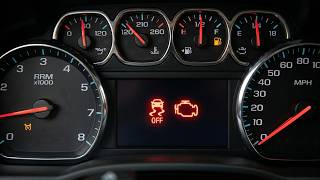
- Multiple warning lights on the instrument panel (Check Engine, ABS, Stabilitrak).
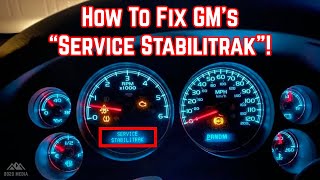
- "Service Stabilitrak" or similar messages on the Driver Information Center (DIC).
- Transmission may not shift or may be stuck in one gear (often 2nd gear).
- Instrument panel gauges fluctuating wildly or going dead.
- Intermittent door lock cycling and chime sounds.
- Engine may stall or fail to start.
- Loss of power features like windows or cruise control.
- Scan tool cannot communicate with one or more modules.
- Replacing the Body Control Module (BCM) without confirming a wiring fault. A GM TSB specifically warns that an intermittent wiring short can make a good BCM appear to be offline, leading to unnecessary replacement.
- Replacing the Transmission Control Module (TCM) when the actual fault is a poor connection or backed-out terminal in the 16-pin transmission harness connector.
Most Likely Causes

- Damaged or Corroded Wiring Harness 🔴 High Probability Vibration, heat, and exposure to the elements can cause the CAN bus wires to chafe, break, or corrode. TSBs point to specific problem areas like the harness near the transmission connector, above the transfer case, and near engine harness clips.
How to confirm: Visually inspect the main wiring harnesses, particularly around the driver's side of the engine, over the valve cover, down to the transmission, and above the transfer case. Look for any signs of rubbing, pinching, or corrosion. Wiggle the harness while the engine is running to see if symptoms can be reproduced.
Typical fix: Repair the specific damaged section of wire. This involves cutting out the bad section, splicing in a new piece of wire, and protecting it with heat shrink tubing.
Est. part cost: $5-$20 - Poor Ground Connection 🔴 High Probability Ground points on the engine block and chassis are susceptible to corrosion and loosening over time. A bad ground for a control module can disrupt the entire network. A known issue is undercoating material getting between the ground eyelet and the frame at point G300.
How to confirm: Locate the main engine and body ground points (e.g., G102, G300). A common problem area is the ground stud on the front of the driver's side of the engine block. Remove the ground nuts, clean all contact surfaces to bare metal, and re-secure them tightly.
Typical fix: Clean and tighten the ground connections.
Est. part cost: $0-$5 - Low Battery Voltage or Failing Alternator 🟡 Medium Probability
How to confirm: Test the battery voltage with the vehicle off; it should be at least 12.4V. With the engine running, check the alternator output; it should be between 13.8V and 14.5V. A weak battery or failing alternator can cause modules to drop off the network, especially during startup.
Typical fix: Charge or replace the battery. Replace the alternator if it is not charging correctly.
Est. part cost: $150-$400 - Faulty Control Module ⚪ Low Probability
How to confirm: This is a process of elimination. If the wiring, grounds, and power supply are all confirmed to be good, a single module may be internally shorted and pulling the network down. A professional would disconnect modules one by one from the CAN bus to see if communication is restored.
Typical fix: Replace the faulty module (e.g., BCM, TCM, ABS module). This often requires programming by a dealer or qualified shop.
Est. part cost: $300-$1000+
Rare But Worth Checking
- Faulty Aftermarket Electronics: Improperly installed remote starters, alarms, or trailer brake controllers can interfere with the CAN bus network and cause communication errors. If you have recently installed any aftermarket electronics, try disconnecting them to see if the problem resolves.
- Faulty CAN Bus Termination Resistor: The CAN bus has two 120-ohm termination resistors. One is typically inside the ECM, and the other is a separate, plug-in component in the harness, often located near the rear of the vehicle by the chassis control module or fuel pump control module. If one of these resistors fails (goes open or shorts), the total bus resistance will be incorrect (120 ohms instead of 60), causing communication to fail.
Diagnosis Steps
- Check the battery and charging system to ensure proper voltage (12.4V+ off, 13.8-14.5V running).
- Perform a full visual inspection of the main wiring harnesses, focusing on areas near the engine, firewall, under the driver's side dash, and especially the harness routing to the transmission and over the transfer case for any signs of damage, corrosion, or chafing.
- Locate, disassemble, clean, and tighten all major ground connections, especially the main engine-to-chassis grounds (G102, G300).
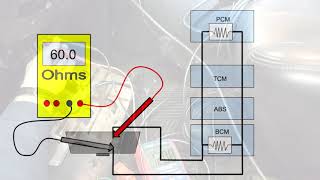
- Using a multimeter, check for CAN bus integrity at the OBD-II port. With the battery disconnected, measure the resistance between Pin 6 (CAN High) and Pin 14 (CAN Low). You should measure approximately 60 ohms. A reading of 120 ohms indicates an open circuit or a missing/failed termination resistor, while a reading near 0 ohms indicates a short circuit.
- If an advanced scan tool is available, perform a network test to see which modules are not communicating.
- If a wiring fault is suspected but not visible, carefully wiggle sections of the harness with the vehicle running to try and trigger the fault.
- Inspect the 16-pin transmission harness connector for any backed-out terminals, corrosion, or fluid intrusion.
- If all wiring and connections are good, the issue may be a single faulty module, which requires professional diagnosis to isolate.
Parts You'll Likely Need
- Wiring Repair Supplies — The most common cause is a break or short in the CAN bus wiring that needs to be repaired.
Trusted brands: 3M
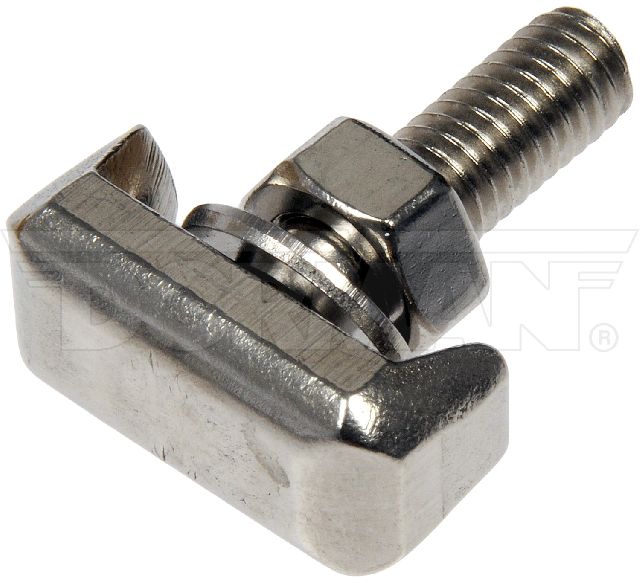
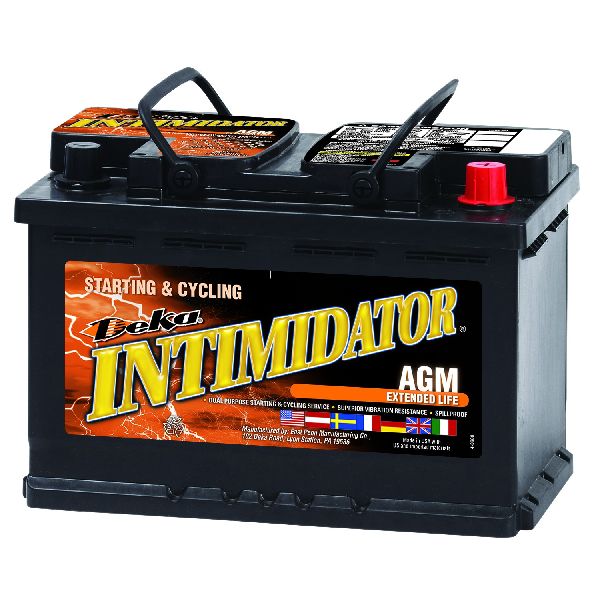
Aftermarket price range: $5-$20 - Battery — A weak or failing battery can cause low voltage, leading to module communication dropouts.
Trusted brands: ACDelco
OEM price range: $200-$300
Aftermarket price range: $150-$250 - CAN Bus Termination Resistor
(OEM #Varies, may be part of a harness.)— If the external termination resistor fails, it will disrupt the entire network, causing a U0073 code.
Trusted brands: ACDelco, Dorman
OEM price range: $25-$75
Aftermarket price range: $15-$50
Related Codes That Often Appear With This One
- U0100 — Lost Communication with ECM/PCM
- U0101 — Lost Communication with TCM
- U0102 — Lost Communication with Transfer Case Control Module
- U0121 — Lost Communication With Anti-Lock Brake System (ABS) Control Module
- U0140 — Lost Communication With Body Control Module
Technical Service Bulletins (TSBs) & Recalls
- Bulletin #08-07-30-021H: Mentions U0073 with symptoms like gauge fluctuation, door lock cy
Platform-Specific Known Issues
- A GM Technical Service Bulletin (#08-07-30-021H) directly addresses this code and its symptoms, pointing towards intermittent opens/shorts in the GMLAN communication circuits as a primary cause. It specifically mentions checking for backed-out terminals in the transmission harness connector.
- Another TSB (#PIT4730B) warns that an intermittent short in the CAN bus wiring can cause the BCM to go offline, which can be misdiagnosed as a failed BCM. The BCM may not communicate again until the vehicle is shut off and the module powers down completely, which can take up to 20 minutes.
- A known chafe point is the chassis harness directly above the transfer case assembly, where an opening in the conduit can align with a boss on the transfer case and cut into the wiring.
Mechanic-Grade Diagnostic Values
- CAN Bus Voltage (Key On, Engine Off) — expected: Pin 6 (CAN High) to Ground: 2.5V to 3.0V. Pin 14 (CAN Low) to Ground: 2.0V to 2.5V.. Failure: A voltage of exactly 2.5V that does not fluctuate indicates a module is powered on but not broadcasting data. A voltage of 1.4V or less on either line can indicate a failed CAN port on a device.
- Module Internal CAN Port Resistance — expected: 28k - 50k ohms between the module's CAN High and CAN Low pins.. Failure: A reading outside this range, or a resistance measurement that is not open/megaohms from either CAN pin to the module's ground pin, indicates internal module damage.
- Global Power Reset — expected: Forces a full reboot of all control modules.. Failure: After a voltage spike event (like a jump start), modules can remain in a locked-up state even after the root cause is fixed. A global reset is required.
Hidden / Shadow Codes Worth Checking
- U0073 71: Control Module Communication Bus A Off - Invalid Serial Data Received. This points to data corruption on the high-speed bus. (see via GM Tech 2 or GDS2 scan tool.)
- U0073 72: Control Module Communication Bus A Off - Alive Counter Incorrect. This suggests a module is not sending its regular 'I am here' message correctly. (see via GM Tech 2 or GDS2 scan tool.)
Scan Tool Commands That Help
- GDS2 (Global Diagnostic System 2): Data Bus Diagnostic Tool — Use this function to actively poll the CAN bus and get a list of which specific modules are communicating and which are not, helping to narrow down the search for the fault.
- GDS2 / Tech2Win: Module Diagnostics > [Module Name] > Control Functions — After identifying a non-communicating module, you can attempt to access it directly. If accessible, using bidirectional controls (e.g., commanding lights on/off via the BCM) can confirm if the module is partially functional or completely offline.
Wiring & Ground Locations

- G103 — Located on the cowl in the left rear of the engine compartment, typically above the brake booster.. This is a critical ground point that serves the Body Control Module (BCM), Instrument Panel Cluster (IPC), and the Data Link Connector (DLC) itself. A poor connection here can cause widespread communication failure.
- G102 — Located at the left rear of the engine.. Grounds the ignition coils. While not directly on the data bus, electrical noise from a bad ground here can sometimes interfere with network communications.
- G300 — Located on the floor behind the driver's seat, near the B-pillar.. Grounds various driver-side controls. A TSB mentions that undercoating can get between the eyelet and frame at this location, causing an intermittent open.
- External Termination Resistor — On many GMT900 trucks, the second 120-ohm resistor is part of the chassis harness located near the rear bumper, often close to the Fuel Pump Control Module (FPCM) or Trailer Brake Control Module (TBCM).. If this resistor is missing or the wiring to it is damaged, the total bus resistance will read 120 ohms instead of the correct 60 ohms, causing communication to fail.
Real Owner Repair Stories
- Tahoe Yukon Forum user (2008 Suburban LTZ, 198k miles) — Service Stabilitrak message, rough idle, hard shifting.
❌ Tried (didn't work) Initial assumption of major failure.
✅ What actually fixed it The issue was caused by a loose spark plug wire on cylinder 1. Tightening the metal clip inside the plug wire boot to ensure a snug fit on the spark plug resolved the symptoms. An engine misfire can trigger Stabilitrak warnings by default. - Chevrolet Forum user (2007 Silverado, 194,000 miles) — Service Traction Control and Service Stabilitrak warnings, rough running, chugging at stops, and very hard shifting.
❌ Tried (didn't work) Worrying about thousands of dollars in transmission or computer repairs.
✅ What actually fixed it A full replacement of all spark plugs resolved all symptoms. The truck ran like new afterward. This highlights that engine performance issues are often the root cause of these electronic warnings.
"I Checked Everything" — The Actual Cause
- A common diagnostic dead-end occurs when all wiring visually appears intact. In these cases, a single module can be internally shorted, pulling the entire network down. A professional technique is to isolate the faulty module by measuring resistance at the DLC (which will read 120 ohms instead of 60). The technician then disconnects modules one by one until the 60-ohm reading is restored. A more advanced method involves creating a jumper harness to bypass a suspected module (like the Power Steering Control Module); if the network communication returns with the module bypassed, that module is confirmed to be the fault.
When the Usual Fixes Don't Work
- While U0073 is a network communication code, a significant number of owner-reported fixes for the primary symptoms (Service Stabilitrak, hard shifting, rough idle) do not involve CAN bus wiring repair. The most common alternative root cause is a simple engine misfire due to worn spark plugs or a bad spark plug wire. The vehicle's computer system is designed to disable traction and stability control as a safety precaution when a misfire is detected. Always check for basic engine maintenance issues before beginning complex and expensive network diagnostics.
Model Year Variations Within This Range
- 2007-2013 vs. 2014: The factory diagnostic software used by technicians differs. For 2007-2013 models, the primary tool is Tech2Win (a software version of the older Tech2 handheld). For 2014 models, GM transitioned to the GDS2 (Global Diagnostic System 2) software platform. While both can diagnose U0073, the interface and specific available tests may vary.
Helpful Videos

We Have This Part in Stock


The information in this article is provided for general reference and educational purposes only. Vehicle specifications, procedures, and part compatibility can vary by production date, trim level, and region. Always consult your vehicle's factory service manual and verify part numbers before purchasing or performing repairs. Safety-critical components such as airbags, seat belts, and braking systems should be installed by a qualified professional.
- Chevrolet SUBURBAN:
- 🎬 Helpful Videos
- 🛍️ Shop This Part
- What's Unique About the 2007-2014 Chevrolet SUBURBAN
- Diagnostic Flowchart
- Symptoms You May Notice
- Most Likely Causes
- Rare But Worth Checking
- Diagnosis Steps
- Parts You'll Likely Need
- Related Codes That Often Appear With This One
- Technical Service Bulletins (TSBs) & Recalls
- Platform-Specific Known Issues
- Mechanic-Grade Diagnostic Values
- Hidden / Shadow Codes Worth Checking
- Scan Tool Commands That Help
- Wiring & Ground Locations
- Real Owner Repair Stories
- "I Checked Everything" — The Actual Cause
- When the Usual Fixes Don't Work
- Model Year Variations Within This Range
- 🎟️ Get 5% Off