

U0073 on 2007-2010 Chevrolet Silverado 2500HD: Causes and Fixes for Communication Bus Failure
On a 2007-2010 Silverado 2500HD, code U0073 indicates a total communication failure on the main vehicle data network (GMLAN). The most common causes are wiring issues, such as chafing near the transmission or corrosion under the fuse block, or a poor ground connection at G107 or G218. The fix is often a wiring repair rather than an expensive module replacement, as detailed in GM TSB #08-07-30-021H.
- U0073 is a serious network failure; do not start by replacing expensive modules like the ECM or TCM.
- The most likely cause on this specific truck is a physical wiring problem (chafing) or a bad connection (corroded fuse block or ground).
- A full vehicle scan is essential. A flood of 'U' codes points to a network problem, not a single part failure.
- Checking CAN bus resistance at the OBD-II port is a critical diagnostic step that can quickly point you in the right direction.
- If the problem occurred immediately after a jump-start, the first part to check is the 175-amp mega fuse near the battery.
What's Unique About the 2007-2010 Chevrolet Silverado 2500HD
On the GMT900 platform, which includes the 2007-2010 Silverado, U0073 is frequently traced to specific, known weak points. A primary culprit is the main wiring harness chafing against brackets near the transmission bell housing or transfer case, a fault explicitly detailed in GM TSB #08-07-30-021H. Additionally, corrosion forming on the underside of the underhood fuse block (UBEC) is a well-documented failure point that can take the entire network down. These physical wiring and connection issues are far more common than an actual module failure, making a thorough inspection critical before replacing any expensive components.
Symptoms You May Notice
- Multiple warning lights on the dashboard (Check Engine, ABS, StabiliTrak, Airbag).
- "Service StabiliTrak" or "Service Trailer Brake System" message appears.
- Instrument panel gauges fluctuate wildly, go blank, or display dashes.
- Transmission shifts hard, gets stuck in one gear (limp mode), or does not shift at all.
- Engine has reduced power, runs rough, stalls, or will not start.
- Loss of power features like door locks or cruise control.
- Scan tool cannot communicate with multiple control modules.
- Door locks may cycle intermittently on their own.
- Replacing the Transmission Control Module (TCM) or Engine Control Module (ECM) without confirming the network wiring is intact. A U0073 code is a network-level fault, and replacing a single module rarely fixes it unless that specific module was diagnosed as the source of the short.
- Replacing the Body Control Module (BCM) because it is not communicating. The BCM can be a victim of the network being down, not the cause.
Most Likely Causes
- Damaged or Corroded Wiring Harness 🔴 High Probability GM Technical Service Bulletin #08-07-30-021H specifically calls out the harness chafing on brackets near the transmission bell housing or transfer case. Vibration and heat cause the insulation on the CAN bus wires (typically a twisted pair of Tan and Tan/Black wires) to wear through, shorting them to each other or to ground.
How to confirm: Visually and physically inspect the wiring harness, particularly where it runs along the driver's side frame rail and around the transmission. Look for worn-through conduit, exposed copper wires, or signs of rubbing. Also check the 16-pin transmission connector (X183) for terminals that have backed out.
Typical fix: Repair the damaged section of the wire harness. This involves cutting out the bad section, soldering in new wire, and protecting the repair with heat-shrink tubing. The harness should then be rerouted or secured with zip ties to prevent future chafing.
Est. part cost: $5-$25 - Corrosion in Underhood Fuse Block (UBEC) 🟡 Medium Probability The UBEC is susceptible to moisture intrusion from a poorly sealed cover, causing corrosion on the multi-pin connectors on its underside. This corrosion creates high resistance and disrupts the CAN bus signals passing through it.
How to confirm: Disconnect the battery, unbolt and lift the underhood fuse block. Inspect the large connectors (like X1) underneath for green or white corrosion, particularly on the pins for the CAN bus circuits.
Typical fix: Thoroughly clean the corroded pins and connectors using a small wire brush and electrical contact cleaner. Apply dielectric grease before reassembly to prevent future corrosion. In severe cases, the entire fuse block or corroded connector pigtails may need to be replaced.
Est. part cost: $10-$300 - Poor Ground Connection 🟡 Medium Probability GM trucks of this era are known for ground issues. Key grounds for the network, like G218 (under the driver's side dash/kick panel) and G107 (on the frame rail below the driver's door), can become loose or corroded, disrupting the stable voltage required by the modules. A specific service bulletin, PIT5405C, notes that the dash insulator mat can get trapped under the G218 ground, preventing a good connection.
How to confirm: Locate the relevant ground points. G218 is behind the driver's kick panel, bolted to the metal dash support. G107 is on the outside of the frame under the driver's door. Disassemble, clean all contact surfaces to bare metal with a wire brush or sandpaper, and re-secure them tightly.
Typical fix: Cleaning and tightening the ground connection. Ensure no carpet or plastic is trapped under the ground lug, a common issue with G218.
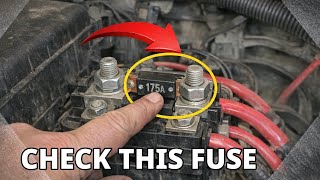
Est. part cost: $0-$5 - Blown 175-Amp Mega Fuse ⚪ Low Probability This is not a wear item but occurs after a specific event. An improper jump-start (reversed cables or voltage spike) can blow this main fuse (GM P/N 15305191), which is designed to protect all the vehicle's modules.
How to confirm: Locate the mega fuse at the battery distribution block on the positive terminal. Disconnect the battery and test the fuse for continuity with a multimeter. If there is no beep (open circuit), the fuse is blown.
Typical fix: Replace the 175A mega fuse. After replacement, perform a 'global power reset' by disconnecting both battery cables and touching the cable ends together for 60 seconds. This clears any logic lockups in the modules caused by the voltage event.
Est. part cost: $10-$20
Rare But Worth Checking
- Failed Control Module: While less common than wiring issues, any module on the network (EBCM, BCM, TCM, etc.) can fail internally and short the CAN bus. Diagnosis involves unplugging modules one by one while monitoring bus resistance to see if communication is restored. The EBCM (ABS module) is a common module to fail in this manner.
- Failed CAN Bus Termination Resistor: The network has two 120-ohm resistors. One is usually in the ECM. The second is often located in the rear harness near the spare tire and muffler, sometimes taped to the harness. If one fails or its wiring is damaged, the total network resistance will read 120 ohms instead of the correct 60 ohms at the OBD-II port.
- Aftermarket Electronics: Improperly installed remote starters, alarms, stereos, or trailer brake controllers can interfere with the CAN bus signals by being incorrectly tapped into the data wires, causing communication to drop.
Diagnosis Steps
- Check Battery and Charging System: Ensure battery voltage is above 12.4V and the charging system is working correctly. Low voltage can cause modules to drop offline.
- Perform a Full Vehicle DTC Scan: Use a scan tool that can read codes from all modules. A long list of 'U' codes from various modules confirms a network-wide issue.
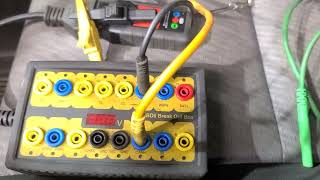
- Check CAN Bus Resistance: Disconnect the battery. Use a multimeter to measure the resistance between Pin 6 (CAN High) and Pin 14 (CAN Low) at the OBD-II port. A healthy network should read approximately 60 Ohms.
- Interpret Resistance Reading: If it reads ~120 Ohms, one of the two terminating resistors is missing from the circuit (likely due to a wiring break or a failed resistor near the spare tire). If it reads near 0 Ohms, the CAN High and Low wires are shorted together.
- Inspect Wiring Harnesses: Following TSB #08-07-30-021H, thoroughly inspect the harness for chafing, especially along the frame rail and near the transmission and transfer case.
- Inspect Connectors and Grounds: Check the main transmission connector (X183) for backed-out pins. Inspect and clean the underhood fuse block connectors and major ground points (G107 on the frame, G218 in the driver's kick panel).
- Isolate Modules: If resistance is incorrect and no wiring damage is found, begin unplugging modules on the high-speed CAN bus one by one (start with the EBCM/ABS module, then TCM) and re-check resistance at the OBD-II port after each one. When the resistance returns to 120 Ohms (or 60 Ohms if the bus was open), the last module unplugged is likely the one causing the short.
Parts You'll Likely Need
- Underhood Fuse Block / UBEC — Often needs replacement if the connectors on the underside are severely corroded beyond cleaning.
Trusted brands: ACDelco
OEM price range: $250-$400
Aftermarket price range: $150-$250 - Electronic Brake Control Module (EBCM) — This module is a common point of failure that can short the CAN bus internally, causing a U0073 code.
Trusted brands: ACDelco, Dorman
OEM price range: $400-$600
Aftermarket price range: $200-$400 - 175A Mega Fuse
(OEM #15305191)— This fuse can blow after an improper jump-start, disabling power to the vehicle's main modules and causing a communication failure.
Trusted brands: ACDelco, Littelfuse
OEM price range: $15-$25
Aftermarket price range: $8-$15
Related Codes That Often Appear With This One
- U0100 — Lost Communication with ECM/PCM. This is a direct result of the U0073 fault, as the entire network is down, preventing communication with the engine computer.
- U0101 — Lost Communication with TCM. This indicates the transmission module is offline, often leading to limp mode and hard shifting.
- U0121 — Lost Communication with ABS Control Module. The EBCM (ABS module) is a critical node on the high-speed CAN bus, and this code is very common alongside U0073.
- P0700 — Transmission Control System (MIL Request). This is a generic code set by the ECM when the TCM has detected a fault and requested the check engine light. It often appears with U0101 and U0073.
Technical Service Bulletins (TSBs) & Recalls
- 08-07-30-021H: This is the primary technical service bulletin for this issue. It covers 'Loss of High Speed GMLAN Communications' and lists symptoms like intermittent no-crank, gauge fluctuation, and the transmission not shifting. It directs technicians to inspect for chafed wiring near the transmission, backed-out terminals in connectors (specifically the 16-way transmission connector), and corrosion.
- PIT5405C: While not directly for U0073, this TSB addresses poor ground connections at G218, a known cause for various electrical and communication issues, including U0073. It notes that insulation from the carpet can get trapped under the ground terminal, causing a poor connection.
Platform-Specific Known Issues
- NHTSA Safety Recall 14V614 (GM #14515B) was issued for potential internal contamination in the Chassis Electronic Module on some GM vehicles, including 2007-2013 Silverados that may have been serviced with a faulty part. This could cause an electrical short, leading to stalling or a no-start condition.
Mechanic-Grade Diagnostic Values
- CAN Bus Network Resistance — expected: ~60 Ohms (measured between Pin 6 and Pin 14 of OBD-II port with battery disconnected). Failure: A reading of ~120 Ohms indicates an open circuit or a missing termination resistor. A reading near 0 Ohms indicates the CAN High and Low wires are shorted together.
- CAN High (GMLAN+) Voltage — expected: ~2.5V to ~3.5V (Key On, Engine Off). Failure: Voltage significantly outside this range indicates a fault on the line.
- CAN Low (GMLAN-) Voltage — expected: ~1.5V to ~2.5V (Key On, Engine Off). Failure: Voltage significantly outside this range indicates a fault on the line.
- CAN Bus Bias Voltage — expected: Both GMLAN High and Low circuits are biased to 2.5V.. Failure: When active, the High line toggles up to 3.5V and the Low line toggles down to 1.5V. A static or incorrect bias voltage points to a network fault.
Scan Tool Commands That Help
- Tech2/GDS2: Module Status / Class 2 Message Monitor — This function allows a technician to see which modules are actively communicating on the network and which are offline. It's a primary step to identify which modules have dropped off the bus, helping to narrow down the location of the fault.
- Tech2/GDS2: Data Bus Diagnostic Tool — As mentioned in TSB 08-07-30-021H, this tool (available in GDS2) assists in diagnosing high-speed LAN issues by providing guided diagnostics and checking the status of network circuits.
Wiring & Ground Locations
- G218 — Under the driver's side dash, behind the kick panel, bolted to the metal dash support structure.. This is a major ground point for several interior modules, including the Body Control Module (BCM). A poor connection here due to looseness or trapped carpet insulation (per TSB PIT5405C) is a very common cause of network failure.
- G107 — On the outside of the driver's side frame rail, typically below the driver's door area.. This is a primary chassis ground. Corrosion or looseness here can cause a host of electrical issues, including disrupting communication between modules grounded to the frame and those grounded elsewhere.
- CAN Bus Termination Resistor (External) — Often located in the rear wiring harness, near the spare tire and muffler area, sometimes simply taped to the harness loom.. The high-speed CAN bus requires two 120-Ohm resistors for proper operation. One is internal to the ECM. If this second, external resistor fails or its wiring is damaged, the total bus resistance will change from 60 ohms to 120 ohms, causing instability and the U0073 code.
- X183 Connector — The main 16-way electrical connector for the automatic transmission.. TSB 08-07-30-021H identifies this connector as a common failure point where terminals for the CAN bus wires can back out or corrode, causing the TCM to lose communication and bringing down the network.
Real Owner Repair Stories
- gm-trucks.com forum user (2008 GMC Sierra 2500HD (platform-mate)) — Transmission went into limp mode, gauges acted up, door locks cycled randomly. Scan tool could not communicate with ECM, TCM, ABS, and BCM after 30 seconds of the key being on. Multiple codes including U0073 and U0101.
❌ Tried (didn't work) Replacing the battery, Cleaning and bypassing the mega fuse, Resetting all connectors
✅ What actually fixed it The user found the wiring harness had chafed through on a bracket for the transfer case control module. The CAN bus wires were shorting to ground at that location. Repairing the wires and protecting the harness resolved all issues.
OEM Part Supersession History
84116252→15305191— Part number consolidation/update by GM.
Heads up: The parts are interchangeable. 15305191 is the current service part number for the 175-Amp Mega Fuse.
Model Year Variations Within This Range
- 2007-2009 vs 2010: While the fundamental causes of U0073 remain the same, there were minor wiring changes. For example, the MAP sensor wiring connector was altered for the 2010 model year on some engines. While not directly related to the main CAN bus fault, it's an example of subtle year-to-year changes that can complicate harness repairs or swaps.
Diagnostic Flowchart
Other Known Issues on This Vehicle
Issues unrelated to this code that are worth knowing about as an owner of this generation:
- Cracked Dashboard 🟠 Medium — Extremely common across all GMT900 models. Cracks typically form on the driver's side above the instrument cluster and/or on the passenger side around the airbag cover. This was the subject of several class-action lawsuits.
- Fuel Level Sensor Failure 🟠 Medium — Very common failure. The fuel gauge becomes erratic, gets stuck on empty or full, or reads inaccurately. This usually requires replacing the sending unit in the fuel tank. (Ref: Multiple TSBs exist for related fuel gauge issues.)
- 6.6L Duramax (LMM) Injector Failure 🔴 High — More common on higher mileage trucks (typically over 150,000 miles). Symptoms include white exhaust smoke at idle, rough running, hard starting, and fuel in the oil.
- 6.0L Vortec (LY6/L96) Broken Exhaust Manifold Bolts 🟡 Low — Common due to heat cycles. Results in an exhaust leak with a ticking noise that is most noticeable when the engine is cold.
- Inside Door Handles Breaking 🟡 Low — The plastic handles, particularly on the driver's side, are known to break from regular use.
- Leaking Transmission Cooler Lines 🟠 Medium — A known issue on models equipped with the Allison transmission, where the factory crimps on the flexible lines can leak.
Used vs. New Parts: Buying Guide for This Vehicle
When a used part is the smart pick: For components like the Underhood Fuse Block (UBEC) or a replacement wiring harness section, a used part from a reputable salvage yard can be a cost-effective solution, provided it is from a vehicle that did not suffer a front-end collision or flood damage.
Donor-vehicle mileage cap: roughly under 150000 miles for the part to have meaningful remaining life.
What to inspect on the donor part:
- For a UBEC, inspect the underside for any signs of green or white corrosion on the connector pins. A clean donor is critical.
- For a wiring harness, ensure the plastic conduit is intact and there are no signs of previous repairs, melting, or chafing.
- Verify the donor vehicle has the same engine and major options to ensure harness compatibility.
OEM-only on this vehicle (don't cheap out):
- Control Modules (ECM, BCM, EBCM): While used modules can be purchased, they often require professional programming with a GM Tech2 or GDS2 scan tool to match the vehicle's VIN and options. The cost of programming can negate the savings of a used part, and there's a risk the used module is also faulty. New or professionally remanufactured modules are a safer bet.
Aftermarket brands forum-validated for this vehicle:
- For fuse block connector pigtails, brands like Dorman often provide reliable repair solutions if only the connector end is corroded.
Brands owners have reported issues with on this vehicle:
- Be cautious with no-name, ultra-low-cost electronic modules from online marketplaces, as they often have high failure rates or can cause further communication issues.
Real Owner Stories
Aggregated from forums and TSBs cited above. Mileages and costs reflect what owners reported in those sources.
2008 Silverado
Symptoms: Full suite of communication codes and the vehicle entered limp mode.
What fixed it: Found and repaired a corroded connector on the frame rail located under the driver's seat.
Source hint: https://www.gm-trucks.com/forums/topic/150033-u0073-u0100-u0101-u0121-u0140-and-more-fixed/
2007.5 Silverado 2500HD
Symptoms: Multiple 'U' communication codes appearing simultaneously; detailed a frustrating diagnostic process.
What fixed it: Diagnostic process highlighted in the forum focused on identifying the common symptoms of the high-speed CAN bus fault.
Source hint: https://www.silveradosierra.com/electrical/u0073-u0100-u0101-u0121-u0140-t690010.html
2007-2010 Silverado (representative)
Symptoms: No-start condition and U0073 code immediately after washing the engine bay.
What fixed it: Traced to a sensor/connector near the spare tire, which is a common location for the CAN bus termination resistor.
Source hint: https://www.performancetrucks.net/forums/tuning-diagnostics-electronics-wiring-15/u0073-code-454519/
Related OBD-II Codes
Frequently Asked Questions
Does TSB 08-07-30-021H apply to my 2007-2010 Chevrolet Silverado 2500HD?
I have a 'Service StabiliTrak' message and my gauges are going blank; is this related to U0073?
Could a problem with my floor mats or carpet cause a U0073 code?
Is there a recall for electrical shorts that could cause my Silverado to stall?
Where should I look for wiring damage on my 2500HD to fix this code?
Why did my Silverado 2500HD throw a U0073 code after I jump-started it?
Helpful Videos
Used OEM Parts in Stock


New Aftermarket Parts Available

The information in this article is provided for general reference and educational purposes only. Vehicle specifications, procedures, and part compatibility can vary by production date, trim level, and region. Always consult your vehicle's factory service manual and verify part numbers before purchasing or performing repairs. Safety-critical components such as airbags, seat belts, and braking systems should be installed by a qualified professional.
- Chevrolet Silverado 2500HD:
- 🎬 Helpful Videos
- 🛍️ Shop This Part
- What's Unique About the 2007-2010 Chevrolet Silverado 2500HD
- Symptoms You May Notice
- Most Likely Causes
- Rare But Worth Checking
- Diagnosis Steps
- Parts You'll Likely Need
- Related Codes That Often Appear With This One
- Technical Service Bulletins (TSBs) & Recalls
- Platform-Specific Known Issues
- Mechanic-Grade Diagnostic Values
- Scan Tool Commands That Help
- Wiring & Ground Locations
- Real Owner Repair Stories
- OEM Part Supersession History
- Model Year Variations Within This Range
- Diagnostic Flowchart
- Other Known Issues on This Vehicle
- Used vs. New Parts: Buying Guide for This Vehicle
- Real Owner Stories
- 2008 Silverado
- 2007.5 Silverado 2500HD
- 2007-2010 Silverado (representative)
- Related OBD-II Codes
- Frequently Asked Questions
- 🎟️ Get 5% Off