

U0073 on 2015-2021 Chevrolet Silverado 1500: Causes and Fixes for Communication Loss
Code U0073 on a 2015-2021 Silverado means there's a major communication failure on the truck's internal network (CAN bus). This is often caused by a poor ground connection (specifically G218 under the dash), a chafed wiring harness near the parking brake or under the driver's seat, or a blown 175-amp mega fuse after a jump-start. The fix usually involves inspecting and repairing wiring or grounds, not replacing expensive modules.
- U0073 indicates a network-wide communication failure, not necessarily a single bad computer.
- Always start diagnosis with the basics: check the battery, fuses, and all major ground connections before suspecting complex issues.
- The most common causes are physical: corroded grounds or chafed/broken wires. A thorough visual inspection is critical.
- Due to the complexity of network diagnostics, this code is often best left to a professional technician to avoid costly misdiagnosis.
- Do not immediately replace expensive modules like the BCM or ECM; they are rarely the root cause of this specific code.
What's Unique About the 2015-2021 Chevrolet SILVERADO 1500

The 2015-2021 Silverado spans two distinct generations (K2XX and T1XX), both with complex electrical networks prone to this fault. A single point of failure can cause a cascade of communication codes, including U0073. TSB PIT5405B specifically identifies the BCM ground (G218) as a culprit, where a dash insulator mat gets trapped between the ground eyelet and the body, causing a poor connection. Other TSBs point to engine harness chafing against the transmission or bulkhead. The symptoms are often dramatic, such as gauges sweeping, the infotainment screen going blank, and multiple warning lights appearing at once, as documented in several GM Technical Service Bulletins. This is not typically a single failed part, but a failure of the network that connects them.
Diagnostic Flowchart

Tap your situation to follow the diagnostic path that matches what you're seeing on this vehicle.
Generation note: This range covers two Silverado 1500 generations: the 3rd Gen (K2XX, 2015-2018) and the 4th Gen (T1XX, 2019-2021). While the underlying cause is a network failure on both, specific wiring harness locations, ground points, and module designs differ. For example, TSB PIT5405B/C, which points to the G218 ground and starter cable issues, applies primarily to the K2XX generation. TSB 21-NA-149 and PIT5713A address engine harness chafing issues more common on the T1XX generation trucks.
Symptoms You May Notice

- Multiple warning lights on the dashboard (Check Engine, ABS, Traction Control, Airbag).
- Instrument panel gauges sweeping randomly or going dead.
- Infotainment screen, radio, and/or HVAC controls go blank or reset.
- Loss of power features like door locks or interior lights.
- Transmission may not shift correctly or may be locked in one gear.
- Engine may not start or may stall.
- Reduced engine power ('limp mode').
- "Service Stabilitrak" message appears.
- Replacing the Body Control Module (BCM) or Engine Control Module (ECM) without first thoroughly checking all grounds, power feeds, and the integrity of the CAN bus wiring harness. The issue is far more likely to be in the wiring than the module itself.
Most Likely Causes
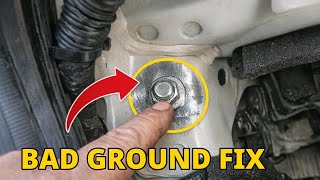
- Poor or Corroded Ground Connections 🔴 High Probability Frame and body grounds can corrode or loosen. TSB PIT5405B/C specifically calls out the BCM ground G218, located under the driver's side dash, where the dash insulator mat can get trapped under the ground terminal, preventing a good connection. On 2019+ models, GM has also flagged grounds G110 (body harness) and G114 (engine harness) as potential problem areas.
How to confirm: Visually inspect and physically check major ground points. For G218, remove the driver-side kick panel and look for the ground stud. Check for tightness and see if the black dash mat is underneath the metal eyelet. For other grounds, check for corrosion or looseness at the frame, engine block, and firewall.
Typical fix: For G218, remove the nut and ground eyelet, cut away the section of the dash insulator mat that is interfering, then reinstall the eyelet directly against the metal body stud and tighten the nut securely. For other grounds, clean contact surfaces with a wire brush until shiny, then re-secure tightly. Apply dielectric grease to prevent future corrosion.
Est. part cost: $0-$10 - Damaged or Chafed Wiring Harness 🔴 High Probability Wiring harnesses can rub against sharp metal edges. TSB 21-NA-149 (which supersedes multiple older bulletins) is critical for 2019+ T1XX trucks, detailing multiple chafe points: against the ECM bracket, the upper control arm, and the shock tower bolt. On K2XX trucks, common chafe points are near the parking brake mechanism and under the driver's seat carpet.
How to confirm: Visually inspect common chafe points identified in TSBs. A diagnostic test involves checking for 60 Ohms of resistance between Pin 6 and Pin 14 of the OBD-II port (with the battery disconnected). A reading of 120 Ohms indicates an open circuit, while near 0 Ohms means a short.
Typical fix: Repair the broken or shorted wires by soldering and protecting them with heat-shrink tubing. Reroute the harness and protect it with woven polyester electrical tape or by securing it with zip ties away from the contact point, as instructed in TSB 21-NA-149.
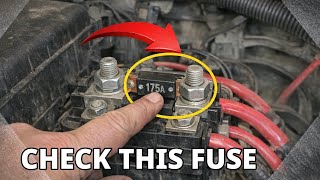
Est. part cost: $5-$25 - Blown Mega Fuse After Jump-Start 🟡 Medium Probability A voltage spike from an improper jump-start (like reversed polarity) can blow the main 175-amp mega fuse on the battery distribution block, cutting power to multiple modules and taking the network down. This is a protective measure to save the modules.
How to confirm: Locate the mega fuse in the plastic box on or near the positive battery terminal. Disconnect the battery and test the fuse for continuity with a multimeter. Silence indicates a blown fuse.
Typical fix: Replace the blown mega fuse (e.g., GM Part #15305191 or #84082847). 🎬 See how to replace a blown mega fuse after jump-starting. After replacement, perform a 'global power reset' by disconnecting both battery cables and touching them together for 60 seconds to clear module memory before reconnecting.
Est. part cost: $10-$25 - Weak Battery or Low System Voltage 🟡 Medium Probability Control modules require a stable voltage (typically above 12.4V) to initialize and communicate properly. A weak or failing battery can cause modules to drop off the network during startup, especially in cold weather.
How to confirm: Test the battery voltage with a multimeter. It should be above 12.4V with the engine off. Check that the charging system is producing 13.7V to 14.7V with the engine running.
Typical fix: Recharge or replace the battery. Ensure battery terminals are clean and tight.
Est. part cost: $150-$300
Rare But Worth Checking
- Faulty Control Module: While possible, a single module (like the ABS, BCM, or even the driver's seat memory module) can fail internally and disrupt the entire network by shorting the CAN bus. This should only be considered after all wiring and power/ground issues have been ruled out.
- Poorly Installed Aftermarket Electronics: Remote starters, alarms, trailer brake controllers, or even cheap OBD-II dongles improperly tapped into or interfering with the CAN bus wiring can corrupt communication and trigger a U0073 code.
Diagnosis Steps

- Check for any aftermarket accessories (remote start, alarm, stereo, trailer brake controller, OBD-II dongles) and temporarily disconnect them to see if communication is restored.
- Perform a full battery and charging system test. Ensure voltage is stable and above 12.4V. Clean battery terminals.
- Visually inspect and verify all major ground connections, especially the BCM ground G218 in the driver-side kick panel area (K2XX models) and engine/body grounds G110/G114 (T1XX models).
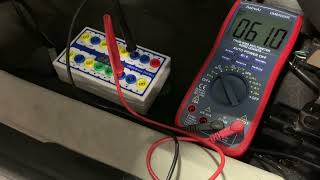
- With the battery disconnected, measure the resistance between Pin 6 (CAN High) and Pin 14 (CAN Low) at the OBD-II port. A healthy network should read approximately 60 Ohms. 🎬 Watch: How to test CAN bus resistance at the OBD-II port.
- If the resistance is 120 Ohms, it indicates a break in the circuit or a missing terminating resistor. If it's near 0 Ohms, the CAN High and Low wires are shorted together.
- Inspect known problem areas for wiring damage: For 2019+ trucks, focus on the TSB 21-NA-149 locations (around the ECM bracket, upper control arm, shock tower). For earlier models, check under the driver's dash near the parking brake and under the carpet.
- If a wiring fault cannot be found, a technician may need to disconnect modules one by one to see if the 60 Ohm resistance returns, which would isolate a faulty module.
Parts You'll Likely Need
- Wiring Repair Supplies — The most common fix is repairing a chafed or broken wire in the CAN bus harness. This requires basic electrical supplies like solder, heat shrink, and quality electrical tape.
Trusted brands: 3M
Aftermarket price range: $5-$25 - 175 Amp Mega Fuse
(OEM #15305191, 84082847)— Can blow during an improper jump-start, taking down the entire high-speed CAN bus. It's a common failure point after such an event.
Trusted brands: GM Genuine, ACDelco, Littelfuse
OEM price range: $15-$25
Aftermarket price range: $10-$20
Related Codes That Often Appear With This One
- U0100 — Lost Communication With ECM/PCM. This is a common companion code as the ECM is a primary module on the network.
- U0101 — Lost Communication with TCM. The transmission control module is also on the high-speed CAN bus.
- U0121 — Lost Communication With Anti-Lock Brake System (ABS) Control Module. The ABS module is another key node on the network.
- U0140 — Lost Communication With Body Control Module. The BCM controls many in-cabin functions and is a central communication hub.
Technical Service Bulletins (TSBs) & Recalls
- PIT5405B / PIT5405C: Reduced Power, Blank Screens, Various DTCs including U0073. Points to G218 ground, starter cable short, and battery issues.
- 21-NA-149 (Supersedes PIT5713A): Engine Wire Harness Chafing, Gauges Sweeping, Various DTCs including U0073. Details multiple chafe points on T1XX trucks.
- 19-NA-225: Engine harness chafing against the transmission housing causing various DTCs including U0073.
- 19-NA-113: Engine harness chafing against the bulkhead causing various DTCs including U0073.
- TSB 18-NA-161: References poor battery ground cable connection as a source of various electrical issues.
Platform-Specific Known Issues
- G218 Ground Point Interference (Mainly 2015-2018 K2XX): A well-documented issue covered in TSB PIT5405B/C where the dash insulator mat is installed incorrectly at the factory, getting pinched between the BCM ground terminal (G218) and the metal stud. This creates a high-resistance ground connection that is a primary cause of U0073 and a host of other electrical gremlins. The fix involves removing the ground, cutting the mat away from the stud, and reinstalling the ground terminal so it has a clean metal-to-metal contact.
- Engine Harness Chafing (Mainly 2019-2021 T1XX): The newer T1XX trucks are prone to the engine wiring harness rubbing through in several locations, as detailed in TSB 21-NA-149. Common contact points include the corner of the ECM/TCM bracket, the driver's side upper control arm, and the shock tower. This chafing can short out the CAN bus wires, causing an immediate U0073 code and network shutdown. The repair involves locating the chafe, repairing the wires, and protecting the harness with tape and rerouting it.
- Mega Fuse Failure from Jump-Start: A common story on owner forums involves all communication failing immediately after a jump-start. A voltage spike or brief reverse polarity is enough to blow the 175A mega fuse located on the battery distribution block. This cuts power to critical modules, triggering the U0073 code. Owners report that replacing this fuse (a ~$15 part) and performing a global power reset often resolves the entire issue.
Mechanic-Grade Diagnostic Values
- CAN Bus Resistance — expected: ~60 Ω. Failure: 120 Ω indicates an open circuit. ~0 Ω indicates a short between CAN High and Low wires.
- CAN High Voltage — expected: 2.5V - 3.5V. Failure: Voltage that is flatlined, stuck high, or stuck low indicates a bus problem.
- CAN Low Voltage — expected: 1.5V - 2.5V. Failure: Voltage that is flatlined, stuck high, or stuck low indicates a bus problem.
Scan Tool Commands That Help
- GDS2 (GM Dealer Tool): Module Status / Network Test — Use this function to see a list of all control modules on the network and identify which ones are not communicating. This is the first step in narrowing down the location of the fault.
- GDS2 (GM Dealer Tool): Clear All DTCs — After performing a repair or during diagnosis, clearing all codes and then operating the vehicle can help identify which code (and therefore which module communication) fails first, pointing towards the root cause.
Wiring & Ground Locations

- G218 — Behind the driver's side kick panel, under the dash.. This is a primary ground for the Body Control Module (BCM). A poor connection here, often due to an interfering insulator mat on K2XX models, can take the BCM offline and disrupt the entire network.
- G110 / G114 — Underhood, on the body (G110) and engine (G114).. These are major grounds for the body and engine harnesses on T1XX (2019+) models. GM issued a document (PIE0548) to gather information on loose connections at these points, indicating they are a known issue.
- TSB 21-NA-149 Chafe Points — On 2019+ models: engine harness contact points at the ECM/TCM bracket, upper control arm, and shock tower bolt.. This TSB details the most common points where the engine harness rubs through on the T1XX platform, causing wires (including CAN bus lines) to short to ground or to each other.
- X225 Connector — A large, linear body harness interconnect located near the base of the driver's side 'B' pillar, often under the sill plate or carpet.. This is a major junction for network wiring. Water intrusion from a window/door seal leak or a clogged sunroof drain can corrode the pins in this connector, causing an open circuit in the CAN bus.
- A-Pillar Grounds — Located inside the cab, under the plastic trim of the A-pillars (the pillars on either side of the windshield).. These ground various interior electronics. A water leak from a bad windshield seal or clogged sunroof drain can cause corrosion here, leading to intermittent network issues.
Real Owner Repair Stories
- YouTube user comment on 'Reduced Engine Power FIX!' video (GM Truck (Silverado/Sierra Platform)) — Reduced engine power, various communication codes.
❌ Tried (didn't work) Spent 8 months and over a thousand dollars on other attempted fixes.
✅ What actually fixed it Found a broken ground wire on the passenger side of the intake manifold. The wire separated with a slight tug. The owner re-grounded the wire to a new location, which permanently fixed the issue. - Chevy HHR Network forum post (GM Vehicle with similar CAN bus architecture) — Multiple communication codes including U0073, erratic electrical system behavior.
❌ Tried (didn't work) General troubleshooting by owner.
✅ What actually fixed it A GM technician found the ABS module was internally shorted, causing chaos on the network. Replacing the ABS module and reflashing it to the vehicle's VIN resolved all the codes and symptoms. - Reddit user on r/AskMechanics (2016 GMC Terrain (similar network)) — Stalling, hard running, codes U0073, P0700, U0100.
❌ Tried (didn't work) Battery test, Visual wiring inspection, Visits to multiple shops who were unable to diagnose.
✅ What actually fixed it The owner ultimately replaced the wiring harness, referencing a past success with this fix on a Chevy Cruze that had similar, difficult-to-diagnose electrical issues.
"I Checked Everything" — The Actual Cause
- A standard visual inspection or continuity test on a wiring harness may not reveal the true cause. According to GM TSB 21-NA-149, wire damage can occur inside the insulation at a connector without being visible. The bulletin advises that after a visual check, a technician should physically pull on the individual wires at the connector. This stress test can reveal an internal break that would otherwise test good intermittently, especially when the fault only occurs with engine vibration.
When the Usual Fixes Don't Work
- While a bad ground (like G218) is a very common cause for U0073 on the K2XX (2015-2018) platform, it is not the only major cause across the entire model range. For the T1XX (2019-2021) platform, GM has extensively documented engine harness chafing as a primary cause in TSB 21-NA-149. A technician focusing only on common ground points on a 2020 Silverado would likely miss a chafed wire against the upper control arm or ECM bracket. Furthermore, a case has been documented where an internally shorted ABS module was the true culprit, taking down the entire CAN bus. In this scenario, no amount of wire or ground inspection would have solved the problem; the fix required module-level diagnosis and replacement.
Model Year Variations Within This Range
- 2015-2018 (K2XX Platform): These models are most famous for the G218 ground issue, where the dash insulator mat gets trapped under the BCM ground lug, causing a poor connection. This is the primary suspect for U0073 on these years after checking the battery.
- 2019-2021 (T1XX Platform): These models are subject to the numerous engine harness chafe points detailed in TSB 21-NA-149. The most common failure points are the harness rubbing against the ECM/TCM bracket, the upper control arm, and the shock tower. This should be the primary inspection area for U0073 on these newer trucks.
Helpful Videos
We Have This Part in Stock



The information in this article is provided for general reference and educational purposes only. Vehicle specifications, procedures, and part compatibility can vary by production date, trim level, and region. Always consult your vehicle's factory service manual and verify part numbers before purchasing or performing repairs. Safety-critical components such as airbags, seat belts, and braking systems should be installed by a qualified professional.
- Chevrolet SILVERADO 1500:
- 🎬 Helpful Videos
- 🛍️ Shop This Part
- What's Unique About the 2015-2021 Chevrolet SILVERADO 1500
- Diagnostic Flowchart
- Symptoms You May Notice
- Most Likely Causes
- Rare But Worth Checking
- Diagnosis Steps
- Parts You'll Likely Need
- Related Codes That Often Appear With This One
- Technical Service Bulletins (TSBs) & Recalls
- Platform-Specific Known Issues
- Mechanic-Grade Diagnostic Values
- Scan Tool Commands That Help
- Wiring & Ground Locations
- Real Owner Repair Stories
- "I Checked Everything" — The Actual Cause
- When the Usual Fixes Don't Work
- Model Year Variations Within This Range
- 🎟️ Get 5% Off