

U0028 on 2013-2018 Chevrolet Equinox: Infotainment Network Failure Causes and Fixes
Code U0028 on a 2013-2018 Equinox means the infotainment communication network (MOST bus) has failed, usually causing a black screen and no audio. The cause is typically a single failed module on the network, like the radio or HMI module, or a wiring issue. Diagnosis requires special tools like a MOST bypass loop and is not a simple DIY fix. A parasitic battery drain is a common secondary symptom.
- U0028 on a 2013-2018 Equinox means a total communication failure on the infotainment (MOST) network.
- Symptoms are severe: a black screen, no sound, and unresponsive controls are typical.
- The cause is almost always a single point of failure: a bad module (like the HMI or radio) or a damaged wire.
- Do not replace the screen or radio without proper diagnosis. A special bypass loop tool is required to find the actual faulty component in the network 'ring'.
- This is not a DIY-friendly repair due to the need for special tools and potential for module programming after replacement.
What's Unique About the 2013-2018 Chevrolet EQUINOX
The 2013-2018 Equinox spans two different generations, with a major redesign for the 2018 model year that included a completely updated interior and infotainment system. While the meaning of U0028 is the same for both, the specific modules on the MOST bus and their locations can differ. On these vehicles, a MOST bus failure is a common cause for a completely black radio screen and loss of all audio, including turn signal clicks and warning chimes which are often generated by a module on the network. Unlike some other codes, this is rarely an intermittent glitch and almost always points to a hard failure in the communication ring. A resulting parasitic battery drain is also a frequent complaint, as a failed module can prevent the rest of the network from going to 'sleep'.
Diagnostic Flowchart
Tap your situation to follow the diagnostic path that matches what you're seeing on this vehicle.
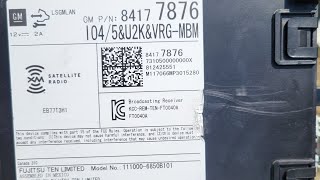
Generation note: This range covers the end of the second generation (2013-2017) and the first year of the redesigned third generation (2018). The 2018 model features a completely different dashboard, screen, and infotainment options, including standard Apple CarPlay/Android Auto. While the U0028 code's meaning is consistent, the physical modules (HMI, radio) and wiring harnesses are different. For the 2018+ models, the HMI module is located behind the heater controls, while the radio receiver is behind the glove box. 🎬 Watch: How to access and remove the 2018 radio receiver. For the earlier generation (2013-2017), the radio is located in the center of the dash, below the CD player and behind the main control panel. The HMI is often behind the glove box.
Symptoms You May Notice
- Completely black infotainment display screen, which may still have a faint backlight
- No audio from the radio, CD player, or any other source
- Infotainment system controls (buttons and touchscreen) are unresponsive
- Loss of audible chimes for warnings or turn signals
- Bluetooth or phone projection (Apple CarPlay/Android Auto) will not connect
- A dead battery after the vehicle sits for a period, caused by a parasitic drain from a module that fails to enter sleep mode
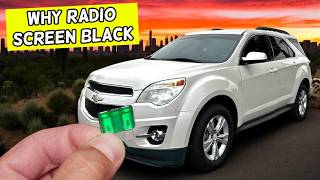
- Replacing the infotainment screen. The screen is usually just a display; a blank screen with code U0028 is almost always caused by a network failure, not a bad screen panel itself. 🎬 Watch: Why your Equinox radio screen is black and how to fix it.
- Replacing the battery first. A dead battery is often a symptom of the U0028 fault (due to parasitic drain), not the cause of it.
Most Likely Causes
- Failed Human Machine Interface (HMI) Module 🔴 High Probability The HMI module is the central computer for the infotainment system. It is a complex electronic component that can fail internally, breaking the MOST communication ring. For 2018+ models, this module is located behind the heater control panel. 🎬 See this video for HMI module location and removal steps.
How to confirm: Using a MOST bypass loop tool (like GM tool EL-51578) to take the HMI module out of the network ring. If communication is restored to other modules when the HMI is bypassed, the module is faulty.
Typical fix: Replace the HMI module. The replacement module must be programmed to the vehicle's VIN by a dealer or a qualified shop with GM programming software (SPS2).
Est. part cost: $150-$700 - Failed Radio or CD Player Module 🟡 Medium Probability The radio (tuner) often acts as the master of the MOST bus, and the CD player is another node in the ring. An internal failure in either of these components will break the ring and cause a U0028 code. A technician on an iATN forum post confirmed a failed CD player was the sole cause of a U0028 code on a similar GM vehicle.
How to confirm: Use a MOST bypass loop to isolate the radio or CD player. If bypassing the module restores function to the rest of the system, that module has failed. The radio is the master and cannot be bypassed, but if all other modules are bypassed and the fault persists, the radio is the cause.
Typical fix: Replace the failed module. In the case of a CD player, many owners choose to permanently install the bypass loop instead of replacing the unit if they don't use CDs.
Est. part cost: $100-$800 - Damaged or Pinched Wiring Harness 🟡 Medium Probability On many GM platforms of this era, a common issue is the main dash wiring harness getting pinched or chafed by a metal instrument panel bracket during assembly. TSB PIT5288H specifically calls this out for GM trucks, noting the harness gets crushed near the driver's side I/P mounting bracket, near the parking brake assembly. This is a highly probable failure point to investigate.
How to confirm: Visually inspect the wiring harness, particularly under the driver's side of the dashboard near any metal support brackets. Look for kinked, crushed, or broken wires (often a twisted pair or orange fiber optic cable). The damage may not be visible without moving the harness away from the bracket.
Typical fix: Carefully repair the broken or shorted wires and reroute the harness, adding protective conduit, to prevent future damage.
Est. part cost: $10-$50 - Failed Amplifier ⚪ Low Probability On vehicles with premium sound systems, the amplifier is a node on the MOST bus. It can be susceptible to failure, sometimes due to water intrusion if located in a vulnerable area.
How to confirm: Isolate the amplifier using a MOST bypass loop. If the rest of the infotainment system comes back online, the amplifier is the cause of the failure.
Typical fix: Replace the amplifier. The replacement may require programming.
Est. part cost: $200-$600
Rare But Worth Checking
- Failed Instrument Panel Cluster (IPC): The IPC is also a module on the MOST bus ring. While less common, an internal failure can break the communication loop, causing a U0028 code. This would be diagnosed using the same bypass loop procedure.
Diagnosis Steps
- Connect a professional scan tool capable of reading manufacturer-specific codes from all modules.
- Confirm that U0028 is present and active. Note any other 'U' codes, especially U0029, and any 'Lost Communication' codes for specific modules (U0184, U0186, etc.).
- As per TSB PIT5288H for related vehicles, perform a thorough physical inspection of the wiring harness under the driver's side dashboard. Check for pinching or chafing against metal support brackets.
- If no wiring damage is found, begin diagnostic bypassing. The MOST ring order is typically Radio -> CD Player -> HMI -> Amplifier (if equipped) -> Instrument Cluster -> Radio.
- Start with the most accessible module (e.g., HMI module behind the glove box/heater controls or CD player).
- Disconnect the module's fiber optic/electrical connector and install a MOST bypass loop tool (GM EL-51578) in its place.
- Turn the ignition on and see if any infotainment function is restored (e.g., screen turns on, audio returns).
- If the system works with a module bypassed, that module is faulty and needs to be replaced.
- If the system does not work, reconnect the module and move the bypass loop to the next module in the ring. Repeat until the faulty module is identified.
- If bypassing every module one-by-one does not restore function, the fault lies in the wiring harness between two modules. A detailed circuit test will be required.
Parts You'll Likely Need
- Human Machine Interface (HMI) Module
(OEM #Varies by year and options. Examples: 84131941 (2017), 84546910 (2018+), 84156699, 23415899. Always verify with VIN.)— This is the 'brain' of the infotainment system and a very common failure point that will break the MOST communication ring.
Trusted brands: ACDelco
OEM price range: $300-$700
Aftermarket price range: $150-$500 - Radio (Tuner) Module — The radio often serves as the master module for the MOST bus. Its internal failure will take down the entire network.
Trusted brands: ACDelco
OEM price range: $250-$800
Aftermarket price range: $150-$600 - MOST Bus Bypass Loop
(OEM #EL-51578 (Official GM Tool Kit), generic fiber optic loops are also available.)— This is an essential diagnostic tool required to isolate the failed module in the MOST bus ring. It is not a repair part, but a diagnostic aid.
OEM price range: $50-$150
Aftermarket price range: $15-$40
Related Codes That Often Appear With This One
- U0029 — This code for 'Vehicle Communication Bus A Performance' often appears with U0028. While U0028 indicates the bus is completely off (a ring break), U0029 can indicate the ring is intact but a module is not communicating correctly, which helps in diagnosis.
- U0184, U0186, U0151 — These are 'Lost Communication' codes for specific modules like the Radio, Amplifier, or Instrument Panel Cluster. A break in the MOST bus will cause other modules to log codes for any component they can no longer communicate with.
Technical Service Bulletins (TSBs) & Recalls
- PIC6073E: Announces the release of the EL-51578 MOST Bus Diagnostic Tool Kit and directs technicians to follow the specific diagnostic procedures for DTC U0028.
- PI1149A: Provides detailed diagnostic advice for 'No Display / No Audio' conditions, explicitly mentioning checking for U0028/U0029 and using the EL-51578 bypass tool to identify the faulty module on the MOST bus.
- PIT5288H (Related Platform): While written for GM trucks, this TSB is highly relevant as it details a known issue of the dash wiring harness being pinched by an instrument panel bracket, causing a U0028 code. This is a critical inspection point.
Platform-Specific Known Issues
- Parasitic Battery Drain: A very common complaint associated with U0028 is a battery that dies after the vehicle sits for a few hours or days. This happens when a failed module on the MOST bus prevents other modules in the network from entering their low-power 'sleep' mode, causing a persistent power draw. In one diagnostic video, a technician identified a 70mA draw caused by the HVAC module waking up intermittently due to a communication fault.
- Pinched Wiring Harness Vulnerability: While not specific to the Equinox in a TSB, the shared GM architecture makes it highly likely to suffer from the same pinched dash harness issue as the Silverado, Tahoe, and Yukon (TSB PIT5288H). The harness can be crushed by a sharp metal I/P bracket near the driver's side kick panel area, severing the MOST bus communication lines. This should be a primary inspection point.
Mechanic-Grade Diagnostic Values
- MOST Control Circuit (Wake-up Signal) Voltage — expected: Each module on the bus supplies B+ (approx. 12V). The master module (Radio) pulls this voltage to 0V for 100ms to signal a wake-up. When communicating, the voltage toggles between approx. 1V (low) and 12V (high).. Failure: A steady low voltage or no voltage can indicate a short or open in the control circuit, preventing wake-up. The EL-51578 bypass tool includes a terminal to verify this voltage.
- GDS2 Scan Tool Data PID: 'Number of MOST Communication Breaks' — expected: 0. Failure: A value greater than 0 indicates a break in the MOST ring. This PID is found in the Radio data display.
- GDS2 Scan Tool Data PID: 'Surrogate MOST Master Node Upstream Position' — expected: 0 or N/A. Failure: A value greater than 0 (e.g., 1, 2, 3) indicates the position of the module *before* the communication break. Counting backward from the master (Radio) in the ring sequence helps pinpoint the faulty module or wiring section.
Hidden / Shadow Codes Worth Checking
- U0028 sym00: This is the most common symptom byte for a general MOST bus failure. It indicates a ring break or a module with a circuit/terminal fault (power, ground, wake-up). (see via GM GDS2 (Global Diagnostic System 2) scan tool.)
- U0028 sym88: On some newer GM platforms, this symptom byte can be set due to a software anomaly in an unrelated module (like the Brake System Control Module) and may require following a different diagnostic path per a specific TSB. (see via GM GDS2 (Global Diagnostic System 2) scan tool.)
Scan Tool Commands That Help
- GDS2 (Global Diagnostic System 2): Radio Data Display -> 'Number of MOST Communication Breaks' / 'Surrogate MOST Master Node Upstream Position' — This is a primary diagnostic step. These data PIDs help determine if a ring break has occurred and can help locate the position of the fault in the ring without immediately needing to physically access modules.
- SPS2 (Service Programming System 2): Module Programming and Setup — Required after replacing the HMI, Radio, or other programmable modules on the MOST bus. SPS2, part of the Techline Connect environment, flashes the module with the correct VIN-specific software and calibrations.
Wiring & Ground Locations
- G103 — Located at the left rear of the engine compartment on the cowl, above the brake booster.. This ground serves the Instrument Panel Cluster (IPC) and the Radio, both of which are critical nodes on the MOST bus. A poor connection here can cause communication failures.
- G200 / G203 — Located inside the vehicle, in the instrument panel area. G200 is to the right of the cluster below the radio; G203 is at the lower center of the dash.. These are primary grounds for the instrument panel and radio/HVAC controls. The pinched harness issue described in TSBs often occurs near these I/P mounting points and grounds.
- G302 — Located under the center console at the rear, below the rear fuse block.. This is the specific ground point for the radio amplifier. A fault at this ground can cause the amplifier to fail and break the MOST ring.
- Radio Connector X2 (2018+) — At the radio module, typically behind the glove box on 2018+ models.. Pin 1 (WH/GN) is MOST Serial Data (-), Pin 2 (GY/VT) is MOST Serial Data (+), and Pin 6 (WH/VT) is the MOST Control (wake-up) line. These pins are essential for testing bus continuity and wake-up signals directly at the module.
Real Owner Repair Stories
- iATN (International Automotive Technicians Network) Forum Post (2015 Chevrolet Silverado (similar MOST architecture)) — MyLink display was completely dark/unilluminated, radio would not play, and all control buttons were non-functional.
❌ Tried (didn't work) Initial checks of power and ground were bypassed in favor of network diagnosis due to multiple simultaneous failures.
✅ What actually fixed it The technician found U0028 in the radio and U0029 in the HMI. GDS2 data showed the failure was upstream of the HMI module, pointing to the CD player. The technician could not communicate with the CD player via the scan tool. After removing the CD player and installing a MOST bypass loop in its place, the MyLink display lit up and the radio began working correctly. The root cause was an internal failure of the CD player module.
OEM Part Supersession History
84131941→84296480— Standard part revision and update by the manufacturer.
Heads up: While 84296480 replaces 84131941, several other part numbers were also used and superseded (e.g., 84004948, 84048398, 84156699). Compatibility is critical and must be verified by VIN. The replacement HMI module will always require SPS2 programming to function in the vehicle.
Model Year Variations Within This Range
- 2013-2017: The radio/tuner module is located in the center dash stack, behind the control panel and often below the CD player. The instrument panel fuse box contains specific fuses for the Infotainment System (Fuse #5, 10A), Radio (Fuse #9, 20A), and Display (Fuse #15, 10A).
- 2018: The radio/tuner module was moved to a location behind the glove box, while the HMI module is located behind the HVAC control panel. The wiring pinouts for the radio connectors are different from the previous generation.
Helpful Videos
We Have This Part in Stock



The information in this article is provided for general reference and educational purposes only. Vehicle specifications, procedures, and part compatibility can vary by production date, trim level, and region. Always consult your vehicle's factory service manual and verify part numbers before purchasing or performing repairs. Safety-critical components such as airbags, seat belts, and braking systems should be installed by a qualified professional.
- Chevrolet EQUINOX:
- 🎬 Helpful Videos
- 🛍️ Shop This Part
- What's Unique About the 2013-2018 Chevrolet EQUINOX
- Diagnostic Flowchart
- Symptoms You May Notice
- Most Likely Causes
- Rare But Worth Checking
- Diagnosis Steps
- Parts You'll Likely Need
- Related Codes That Often Appear With This One
- Technical Service Bulletins (TSBs) & Recalls
- Platform-Specific Known Issues
- Mechanic-Grade Diagnostic Values
- Hidden / Shadow Codes Worth Checking
- Scan Tool Commands That Help
- Wiring & Ground Locations
- Real Owner Repair Stories
- OEM Part Supersession History
- Model Year Variations Within This Range
- 🎟️ Get 5% Off