

U0001 on 2014-2018 Ram 3500 Cab Chassis: CAN Bus Communication Failure Guide
U0001 indicates a critical failure on the vehicle's main communication network (CAN C Bus). The most common causes on the Ram 3500 are a chafed or corroded wiring harness, a faulty ABS module, or a software glitch requiring a dealer update. Specific weak points include the large bulkhead connector on the driver's side frame rail and wiring near the ABS module. This is a complex electrical issue that usually requires professional diagnosis.
- U0001 is a critical network failure code that makes the vehicle unsafe to drive.
- Do not start by replacing expensive computers. The most likely causes are the simplest to check: battery voltage, grounds, and a thorough visual inspection of the wiring harness for damage.
- Diagnosis is a process of elimination. Testing CAN bus resistance at the OBD-II port is the most important first step to understanding the nature of the network fault.
- On these trucks, the problem is very often a physical wiring issue (chafing/corrosion) that requires patience and a careful inspection to find.
- Consult a dealer to see if any PCM software updates are available for your VIN, as this can sometimes be a simple fix.
What's Unique About the 2014-2018 Ram 3500 Cab Chassis
On the heavy-duty Ram 3500 platform, the extensive wiring required for the diesel engine, emissions systems, and various chassis components creates numerous potential chafe points. Unlike lighter-duty vehicles where a single module is often the culprit, these trucks are highly susceptible to physical wiring damage in the harsh environment of the engine bay and along the frame rails. A large wiring harness bulkhead connector on the driver-side frame rail is a known weak point for moisture intrusion and corrosion. TSBs for related models also point to software glitches that can trigger this code, often in conjunction with emissions system faults, making a trip to the dealer for potential updates a wise first step.
Symptoms You May Notice
- "NO BUS" message on the instrument cluster
- Multiple warning lights illuminated simultaneously (Check Engine, ABS, Traction Control, etc.)
- Engine stalls or will not start
- Gauges on the instrument cluster behave erratically or drop to zero
- Transmission may be stuck in 'limp mode' or not shift correctly
- Loss of convenience features like radio, climate control, or power windows
- Loss of power steering if equipped with electric power steering (EPS)
- Replacing the Powertrain Control Module (PCM) or Totally Integrated Power Module (TIPM) without proper diagnosis. These are expensive components, and the fault is more often in the wiring, a software update, or a different, less expensive module on the network.
- Replacing a single module that has logged a communication code (e.g., the TCM) when the root cause is a network-wide failure triggering the U0001.
Most Likely Causes
- Damaged or Corroded Wiring Harness 🔴 High Probability The engine bay and frame rails of these work trucks expose wiring to vibration, heat, and moisture. Specific known weak points include the large bulkhead connector on the driver-side frame rail, wiring near the ABS module in the driver's wheel well, and harnesses near the A/C compressor.
How to confirm: Perform a thorough visual inspection of all accessible wiring harnesses, paying close attention to the driver-side frame rail connector for corrosion. Test resistance between pins 6 (CAN-H) and 14 (CAN-L) at the OBD-II port with the battery disconnected. A healthy network should read approximately 60 ohms.
Typical fix: Repair the damaged section of wire by soldering and protecting with heat-shrink tubing. If corrosion is found in a connector, it must be cleaned with electrical contact cleaner or the connector replaced.
Est. part cost: $10-$100 - Faulty ABS Module 🟡 Medium Probability The ABS module is a key node on the CAN C bus. Its location in the driver's side front wheel well exposes it and its main connector to dirt, sand, and moisture, leading to corrosion or internal failure that can disrupt the entire network.
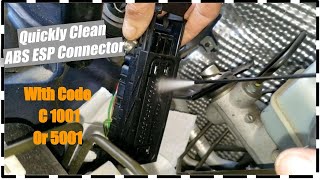
How to confirm: If the CAN bus resistance test is abnormal (not 60 ohms), disconnect the main connector at the ABS module and re-test. If the reading returns to a normal 120 ohms (indicating one of two terminating resistors is now isolated), the ABS module is likely the fault. A simple first step is to disconnect, clean the connector with electrical contact cleaner, and reconnect it, as a poor connection is a common issue. 🎬 See how to quickly clean a dirty ABS module connector
Typical fix: Replace the ABS control module. This may require programming by a dealer or a qualified shop. In some cases, the module can be sent out for repair, which avoids the need for reprogramming.
Est. part cost: $400-$1600 - Low Battery Voltage or Poor Grounds 🟡 Medium Probability These trucks have high electrical demands, often with dual batteries. A weak battery, failing alternator, or corroded ground strap can cause unstable voltage, leading to modules dropping off the network. Multiple owners have traced a 'no bus' fault solely to a loose battery terminal.
How to confirm: Load test the vehicle's battery/batteries. Check the alternator output (should be 13.5-14.5V with the engine running). Inspect and clean all major ground connections from the battery to the frame and engine block.
Typical fix: Replace the weak battery or failing alternator. Clean or replace corroded ground straps.
Est. part cost: $150-$600 - PCM Software Glitch 🟡 Medium Probability Multiple Technical Service Bulletins (TSBs), including 18-130-22 REV A, have been issued for these trucks to fix U0001 and other emissions-related codes with a simple PCM reflash. This is a very common issue, especially when U0001 appears with codes like P229E (NOx Sensor).
How to confirm: Contact a Ram dealer with your vehicle's VIN and ask if there are any open recalls or available software updates related to the PCM or emissions systems.
Typical fix: Dealer reprograms the Powertrain Control Module (PCM) with updated software.
Est. part cost: $0-$200 - Faulty Module (Other than ABS) ⚪ Low Probability Any module on the CAN C network (Instrument Cluster, TIPM, Radio, NOx sensors, etc.) can fail and bring down the network. The Totally Integrated Power Module (TIPM) is a known point of failure.
How to confirm: This requires a systematic process of disconnecting one module at a time and re-checking CAN bus resistance to isolate the faulty component. This is best left to a professional with wiring diagrams.
Typical fix: Replace the identified faulty module. Many modules, like the TIPM, require programming after installation.
Est. part cost: $300-$1500+
Rare But Worth Checking
- Aftermarket Electronics: Poorly installed aftermarket devices like remote starters, alarms, or even plug-in OBD-II scanners can cause interference or shorts. Always check for and disconnect these devices early in the diagnostic process.
Diagnosis Steps
- Check for TSBs: Contact a dealer with your VIN to check for software updates like TSB 18-130-22 REV A, which is a common fix.
- Check and charge the battery. Ensure system voltage is stable and above 12.4V with the engine off and 13.5-14.5V when running.
- Scan all vehicle modules and record all fault codes. Note which modules are not communicating.
- Disconnect any aftermarket devices plugged into the OBD-II port or wired into the vehicle's electronics.
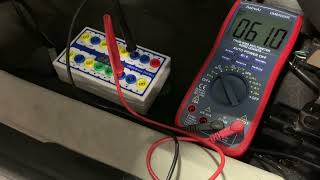
- With the ignition off and battery disconnected, use a quality multimeter to measure the resistance between Pin 6 (CAN-H) and Pin 14 (CAN-L) at the OBD-II diagnostic port. 🎬 Watch: Step-by-step guide to testing CAN bus resistance
- A reading of ~60 Ohms is normal and indicates the two 120-Ohm terminating resistors and the circuit between them are intact.
- A reading of ~120 Ohms indicates an open circuit or that one of the terminating resistors (often in a module like the instrument cluster or PCM) is not seen by the network.
- A reading near 0 Ohms indicates a short circuit between the CAN-H and CAN-L wires.
- Perform a thorough visual inspection of the main engine and frame wiring harnesses. Pay close attention to the large bulkhead connector on the driver's side frame rail and the harness/connector at the ABS module in the driver's front wheel well.
- If the resistance reading is abnormal, begin disconnecting modules on the CAN C bus one by one (e.g., ABS module, instrument cluster, radio) and re-measure resistance each time. When the reading returns to normal, the last module disconnected is likely the source of the fault.
- If wiring is suspected, check for continuity and shorts to power/ground on the CAN-H and CAN-L wires between the OBD-II port and suspect modules.
Parts You'll Likely Need
- Wiring Harness Repair Supplies — Since chafed or corroded wires are a primary cause, repairing the existing harness is the most common fix.
Trusted brands: 3M, Tesa Tape, Standard Motor Products
Aftermarket price range: $10-$50 - ABS Control Module — The ABS module is a common failure point that can bring down the entire CAN C network. Its location makes it vulnerable to the elements.
Trusted brands: Mopar (OEM), Dorman (Remanufactured), Cardone (Remanufactured)
OEM price range: $600-$1600
Aftermarket price range: $400-$800 - Totally Integrated Power Module (TIPM) — Though less common than wiring, an internal failure in the TIPM, which acts as a central gateway, can cause a total network shutdown.
Trusted brands: Mopar (OEM), Dorman
OEM price range: $800-$1500
Aftermarket price range: $500-$900
Related Codes That Often Appear With This One
- U0002 — This code indicates a 'CAN Bus Performance' issue, often set alongside U0001 as they both relate to the same network communication problem.
- U0100 — Lost Communication With ECM/PCM. This is a direct result of the U0001 fault, as the ECM is a primary module on the failed network.
- U0121 — Lost Communication With Anti-Lock Brake System (ABS) Control Module. This often appears with U0001 and can point towards the ABS module or its wiring as the source of the problem.
- P229E — NOx Sensor Circuit. On diesel models, TSB #18-130-22 shows this code appearing with U0001, indicating emissions system components can be involved in the network fault.
Technical Service Bulletins (TSBs) & Recalls
- TSB #9100194 / #S2308000042: While for the Ram 1500, these bulletins link U0001/U0002 to the CAN C Bus and warn against replacing the EPS gear without thorough diagnostics, highlighting the risk of misdiagnosing a module failure when the fault is elsewhere.
- TSB #1813022REVA: This bulletin for the Ram 2500 confirms U0001-00 as 'CAN C BUS' and shows it appearing with numerous other codes, reinforcing that it's a network-level fault.
Platform-Specific Known Issues
- A known wiring harness chafe point exists in the engine bay, where the harness can rub against A/C lines or other brackets, eventually shorting the CAN bus wires.
- Water intrusion into the main bulkhead connector on the driver's side frame rail is a known cause of corrosion and communication faults.
- Rodent damage to wiring is a possible cause, as noted in an official FCA investigation into a U0001 fault.
Mechanic-Grade Diagnostic Values
- CAN Bus Resistance (at OBD-II Pins 6 & 14, battery disconnected) — expected: ~60 Ω. Failure: ~120 Ω indicates one terminating resistor is offline (bad module or open wire); ~0 Ω indicates a short between CAN-H and CAN-L wires.
- CAN Bus Voltage (Key On, Engine Off) — expected: CAN-H (Pin 6 to ground): ~2.6-2.7V; CAN-L (Pin 14 to ground): ~2.3-2.4V. Failure: Voltages that are identical, stuck high/low, or absent indicate a bus wiring fault or a module pulling the bus down.
- Continuity of CAN C wires from module to Star Connector — expected: < 5.0 Ω. Failure: Resistance higher than 5.0 Ohms indicates an open or high-resistance in the circuit.
- Module Ground Circuit Voltage Drop — expected: < 0.1 V. Failure: Voltage greater than 0.1V between the module's ground pin and the negative battery terminal indicates a poor ground connection.
Hidden / Shadow Codes Worth Checking
- U0001-00: The '-00' suffix is a sub-type code provided by the manufacturer. While its specific meaning isn't publicly defined, its presence in TSBs indicates it's logged by the OEM scan tool and helps differentiate the fault type. (see via OEM-level scan tool like wiTECH.)
Scan Tool Commands That Help
- wiTECH (OEM Tool): Network Topology View — This is the first screen to check. It provides an instant, color-coded overview of all modules on the bus, showing which are communicating (green), which have codes (yellow), and which are offline (red), immediately focusing diagnostic efforts.
- wiTECH or equivalent professional scanner: Read Module Status — After identifying a non-communicating module in the topology view, this function is used to actively poll the module to see if it's present on the bus at all. This helps differentiate between a module that is completely dead versus one that is communicating but has a fault.
- wiTECH or equivalent professional scanner: Read All DTCs from All Modules — Essential at the start of diagnosis. A U0001 code is often accompanied by more specific 'Lost Communication' codes (like U0121 for ABS) from other modules, which helps pinpoint the origin of the network failure.
Wiring & Ground Locations
- CAN C Star Connector (Hub) — Located under the dash, near the steering column shaft, often above the gauge cluster.. This is a central junction point where CAN C wires from multiple modules meet. A bad connection here can take down the entire network. It's a key location for isolating different branches of the network during diagnosis.
- G301 / G302 — Located on the left front body structure, often near the driver-side fender or firewall area.. These are primary chassis ground points for modules and harnesses in the front of the vehicle. Corrosion or a loose connection here can cause intermittent communication failures for critical modules like the ABS or PCM.
- Main Bulkhead Connector — Large, multi-wire connector located on the driver's side frame rail.. This connector is a known weak point for water intrusion and corrosion on Ram HD trucks, which can short or open the CAN bus wires that pass through it.
- BCM Connector — Connected to the Body Control Module, located in the driver's side footwell, up above the parking brake area.. A large lever-lock connector that can come loose or break, causing a loss of network communication as the BCM is a major hub on the bus.
Real Owner Repair Stories
- Ram Forum user (Ram Truck (year not specified, but 4th Gen)) — Multiple CAN bus failure codes, truck would shut down.
❌ Tried (didn't work) Initial diagnosis pointed to PCM, CAN star connector, or general power failure.
✅ What actually fixed it The dealer found a faulty Intelligent Power Control (IPC) board, which is integrated into the Totally Integrated Power Module (TIPM). The entire TIPM was replaced under warranty to resolve the issue.
OEM Part Supersession History
68477878AB→68477878AF— Updated part revision from the manufacturer, likely to address reliability issues or component changes.
Heads up: This example is for a 2020 Ram 3500 ABS module, but illustrates that part numbers are frequently superseded. Always verify the latest part number with a dealer using your VIN before ordering.
Model Year Variations Within This Range
- 2014-2018: Significant wiring harness changes exist within this generation. A user attempting to swap an interior and dash harness from a 2017 Laramie into a 2014 BigHorn found that the main dash harness connectors did not match between the years, and door harnesses were also different. This means parts like wiring harnesses are not universally interchangeable and must be sourced for the specific model year.
Diagnostic Flowchart
Other Known Issues on This Vehicle
Issues unrelated to this code that are worth knowing about as an owner of this generation:
- Front End 'Death Wobble' 🔴 High — Common on solid front axle trucks, especially after hitting a bump at highway speeds. Can occur at various mileages, often triggered by worn track bar bushings, ball joints, or steering dampers. (Ref: No specific recall for this generation, but it's a widely documented issue. Fix involves inspecting and replacing worn front-end components.)
- Diesel Emissions System Faults (DEF/SCR/EGR) 🟠 Medium — Frequent, especially on trucks used for short trips or with high idle time. Issues include DEF crystallization, clogged DPF filters, and failing NOx sensors, leading to check engine lights and potential power reduction ('limp mode'). (Ref: Multiple software updates and an extended warranty (Recall 67A) were issued to address emissions system performance and component failures.)
- Turbo Actuator Failure 🟠 Medium — A common problem on the 6.7L Cummins, where the electronic actuator for the variable geometry turbo (VGT) fails, causing low boost, excessive smoke, and fault codes.
- Grid Heater Bolt Failure 🔴 High — The nut and bolt holding the power wire to the intake grid heater can fail, potentially dropping into the engine and causing catastrophic damage. It's a known failure point, especially on higher mileage trucks.
- CP4 High-Pressure Fuel Pump Failure (2019-2020 models) 🔴 High — While slightly outside the primary 2014-2018 range, it's a critical issue for late-model owners. The CP4 pump can fail internally, sending metal debris throughout the entire fuel system, resulting in extremely expensive repairs. (Ref: A major recall was issued to replace the CP4 pump with the more robust CP3 pump on affected 2019-2021 models.)
Used vs. New Parts: Buying Guide for This Vehicle
When a used part is the smart pick: A complete wiring harness from a donor vehicle can be a cost-effective choice if the original is extensively damaged by corrosion or fire. However, it must be from a vehicle with the exact same year, model, and options to ensure compatibility.
Donor-vehicle mileage cap: roughly under 100000 miles for the part to have meaningful remaining life.
What to inspect on the donor part:
- For a wiring harness, inspect for any signs of previous repair (splices, non-OEM tape).
- Check all connector housings for cracks or broken locking tabs.
- Look for green or white powder-like corrosion on connector pins.
- Ensure the harness comes from a vehicle in a dry, salt-free climate if possible.
OEM-only on this vehicle (don't cheap out):
- Powertrain Control Module (PCM)
- Totally Integrated Power Module (TIPM)
- ABS Module (unless using a remanufacturing service that offers plug-and-play)
Aftermarket brands forum-validated for this vehicle:
- Dorman (Remanufactured Modules & Connectors)
- Cardone (Remanufactured Modules)
- UpFix (Module Repair Service)
Brands owners have reported issues with on this vehicle:
- Unbranded, no-name electronic modules from online marketplaces should be avoided due to high failure rates and potential programming issues.
Real Owner Stories
Aggregated from forums and TSBs cited above. Mileages and costs reflect what owners reported in those sources.
2016 Ram 3500
Symptoms: The owner experienced an intermittent Check Engine Light with a U0001 CAN C Bus error. Interestingly, the code cleared itself as soon as a scanner was connected to the OBD-II port.
What fixed it: The issue was linked to the Totally Integrated Power Module (TIPM) wiring, though the code was intermittent.
Source hint: RamForum.com: CEL light today with a U0001 CAN C Bus error
2018 Ram 2500/3500
Symptoms: ABS and electronic brake system warnings were illuminated on the dashboard.
What fixed it: The owner removed the driver's side fender liner and disconnected the main ABS module connector. After cleaning out a significant amount of sand and dirt from the connector and reconnecting it, the codes were resolved.
Cost: $0-$0
Source hint: YouTube: 2018 Ram 2500 and 3500 HCU/ABS Pump/ABS Module Failure Repair for $0
Related OBD-II Codes
Frequently Asked Questions
Is there a specific software update for my Ram 3500 that addresses the U0001 code?
Why does my instrument cluster show 'NO BUS' and all the warning lights come on at once?
Can a dirty ABS connector really cause a U0001 network code on a 2018 Ram?
What should the resistance be when testing the OBD-II port for this code?
Could my aftermarket trailer brake controller or GPS tracker cause a U0001 code?
Is the TIPM a common failure point for communication issues on these trucks?
Helpful Videos

Used OEM Parts in Stock


New Aftermarket Parts Available


The information in this article is provided for general reference and educational purposes only. Vehicle specifications, procedures, and part compatibility can vary by production date, trim level, and region. Always consult your vehicle's factory service manual and verify part numbers before purchasing or performing repairs. Safety-critical components such as airbags, seat belts, and braking systems should be installed by a qualified professional.
- Ram 3500 Cab Chassis:
- 🎬 Helpful Videos
- 🛍️ Shop This Part
- What's Unique About the 2014-2018 Ram 3500 Cab Chassis
- Symptoms You May Notice
- Most Likely Causes
- Rare But Worth Checking
- Diagnosis Steps
- Parts You'll Likely Need
- Related Codes That Often Appear With This One
- Technical Service Bulletins (TSBs) & Recalls
- Platform-Specific Known Issues
- Mechanic-Grade Diagnostic Values
- Hidden / Shadow Codes Worth Checking
- Scan Tool Commands That Help
- Wiring & Ground Locations
- Real Owner Repair Stories
- OEM Part Supersession History
- Model Year Variations Within This Range
- Diagnostic Flowchart
- Other Known Issues on This Vehicle
- Used vs. New Parts: Buying Guide for This Vehicle
- Real Owner Stories
- 2016 Ram 3500
- 2018 Ram 2500/3500
- Related OBD-II Codes
- Frequently Asked Questions
- 🎟️ Get 5% Off