

U0001 on 2011-2023 Chrysler 300: Fixing CAN Bus Failure (ABS, TIPM, Wiring)
Code U0001 on a Chrysler 300 means there's a critical failure on the high-speed CAN C communication bus. This often results in stalling, a no-start condition, or multiple warning lights. The most common causes are wiring damage, a faulty ABS module, or a failing Totally Integrated Power Module (TIPM). Diagnosis is complex and usually requires professional tools.
- U0001 on a Chrysler 300 is a critical network failure code that makes the vehicle unreliable and unsafe to drive.
- Do not immediately replace the ECM or TCM; the fault is often in the wiring, the ABS module, or the TIPM.
- Diagnosis is complex and requires tools that can test the entire network. This is not a simple DIY fix.
- Always start by checking the battery and all major ground connections, as low voltage can mimic more severe module failures.
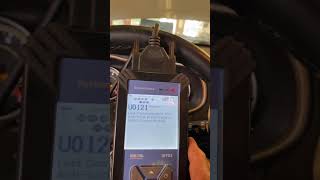
- If you see U0001 accompanied by U0121, the ABS module or its wiring is the most probable cause.
What's Unique About the 2011-2023 Chrysler 300
On Chrysler platforms like the 300, the Totally Integrated Power Module (TIPM) acts as a central gateway and power distribution center. Many communication issues, including U0001, can be traced back to an internal failure within the TIPM, which is known to cause a wide range of strange electrical problems, especially on 2011-2015 models. Additionally, the ABS module is a very common point of failure on the CAN bus for these vehicles; an internal fault within the ABS module can disrupt the entire network and prevent other modules from communicating. A key architectural detail is that the OBD-II port's diagnostic CAN lines are isolated from the main CAN C bus by the TIPM/BCM; this means a scan tool may not directly see the fault, requiring technicians to test at individual modules or star connectors.
Generation note: The 2011-2023 range covers two generations of the Chrysler 300 (LD platform): the 2011-2014 refresh and the 2015-2023 refresh. While the underlying CAN bus architecture is similar, specific module locations and wiring harnesses may differ. The principles of diagnosis remain the same across both generations. The TIPM is a more frequent culprit on the earlier 2011-2014 models. Later models (post-2015) feature more advanced 'PowerNet' or 'Atlantis' electrical architectures, which are more complex but use the same diagnostic principles.
Symptoms You May Notice
- Multiple warning lights on the dashboard simultaneously (Check Engine, ABS, Airbag, Traction Control).
- Engine stalling or shutting off while driving.
- Vehicle will not start or cranks but does not turn over.
- Transmission stuck in one gear (limp mode).
- Erratic or non-functioning instrument cluster gauges (e.g., speedometer at zero).
- Loss of power steering.
- Electrical features like power windows, radio, or A/C stop working.
- "Service Airbag" or "Service ABS System" message on the EVIC display.
- Replacing a single module (like the TCM or PCM) without confirming it is the source of the network failure. The U0001 code indicates a network-wide problem, and the faulty part could be a different module or the wiring itself.
Most Likely Causes
- Damaged or Corroded CAN Bus Wiring 🔴 High Probability Wiring harnesses can chafe against the chassis or engine components, particularly near the transmission bell housing or around the ABS module. Connectors exposed to the elements, like the main ABS connector in the wheel well, are susceptible to moisture and corrosion. The central 'star connector' where CAN bus wires join can also corrode.
How to confirm: Visually inspect the main wiring harnesses. Check for spread terminals in the BCM connectors C1 and C2 as per TSB 08-021-16. With the battery disconnected, measure the resistance between CAN C High and CAN C Low at a module connector (like the ABS module) or the TIPM; a healthy network should read approximately 60 ohms.
Typical fix: Repair the damaged section of the wiring harness, clean/replace the corroded connector, or fix spread terminals.
Est. part cost: $10-$100 for wiring repair supplies or pigtail connectors - Faulty ABS Module 🔴 High Probability The ABS module is a very common failure point on many Chrysler vehicles. An internal short or logic failure in the module can disrupt the entire CAN network, causing a U0001 code and often a U0121 (Lost Communication with ABS Module).
How to confirm: Using an advanced scan tool, check if you can communicate with the ABS module. If it's the only module that is offline, it's a strong suspect. A definitive DIY test is to disconnect the ABS module's electrical connector and see if communication between other modules is restored and if the car starts.
Typical fix: Replace the ABS module. The replacement may need to be programmed to the vehicle.
Est. part cost: $200-$600 for a remanufactured or new module - Faulty Totally Integrated Power Module (TIPM) 🟡 Medium Probability The TIPM is a known weak point on many 2007-2015 Chrysler products, including the 300. Internal relay and circuit board failures can cause widespread communication and electrical issues, often leading to a U0001 code.
How to confirm: Diagnosis is difficult without specialized tools. A mechanic will check for power/ground issues at the TIPM and see if it's acting as a gateway. If multiple unrelated systems are failing and other causes are ruled out, the TIPM is a likely culprit.
Typical fix: Replace the TIPM. This part must be correct for the vehicle's year and options, and often requires programming.
Est. part cost: $400-$1200 - Poor Battery Voltage or Ground Connection ⚪ Low Probability Low system voltage can cause modules to drop off the network intermittently. Main ground straps in the engine bay can corrode over time, creating a poor connection and unstable voltage.
How to confirm: Test the battery voltage; it should be above 12.4V with the engine off. Load test the battery. Check that the battery terminals are clean and tight. Inspect the main engine and chassis ground straps for corrosion or looseness.
Typical fix: Charge or replace the battery. Clean or replace faulty ground straps.
Est. part cost: $10-$250
Rare But Worth Checking
- Faulty Control Module (Other than ABS/TIPM): Any module on the high-speed CAN bus (TCM, PCM, Instrument Cluster, etc.) can fail and bring down the network. A technician in a video diagnosed a faulty power steering control module as the cause on a 2012 300. Diagnosis involves disconnecting modules one-by-one to isolate the fault.
- Aftermarket Electronics: Improperly installed remote starters, alarms, or even plug-in OBD-II devices can interfere with or short out the CAN bus wiring, causing communication failures.
Diagnosis Steps
- Check Battery Health: Ensure the battery is fully charged (12.4V+) and terminals are clean and tight. Low voltage can cause communication errors.
- Scan All Modules: Use a professional-grade scan tool that can access all vehicle modules (Engine, Transmission, ABS, Body, etc.). Note which modules are not communicating.
- Inspect Wiring: Perform a thorough visual inspection of the main CAN bus wiring harnesses, especially around the ABS module, TIPM/fuse box, and near the transmission. Look for any signs of chafing, pinching, or corrosion.
- Check CAN Bus Resistance: Disconnect the battery. At the DLC (OBD-II port), measure the resistance between Pin 6 (CAN High) and Pin 14 (CAN Low). A healthy network should read approximately 60 Ohms. A reading of 120 Ohms suggests a break in the circuit or a missing terminating resistor (often in a module). A reading near 0 Ohms indicates a short between the two wires.
- Isolate Modules: If the resistance is incorrect or modules are offline, begin disconnecting modules from the CAN bus one at a time. Start with the most likely culprits like the ABS module or any aftermarket devices. After disconnecting each one, re-check if communication is restored to the other modules.
- Inspect Star Connector / Junction Block: Locate the CAN bus star connector (junction point) and inspect its terminals for corrosion or damage. These are often located behind kick panels or under the dash.
- Check for TSBs: Specifically check for TSB 08-021-16, which involves inspecting the BCM connectors for spread terminals that can cause an open circuit.
- Check Power and Grounds: For any non-communicating module, use a multimeter to verify it is receiving proper power and has a solid ground connection.
- Advanced Diagnostics: If the problem persists, a technician will use an oscilloscope to view the CAN signal waveform on Pins 6 and 14 to check for signal integrity, noise, or shorts to power/ground.
Parts You'll Likely Need
- ABS Control Module
- Totally Integrated Power Module (TIPM)
- Wiring Harness Pigtail Connector
Related Codes That Often Appear With This One
- U0121 — Lost Communication With Anti-Lock Brake System Control Module. This code is very common with U0001, as a failing ABS module is a frequent cause of the entire CAN bus going down.
- U0100 — Lost Communication With ECM/PCM. This indicates the main engine computer is offline.
- U0101 — Lost Communication with TCM. This indicates the transmission controller is offline.
- U0140 — Lost Communication With Body Control Module. On Chryslers, this often points towards the TIPM or BCM itself.
Technical Service Bulletins (TSBs) & Recalls
- TSB 08-021-16 REV. B: Addresses CAN bus communication issues, including U0001. A potential fix is inspecting the CAN C bus harness connectors C1 and C2 at the Body Control Module (BCM) for spread terminals and reprogramming the BCM.
Platform-Specific Known Issues
- NHTSA TSB #21-019-17 REV. A, while for a 2015 Chrysler 200, shows that Chrysler has acknowledged CAN C Bus (U0001) issues in conjunction with other module communication problems, suggesting a pattern across their vehicle lineup.
- An owner complaint filed with the NHTSA for a 2015 Chrysler 200 (ODI #11256589) directly links a U0001 code to a faulty TIPM.
Mechanic-Grade Diagnostic Values
- CAN C Bus Voltage (scoped at module or star connector) — expected: CAN High (H) toggles between 2.5V and 3.5V. CAN Low (L) toggles between 2.5V and 1.5V. Both signals should be clean mirror images of each other centered around a 2.5V bias.. Failure: A signal resting at 0V or 5V, a bias voltage significantly different from 2.5V, or a noisy/garbled waveform indicates a short, open, or interference.
- CAN C Bus Total Resistance — expected: Approximately 60 Ohms. This must be measured with the battery disconnected.. Failure: A reading of ~120 Ohms indicates an open circuit or a missing terminating resistor (one of the two main modules is disconnected or faulty). A reading near 0 Ohms indicates a short between the CAN High and CAN Low wires.
- Diagnostic CAN C (-) Circuit to Ground Resistance — expected: Above 100.0 ohms.. Failure: Resistance below 100.0 ohms indicates a short to ground on that circuit.
Scan Tool Commands That Help
- wiTECH 2.0: Network Topology View — This is the primary screen for diagnosing a U0001. It provides a color-coded map of all vehicle modules, instantly showing which modules are not communicating (often colored red), which have codes, and which are responsive. This helps quickly identify the scope of the network failure.
- wiTECH 2.0: View DTCs / Read Environmental Data — After identifying a non-responsive module, this function can show stored 'environmental data' which captures vehicle operating conditions at the moment the fault occurred. This can help replicate intermittent issues.
- wiTECH 2.0 / Professional Scan Tool: Module Isolation (Manual Process) — When the entire CAN C bus is down, a technician uses the scan tool's live topology view while physically disconnecting modules one-by-one from a star connector. When the faulty module is disconnected, the other modules on the topology map will become responsive again, isolating the source of the problem.
Wiring & Ground Locations
- CAN Bus Star Connector (Front) — On some models, located underneath the passenger side glove box area, potentially behind a kick panel.. This is a central junction where multiple CAN C bus circuits meet. It's a critical diagnostic point for isolating a faulty module or wiring branch. A failure in the connector itself can also take down the network.
- CAN Bus Star Connector (Rear) — On later models (e.g., 2018), located in the trunk, near the battery and behind the spare tire cover. It may be a green module that is difficult to access without unclipping it.. This serves the same function as the front connector for a different set of modules. Technicians use this point to diagnose network issues and sometimes for key programming.
- Diagnostic CAN C Bus at DLC — OBD-II Data Link Connector (DLC), pins 6 (CAN H) and 14 (CAN L).. This is the scan tool's entry point. On these Chrysler platforms, it's a 'Diagnostic CAN' bus that goes to the TIPM/BCM gateway, not the main module-to-module CAN C bus. A failure on the main bus might not be directly visible here with a simple multimeter, requiring a scope or testing at a star connector.
Real Owner Repair Stories
- YouTube channel 'Advanced Level Automotive' (2012 Chrysler 300 3.6L) — Numerous communication codes across all modules.
❌ Tried (didn't work) Focusing on a single specific code instead of the overall network.
✅ What actually fixed it The technician scoped the CAN lines at the DLC and saw a noisy signal. He then located the front star connector under the glove box and began disconnecting modules one by one. This process allowed him to isolate which module (or its wiring) was corrupting the entire network. The video identifies a faulty power steering control module as the culprit. - iATN (International Automotive Technicians Network) Forum Post (Chrysler vehicle with TIPM gateway (similar architecture)) — No crank, all dash lights on, key fobs not working. Scan tool showed all modules on the CAN-C bus were unresponsive.
❌ Tried (didn't work) Initial scan from DLC could not see the problem directly.
✅ What actually fixed it The technician disconnected the battery and measured CAN resistance at the ABS module connector, finding it was over 100 ohms (incorrect). Scoping the CAN wires at the TIPM showed the bias voltage was being pulled close to zero instead of the normal 2.5V. This pointed to a short or faulty module on the bus, which was then isolated. - YouTube channel 'Rob The Mechanic' (Ram Truck (similar star connector architecture)) — Intermittent loss of communication with an entire network of modules, but only after driving for exactly 33 miles. The truck would idle indefinitely without issue.
❌ Tried (didn't work) Checking individual modules., Inspecting wiring for obvious damage.
✅ What actually fixed it After multiple diagnostic cycles, the technician isolated the problem to the star connector itself. Even though the internal terminating resistors tested good with a multimeter (60/120 ohms), the connector had an intermittent internal failure that only manifested after a specific drive cycle. Replacing the star connector resolved the issue.
OEM Part Supersession History
68195727AA→68210119AB— Part update or revision by manufacturer.
Heads up: Using the wrong part number, even if it physically fits, can cause communication or functional errors. Always verify the correct, most current part number with the vehicle's VIN.4692170AF, 4692170AG, 4692170AH→4692170AJ or later— Rolling updates and revisions to fix internal flaws.
Heads up: TIPM part numbers are highly specific to year and vehicle options. A part from another year will likely not work correctly.
Model Year Variations Within This Range
- 2011-2014: These earlier LD-platform models more commonly used the TIPM as the central gateway in a 'PowerNet' architecture. The 5-speed automatic was still available on some trims, affecting the TCM and network configuration.
- 2015-2023: This facelift generation standardized the 8-speed automatic and introduced a more refined interior with the 8.4-inch Uconnect system. The electrical architecture is more complex ('PowerNet' or 'Atlantis'), using the BCM as a gateway for multiple high and medium-speed CAN buses. Star connector locations may differ from earlier models (e.g., rear of vehicle).
Diagnostic Flowchart
Other Known Issues on This Vehicle
Issues unrelated to this code that are worth knowing about as an owner of this generation:
- 5.7L HEMI V8 Lifter/Camshaft Failure 🔴 High — Common issue, particularly on engines with the Multi-Displacement System (MDS). Often presents as a distinct 'ticking' noise that can progress to a misfire (P0300) and catastrophic engine damage if ignored.
- Uconnect 8.4-inch Screen Delamination 🟠 Medium — Widespread on models from approximately 2017 onwards. The screen adhesive fails, causing bubbling and 'ghost touches' that can randomly change settings, make calls, and render the infotainment system unusable.
- Electronic Shifter Rollaway Risk (2012-2014) 🔴 High — Affected 2012-2014 models with the 'monostable' electronic shifter. Drivers could exit the vehicle believing it was in Park, leading to rollaway incidents. (Ref: NHTSA Recall 16V-240 (FCA S27))
- Premature Alternator Failure (2011-2014) 🟠 Medium — A recall was issued for early models due to alternator diode failure, which could lead to stalling, a no-start condition, or electrical fires. (Ref: NHTSA Recall 14V-634)
Used vs. New Parts: Buying Guide for This Vehicle
When a used part is the smart pick: For both the TIPM and ABS Module, a used or remanufactured part is a very common and financially smart choice. These parts fail frequently, and a robust market of specialized rebuilders exists. A quality remanufactured unit is often more reliable than a junkyard part and significantly cheaper than a new OEM part from a dealership.
Donor-vehicle mileage cap: roughly under 100000 miles for the part to have meaningful remaining life.
What to inspect on the donor part:
- For junkyard parts, check for corrosion on all connector pins.
- Verify the part number, including all suffix letters (e.g., AB, AC), matches the original part EXACTLY.
- Prefer parts from vehicles in dry climates to reduce the risk of moisture damage.
- Best practice: Purchase from a reputable remanufacturer that offers a warranty and pre-programs the module to your VIN.
Aftermarket brands forum-validated for this vehicle:
- Dorman (for TIPMs)
- Specialized Remanufacturers: MAKS TIPM Rebuilders, Circuit Board Medics, GoECM (for TIPMs and other modules).
Brands owners have reported issues with on this vehicle:
- Unbranded, no-name modules from online marketplaces without a warranty or return policy.
Real Owner Stories
Aggregated from forums and TSBs cited above. Mileages and costs reflect what owners reported in those sources.
2012 Chrysler 300C
Symptoms: No crank, no start condition with codes U0001 and U0121. Diagnostic testing showed 120 Ohm resistance on the bus instead of the standard 60 Ohms.
What fixed it: Isolated the faulty ABS module by disconnecting it, which restored communication to the rest of the network and allowed the car to start.
Source hint: 300cforums.com - Thread: '2012 300c No Crank No Start U0001, U0121'
2015 Chrysler 200
Symptoms: U0001 code present in conjunction with other module communication problems.
What fixed it: Replacement of a faulty Totally Integrated Power Module (TIPM).
Source hint: NHTSA owner complaint (ODI #11256589)
Related OBD-II Codes
Frequently Asked Questions
Does TSB 08-021-16 apply to my Chrysler 300 if I have a U0001 code?
Why is my Chrysler 300 stuck in one gear and showing a U0001 code?
Can a faulty ABS module on a 2012 Chrysler 300 cause a no-start condition?
Is the U0001 code related to the 'Service Airbag' message on my dashboard?
Could a problem with my TIPM be causing the U0001 code?
How much does it cost to fix the CAN bus wiring on a Chrysler 300?
Helpful Videos
We Have This Part in Stock



The information in this article is provided for general reference and educational purposes only. Vehicle specifications, procedures, and part compatibility can vary by production date, trim level, and region. Always consult your vehicle's factory service manual and verify part numbers before purchasing or performing repairs. Safety-critical components such as airbags, seat belts, and braking systems should be installed by a qualified professional.
- Chrysler 300:
- 🎬 Helpful Videos
- 🛍️ Shop This Part
- What's Unique About the 2011-2023 Chrysler 300
- Symptoms You May Notice
- Most Likely Causes
- Rare But Worth Checking
- Diagnosis Steps
- Parts You'll Likely Need
- Related Codes That Often Appear With This One
- Technical Service Bulletins (TSBs) & Recalls
- Platform-Specific Known Issues
- Mechanic-Grade Diagnostic Values
- Scan Tool Commands That Help
- Wiring & Ground Locations
- Real Owner Repair Stories
- OEM Part Supersession History
- Model Year Variations Within This Range
- Diagnostic Flowchart
- Other Known Issues on This Vehicle
- Used vs. New Parts: Buying Guide for This Vehicle
- Real Owner Stories
- 2012 Chrysler 300C
- 2015 Chrysler 200
- Related OBD-II Codes
- Frequently Asked Questions
- 🎟️ Get 5% Off