

OBD-II Code P3857: Diesel Exhaust Fluid (DEF) Pressure Too Low
What P3857 means on your PACCAR engine, why it triggers, and how to fix it
- P3857 is a serious code on PACCAR engines that indicates low pressure in the Diesel Exhaust Fluid (DEF) system and will lead to a severe engine power reduction.
- For 2017-2018 Kenworth and Peterbilt trucks, the most common cause is a small, clogged filter screen at the DEF dosing valve, as noted in TSB E222.
- Do not ignore this code; driving will become impossible once the final 5 mph derate is active.
- Troubleshooting should start with the simple, inexpensive things: checking for other codes, inspecting DEF quality, and looking for visible leaks or clogged filters before replacing expensive parts like the DEF pump.
What Does P3857 Mean?

The trouble code P3857 means your truck's engine control module (ECM) has detected that the pressure in the Diesel Exhaust Fluid (DEF) system is too low. This system is crucial for reducing harmful NOx emissions by injecting DEF into the exhaust stream. For this injection to be effective, the fluid must be pressurized to a specific level (typically around 73 PSI / 5 Bar for PACCAR systems). Low pressure prevents the system from working correctly, so the truck's computer triggers this code to alert you that the aftertreatment system needs immediate attention before it leads to a more serious engine derate.
Technical definition: The official SAE/OBD-II definition for P3857 on PACCAR MX-11 and MX-13 engines is "DEF Pressure – Data Valid But Too Low". Some diagnostic tools may also interpret this code as "Pump module (L074) - ECU pin A24, short circuit to supply," which points to a specific electrical fault with the DEF pump module.
Can I Drive With P3857?

Yes, But With Caution. You can drive, but your truck will soon enter a multi-stage derate mode, limiting engine power and speed, eventually down to 5 mph. While the low pressure itself doesn't harm the engine internals, ignoring it forces the aftertreatment system to operate incorrectly. This can lead to accelerated soot buildup in the DPF and damage to sensitive SCR components, potentially adding thousands of dollars to the final repair bill. Address this code immediately to avoid getting stranded or causing expensive collateral damage.
Common Causes

- Plugged DEF Dosing Valve Inlet Screen (very_common) — For 2017-2018 PACCAR MX-11 and MX-13 engines, this is a very common cause. Debris from corrosion on the DEF pump's heating element can flake off and clog the small filter screen at the dosing valve, restricting flow and causing low pressure.
- Failed DEF Pump (common) — The DEF pump itself can fail internally, losing its ability to generate the required pressure (typically around 73 PSI / 500 kPa for PACCAR, but can range from 65-130 PSI on other makes) to send fluid to the injector. This is a frequent issue in modern diesel aftertreatment systems across all makes.
- Clogged or Dirty DEF Filter (common) — The DEF system has a serviceable filter, usually located on the pump module. If this filter becomes clogged with debris or crystallized DEF, it will restrict flow and cause a drop in pressure. This is a critical maintenance item.
- Leaking DEF Injector (Dosing Valve) (common) — The DEF injector nozzle can get stuck open or become clogged with crystallized DEF, causing it to leak pressure into the exhaust system. If the system cannot hold residual pressure after the pump shuts off, a leaking injector is a prime suspect.
- Wiring Harness or Connector Issues (less_common) — An electrical fault, such as a short circuit to the power supply on the wire to the pump module, can trigger a P3857 code. This could be due to chafed wires, corrosion in a connector, or a loose pin, preventing the pump from operating correctly to build pressure.
- Leaking or Cracked DEF Lines (less_common) — A crack or leak in the DEF lines between the pump and the dosing valve will cause a loss of pressure. Sometimes a line can pop off a connector, leading to a sudden loss of pressure and an empty DEF tank.
- Frozen DEF Lines or Pump (less_common) — In cold weather, if the DEF tank or line heaters fail, the fluid can freeze (around 12°F / -11°C). The system will be unable to build pressure if the pump or lines are blocked with ice, which can trigger a P3857 code. This is often accompanied by heater-related fault codes.
- Contaminated or Low-Quality DEF (less_common) — Using old, contaminated, or low-quality DEF can lead to the formation of crystals inside the system. These crystals can clog filters, lines, and the pump itself, leading to low pressure.
- Faulty DEF Pressure Sensor (rare) — The sensor that reads the DEF pressure could be faulty, sending an incorrect low-pressure signal to the ECM. While possible, it's more common for the pressure to actually be low. The sensor's reading should be verified with a diagnostic tool during a pump test.
Symptoms
- Check Engine Light and DEF Warning Light — The most obvious sign is the illumination of the check engine light and/or a specific DEF warning lamp on your dashboard with messages like 'Service Emission System'.
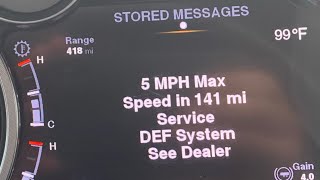
- Engine Derate (Limp Mode) — Your truck's power and speed will be significantly reduced in stages. You may see messages like "Stop Engine Now" or a countdown to a 5 mph speed limit.
- Visible DEF Leaks or Crystals — You might see white, crusty crystal formations on or around the DEF system components, especially at the injector nozzle or line connections, which is a sure sign of a leak.
- Audible Buzzing from DEF Pump — You may hear the DEF pump, typically located on top of the DEF tank, running continuously or buzzing loudly as it struggles to build pressure. A healthy pump should prime and then quiet down.
- Frequent Forced Regenerations — The truck may constantly request parked regenerations because the aftertreatment system isn't working efficiently without proper DEF flow, leading to faster soot accumulation in the DPF.
Diagnosis Steps

- Check for Other Fault Codes
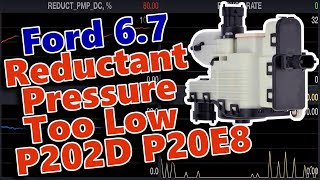
Use an OBD-II scanner to see if other codes are present. Codes like P3912 (Unable to Prime), P3926 (Pressure Too High), or DEF heater codes can help pinpoint the problem. On Ford models, P202D (Reductant Leakage) often appears with P20E8.
Tools: OBD-II Scanner for heavy trucks (beginner) - Inspect the DEF Tank and Fluid
Check the DEF level and ensure the fluid is clear and free of contamination. Low-quality or contaminated fluid can cause system-wide problems.
Tools: Flashlight, DEF Refractometer (optional) (beginner) - Visual Inspection for Leaks
Carefully inspect the DEF pump, lines, and dosing injector for any signs of leaks or white crystal buildup. A leak is a direct cause of low pressure.
Tools: Flashlight, safety glasses (beginner) - Inspect the DEF Dosing Valve Inlet Screen
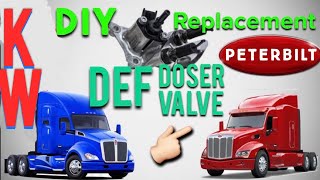
On affected models (especially 2017-2018 PACCAR), 🎬 See this walkthrough for replacing the DEF dosing valve. remove the DEF line at the dosing valve and check the small inlet screen for debris. A clogged screen is a known issue and a very common cause of this code.
Tools: Wrenches, catch pan, safety glasses (intermediate) - Replace the DEF Pump Filter
The main DEF pump filter is a maintenance item. If it hasn't been changed recently, replacing this inexpensive part can often solve pressure issues.
Tools: Filter wrench or large socket, catch pan, new DEF filter (intermediate) - Test DEF Pump Function & Duty Cycle
Using a diagnostic tool, command the DEF pump to prime and perform a leak test. Monitor the live pressure data; it should build to and hold around 73 PSI (500 kPa). Simultaneously, monitor the pump's duty cycle. A healthy pump should reach pressure with a duty cycle under 30%. If the duty cycle exceeds 50-80% while struggling to build or maintain pressure, the pump is weak or there's a significant leak.
Tools: Heavy-duty diagnostic scanner (advanced) - Verify DEF System Pressure with Live Data
Connect a diagnostic scanner and monitor the DEF pressure PID. With the key on, engine off, command the pump on. The pressure should meet manufacturer specifications. For PACCAR, target is ~73 PSI (5 Bar). 🎬 Watch: How to troubleshoot and verify proper system pressure. For Ford 6.7L, expect 60-87 PSI. For Cummins 6.7L, look for 75-90 PSI. If pressure fails to reach the minimum threshold, it confirms a flow/pressure problem (pump, filter, leak) rather than a sensor issue.
Tools: Heavy-duty diagnostic scanner (advanced) - Inspect and Clean DEF Injector
Remove the DEF injector from the exhaust. Inspect the nozzle for white crystal buildup. A heavily crystallized injector can be cleaned with hot distilled water and a soft brush. While removed, you can also perform a continuity test on the injector's electrical pins; for a Ram Cummins, for example, a reading between 12-14 ohms is expected.
Tools: Wrenches, hot distilled water, soft brush, multimeter (advanced) - Check Wiring and Connectors
Disconnect the harness at the DEF pump and pressure sensor. Check for battery voltage and ground on the appropriate pins as per the manufacturer's wiring diagram. Inspect pins for corrosion or damage. A load test on the power and ground circuits can confirm the wiring's integrity under operating conditions.
Tools: Multimeter, wiring diagram, test light or power probe (professional)
Common Fixes & Costs

- Clean or Replace DEF Dosing Valve Inlet Screen — Parts: $5-$20 (for screen), or included with dosing valve, Labor: $100-$200 (labor only) (intermediate)
- Replace DEF Pump Module — Parts: $450-$1,300, depending on make and if OEM or aftermarket., Labor: $200-$400 (labor only) (professional)
- Replace DEF Pump Filter — Parts: $20-$60., Labor: $50-$100 (labor only) (diy)
- Replace DEF Dosing Valve (Injector) — Parts: $250-$900, Labor: $150-$300 (labor only) (intermediate)
- Repair or Replace DEF Line — Parts: $150-$400, Labor: $100-$200 (labor only) (intermediate)
Most Commonly Affected Vehicles
- Peterbilt 579, 389 (2017-2018) — Specifically mentioned in Technical Service Bulletin E222 for having issues with plugged DEF dosing valve screens due to corrosion from the DEF heater.
- Kenworth T680 (2017-2018) — Shares the same PACCAR MX-11/MX-13 engine and aftertreatment components as the Peterbilt 579, making it prone to the same DEF screen clogging issue per TSB E222.
- Ford F-250 / F-350 / F-450 Super Duty (2011-2017) — Logs generic code P20E8. TSB 17-0020 notes that on 2017 models, this can be caused by trapped air or loose line connections. Owners often report replacing the pump multiple times when the root cause is a bad sender or other issue. Repair costs can be very high, leading some to consider full system delete kits.
- Chevrolet / GMC Silverado / Sierra 2500HD/3500HD (2017-2020) — On Duramax L5P engines, this appears as P20E8. GM Service Bulletin PIP5431 advises replacing the pump if it is not the updated part number. Bulletin 20-NA-110 highlights a critical quirk where a new pump may not build pressure until it has soaked in DEF overnight.
- Ram 2500 / 3500 (2013-2020) — Uses code P20E8. A very common issue on the 6.7L Cummins is DEF crystallization on the injector tip, causing a blockage. Many owners have avoided a $3,000 dealer bill by simply removing and cleaning the injector with hot distilled water.
- Nissan Titan XD (2016-2019) — Equipped with a 5.0L Cummins engine, these trucks are known for DEF system problems, including pump failures that lead to low pressure (P20E8) and derates.
- Volkswagen Passat / Touareg / Golf TDI (2012-2015) — Logs P20E8 for low AdBlue pressure. A VW Tech Bulletin points to faulty welds on the reductant line connector as a potential cause for leaks. Cleaning a crystallized injector is also a common, simple fix.
- BMW X5 35d / 328d (2014-2018) — Logs P20E8. These models use a complex two-tank 'Active' and 'Passive' DEF system. A failure of the transfer pump that moves fluid from the passive to the active tank can cause this fault. Diagnosing this system is complex and often requires replacing the entire active tank assembly if a sensor fails.
Manufacturer-Specific Notes
- PACCAR (Kenworth/Peterbilt): A known issue for 2017-2018 models with MX-11 and MX-13 engines is that corrosion on the DEF pump's heating element can flake off and clog the dosing valve's inlet screen, directly causing fault codes P3857, P3912, and P3926. This is documented in PACCAR Technical Service Bulletin E222.
- General Motors (Chevrolet/GMC): Per TSB 20-NA-110, after replacing a DEF pump on models like the Silverado/Sierra with Duramax engines, the pump may fail to build pressure. This can be due to the new pump's internal filter being dry from sitting on a shelf. The fix is to let the vehicle sit overnight with DEF in the tank to allow the filter to become saturated before re-testing.
- Ford: On 6.7L Power Stroke engines, TSB 17-0020 for the 2017 model year indicates that code P20E8 can be set simply due to trapped air in the reductant lines or loose connections, not necessarily a failed pump. The recommended procedure involves checking connections before replacing the pump assembly.
- BMW: BMW has issued extended warranties (typically 10 years / 120,000 miles) for several emissions-related components on its N47 and N57 diesel engines, including the high-pressure fuel pump and diesel particulate sensor. While not directly for the DEF pump, failures of these components can cause complex diagnostic situations. Owners report that coverage for collateral damage (e.g., a failed pump contaminating the whole system) is handled by BMW on a case-by-case basis and is not guaranteed.
Related Codes
- P20E8 — This is the generic SAE code for "Reductant (DEF) Pressure Too Low." P3857 is PACCAR's manufacturer-specific version. Diagnostically, they point to the exact same set of problems (bad pump, leaks, clogs) but are seen on different vehicle makes like Ford, GM, and Ram.
- P3912 — P3912 means "Unable to prime," while P3857 means pressure is low after priming. To differentiate, listen during a commanded prime. If the pump runs continuously without building pressure, suspect P3857 (leak, weak pump). If the pump runs briefly and stops, or doesn't run at all, suspect P3912 (major blockage, empty tank, air in lines, or electrical failure preventing the pump from running).
- P3926 — P3926 means "Pressure too high." This is the opposite of P3857. P3926 points to a blockage *after* the pressure sensor, such as a clogged DEF injector or a frozen line, causing pressure to spike. P3857 points to a problem *before* or at the pump, like a leak or failed pump, preventing pressure from building.
- P3859 — P3859 means the "DEF dosing valve - Not responding or out of adjustment." A dosing valve stuck open could cause P3857 because the system can't build pressure. A valve stuck closed would more likely cause a high-pressure fault (P3926). If you have both P3857 and P3859, the dosing valve is the primary suspect.
DIY vs Professional
- Clean or Replace DEF Dosing Valve Inlet Screen — Beginner:
Tools: Filter wrench or large socket, catch pan, new filter, safety glasses. - Replace DEF Pump Module — Beginner:
Tools: Basic wrench/socket set, soft brush (toothbrush), bowl, hot distilled water, new gasket/O-ring, safety glasses. - Replace DEF Pump Filter — Beginner:
Tools: Basic wrench/socket set, torque wrench, new injector and gasket. - Replace DEF Dosing Valve (Injector) — Beginner:
Tools: Extensive socket/wrench set, floor jack and jack stands, line disconnect tools, diagnostic scanner (for priming/testing).
Climate & Environmental Factors
- Cold Weather: DEF freezes around 12°F (-11°C). If the system's heaters fail, frozen fluid blocks lines and the pump, preventing pressure generation and triggering P3857. This can also promote physical crystallization as the water freezes and separates from the urea.
- High Heat: Sustained temperatures above 86°F (30°C) accelerate the degradation of DEF. The water component evaporates, leaving behind concentrated urea which forms performance-inhibiting crystals in the tank, lines, and pump.
- High Humidity: If the DEF tank or storage container is not properly sealed, the fluid can absorb moisture from the air. This dilutes the DEF, altering the precise 32.5% urea concentration required for proper SCR function and potentially leading to crystallization.
- High Altitude: Reduced air density at high altitudes leads to less efficient combustion and increased soot production. This forces the entire aftertreatment system (DPF and SCR) to work harder. While it doesn't directly cause low DEF pressure, it increases the demand on the system, which can expose underlying weaknesses and make DPF regeneration cycles less effective.
Frequently Asked Questions
Can I clear the P3857 code and keep driving?
You can clear the code with a scanner, but it will return quickly if the underlying mechanical or electrical problem isn't fixed. Ignoring it will lead to a severe engine derate where your speed is limited to 5 mph.
What is a common misdiagnosis for P3857?
A very common misdiagnosis is immediately replacing the expensive DEF pump without first checking for simpler issues. Technicians often find the actual problem was a clogged inlet screen at the dosing valve, a crystallized injector nozzle, a loose electrical connector, a popped-off DEF line, or a clogged filter.
I replaced the DEF pump but the code came back. What now?
If a new pump didn't fix it, the problem is elsewhere. Re-check for clogged filters or screens, inspect DEF lines for small leaks, and verify the wiring. On GM trucks, a new pump may have a dry internal filter and needs to be soaked in DEF overnight before it will prime correctly. On Fords, owners have reported chasing the issue by replacing multiple pumps when the real problem was a faulty DEF sender unit.
Can cold weather cause a P3857 code?
Yes. DEF fluid can freeze at approximately 12°F (-11°C). The system has heaters to prevent this, but if a heater fails, the frozen fluid will block the lines or pump. This prevents the system from building pressure on startup, triggering the P3857 code. Often, a DEF heater fault code will be present as well.
What is the difference between a low DEF warning and a P3857 fault?
A 'Low DEF' warning is a simple fluid level notification, like a low fuel light. You just need to add more DEF. A P3857 fault is a mechanical or electrical problem. It means you have plenty of DEF in the tank, but the system is unable to build enough pressure to inject it into the exhaust, indicating a failed part like a pump, a leak, or a blockage.
What does 'engine derate' mean?
Engine derate is a safety measure programmed into your truck's computer. To prevent damage and ensure emissions compliance, it reduces the engine's power and limits your speed when a critical fault like low DEF pressure is detected.
How often should I change my DEF filter?
While there isn't a single universal interval, it is a critical maintenance item that is often overlooked. Many technicians recommend inspecting or changing it at every fuel filter service interval or any time you experience aftertreatment system issues. A clogged filter is a common and inexpensive fix for pressure problems.
Helpful Videos

The information in this article is provided for general reference and educational purposes only. Vehicle specifications, procedures, and part compatibility can vary by production date, trim level, and region. Always consult your vehicle's factory service manual and verify part numbers before purchasing or performing repairs. Safety-critical components such as airbags, seat belts, and braking systems should be installed by a qualified professional.
- 🎬 Helpful Videos
- What Does P3857 Mean?
- Can I Drive With P3857?
- Common Causes
- Symptoms
- Diagnosis Steps
- Common Fixes & Costs
- Most Commonly Affected Vehicles
- Manufacturer-Specific Notes
- Related Codes
- DIY vs Professional
- Climate & Environmental Factors
- Frequently Asked Questions
- Can I clear the P3857 code and keep driving?
- What is a common misdiagnosis for P3857?
- I replaced the DEF pump but the code came back. What now?
- Can cold weather cause a P3857 code?
- What is the difference between a low DEF warning and a P3857 fault?
- What does 'engine derate' mean?
- How often should I change my DEF filter?
- 🎟️ Get 5% Off