

OBD-II Code P3797: Diesel Particulate Filter (DPF) Soot Level Moderately Severe
What P3797 means, why it triggers, and how to fix it on Paccar and Cummins heavy-duty diesel engines.
- P3797 (SPN 3251 FMI 15) triggers on Paccar and Cummins engines when the Diesel Particulate Filter (DPF) soot load reaches a moderately severe 70-85% capacity.
- Safely pull over and initiate a 20-to-60-minute parked regeneration immediately to prevent a mandatory 5-mph engine derate.
- Ignoring P3797 escalates the fault to P3796, locking out manual regeneration and forcing a $3,000 to $12,000 DPF replacement or professional bake.
- If a parked regeneration fails, diagnose the 7th injector (doser) for carbon clogs and verify the DPF differential pressure sensor reads 0.0 PSI with the engine off.
What Does P3797 Mean?

P3797 is a manufacturer-specific code for Paccar and Cummins engines (corresponding to SPN 3251 FMI 15) indicating the Diesel Particulate Filter (DPF) soot level has reached a moderately severe capacity. The Engine Control Module (ECM) requires an immediate parked regeneration to burn off the accumulated soot.
Technical definition: Aftertreatment DPF Soot Load - Moderately Severe. Note: Generic OBD-II databases incorrectly list this as 'Engine Shutoff Solenoid A Control Circuit'. Ignore generic definitions; on heavy-duty diesels, P3797 strictly relates to DPF soot load.
Can I Drive With P3797?
No — Do Not Drive. Stop driving immediately. P3797 indicates a moderately severe DPF soot load. Ignoring it triggers a progressive engine derate, limiting speed to 5 mph, and culminates in a complete engine shutdown. Continuing to drive risks melting the DPF substrate, adding $3,000 to $12,000 to the repair cost.
Common Causes

- DPF Requires Parked Regeneration (Very Common) — The DPF has trapped enough soot to require a stationary burn-off. This is naturally caused by extended idling, short trips, or a driver repeatedly canceling automatic regeneration requests.
- Clogged 7th Injector (Dosing Module) (Common) — The dedicated exhaust fuel injector nozzle is clogged with carbon. 🎬 See how to clean a clogged Paccar MX13 dosing module. This prevents the system from injecting fuel into the exhaust stream to raise temperatures enough to burn off soot.
- Failed Exhaust Gas Temperature (EGT) Sensor (Common) — A temperature sensor providing low or out-of-range voltage prevents the ECM from accurately monitoring exhaust heat, causing it to abort the regeneration process.
- Faulty DPF Differential Pressure Sensor (Less Common) — The sensor or its connecting hoses are clogged with soot or cracked. This causes the sensor to falsely report a high soot level to the ECM, triggering the code even if the filter is clean.
- Upstream Engine Faults (EGR or Boost Leaks) (Less Common) — A malfunctioning EGR valve, leaking fuel injector, or cracked charge air hose creates an overly rich fuel mixture. This produces excessive black smoke, overloading the DPF faster than it can regenerate.
- Damaged Aftertreatment Wiring (Rare) — Corrosion, heat damage, or physical breaks in the wiring harness cause open or short circuits in the sensor network, feeding bad data to the ECM.
Symptoms

- Dashboard Warnings (CEL, DPF Light, Regen Messages) — The Check Engine Light illuminates, the DPF status light flashes, and the dashboard displays a 'Regen Required' or 'Soot Level High' message.
- Engine Power Derate — The ECM limits engine power and vehicle speed to prevent DPF damage. This derate becomes progressively worse if the code is ignored.
- Excessive Black Smoke During Regen — A malfunctioning 7th injector sprays fuel incorrectly, causing visible black smoke from the exhaust stack during a regeneration attempt.
- Frequent or Failed Regenerations (also visible on scanner) — The truck constantly attempts regeneration but fails to complete the cycle because the ECM aborts the process due to bad sensor data or lack of heat.
- High DPF Differential Pressure (Engine Off) (scan-tool only — no driver-felt sign) — Scan tool live data shows a non-zero pressure reading when the engine is off, indicating a biased or failed differential pressure sensor. 🎬 Watch: How to test and diagnose a DPF differential pressure sensor.
Diagnostic Flowchart
Tap your situation to follow the diagnostic path that matches what you're seeing on this code.
Common Fixes & Costs
- Perform a Parked DPF Regeneration — Parts: $0, Labor: $0 - $250 (if forced at a shop), ~1.0 hr book time (DIY)
- Clean or Replace 7th Injector (Doser) — Parts: $20 - $600, Labor: $150 - $300, ~1.5 hr book time (Intermediate)
- Replace DPF Differential Pressure Sensor — Parts: $100 - $250, Labor: $100 - $150, ~1.0 hr book time (Intermediate)
- Replace Exhaust Gas Temperature Sensor — Parts: $125 - $250, Labor: $100 - $200, ~1.0 hr book time (Intermediate)
- Professionally Clean or Replace DPF — Parts: $600 - $8,000+, Labor: $400 - $800, ~4.5 hr book time (Professional)
DIY vs Professional
- Perform a Parked DPF Regeneration — Beginner:
Tools: Vehicle's regeneration switch. - Replace DPF Differential Pressure Sensor — Beginner:
Tools: Wrench/socket set, pliers for hose clamps, safety glasses, scan tool. - Clean or Replace 7th Injector (Doser) — Beginner:
Tools: Wrench/socket set, gaskets, parts cleaner, diagnostic scan tool. - Replace Exhaust Gas Temperature Sensor — Beginner:
Tools: Sensor socket set, torque wrench, penetrating oil, anti-seize compound. - Professionally Clean or Replace DPF — Beginner:
Tools: Professional DPF baking equipment, heavy-duty jacks, advanced diagnostic scan tool.
Used vs. New Parts: Buying Guide
When a used part is worth it: Buy new OEM for electronic sensors. A professionally cleaned and tested used 7th injector is an acceptable budget option. Never buy a used DPF unless it is a certified, flow-tested remanufactured unit with a warranty.
Donor-vehicle mileage cap: roughly under 50000 miles for the part to have meaningful remaining life.
Donor quality checklist:
- Verify the exact part number, as multiple revisions exist.
- Avoid sensors from high-mileage vehicles.
- Demand a flow test report for any remanufactured DPF.
Decision logic:
- If The part is an electronic sensor (temperature, pressure) → Buy new OEM. The labor cost to replace a failed used sensor outweighs the initial savings.
- If The part is a 7th injector/doser → A professionally cleaned used part is acceptable, but a new or remanufactured unit is preferred for reliability.
- If The part is the DPF assembly → Professionally bake your existing filter first. If replacement is necessary, buy a new or certified remanufactured unit.
Warranty tradeoff: Used parts offer a 30-day warranty at best. New OEM parts carry a 1-year or longer warranty, especially if installed by a dealer.
Worst-case if a used part fails: $500-$1500 if a used part fails, factoring in repeat labor and vehicle downtime.
What Happens If You Wait — Timeline
- 0-1 day: Code P3798 appears. Solid DPF light requests a parked regen. No performance loss. (MPG impact: 0%% · Added cost: $0)
- 1-3 days: Code escalates to P3797. DPF light flashes. A 25% engine power derate begins. (MPG impact: 3-5%% · Added cost: $50-$150 in wasted fuel and lost time.)
- 3-7 days: Code escalates to P3796. Red 'Stop Engine' light illuminates. Engine is derated to 5 mph 'limp mode'. (MPG impact: 10-25%% · Added cost: $300-$800 for a mandatory tow and forced DPF cleaning.)
- 1+ week: Extreme backpressure melts the DPF substrate and damages turbocharger seals and EGR components. (MPG impact: >25%% · Added cost: $3,000 - $15,000+ to replace the DPF and repair engine damage.)
Cost of Not Fixing It

- 0-1 week: Progressive engine derate and failed regeneration attempts. (Added cost: $50-$200 in wasted fuel and lost time.)
- 1-4 weeks: DPF becomes critically clogged (P3796), requiring a forced regeneration at a shop. (Added cost: $300-$800 for forced regen and sensor replacement.)
- 1+ month: Irreversible DPF melting and potential damage to the turbocharger and EGR system due to extreme backpressure. (Added cost: $3,000 - $15,000+ for DPF replacement and engine repair.)
Diagnosis Steps
- Read Fault Codes and Live Data
Use a heavy-duty scanner to confirm P3797 (SPN 3251 FMI 15). Check for upstream codes (like EGR or fuel shutoff faults) that must be fixed before addressing the DPF.
Tools: Heavy-duty OBD-II Scanner (Intermediate) - Attempt a Parked Regeneration
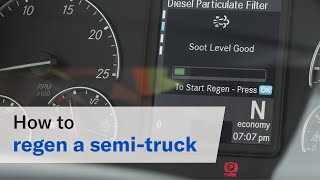
Park safely away from flammables, set the parking brake, and activate the dash regen switch. If it completes successfully (20-60 minutes), the issue was normal soot buildup.
Tools: Vehicle's regen switch (Beginner) - Analyze DPF Pressure with a Scan Tool
Monitor the 'DPF Differential Pressure' PID. It must read 0.0 PSI with the key on, engine off. At high idle, readings over 3.0 PSI indicate a severely clogged filter requiring professional baking.
Tools: Advanced diagnostic scan tool (Advanced) - Inspect and Test the 7th Injector (Doser)
Remove the 7th injector from the exhaust pipe. Inspect the nozzle for carbon buildup. Command a spray test via the scan tool to verify the spray pattern and check for leaks.
Tools: Basic hand tools, parts cleaner, soft brush, diagnostic scan tool (Advanced) - Test DPF Differential Pressure Sensor Voltage
Back-probe the sensor with the key on, engine off. Verify a 5V reference and 0V ground. The signal wire should read between 0.5V and 0.8V depending on OEM specifications.
Tools: Multimeter, back-probe kit, service manual (Advanced) - Test Exhaust Gas Temperature (EGT) Sensors
Monitor EGT sensors via the scan tool during a forced regen. Temperatures must rise smoothly. A sensor stuck at a default value (e.g., 32°F or 1800°F) is faulty and must be replaced.
Tools: Advanced diagnostic scan tool, service manual (Advanced) - Smoke Test the Charge Air System
Use a smoke machine on the intake piping between the turbocharger and the engine intake. Fix any boost leaks causing rich fuel mixtures and excess soot production.
Tools: Smoke machine (Professional)
When This Code Triggers (Freeze-Frame Conditions)
- Engine Coolant Temp: 185-200°F (Fully warmed up, required for regeneration.)
- Soot Load Percent: 70-85% (DPF is reaching capacity, triggering the regen request.)
- Time Since Last Regen: > 10 hours (Extended operation without a successful regeneration cycle.)
- Vehicle Speed: < 5 mph (Code often sets after extended idle or low-speed driving prevents passive regeneration.)
Related Codes
- P3798 — Indicates the first stage of high soot level (SPN 3251 FMI 16). This is the initial request for a parked regen before escalating to P3797.
- P3796 — Indicates critically high soot (SPN 3251 FMI 0). The ECU locks out all regeneration. Requires immediate professional service and a forced regen.
- P1496 — Indicates an EGR fault. An active EGR code prevents regeneration and causes excessive soot. Fix this before addressing P3797.
- P3834 — Indicates a Fuel Shutoff Valve fault. This valve supplies the 7th injector. A fault here prevents regeneration and directly causes P3797.
Climate & Environmental Factors
- High Altitude: Lower oxygen density creates richer combustion, producing more soot and overloading the DPF faster than normal.
- Cold Weather & Extended Idling: Prevents the exhaust from reaching the 570°F+ required for passive regeneration, forcing the need for manual parked regens.
How to Talk to a Mechanic About This Code
Say this: "My truck has code P3797 (SPN 3251 FMI 15) and a flashing DPF light. A parked regen failed to complete. Please check live data for the DPF differential pressure sensor and test the 7th injector before assuming the DPF needs replacement."
This provides the exact fault code and directs the technician toward a logical diagnostic process (checking sensors and doser function) rather than jumping to an expensive DPF replacement.
Avoid saying:
- 'My check engine light is on, can you just fix it?'
- 'The truck says it needs a regen, just do a forced regen.'
- 'Just do whatever it takes to get me back on the road.'
Questions to ask before authorizing the repair:
- What were the DPF differential pressure readings at idle and high idle?
- Did you inspect the 7th injector (doser) for carbon buildup and test its function?
- Were all exhaust gas temperature sensors reading correctly during the regen attempt?
- Are there any other fault codes present for the EGR system or turbo?
Where to Take It: Dealer vs Independent vs Chain
- Dealer:
Recommended if the truck is under warranty or if independent shops fail to find the root cause.
Best for: Vehicles under engine or emissions warranty., Complex issues requiring manufacturer-specific software updates., Access to proprietary diagnostic tools like Paccar Davie4 or Cummins Insite.
Downsides: Highest labor rates., May default to replacing entire assemblies rather than repairing components. (Typical cost: +40% vs. baseline) - Independent Shop:
Excellent fit, provided it's a reputable heavy-duty diesel specialist. Ensure they can force a regen and reset the system.
Best for: Out-of-warranty trucks where cost is a factor., Common failures like sensor replacement or 7th injector cleaning., Shops specializing in heavy-duty diesel with professional multi-brand tools.
Downsides: Diagnostic capability varies widely., May lack access to the latest OEM software updates. (Typical cost: +0% vs. baseline) - Chain Shop:
Avoid for initial diagnosis. Acceptable only for sending out a DPF for cleaning after a proper diagnosis.
Best for: Standalone services like professional DPF baking., Tire and light mechanical work.
Downsides: Not equipped for complex root-cause diagnosis of aftertreatment systems. (Typical cost: -10% vs. baseline)
When to Walk Away From the Repair
Consider replacement when annual repair costs consistently exceed the annual payments on a newer truck, or when unpredictable downtime threatens revenue.
- Car worth $80000, fix is $4500: Fix it. This is a standard repair cost for a revenue-generating asset and is well below the replacement threshold.
- Car worth $35000, fix is $12000: Borderline. Analyze the last 12 months of repair costs. If other major repairs are looming, consider replacement.
- Car worth $20000, fix is $15000: Walk away. The repair cost approaches the truck's market value. It is not financially sound to invest this much into an older asset.
What Scan Tool You Need for This Code

Minimum: A heavy-duty scanner supporting J1939 protocols that reads manufacturer-specific fault codes (SPN/FMI), views live aftertreatment data, and performs a DPF forced regeneration.
A standard passenger car OBD-II scanner cannot communicate with heavy-duty truck systems, cannot read the correct codes, and cannot command a DPF regeneration.
Budget: None Recommended (~$0) — No credible heavy-duty diagnostic tools exist in this price range.
Mid-range: FOXWELL HD500 / ANCEL HD3300 (~$350-480) — Entry-level heavy-duty tools. They read codes and show live data, but their ability to successfully command a DPF regen is inconsistent.
Professional: OTR Diagnostics / ANCEL HD8000 (~$500-1200) — The sweet spot for owner-operators. Provides reliable multi-brand coverage for reading codes, viewing live data, and successfully commanding a parked DPF regeneration.
Rent vs buy: Buying a tool in the $500-$1200 range is a smart investment for an owner-operator. A single avoided tow pays for the tool.
How to Clear the Code After You Fix It
- Address the root cause (e.g., perform regen, replace sensor).
- Use a heavy-duty OBD-II scan tool to clear the fault code.
- Perform a DPF system reset if a new component was installed.
- Initiate a test drive that includes highway speeds to verify the repair.
Drive cycle (~45 minutes): Perform a successful 20-60 minute parked regeneration. Follow with a 20-minute drive at highway speeds (>45 mph) to confirm system operation and set readiness monitors.
Readiness monitors affected: Catalyst Monitor, Exhaust Gas Sensor Monitor
Before emissions retest: drive at least 100 miles to fully set monitors.
Watch out for:
- Clearing the code without performing a regeneration causes the code to return immediately.
- Failing to perform a scan tool system reset after replacing the DPF or pressure sensor leads to incorrect readings.
- Shutting off the truck before a parked regeneration completes fully.
Will This Fail Emissions / State Inspection?
Yes — this code typically fails an OBD-II emissions inspection.
- California: An active Check Engine Light results in an automatic failure of a smog inspection. All readiness monitors must be set to 'Ready'.
- New York: A vehicle with an illuminated Malfunction Indicator Lamp (MIL) due to an emissions fault will fail the NYS inspection.
- Texas: Commercial heavy-duty trucks are subject to inspection, and an active emissions-related fault code results in a failure.
Most Commonly Affected Vehicles
- Peterbilt Models with Paccar MX-11 / MX-13 engines (2013-Present) — EPA2013 and newer models have strict maintenance schedules for aftertreatment components.
- Kenworth Models with Paccar MX-11 / MX-13 engines (2013-Present) — Uses the identical Paccar powertrain and aftertreatment system as Peterbilt.
- Cummins ISX, X15, ISB engines (2010-Present) — Uses the SPN 3251 FMI 15 designation for a moderately severe DPF soot load, translating to P3797 on OBD-II scanners.
- DAF LF, CF, XF with Paccar MX engines (2013-Present) — European Paccar-owned brand utilizing the same MX series engines and aftertreatment logic.
Manufacturer-Specific Notes
- Paccar (Peterbilt, Kenworth): Paccar uses a strict sequence of codes (P3798, P3797, P3796) to indicate increasing soot severity. The system relies heavily on a 7th injector that frequently clogs but can often be cleaned rather than replaced.
- Cummins: Cummins uses the exact same SPN/FMI code (3251/15) as Paccar for this fault. The diagnostic principles and sensor testing procedures are identical.
Real Owner Stories
2019 Kenworth T680 with Paccar MX-13
Check engine light and DPF warning appeared, but the truck would not perform a parked regen.
Outcome: Diagnostics revealed a code for the 7th injector (doser). The mechanic replaced the injector, cleared the codes, and initiated a successful forced regen roadside, avoiding a tow.
Lesson: If a parked regen is inhibited, the cause is often a failed component required for regeneration, like the 7th injector, rather than the DPF itself.
Peterbilt with Cummins ISX engine
P3797 returned shortly after a forced regen. The DPF had been cleaned 10,000 miles prior.
Outcome: A technician diagnosed a biased DPF differential pressure sensor giving the ECM false high readings. Replacing the sensor and resetting the system resolved the recurring codes.
Lesson: When a DPF code returns quickly after a cleaning, suspect a faulty DPF differential pressure sensor tricking the ECM.
Paccar MX-13 with P3797 and P3834 codes
The truck repeatedly showed a DPF soot level code (P3797) alongside a fuel shutoff valve code (P3834).
Outcome: A faulty shutoff valve was preventing the 7th injector from getting fuel. Replacing the valve and cleaning the 7th injector fixed both codes.
Lesson: Always diagnose upstream fault codes first. A fuel system fault (P3834) was the root cause of the DPF's inability to regenerate (P3797).
2023 Peterbilt with EGR codes
The truck showed EGR-related fault codes, leading to excessive soot and DPF issues.
Outcome: The owner found a break in the flexible exhaust mesh pipe. This leak prevented backpressure required for the EGR system, triggering false codes. Repairing the pipe resolved the issue.
Lesson: Perform a thorough visual inspection for exhaust leaks before replacing expensive components like an EGR valve or DPF.
How to Prevent This Code From Triggering
- Avoid extended idling (Daily habit) — Idling produces low exhaust temperatures insufficient for passive regeneration, leading to rapid soot accumulation.
- Use high-quality ULSD and low-ash engine oil (Every fill-up and oil change) — Poor fuel and incorrect oil increase non-burnable ash, permanently clogging the DPF over time.
- Perform regular highway driving (Weekly) — Sustained highway speeds generate the 570°F+ exhaust temperatures needed for passive regeneration.
- Clean the 7th Injector (HC Doser) (Annually) — The doser nozzle is prone to carbon buildup. Annual cleaning ensures it sprays fuel correctly to start a regen.
- Follow OEM DPF cleaning intervals (Per maintenance schedule (e.g., 200k miles)) — Adhering to the manufacturer's schedule for professional DPF baking prevents catastrophic clogging.
Frequently Asked Questions
Why did my truck show a P3797 code?
Your Diesel Particulate Filter (DPF) has collected a moderately severe level of soot. The engine computer requires an immediate parked regeneration to burn it off safely.
Can I ignore P3797 and keep driving?
No. Ignoring it triggers a severe engine derate, limiting speed to 5 mph. It eventually forces an engine shutdown and causes irreversible DPF damage.
What is a parked regen and how do I do it?
A parked regeneration is a stationary, high-temperature exhaust cleaning cycle. Park away from flammables, set the parking brake, and press the dash regen switch. The automatic process takes 20 to 60 minutes.
Is P3797 related to cylinder deactivation or a shutoff solenoid?
No. Generic OBD-II scanners often misinterpret heavy-duty codes. On Paccar and Cummins engines, P3797 strictly indicates a DPF soot load issue.
My regen won't start or the code came back immediately. Why?
This indicates a hardware failure preventing regeneration. Common culprits include a clogged 7th injector, a failed exhaust temperature sensor, or an upstream EGR fault.
What is the most common misdiagnosis for P3797?
Replacing the $3,000+ DPF assembly without testing the sensors first. Faulty differential pressure sensors or clogged 7th injectors frequently trigger this code while the DPF itself is fine.
I did a forced regen and the code cleared, but returned 100 miles later. Why?
This proves an upstream engine problem is creating excessive soot. A failing EGR valve, leaking fuel injectors, or a turbo boost leak is overloading the working DPF system.
What does SPN 3251 FMI 15 mean?
This is the SAE standard J1939 code that translates to P3797 on OBD-II scanners. SPN 3251 identifies the DPF Differential Pressure, and FMI 15 means the soot load is moderately severe.
Key Takeaways
- P3797 (SPN 3251 FMI 15) triggers on Paccar and Cummins engines when the Diesel Particulate Filter (DPF) soot load reaches a moderately severe 70-85% capacity.
- Safely pull over and initiate a 20-to-60-minute parked regeneration immediately to prevent a mandatory 5-mph engine derate.
- Ignoring P3797 escalates the fault to P3796, locking out manual regeneration and forcing a $3,000 to $12,000 DPF replacement or professional bake.
- If a parked regeneration fails, diagnose the 7th injector (doser) for carbon clogs and verify the DPF differential pressure sensor reads 0.0 PSI with the engine off.
Helpful Videos

The information in this article is provided for general reference and educational purposes only. Vehicle specifications, procedures, and part compatibility can vary by production date, trim level, and region. Always consult your vehicle's factory service manual and verify part numbers before purchasing or performing repairs. Safety-critical components such as airbags, seat belts, and braking systems should be installed by a qualified professional.
- 🎬 Helpful Videos
- What Does P3797 Mean?
- Can I Drive With P3797?
- Common Causes
- Symptoms
- Diagnostic Flowchart
- Common Fixes & Costs
- DIY vs Professional
- Used vs. New Parts: Buying Guide
- What Happens If You Wait — Timeline
- Cost of Not Fixing It
- Diagnosis Steps
- When This Code Triggers (Freeze-Frame Conditions)
- Related Codes
- Climate & Environmental Factors
- How to Talk to a Mechanic About This Code
- Where to Take It: Dealer vs Independent vs Chain
- When to Walk Away From the Repair
- What Scan Tool You Need for This Code
- How to Clear the Code After You Fix It
- Will This Fail Emissions / State Inspection?
- Most Commonly Affected Vehicles
- Manufacturer-Specific Notes
- Real Owner Stories
- 2019 Kenworth T680 with Paccar MX-13
- Peterbilt with Cummins ISX engine
- Paccar MX-13 with P3797 and P3834 codes
- 2023 Peterbilt with EGR codes
- How to Prevent This Code From Triggering
- Frequently Asked Questions
- Why did my truck show a P3797 code?
- Can I ignore P3797 and keep driving?
- What is a parked regen and how do I do it?
- Is P3797 related to cylinder deactivation or a shutoff solenoid?
- My regen won't start or the code came back immediately. Why?
- What is the most common misdiagnosis for P3797?
- I did a forced regen and the code cleared, but returned 100 miles later. Why?
- What does SPN 3251 FMI 15 mean?
- Key Takeaways
- 🎟️ Get 5% Off