

OBD-II Code P3325: Ignition Circuit Power Supply Fault (Volkswagen & Audi)
What P3325 means, why it triggers, and how to fix it on your VW or Audi
- Swap the '460' power supply relay first; this $15-$30 part causes over 70% of P3325 faults and takes 5 minutes to test.
- Inspect the plenum and sunroof drains for standing water, as clogged drains flood the cabin and corrode the Terminal 15 electrical circuits.
- Never drive with an active P3325 code, as the sudden loss of Terminal 15 power instantly kills the engine, power steering, and power brakes.
- If a new relay fails to restore power, test the ignition switch and start authorization module (J764) for a missing 12V wake-up signal.
What Does P3325 Mean?

Code P3325 is specific to Volkswagen and Audi vehicles, indicating a voltage failure on 'Terminal 15'. Terminal 15 is the switched ignition circuit that powers the engine control module (ECM) and most cabin electronics. The ECM triggers this code when it detects the circuit voltage is below 11.0V, unstable, or completely missing.
Technical definition: Power Supply (B+) Terminal 15: Implausible Signal. The Engine Control Module (ECM) sets this manufacturer-specific code when it detects an invalid voltage reading from the main ignition-switched power supply (Terminal 15). The fault triggers if the measured module voltage drops below 11.0V for a sustained period or fluctuates when it requires steady battery voltage.
Can I Drive With P3325?
No — Do Not Drive. This fault causes your engine to stall without warning or fail to start entirely. Driving is strictly prohibited as you will become stranded or lose power in traffic. A sudden engine stall instantly disables power steering and power brake assistance, creating a severe safety hazard.
Common Causes

- Faulty Power Supply Relay (J329 / Relay '460') (Very Common) — The main power supply relay, labeled J329 or '460', fails internally due to worn contacts or a bad coil. This severs the connection, resulting in an intermittent or complete loss of power to the Terminal 15 circuit.
- Water Ingress and Corroded Fuse Boxes (Very Common) — Clogged plenum or sunroof drains force rainwater into the cabin, directly soaking fuse boxes, relay panels, and control modules. This moisture causes severe corrosion on terminals and relay sockets, creating high resistance and short circuits.
- Faulty Ignition Switch (Electrical Portion) (Common) — The electrical portion of the ignition switch wears out internally, leading to poor contacts. It fails to send the 12V wake-up signal to the Terminal 15 relay when the key turns, causing power loss.
- Corroded or Damaged Wiring (Common) — Wires leading to the fuse box, relay panel, or ignition switch chafe or break. This occurs frequently in the wiring harness near the steering column or under the driver's seat where relays are located.
- Weak or Failing Battery (Less Common) — A failing battery provides unstable voltage during engine cranking. This voltage drop falls below the ECM's 11.0V threshold, triggering a P3325 code even if the ignition circuit is healthy.
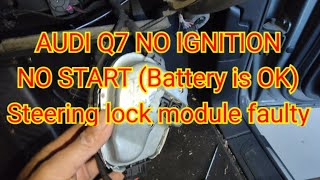
- Faulty Steering Column Control Module (J527) or Start Authorization Module (J764) (Less Common) — The J527 module reads the ignition key, and the J764 module authorizes the start. An internal failure prevents them from sending the activation signal to the Terminal 15 relay.
- Improperly Installed Aftermarket Electronics (Rare) — Poorly wired remote starters, alarms, or stereos tapped into the ignition circuit overload the wiring, create parasitic draws, or send stray voltage that confuses the ECM.
- Failing Engine Control Module (ECM) (Rare) — An internal fault in the ECM's power supply monitoring circuits causes it to incorrectly report a P3325 code when the voltage is actually stable.
Symptoms

- Engine will not start (no-crank or cranks but won't fire) — You turn the key and either nothing happens, or the engine turns over but never starts because the ECM and fuel system lack power.
- Engine stalls instantly while driving — The vehicle suddenly shuts off while driving, often while slowing down or at idle, as the power relay momentarily loses connection.
- Complete loss of power to accessories — The instrument cluster, radio, climate control, and power windows go completely dead or flicker erratically when turning the key to the 'ON' position.
- Multiple warning lights illuminate simultaneously — Because Terminal 15 powers numerous modules, the ABS, Airbag, EPC, and Check Engine lights appear at the same time when the circuit fails.
- Erratic engine idle speed — During an intermittent fault, the engine starts but the idle speed fluctuates irregularly as the ECM rapidly powers on and off.
Diagnostic Flowchart
Tap your situation to follow the diagnostic path that matches what you're seeing on this code.
Common Fixes & Costs
- Replace the Power Supply Relay (J329 / '460')
— Parts: $15-$30, Labor: $50-$100, ~0.5 hr book time
(DIY)
VW Passat / Golf / Jetta, Audi A3 / Q7: OEM - Address Water Ingress and Clean Contacts — Parts: $5-$20, Labor: $150-$500, ~2.5 hr book time (Intermediate)
- Replace the Ignition Switch (Electrical Portion)
— Parts: $40-$140, Labor: $200-$350, ~2.0 hr book time
(Intermediate)
VW Passat B6 / Golf Mk6: OEM
Audi Q7 (2007-2015): OEM - Repair Damaged Wiring Harness — Parts: $10-$50, Labor: $250-$1200+, ~5.0 hr book time (Professional)
- Replace Steering Column Control Module (J527)
— Parts: $150-$400, Labor: $250-$500, ~2.5 hr book time
(Professional)
VW Passat B6: OEM - Replace Engine Control Module (ECM) — Parts: $800-$1800, Labor: $1500-$2500+, ~1.5 hr book time (Professional)
DIY vs Professional
- Replace the Power Supply Relay (J329 / '460') — Beginner: True
- Address Water Ingress and Clean Contacts — Beginner: False
- Replace the Ignition Switch (Electrical Portion) — Beginner: False
- Repair Damaged Wiring Harness — Beginner: False
- Replace Steering Column Control Module (J527) — Beginner: False
Used vs. New Parts: Buying Guide
When a used part is worth it: Never buy a used '460' relay, as new ones are inexpensive. Used parts only make sense for expensive modules (J527) if the vehicle's value is low and you source from a reputable dismantler with an exact part number match.
Donor-vehicle mileage cap: roughly under 60000 miles for the part to have meaningful remaining life.
Donor quality checklist:
- Verify donor vehicle was not scrapped due to flood or electrical failure.
- Part number must be an exact match.
- Confirm the module does not have Component Protection or prepare for dealer programming.
Decision logic:
- If The part is a relay or switch under $150 → Always buy new. The savings are minimal and the risk is not worth the labor.
- If The part is a complex electronic module (J527, ECM) → Favor new or remanufactured. Used modules may be locked to the donor car's immobilizer.
- If Vehicle is over 15 years old and budget is tight → A used module with a return policy is acceptable, but factor in the risk of repeat labor costs.
Warranty tradeoff: Used parts offer 30-90 day warranties. New aftermarket parts offer 1-3 years. Remanufactured modules often include lifetime warranties but require core returns.
Worst-case if a used part fails: $500-$1000 if a used electronic module is faulty or non-programmable.
What Happens If You Wait — Timeline
- 0-2 weeks: Intermittent no-start or stall. The car usually starts on the second try. Check Engine Light illuminates. (MPG impact: 0%% · Added cost: $100-$300 (Towing cost if it fails to restart))
- 2 weeks - 3 months: Failure becomes frequent, especially in damp weather. Repeated start attempts with low voltage strain the battery. (MPG impact: 0%% · Added cost: $200-$500 (Cost of a new battery + towing))
- 3-6 months: Corrosion sets in on the relay panel. The fault is constant, and the vehicle is disabled. Voltage spikes damage other electronics. (MPG impact: N/A (Vehicle undrivable)% · Added cost: $400-$1500 (Cost to replace damaged Comfort Control Module or Instrument Cluster))
- 6+ months: Catastrophic corrosion migrates through the wiring harness. The relay box melts. Requires replacing entire harness sections and multiple modules. (MPG impact: N/A (Vehicle is a paperweight)% · Added cost: $1500-$5000+)
Cost of Not Fixing It
- Immediate: Vehicle fails to start or stalls while driving, resulting in being stranded. (Added cost: $100-$300 for towing.)
- 1-4 weeks: Repeated start attempts with intermittent faults cause voltage spikes, damaging sensitive electronics like the instrument cluster. (Added cost: $400-$1500 per damaged module.)
- 1+ month: Unresolved water ingress leads to catastrophic corrosion of wiring harnesses and control modules. (Added cost: $1200-$5000+ for harness and module replacements.)
Diagnosis Steps

- Swap the Power Supply Relay
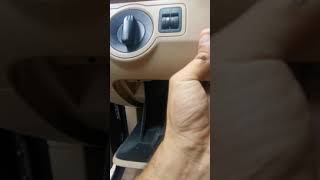
Locate the Terminal 15 power supply relay (labeled J329 or '460') under the driver's side dashboard, under the driver's seat, or in the engine bay. Swap it with an identical relay from a non-critical circuit (like the horn). If the vehicle starts, the original relay is faulty.
Tools: Trim removal tools (optional) (Beginner) - Check the Battery and Fuses
Verify the battery reads ~12.6V with the engine off. Inspect all fuses related to the ignition circuit and ECM in the cabin and engine bay fuse panels. A weak battery causes false low-voltage codes.
Tools: Multimeter, Fuse puller (Beginner) - Inspect for Water Intrusion
Inspect the plenum area under the windshield cowl and the sunroof drains. Look for standing water, debris, or damp carpets in the front footwells. Water ingress corrodes the relay panels and triggers this code.
Tools: Flashlight (Beginner) - Test the Relay Socket for Power
With the relay removed and ignition ON, check for battery voltage at the socket. You need constant 12V+ on pin 30 (from battery) and switched 12V+ on pin 86 (from ignition). No power on pin 30 means a blown fuse; no power on pin 86 points to a bad ignition switch.
Tools: Multimeter, Vehicle-specific wiring diagram (Intermediate) - Bench Test the Power Supply Relay
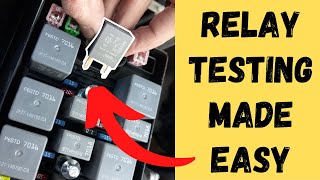
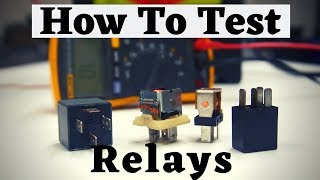
Remove the relay. Check resistance between terminals 85 and 86 (should be 50-120 Ohms). Apply 12V power to 85 and 86 to hear a 'click'. While energized, check for continuity (near zero Ohms) between terminals 30 and 87. No click or continuity means the relay is dead.
Tools: Multimeter, 12V power source, Jumper wires (Intermediate) - Test the Relay Control Circuit
If the relay works, test the signal. With the key ON, probe the relay socket. Measure ~12V between terminal 86 and ground, and verify continuity to ground on terminal 85. Missing signals indicate a fault in the ignition switch, J527 module, or wiring.
Tools: Multimeter, Vehicle-specific wiring diagram (Advanced) - Perform a Voltage Drop Test
Connect the multimeter positive lead to the battery positive post and the negative lead to the ECM's Terminal 15 power input pin with the ignition ON. A reading above 0.5V indicates unacceptable resistance from a corroded wire or loose connection.
Tools: Multimeter with long leads, Back-probe pins, Wiring diagram (Advanced) - Analyze Scan Tool Live Data
Use a VAG-compatible scan tool to view the Engine Control Module (01) live data for 'Terminal 15 Voltage'. Compare this reading to the actual battery voltage. A difference greater than 0.3V confirms a severe voltage drop issue in the harness.
Tools: VAG-compatible scan tool, Multimeter (Advanced)
When This Code Triggers (Freeze-Frame Conditions)
- Module Voltage: < 11.0V (During key-on or engine cranking)
- Engine RPM: 0 or dropping rapidly (At the moment of stall or during a no-start attempt)
- Fault Status: Active/Static (Logged immediately when the ECM powers on and detects low voltage)
- Event Time: 0 seconds after ignition on (Fault is present the instant the circuit energizes)
Related Codes
- 00576 — A VAG-specific fault code meaning 'Terminal 15: Implausible Signal'. It is identical to P3325 and often appears alongside it depending on the scanner used.
- U0100 — 'Lost Communication With ECM/PCM'. This is a symptom of P3325. When the ECM loses power, other modules cannot communicate with it. Fix P3325 first to resolve U0100.
- P1602 — 'Power Supply (B+) Terminal 30: Voltage too Low'. Terminal 30 is constant battery power. Seeing both codes points to a failing battery or bad main ground, rather than just the switched ignition circuit.
- 02811 — 'Control Module for Steering Column Lock (J764): Defective'. Appears with P3325 if the start authorization module fails, preventing the ignition circuit from ever powering on.
Climate & Environmental Factors

- High Humidity and Heavy Rain: Moisture overwhelms clogged plenum and sunroof drains, leaking into the cabin and corroding relay panels, fuse boxes, and wiring connectors.
- Cold Weather (<32°F / 0°C): Cold temperatures reduce battery cranking power, dropping system voltage low enough to trigger P3325. Condensation also freezes inside unsealed relays, causing mechanical failure.
- Parking Under Trees: Leaves and pine needles rapidly clog plenum and sunroof drains, directly leading to the water ingress that destroys the Terminal 15 electrical circuits.
How to Talk to a Mechanic About This Code
Say this: "My VW/Audi has a P3325 code causing a no-start condition. I'd like to book a diagnostic appointment. Please start by checking the '460' power supply relay, inspecting for water intrusion from clogged drains, and testing the ignition switch."
This directs the shop to the most likely and cost-effective starting points, preventing them from starting with a generic diagnostic that ignores VW/Audi quirks and misdiagnosing a starter or battery.
Avoid saying:
- 'My car won't start, can you fix it?' (Too vague, invites expensive diagnostics)
- 'Just do whatever it takes to get it running.' (Gives a blank check to replace parts)
- 'My friend said it's the starter.' (Anchors the mechanic to an incorrect diagnosis)
Questions to ask before authorizing the repair:
- Did you test the '460' relay and its socket for power, or just swap it?
- If you recommend a wiring repair, can you show me where the corrosion is?
- If the cause was water intrusion, what is the plan to clear the drains?
- If you recommend a new control module, did you perform voltage drop tests to rule out wiring resistance first?
Where to Take It: Dealer vs Independent vs Chain
- Dealer:
Recommended for complex cases involving the Start Authorization Module (J764) or Steering Column Control Module (J527) that require online coding.
Best for: Vehicles under warranty., Complex repairs requiring module programming (Steering Column Control Module)., When an independent specialist cannot solve the issue.
Downsides: Highest labor rates and part costs., May recommend replacing expensive assemblies rather than targeted wiring repairs. (Typical cost: +50% vs. baseline) - Independent Shop:
Best fit for most P3325 situations. An experienced VW/Audi specialist offers high-quality repair at a fair price.
Best for: Out-of-warranty vehicles., Diagnosing common causes (bad relay, water ingress, ignition switch)., Owners seeking better value.
Downsides: Quality varies; must find a shop specializing in VW/Audi., May lack dealer-level tools for programming certain modules. (Typical cost: +0% vs. baseline) - Chain Shop:
AVOID for diagnosis. Only use if you are 100% certain the relay is the fault and just need someone to perform the swap.
Best for: Simple part swaps IF you have already diagnosed the problem yourself.
Downsides: Technicians are rarely specialized in complex German electronics., High risk of misdiagnosing the battery or starter., Not equipped for in-depth electrical troubleshooting. (Typical cost: -10% vs. baseline)
When to Walk Away From the Repair
If the estimated repair cost for P3325 exceeds 50% of your car's private-party market value, sell the vehicle as-is or trade it in.
- Car worth $5000, fix is $450: Fix it. The repair cost is well below the threshold and restores a critical function.
- Car worth $4000, fix is $2200: Walk away. The repair cost is over 50% of the car's value, implying a severe wiring or module failure.
- Car worth $15000, fix is $2200: Fix it. While expensive, the repair cost is a small fraction of the vehicle's value.
What Scan Tool You Need for This Code
Minimum: A VAG-specific scanner that reads live data, specifically 'Module Voltage' from the Engine Control Module (01).
A generic $20 OBD-II reader only shows the P3325 code. It cannot read manufacturer-specific live data for module voltage to confirm a voltage drop, nor can it access the steering column modules.
Budget: ANCEL BD500 (Bluetooth) or ANCEL VD700 (Handheld) (~$60-90) — Reads and clears codes from all VW/Audi modules. Displays live data streams to monitor Terminal 15 voltage as seen by the ECM.
Mid-range: OBDeleven Pro or Foxwell NT510 Elite for VAG (~$100-200) — Offers bidirectional controls to command relays on/off for testing. Allows for advanced adaptations if a module needs replacement.
Professional: Ross-Tech VCDS or Autel MaxiCOM MK808S (~$450-600) — Provides dealer-level diagnostics. VCDS is the gold standard for VW/Audi, offering detailed logging for tracking intermittent wiring issues.
Rent vs buy: Rent a generic scanner from a parts store for free to confirm the code, but you cannot properly diagnose P3325 with it. Buying a budget VAG-specific scanner pays for itself by preventing a single misdiagnosis.
How to Clear the Code After You Fix It
- Fix the underlying electrical fault (replace relay, repair wiring).
- Use an OBD-II scan tool to erase the fault codes from all modules.
- Perform a complete VW drive cycle to reset emissions readiness monitors.
Drive cycle (~20 minutes): From a cold start (coolant temp below 122°F), idle for 3 minutes. Drive at 45-55 mph for 7 minutes. Accelerate to 60-65 mph and cruise for 5 minutes. Decelerate to a stop and idle for 3 minutes.
Readiness monitors affected: All monitors reset when codes are cleared., The drive cycle sets Catalyst (CAT), Evaporative System (EVAP), and Oxygen Sensor (O2S) monitors.
Before emissions retest: drive at least 50 miles to fully set monitors.
Watch out for:
- Clearing the code without fixing the electrical problem causes it to return instantly.
- Testing immediately after clearing codes results in a 'Not Ready' emissions failure.
Will This Fail Emissions / State Inspection?
Yes — this code typically fails an OBD-II emissions inspection.
- California: An illuminated Check Engine Light is an automatic failure. A full drive cycle must be performed after repair to set readiness monitors.
- New York: An active P3325 code fails the NYVIP3 inspection. Clearing the code just before the test results in a 'Not Ready' failure.
- Texas: An illuminated Check Engine Light fails the test in emissions counties. Clearing codes resets all monitors, leading to failure.
Most Commonly Affected Vehicles
- Volkswagen Passat (2005-2011) — The B6 generation is notorious for clogged plenum drains under the windshield cowl, which floods the cabin electronics. VW issued a TSB to remove the rubber drain grommets.
- Volkswagen Golf / Jetta (2005-2015) — The Mk5 and Mk6 generations are highly prone to failures in the '460' power supply relay and the electrical portion of the ignition switch.
- Audi Q7 (2007-2015) — The J329 power supply relay is located under the driver's seat. Clogged sunroof drains soak the carpet and destroy this relay. Early models had TSBs for kinked drain hoses.
- Audi A3 / A4 / A6 (2006-2016) — Frequently experience P3325 due to faulty relays, corroded fuse panels, or failures in the steering column lock modules.
- Volkswagen Transporter (T5) (2003-2015) — Known to suffer wiring harness chafing and relay failures that trigger P3325 and result in a no-start condition.
- Audi TT (2007-2019) — Prone to wiring harness connection failures near the ignition switch and fuse box, interrupting the Terminal 15 circuit.
- Skoda / SEAT Octavia, Superb, Leon, Altea (2004-2017) — Sharing platforms with VW, these models suffer identical P3325 causes, including relay failures and water ingress.
- Porsche Cayenne (2003-2010) — Shares its platform with the VW Touareg and Audi Q7, experiencing identical power supply relay failures under the driver's seat.
Manufacturer-Specific Notes
- Volkswagen/Audi: The power supply relay is universally referred to by the number printed on its top, most commonly '460'. Mechanics diagnose this by asking to 'check the 460 relay'.
- Audi: On the Q7 and Porsche Cayenne, the primary power supply relay (J329) is located under the driver's seat, making it highly vulnerable to water damage from clogged sunroof drains.
- Volkswagen/Audi: There are no recalls for P3325, but numerous TSBs exist for its causes, including TSB 60 12 20 for kinked Audi Q7 sunroof drains and VW communications for clearing Passat plenum drains.
- Volkswagen/Audi: On keyless start vehicles, a 'Start Authorization' failure mimics a dead P3325 fault. Technicians force-wake the network by turning on hazard lights and high beams, then pressing the brake, to allow scanner communication.
Real Owner Stories
2008 VW Passat at 110K miles - The Easy Fix
Car suddenly wouldn't start. Dash lights illuminated, but the engine would not crank. Just a single click.
What they tried:
- Jump-started the battery (no effect).
- Checked all related fuses (none blown).
- Researched the '460' relay.
Outcome: Swapped the '460' power supply relay with the identical horn relay. The car started immediately. Purchased a new OEM relay for $15. The car has run reliably since.
Lesson: Always try the simplest fix first. Swapping the '460' relay is a free, 5-minute diagnostic step that saves hundreds in fees.
2007 Audi Q7 at 140K miles - The Misdiagnosis Story
Vehicle intermittently failed to start on rainy days. Multiple warning lights flashed.
What they tried:
- Replaced the battery.
- Shop replaced the starter for $800 (problem returned).
- Took vehicle to an Audi specialist.
Outcome: Specialist found clogged sunroof drains and a soaked carpet. The J329 relay under the seat was severely corroded. Replaced the relay, connector, and cleared drains for $450.
Lesson: Intermittent electrical issues in wet weather indicate water intrusion. Check common leak areas before replacing expensive components like starters.
2010 VW Jetta at 95K miles - The Unusual Root Cause
Car stalled while driving and would not restart. Dashboard was completely dead.
What they tried:
- Shop replaced the '460' relay (stalled again next day).
- Tested wiring between relay and ECM (no faults).
- Manipulated the steering column and noticed power flickering.
Outcome: Traced the fault to a worn electrical portion of the ignition switch. Replacing the $60 switch and 1.5 hours of labor resolved the issue.
Lesson: If a new relay doesn't fix P3325, the problem lies upstream (ignition switch) or downstream (wiring). Wiggling components helps pinpoint intermittent breaks.
How to Prevent This Code From Triggering
- Clean plenum and sunroof drains annually (Once per year (or every 6 months if parked under trees)) — Debris clogs drains, causing rainwater to overflow and corrode the relay panel. This is the #1 underlying cause of P3325.
- Proactively replace the Power Supply Relay ('460') (Every 5-7 years or 80,000 miles) — Mechanical relays have a finite lifespan. Replacing this $15-$30 part proactively prevents sudden no-start or stalling failures.
- Inspect battery terminals during oil changes (Every 5,000-10,000 miles) — Corrosion creates high resistance, causing low voltage across the system and triggering false P3325 codes.
- Avoid using sealants on pollen filter housing gaskets (During related repairs) — Improperly applied silicone fails to create a proper seal, worsening water ingress into the cabin electronics area. Use specified foam gaskets.
Frequently Asked Questions
What is 'Terminal 15'?
'Terminal 15' is a standard German automotive term for the electrical circuit that is live only when the ignition is switched on. It powers the engine controls, dashboard, and safety systems.
What is the difference between Terminal 15 and Terminal 30?
Terminal 30 is constant battery power that is always live, powering the clock and alarm. Terminal 15 is switched power that only becomes live when the key turns to 'ON' or 'START'.
Can a bad battery cause a P3325 code?
Yes. VW and Audi vehicles are highly sensitive to low voltage. A weak battery causes Terminal 15 voltage to drop below 11.0V during startup, triggering P3325 even if the relay is fine.
I replaced the relay and the code came back. What's next?
If a new relay fails to fix the issue, the cause is a faulty ignition switch, a wiring break, or a start authorization module failure. Inspect the fuse panels for water intrusion and perform voltage drop tests.
Why do I see P3325 listed for a knock sensor on my Honda/Toyota?
P3325 is a VW/Audi specific code for 'Ignition Circuit Power Supply Fault'. On brands like Honda or Toyota, you are likely seeing P0325, which is a 'Knock Sensor Circuit Malfunction'. Consult a brand-specific manual if your non-VAG vehicle shows P3325.
Can I bypass the relay with a jumper wire to get the car running?
This should only be done briefly for diagnosis. Running a permanent jumper wire bypasses the ignition switch, draining the battery and creating a severe fire risk.
Is this an expensive repair?
If the problem is a bad relay, the repair costs under $100. If the cause is a water-damaged wiring harness or a faulty control module, labor and parts easily exceed $1,000.
My car has no power and won't scan, but I suspect P3325. What can I do?
This indicates a complete failure of the Terminal 15 circuit, which powers the OBD-II port. For diagnosis only, jump terminals 30 and 87 in the '460' relay socket to manually power the circuit. If the scanner connects, the fault is in the relay's control circuit.
Can I just clear the P3325 code?
You can clear it, but if the electrical fault remains, the code returns immediately upon the next ignition cycle. Clearing the code does not fix the vehicle.
Key Takeaways
- Swap the '460' power supply relay first; this $15-$30 part causes over 70% of P3325 faults and takes 5 minutes to test.
- Inspect the plenum and sunroof drains for standing water, as clogged drains flood the cabin and corrode the Terminal 15 electrical circuits.
- Never drive with an active P3325 code, as the sudden loss of Terminal 15 power instantly kills the engine, power steering, and power brakes.
- If a new relay fails to restore power, test the ignition switch and start authorization module (J764) for a missing 12V wake-up signal.
Helpful Videos



The information in this article is provided for general reference and educational purposes only. Vehicle specifications, procedures, and part compatibility can vary by production date, trim level, and region. Always consult your vehicle's factory service manual and verify part numbers before purchasing or performing repairs. Safety-critical components such as airbags, seat belts, and braking systems should be installed by a qualified professional.
- 🎬 Helpful Videos
- What Does P3325 Mean?
- Can I Drive With P3325?
- Common Causes
- Symptoms
- Diagnostic Flowchart
- Common Fixes & Costs
- DIY vs Professional
- Used vs. New Parts: Buying Guide
- What Happens If You Wait — Timeline
- Cost of Not Fixing It
- Diagnosis Steps
- When This Code Triggers (Freeze-Frame Conditions)
- Related Codes
- Climate & Environmental Factors
- How to Talk to a Mechanic About This Code
- Where to Take It: Dealer vs Independent vs Chain
- When to Walk Away From the Repair
- What Scan Tool You Need for This Code
- How to Clear the Code After You Fix It
- Will This Fail Emissions / State Inspection?
- Most Commonly Affected Vehicles
- Manufacturer-Specific Notes
- Real Owner Stories
- 2008 VW Passat at 110K miles - The Easy Fix
- 2007 Audi Q7 at 140K miles - The Misdiagnosis Story
- 2010 VW Jetta at 95K miles - The Unusual Root Cause
- How to Prevent This Code From Triggering
- Frequently Asked Questions
- What is 'Terminal 15'?
- What is the difference between Terminal 15 and Terminal 30?
- Can a bad battery cause a P3325 code?
- I replaced the relay and the code came back. What's next?
- Why do I see P3325 listed for a knock sensor on my Honda/Toyota?
- Can I bypass the relay with a jumper wire to get the car running?
- Is this an expensive repair?
- My car has no power and won't scan, but I suspect P3325. What can I do?
- Can I just clear the P3325 code?
- Key Takeaways
- 🎟️ Get 5% Off