

OBD-II Code P3104: Intake Manifold Flap Motor Electrical Fault
What P3104 means, why it triggers, and how to fix it
- P3104 is a Volkswagen/Audi-specific code indicating a 'short to plus' electrical fault in the intake manifold runner control motor (V157) or its wiring.
- Check engine bay fuse F23 first; a blown fuse immediately confirms a short circuit in the motor or wiring harness.
- Do not replace the $800+ intake manifold without first inspecting the wiring harness for melted insulation, which is the root cause in over 50% of cases.
- Driving more than 300 miles with this code forces the engine to run rich, risking a $1,500 catalytic converter failure.
- On TDI diesel engines, a violent engine shudder during shutdown definitively points to a failed anti-shudder valve motor.
What Does P3104 Mean?

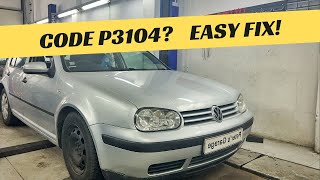
P3104 is a manufacturer-specific code for Volkswagen and Audi indicating the Engine Control Unit (ECU) 🎬 Watch: How to fix the intake manifold flap valve detected an electrical short circuit in the intake manifold flap motor. These flaps (intake runners) adjust airflow to optimize engine performance and fuel efficiency at different speeds. Specifically, the code flags a 'short to plus,' meaning the motor's circuit has an unintended connection to a power source.
Technical definition: Valve for Intake Manifold Flap (N239): Short to Plus / Short to Ground. The Powertrain Control Module (PCM) detects that electrical current intended for the intake manifold runner control (IMRC) motor is diverting directly to a power or ground source, bypassing the intended circuit.
Can I Drive With P3104?
Yes, But With Caution. You can drive, but expect reduced engine power, poor acceleration, and lower gas mileage. Fix it within a few hundred miles to prevent excessive carbon buildup and catalytic converter damage, which adds $800 to $2,500 in future repair costs.
Common Causes

- Damaged or Frayed Wiring Harness (Very Common) — The wires routing to the intake runner motor sit in a high-heat area of the engine bay. The plastic insulation melts or becomes brittle and cracks, allowing the exposed copper wire to touch the engine block (short to ground) or another wire (short to plus).
- Faulty Intake Manifold Runner Control (IMRC) Motor (Common) — The electric motor (V157) that actuates the flaps fails internally. Electronic components burn out or engine oil seeps into the housing, creating a dead short that triggers the code and instantly blows the circuit's fuse.
- Heavy Carbon Buildup on Intake Flaps (Common) — On direct-injection (FSI, TSI) and diesel (TDI) engines, carbon builds up heavily on the intake flaps, causing them to physically jam. This seizes the mechanism, overloads the control motor, and causes it to overheat and short out.
- Contaminated or Damaged Electrical Connector (Less Common) — Moisture from heavy rain, pressure washing, or oil leaking from a failing valve cover gasket seeps into the motor's electrical connector. This fluid bridges the pins, creating an unintended path for electricity and causing a short.
- Internal Mechanical Failure of Intake Manifold (Rare) — The plastic components of the flap mechanism inside the manifold break or disconnect. The jammed flaps overload and burn out the control motor, resulting in the P3104 electrical fault.
- Faulty Powertrain Control Module (PCM) (Very Rare) — A failed driver circuit inside the vehicle's main computer sends an incorrect signal or falsely reports a short. This is the absolute last consideration after exhaustively testing the wiring and motor.
Symptoms

- Reduced Engine Power — The vehicle feels sluggish and struggles to accelerate because the intake flaps default to a fail-safe position that restricts optimal airflow.
- Rough Idle — The engine runs unevenly, shakes, or stalls when stopped at a red light due to improper air/fuel mixing.
- Poor Fuel Economy — Gas mileage drops by 10-20% because the engine operates inefficiently without variable airflow control.
- Violent Engine Shudder at Shutdown — On VW and Audi TDI models, the engine shakes violently when turned off because the anti-shudder valve (integrated into the V157 motor) fails to close.
- Audible Clicking from Engine Bay — A repetitive clicking sound emits from the intake manifold as the faulty motor attempts to actuate the jammed flaps.
- Check Engine Light On (also visible on scanner) — The ECU illuminates the check engine light immediately upon detecting the short circuit.
Common Fixes & Costs

- Repairing Damaged Wiring Harness — Parts: $5-$20, Labor: $100-$250, ~1.5 hr book time (Intermediate)
- Replacing the Intake Manifold Runner Control Motor
— Parts: $150-$350, Labor: $150-$300, ~1.2 hr book time
(DIY)
Audi A4 (2005-2008 B7), VW Jetta/Passat (2006-2008 FSI): OEM 06F133482E (Alt: Bosch, ET Engineteam)
VW Jetta/Tiguan TDI (2009-2014): OEM 03L129086 (Alt: Pierburg) - Cleaning Carbon Buildup from Intake Manifold and Flaps — Parts: $20-$50, Labor: $400-$800, ~4.5 hr book time (Professional)
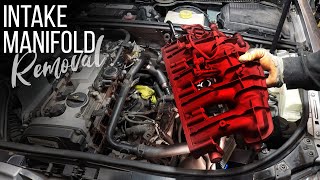
- Replacing the Entire Intake Manifold Assembly 🎬 Watch this step-by-step Audi A4 intake manifold removal guide
— Parts: $250-$800, Labor: $500-$1500, ~2.5 hr book time
(Professional)
Audi A4 (B7), VW Jetta/Passat (FSI engines BPY, BWT): OEM 06F133201P (Alt: Vaico, Topran)
Audi A3, VW GTI/Jetta (TSI engines CCTA, CBFA): OEM 06J133201BH (Alt: Vaico, SKP, Dorman)
Audi A4 (2009-2016 B8): OEM 06H133201AT (Alt: APA/URO Parts, SKP, Vaico)
Used vs. New Parts: Buying Guide
When a used part is worth it: For the intake runner motor, a used OEM part from a low-mileage vehicle is a cost-effective alternative. For the full intake manifold, used parts are never recommended due to the high likelihood of unseen carbon buildup or internal wear on the plastic flap mechanism.
Donor-vehicle mileage cap: roughly under 80000 miles for the part to have meaningful remaining life.
Donor quality checklist:
- Verify the part number matches exactly, as there are many revisions.
- Check the electrical connector for corrosion or oil contamination.
- Avoid parts from regions with extreme heat, which degrades wiring and plastic components faster.
Decision logic:
- If The fault is the intake runner motor and a low-mileage used OEM motor is available for less than 50% of a new one → A used part is a reasonable choice.
- If The entire intake manifold needs replacement → Buy a new OEM or high-quality aftermarket part. The risk of a used manifold having the same issues is too high.
- If The vehicle has over 120,000 miles and the budget is very tight → A used motor is acceptable, but understand it has a significantly shorter lifespan.
Warranty tradeoff: Used parts from salvage yards typically offer a 30-90 day warranty. New aftermarket parts offer a 1-year to limited lifetime warranty. New OEM parts carry a 1-2 year warranty.
Worst-case if a used part fails: 600-1000. If a used manifold or motor fails after installation, you pay for the labor a second time, plus the cost of another replacement part.
Cost of Not Fixing It
- Short Term (0-1 month): Noticeable 10-20% drop in fuel economy, sluggish acceleration, and a guaranteed failure of any OBD-II emissions test. The car feels 'lazy' and idles roughly. (Added cost: 50-150)
- Medium Term (1-6 months): The engine runs in a non-optimal state, accelerating carbon buildup on valves and pistons. An overly rich fuel mixture overheats and degrades the catalytic converter's internal structure. (Added cost: 400-800)
- Long Term (6+ months): Complete failure of the catalytic converter occurs, resulting in a P0420 code. The clogged converter creates exhaust backpressure that causes internal engine damage. (Added cost: 1200-2800)
Diagnosis Steps
- Read the Fault Codes
Use an OBD-II scanner to confirm P3104 is the active code. Check for related codes (P2015, P030x misfires) that point to the root cause. Note the exact fault definition, such as 'Short to Plus'.
Tools: OBD-II Scanner (Beginner) - Check for a Blown Fuse
Inspect the fuse dedicated to the intake flap motor (often fuse F23 in the engine bay on VW models). A blown fuse immediately confirms a hard short circuit in the motor or wiring harness.
Tools: Fuse Puller or Pliers (Beginner) - Visually Inspect the Wiring and Connector
Examine the wiring harness connecting to the intake manifold motor. Look for melted insulation, pinched wires, or exposed copper touching metal. Unplug the connector and check the pins for green corrosion, water, or oil.
Tools: Flashlight (Beginner) - Perform a 'Wiggle Test'
With the ignition on (engine off), connect a scanner to view live data for the flap position. Gently wiggle the wiring harness leading to the motor. If the fault code status changes or the live data spikes, you have an intermittent short in the wiring.
Tools: OBD-II Scanner with Live Data (Intermediate) - Test the Motor with a Bi-Directional Scan Tool
Use an advanced scan tool (like VCDS) to run an 'Output Test' commanding the IMRC motor to cycle. If the motor makes no sound, or if commanding the test instantly blows the fuse, the motor is internally shorted and requires replacement.
Tools: Advanced Bi-Directional Scan Tool (e.g., VCDS) (Advanced) - Test the Motor Circuit with a Multimeter
Disconnect the motor. Set a multimeter to Ohms (Ω). Probe the motor's power supply pin and the negative battery terminal. A reading near zero ohms confirms a short to ground. Probe the signal wire and the positive battery terminal; reading 12V where there should be none confirms a 'short to plus'.
Tools: Multimeter (Intermediate) - Advanced: Connector Pin-Out Voltage Test
With the key on and motor unplugged, test the harness pins. Pin 1 should have 12V. Pin 5 should have ground. Pin 4 should have a 5V reference from the ECU. A 'Short to Plus' (P3104) fault often reveals 12V on the signal wire (Pin 3) or ECU ground (Pin 2) due to wires melting together inside the harness.
Tools: Multimeter, Wiring Diagram (Advanced)
When This Code Triggers (Freeze-Frame Conditions)
- Engine Coolant Temp: 180-200°F (82-93°C) (The fault is most often logged when the engine is fully warmed up.)
- Engine RPM: 1500-3000 RPM (The ECU actively commands the flaps during transitions in this RPM range, making a fault more likely to be detected.)
- Engine Load: 25-70% (Occurs under normal driving conditions, such as moderate acceleration or cruising, when the ECU expects the flaps to actuate.)
- Vehicle Speed: 30-60 mph (48-97 km/h) (Triggered during city or highway cruising when engine speed and load are variable.)
Related Codes
- P2008 — P2008 means the IMRC circuit is 'Open,' while P3104 means it is 'Shorted.' An open circuit is a cut wire; a short is a wire touching ground or power. A multimeter shows infinite resistance (OL) for an open, but near-zero resistance for a short.
- P2015 — Targets the IMRC Position Sensor, not the motor circuit. It appears with P3104 because a shorted motor cannot move the flaps, causing the sensor to report a position that conflicts with the ECU's command.
- P2009 — The generic OBD-II code for 'IMRC Circuit Low,' which is the standardized equivalent of a short-to-ground fault. P3104 is the specific VAG code for the same problem.
- P2004 — Means 'Intake Manifold Runner Control Stuck Open'. This is a mechanical fault caused by carbon buildup. A seized flap (P2004) strains the motor until it shorts out, triggering P3104.
Climate & Environmental Factors
- High Humidity / Moisture: Wet conditions force moisture into the motor or sensor's electrical connector, causing corrosion and short circuits. Audi TSB 2048411/1 specifically addresses moisture ingress causing these faults.
- Extreme Cold: Freezing temperatures cause the plastic insulation on engine bay wiring harnesses to become brittle. Engine vibration then cracks the insulation, exposing the wire and creating a short circuit against the engine block.
How to Clear the Code After You Fix It
- Use an OBD-II scan tool to clear the P3104 fault code from the ECU's memory.
- Perform a Volkswagen/Audi specific drive cycle to allow the readiness monitors to run and complete.
- Disconnecting the battery for 15 minutes clears codes, but resets all readiness monitors, requiring a longer drive cycle to pass an emissions test.
Drive cycle (~20 minutes): Start with a cold engine. Let it idle for 2-3 minutes. Accelerate to 45-55 mph and hold for 7 minutes. Accelerate to 60-65 mph and hold for 5 minutes. Decelerate and idle for 3 minutes. This process forces the Catalyst and O2 sensor monitors to run.
Readiness monitors affected: Catalyst (CAT) monitor, Oxygen (O2) sensor monitor, Evaporative Emission (EVAP) System monitor
Before emissions retest: drive at least 50 miles to fully set monitors.
Watch out for:
- Clearing the code without performing the repair causes the code to return immediately due to the hard electrical fault.
- Disconnecting the battery clears the code but resets all emissions readiness monitors, guaranteeing a failed smog test if not driven sufficiently afterward.
Will This Fail Emissions / State Inspection?
Yes — this code typically fails an OBD-II emissions inspection.
- California: An illuminated Check Engine Light results in an automatic failure. After repair, a complete drive cycle must be performed to set all readiness monitors before re-testing.
- New York: An active P3104 code causes an automatic failure. The vehicle cannot be registered until the issue is repaired and the code is cleared.
- Texas: In counties requiring emissions testing, an illuminated Check Engine Light is an automatic failure. The vehicle also fails if the readiness monitors are not set to 'Ready'.
Most Commonly Affected Vehicles
- Audi A4 (2005-2016) — Extremely common on the 2.0T FSI and TSI engines due to wiring harness degradation near the motor and heavy carbon buildup.
- Volkswagen Jetta (2006-2014) — Affects 2.0T gasoline and 2.0 TDI diesel engines. TDI models frequently suffer from a seized anti-shudder valve (part of the same motor assembly) due to soot.
- Volkswagen Passat (2006-2010) — The 2.0T engine in these models is highly prone to internally shorted runner motors that blow the F23 system fuse.
- Audi A6 (2006-2011) — The 3.2L V6 and 2.0 TDI engines experience this code due to faulty actuator motors on the front of the intake manifold.
- Volkswagen Tiguan (2009-2017) — Seen on TDI and early TSI models where heavy carbon buildup jams the flap mechanism, leading to motor overload and failure.
- SEAT Leon (2006-2012) — Shares the 2.0T FSI and TDI engines with VW/Audi and suffers identical P3104 wiring and motor failures.
- Kia Forte (2010-2013) — Uses a similar variable intake system. The actuator motor is a known failure point leading to comparable symptoms, though logged under code P200A.
- Subaru Legacy (2015-2019) — Experiences identical failures of the Tumble Generator Valves (TGV), generating codes like P2004/P2005. The diagnosis and repair are functionally the same.
Manufacturer-Specific Notes
- Volkswagen / Audi: This code is almost exclusively used by VAG. VAG issued an extended warranty for the intake manifold on certain 2.0T TSI engines to 10 years/120,000 miles. Audi TSB 2048411/1 provides a repair kit for related faults caused by moisture ingress.
- Porsche: On some Porsche models, P3104 means 'Warm up catalyst efficiency below threshold bank 2'. This highlights the danger of using generic scanners on manufacturer-specific codes.
- BMW: On BMW N53 engines, fault code 3104 means 'Uneven Running, Stratified Charge Operation'. This points to a fuel combustion issue, entirely unrelated to the intake manifold.
- Ford: Owners frequently transpose numbers and search for P3104 when their actual code is P3014, leading to incorrect diagnostic paths. Always double-check the scanner.
Frequently Asked Questions
Is P3104 a serious problem?
It is moderately serious. It will not leave you stranded, but it causes poor engine performance, bad fuel economy, and emissions test failures. Ignoring it leads to expensive catalytic converter damage.
What are common misdiagnosis mistakes for P3104?
A frequent mistake is replacing the entire $800 intake manifold assembly when only the wiring harness is damaged. Always test the circuit and motor independently before replacing expensive parts.
My shop quoted me over $1500 to fix this. Is that reasonable?
It depends on the required fix. If the entire intake manifold requires replacement, $1,500 is a standard dealership quote. However, if the problem is just a wiring repair ($150-$250) or a new motor ($300-$550), a $1,500 bill is unreasonable.
My car has P3104 and a misfire code (e.g., P0304). Are they related?
Yes, they are directly related. Stuck intake flaps disrupt the air/fuel mixture entering the cylinders, causing incomplete combustion and triggering misfire codes. Fixing the P3104 electrical fault almost always resolves the misfire.
Can a bad battery cause code P3104?
No. This code specifically points to a short circuit in the intake runner motor's dedicated electrical circuit. A failing battery causes general electrical gremlins, but not an isolated short circuit.
How much does it cost to fix P3104?
A simple wiring repair costs $150-$250. Replacing a faulty motor typically costs $300-$550 for parts and labor. Replacing the entire intake manifold assembly ranges from $800 to over $1,800.
Can I fix P3104 myself?
Replacing a blown fuse or an accessible flap motor is a beginner-friendly DIY job. However, repairing a wiring harness requires soldering skills, and replacing the entire manifold requires advanced tools. Stop and go to a professional if you lack fuel line disconnect tools.
Will clearing the code fix the problem?
No. P3104 indicates a hard electrical short circuit. The code returns immediately after being cleared, often as soon as you turn the ignition back on.
What is an 'anti-shudder valve' and how does it relate to P3104?
On VW/Audi TDI diesel engines, the intake flap motor (V157) also functions as the anti-shudder valve. It closes briefly when the engine turns off to prevent shaking. If this motor fails, you will experience a violent shudder when shutting off the car.
Key Takeaways
- P3104 is a Volkswagen/Audi-specific code indicating a 'short to plus' electrical fault in the intake manifold runner control motor (V157) or its wiring.
- Check engine bay fuse F23 first; a blown fuse immediately confirms a short circuit in the motor or wiring harness.
- Do not replace the $800+ intake manifold without first inspecting the wiring harness for melted insulation, which is the root cause in over 50% of cases.
- Driving more than 300 miles with this code forces the engine to run rich, risking a $1,500 catalytic converter failure.
- On TDI diesel engines, a violent engine shudder during shutdown definitively points to a failed anti-shudder valve motor.
Helpful Videos


The information in this article is provided for general reference and educational purposes only. Vehicle specifications, procedures, and part compatibility can vary by production date, trim level, and region. Always consult your vehicle's factory service manual and verify part numbers before purchasing or performing repairs. Safety-critical components such as airbags, seat belts, and braking systems should be installed by a qualified professional.
- 🎬 Helpful Videos
- What Does P3104 Mean?
- Can I Drive With P3104?
- Common Causes
- Symptoms
- Common Fixes & Costs
- Used vs. New Parts: Buying Guide
- Cost of Not Fixing It
- Diagnosis Steps
- When This Code Triggers (Freeze-Frame Conditions)
- Related Codes
- Climate & Environmental Factors
- How to Clear the Code After You Fix It
- Will This Fail Emissions / State Inspection?
- Most Commonly Affected Vehicles
- Manufacturer-Specific Notes
- Frequently Asked Questions
- Is P3104 a serious problem?
- What are common misdiagnosis mistakes for P3104?
- My shop quoted me over $1500 to fix this. Is that reasonable?
- My car has P3104 and a misfire code (e.g., P0304). Are they related?
- Can a bad battery cause code P3104?
- How much does it cost to fix P3104?
- Can I fix P3104 myself?
- Will clearing the code fix the problem?
- What is an 'anti-shudder valve' and how does it relate to P3104?
- Key Takeaways
- 🎟️ Get 5% Off