

OBD-II Code P3089: Fuel Pump Electronics Signal Problem
What P3089 means, why it triggers, and how to fix it
- Code P3089 signals a fuel pump control circuit failure, meaning a broken signal line on VW/Audi vehicles or a chafed engine wiring harness on 2019-2021 GM trucks.
- Do not drive with an active P3089 code; the fault cuts power to the fuel pump and causes sudden engine stalling at highway speeds.
- Replacing the Fuel Pump Control Module (FPCM) fixes 80% of P3089 codes on VW/Audi models, costing between $200 and $600 for parts and labor.
- On 2019-2021 Chevy and GMC 1500 trucks, ignore the fuel pump and inspect the engine wiring harness for chafing per GM TSB 21-NA-149.
- DIYers cannot replace the FPCM on 2010 and newer VW/Audi vehicles without dealer-level software to bypass the 'Component Protection' anti-theft system.
What Does P3089 Mean?

P3089 is a manufacturer-specific code indicating an electrical failure in the communication line for the fuel pump's electronic control module. On Volkswagen and Audi vehicles, it points directly to a broken or corrupted signal between the Engine Control Module (ECM) and the Fuel Pump Control Module (FPCM/J538), preventing the ECM from regulating the low-pressure fuel pump. On 2019-2021 General Motors (GM) trucks, this code flags a broader electrical fault caused by a chafed engine wiring harness shorting out multiple components, as outlined in TSB 21-NA-149.
Technical definition: Signal Line for Fuel Pump Electronics: Electrical Malfunction. The Engine Control Module (ECM) logs this fault when it detects an open circuit, short circuit, or missing Pulse-Width Modulated (PWM) signal on the communication line to the Fuel Pump Control Module.
Can I Drive With P3089?
No — Do Not Drive. Do not drive. This fault indicates a critical failure in the fuel delivery system that causes the engine to stall without warning. Stalling at highway speeds or in intersections creates a severe safety risk.
Common Causes

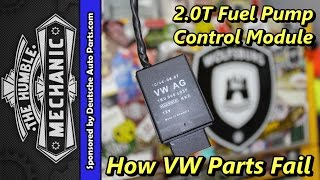
- Failed Fuel Pump Control Module (FPCM / J538) (Very Common) — The module controlling the in-tank fuel pump fails internally from heat, vibration, or moisture ingress under the rear seat. This is the primary cause on VW/Audi vehicles. 🎬 See how these fuel pump modules fail internally.
- Damaged Wiring or Connectors (Common) — The signal wire between the ECM and FPCM frays, corrodes, or disconnects. On GM trucks, the engine harness rubs against the chassis or engine block, causing a direct short to ground.
- Blown Fuse (Less Common) — A blown fuse cuts power to the FPCM, triggering a communication loss. Always trace the short circuit or overloaded component that caused the fuse to blow.
- Failed Fuel Pump Relay (Less Common) — A faulty relay with burnt contacts or a failed coil causes intermittent power loss to the FPCM, dropping the signal to the ECM.
- Failed In-Tank Low-Pressure Fuel Pump (LPFP) (Less Common) — A failing fuel pump motor draws excessive current, overheating and permanently damaging the control module.
- Low Battery Voltage (Rare) — System voltage below 12.2V causes widespread communication errors between control modules, including the FPCM.
- Poor Ground Connection (Rare) — A corroded ground wire for the FPCM or ECM causes erratic voltage and intermittent communication failures.
- Faulty Engine Control Module (ECM) (Very Rare) — The driver circuit inside the ECM fails, or a bent pin on the ECM connector breaks the signal to the FPCM.
Symptoms

- Sudden engine stalling — The engine dies unexpectedly while driving or idling. It often restarts after cooling down for 5 to 15 minutes, indicating an overheating control module. 🎬 Watch: Why your VW stalls when hot and won't restart.
- Engine cranks but will not start — The starter motor turns the engine over, but it never fires because the fuel pump is disabled.
- Check Engine Light is on — The Malfunction Indicator Lamp (MIL) illuminates. On VW/Audi models, the EPC (Electronic Power Control) light also triggers.
- Intermittent hesitation or loss of power — The vehicle feels sluggish and hesitates violently during acceleration because the fuel pump cannot deliver adequate fuel pressure under load.
- No humming sound from fuel tank — The faint, 2-second humming sound from the rear of the car when turning the key to the 'ON' position is absent, confirming the fuel pump is offline.
Diagnostic Flowchart

Tap your situation to follow the diagnostic path that matches what you're seeing on this code.
Common Fixes & Costs
- Replace Fuel Pump Control Module (FPCM) — Parts: $70-$270, Labor: $125-$300, ~1.2 hr book time (Intermediate)
- Repair Damaged Wiring/Connector — Parts: $10-$100, Labor: $200-$1000+, ~4.5 hr book time (Professional)
- Replace Blown Fuse — Parts: $1-$5, Labor: $0-$50, ~0.1 hr book time (DIY)
- Replace Fuel Pump Relay — Parts: $15-$60, Labor: $0-$75, ~0.2 hr book time (DIY)
- Replace In-Tank Fuel Pump — Parts: $250-$1500+, Labor: $200-$500, ~2.5 hr book time (Professional)
Used vs. New Parts: Buying Guide
When a used part is worth it: For pre-2010 vehicles without 'Component Protection' software, a used FPCM from a low-mileage donor car is a viable budget option.
Donor-vehicle mileage cap: roughly under 70000 miles for the part to have meaningful remaining life.
Donor quality checklist:
- Match the OEM part number exactly, including suffix letters.
- Inspect the used module for melted plastic, scorch marks, or corroded pins.
- Ensure the donor vehicle was not scrapped for electrical fires or flood damage.
Decision logic:
- If Vehicle is a 2010+ VW/Audi with Component Protection → Buy new OEM. A used part will not work without expensive dealer programming.
- If A new OEM or quality aftermarket part is available for under $150 → Buy new. The warranty and reliability outweigh the minimal savings of a used part.
- If Vehicle is over 150K miles, budget is tight, and no Component Protection is involved → Buy used, but expect a significantly shorter lifespan.
Warranty tradeoff: Used parts offer a 30-day warranty. New aftermarket parts offer 1-year to lifetime warranties. New OEM parts carry a 1-2 year warranty.
Worst-case if a used part fails: $250-$500 for repeat labor and a second replacement part if the used module fails.
What Happens If You Wait — Timeline
- 0-1 month: Intermittent fault. The Check Engine Light illuminates but the car runs normally. The code logs in the ECM. (MPG impact: 0%% · Added cost: $0)
- 1-3 months: Fault becomes frequent. Hesitation during acceleration and intermittent stalling occur, especially when the engine is hot. (MPG impact: 0-5%% · Added cost: $100-$300 (Towing cost if stranded))
- 3-6 months: Hard failure is imminent. Stalling is unpredictable. A failing FPCM gets stuck 'on', draining the battery overnight. (MPG impact: 5-10%% · Added cost: $250-$550 (Towing plus new battery))
- 6+ months: Permanent failure. The car will not start. An FPCM sending incorrect voltage burns out the in-tank fuel pump. (MPG impact: N/A (Vehicle is undrivable)% · Added cost: $500-$1500+ (Cost of a new fuel pump assembly))
Cost of Not Fixing It
- Immediate: High risk of sudden engine stalling in traffic, creating a severe safety hazard. The vehicle will eventually fail to start. (Added cost: Towing costs ($100-$300+).)
- 1-3 months: A failing module gets stuck 'on', running the pump continuously and draining the battery overnight. (Added cost: Cost of a new battery ($150-$400).)
- 3+ months: Erratic voltage from a failing FPCM overloads and destroys the in-tank fuel pump. (Added cost: Cost of a new fuel pump ($500-$1500+).)
Diagnosis Steps
- Read All Fault Codes
Use an OBD-II scanner to confirm P3089. Look for related codes like P310B (Low Pressure Fuel Regulation). On GM trucks, a cluster of unrelated codes (U0100, P0707) confirms the TSB 21-NA-149 harness chafing issue.
Tools: OBD-II Scanner (VCDS preferred for VAG) (Beginner) - Inspect Engine Wiring Harness (GM Specific)
For 2019-2021 GM trucks, skip to this step. Follow TSB 21-NA-149 and inspect the engine wiring harness for chafing where it passes over the camshaft cover, upper control arm, and shock towers.
Tools: Flashlight, Inspection Mirror (Intermediate) - Inspect the Fuel Pump Control Module (FPCM) and Connector
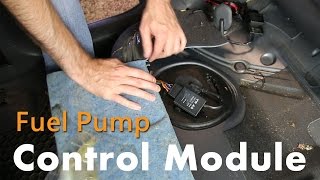
On VW/Audi models, remove the rear seat cushion to access the FPCM. Inspect the module, connector, and wiring for corrosion, moisture damage, or melted plastic.
Tools: Basic Hand Tools, Trim Removal Tools (Intermediate) - Check Fuses and Relays
Locate the fuse box and inspect fuses related to the Fuel Pump and FPCM (e.g., fuse S228 on VW/Audi). Replace blown fuses, but trace the underlying short circuit.
Tools: Owner's Manual, Fuse Puller (Beginner) - Test Battery and Charging System
Check the 12V battery voltage. A healthy battery reads 12.6V with the engine off. Voltage below 12.2V causes false communication faults and must be corrected before further testing.
Tools: Multimeter (Beginner) - PRO TIP: Test FPCM Power, Ground, and Signal Wires
Unplug the FPCM connector. Turn the ignition on. Verify battery voltage at the power pin and check for a solid ground (<0.1V). Check the signal wire for a PWM signal from the ECM. A missing signal indicates a wiring break, not a bad FPCM.
Tools: Multimeter, Wiring Diagram (Advanced) - PRO TIP: Perform a Load Test on the Power Circuit
A circuit showing 12V on a multimeter can still fail under load. Connect a headlamp bulb between the FPCM connector's power and ground pins. If the bulb is dim, high resistance exists in the wiring.
Tools: Headlamp bulb, Multimeter, Wire leads (Advanced) - Test the Fuel Pump
Check for power and ground at the in-tank fuel pump connector. Measure the fuel pressure to ensure it meets manufacturer specifications and isn't drawing excessive current.
Tools: Multimeter, Fuel Pressure Gauge (Advanced) - ADVANCED: Check Low-Pressure Fuel System Specs (VW/Audi)
Use VCDS to monitor the low-pressure fuel system. Specified pressure should be 3.0 to 6.0 bar (44-87 PSI). At idle, the FPCM should supply 4.0 to 5.7 volts to the pump.
Tools: VCDS or Advanced Scan Tool (Advanced) - ADVANCED: Analyze FPCM PWM Signal (VW/Audi)
Connect an oscilloscope to the signal wire between the ECM and FPCM. You must see a square wave (PWM signal) varying with fuel demand. A flat-lined signal confirms an ECM or wiring fault.
Tools: Oscilloscope, Back-probe pins (Advanced)
When This Code Triggers (Freeze-Frame Conditions)
- Engine Load: 30-70% (Occurs during acceleration or steady cruising when fuel demand increases.)
- RPM: 1500-3000 (The fault triggers during active driving, rarely at a standstill idle.)
- Vehicle Speed: 30-65 mph (Logged during city or highway driving as the module actively regulates fuel flow.)
- Ambient Temperature: >80°F (Failures spike on hot days, as high ambient temperatures accelerate module overheating.)
Related Codes
- P310B — Low Pressure Fuel Regulation. This is a symptom of P3089. Diagnose the electrical fault (P3089) first, as fixing it resolves the pressure drop.
- P0087 — Fuel Rail Pressure Too Low. If seen with P3089, troubleshoot the electrical communication problem first. If seen alone, suspect a mechanical failure like a clogged filter.
- P008B — Low Pressure Fuel System Pressure Too High. A faulty FPCM commands the fuel pump to run at full speed continuously, causing excessive pressure.
- Multiple Unrelated Codes (GM) — Codes like P0707, U0100, and P1101 appearing alongside P3089 confirm the GM TSB 21-NA-149 wiring harness chafing issue.
Climate & Environmental Factors
- Humidity and Moisture: Spilled liquids or high humidity seep under the rear seat of VW/Audi vehicles, corroding the FPCM circuit board and connector pins.
- Heat: The FPCM generates heat. Repeated heat cycles degrade internal electronic components. A failing fuel pump drawing excessive current melts the module entirely.
- Vibration and Abrasion: Engine vibrations cause the GM wiring harness to rub against sharp brackets, wearing through the insulation and shorting wires to ground.
How to Talk to a Mechanic About This Code
Say this: "For VW/Audi: 'I have a P3089 code. Please diagnose the signal line between the ECM and the fuel pump control module before replacing any parts.' For a 2019-2021 GM truck: 'I have code P3089. Please inspect the engine wiring harness for chafing per TSB 21-NA-149 before looking at the fuel system.'"
Directs the technician to the exact manufacturer-specific failure points, preventing them from blindly replacing an expensive fuel pump.
Avoid saying:
- 'My car won't start, replace the fuel pump.'
- 'Just fix the check engine light.'
- 'My friend said it needs a new module.'
Questions to ask before authorizing the repair:
- Did you test the power, ground, and signal wire at the fuel pump control module connector?
- For GM: Did you find a specific point of chafing on the engine wiring harness?
- Are you equipped to handle the 'Component Protection' programming for this new module in-house?
- What is the warranty on this specific repair?
Where to Take It: Dealer vs Independent vs Chain
- Dealer:
Necessary for newer VW/Audi due to software locks. A strong, but expensive, option for GM wiring issues.
Best for: Vehicles under warranty., 2010+ VW/Audi models requiring 'Component Protection' programming., Complex GM wiring harness repairs (TSB 21-NA-149).
Downsides: Highest labor rates., May recommend full harness replacement over targeted wire repair. (Typical cost: +50% vs. baseline) - Independent Shop:
Best fit for older VW/Audi models and GM owners seeking cost-effective wiring repairs.
Best for: Out-of-warranty VW/Audi (pre-2010) where the FPCM is a simple swap., German specialty shops with VCDS/ODIS diagnostic tools., GM wiring harness repairs by skilled electrical technicians.
Downsides: General shops lack VW/Audi 'Component Protection' programming tools. (Typical cost: +0% vs. baseline) - Chain Shop:
AVOID. This code requires diagnostic expertise not found at chain shops.
Best for: Simple battery testing or fuse replacement.
Downsides: Technicians lack specialized skills for advanced electrical diagnosis or manufacturer programming., High risk of misdiagnosis and unnecessary fuel pump replacement. (Typical cost: -10% vs. baseline)
When to Walk Away From the Repair
If the estimated repair cost exceeds 50% of the car's private-party value, sell the car as-is.
- Car worth $5000, fix is $1800: Fix it. The repair cost for a new fuel pump is well below the 50% threshold.
- Car worth $25000, fix is $1000: Fix it. A wiring harness repair is a small fraction of the truck's value.
- Car worth $4000, fix is $3000: Walk away. A full engine harness replacement at a dealer is 75% of the car's value.
What Scan Tool You Need for This Code
Minimum: A scanner that reads manufacturer-specific fault codes and live data for VW/Audi or GM.
A generic $20 scanner cannot read fuel pressure data or PWM signal duty cycles required to diagnose P3089.
Budget: OBDeleven Standard (~$65) — Reads manufacturer-specific codes and views live data in VAG modules, essential for diagnosing P3089.
Mid-range: Ross-Tech VCDS HEX-V2 (~$200) — The gold standard for VW/Audi. Graphs live data like fuel pump duty cycle and offers guided fault finding.
Professional: Autel MaxiCOM MK808BT (~$550) — Offers bidirectional control to test the fuel pump directly and displays extensive live data streams for complex electrical diagnosis.
Rent vs buy: Auto parts store loaner tools are too basic for this code. Buying an OBDeleven or VCDS pays for itself by preventing a single misdiagnosis.
How to Clear the Code After You Fix It
- Reconnect the battery if disconnected during repair.
- Use an OBD-II scan tool to clear the P3089 fault code from the ECM.
- Perform a complete drive cycle to reset the vehicle's readiness monitors.
Drive cycle (~30 minutes): Cold start and idle for 3 minutes. Drive at a steady 45-55 mph for 7 minutes. Accelerate to 65 mph and hold for 5 minutes. Coast down to a stop without hard braking. Idle for 3 minutes.
Readiness monitors affected: Fuel System monitor, Catalyst (CAT) monitor, Oxygen (O2) Sensor monitor, Evaporative System (EVAP) monitor
Before emissions retest: drive at least 100 miles to fully set monitors.
Watch out for:
- Clearing the code with a scanner does not set readiness monitors; you must complete the drive cycle.
- The fuel tank must be between 1/4 and 3/4 full for the EVAP monitor to run.
- The code returns immediately if the underlying electrical short was not repaired.
Will This Fail Emissions / State Inspection?
Yes — this code typically fails an OBD-II emissions inspection.
- California: An active Check Engine Light for P3089 is an automatic failure. A full drive cycle must be completed after repair to set readiness monitors.
- New York: The NYS DMV inspection includes an OBD-II scan. Any fault code illuminating the Check Engine Light results in immediate failure.
- Texas: Vehicles in emissions-testing counties (Harris, Dallas) automatically fail with an illuminated Check Engine Light.
Most Commonly Affected Vehicles
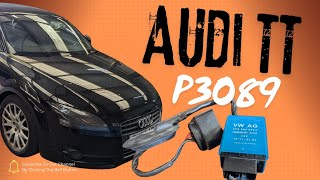
- Audi TT (MK2, 8J) (2007-2014) — The FPCM is a highly common failure item due to moisture buildup under the rear seat.
- Volkswagen GTI / Golf R (MK5, MK6) (2006-2014) — P3089 is almost always traced to internal FPCM failure on these platforms.
- Chevrolet Silverado 1500 (2019-2021) — P3089 is a general electrical code caused by a chafed engine wiring harness, per GM TSB 21-NA-149.
- GMC Sierra 1500 (2019-2021) — Points to the same wiring harness chafing issue covered by GM TSB 21-NA-149.
- Audi A4 / A5 / S5 / Q5 (2009-2016) — Intermittent stalling is a frequent complaint associated with FPCM failure on these models.
- Audi A8 (D3) (2007-2010) — The FPCM is located in the trunk on top of the fuel tank, making access difficult.
- Volkswagen Tiguan (2009-2017) — Shares the MK6 GTI platform and suffers identical FPCM failures.
Manufacturer-Specific Notes
- Volkswagen / Audi: The FPCM is located under the rear seat, exposing it to moisture from interior spills that corrode the module.
- General Motors: On 2019-2021 trucks, P3089 flags a chafed engine wiring harness (TSB 21-NA-149), not a fuel pump failure. Diagnosis must focus on the harness.
- Volkswagen / Audi: Replacing the FPCM on 2010+ models requires dealer-level 'Component Protection' programming. DIY replacements will not start the car.
- Volkswagen / Audi: The FPCM uses a Pulse-Width Modulated (PWM) signal. Testing the signal wire requires an oscilloscope; a multimeter cannot accurately read it.
- Volkswagen / Audi: TSB 01-08-06 recommends installing an updated in-tank fuel pump on 2006-2007 2.0T FSI (BPY) engines to resolve P3089.
Real Owner Stories
2007 Audi A8L with intermittent no-start
Car cranked but wouldn't fire, then started fine after waiting 10 minutes. The problem worsened over a week.
What they tried:
- An independent shop replaced the Fuel Pump Control Module, but the problem returned the next day.
Outcome: The issue was traced to a broken prong on the fuel pump relay, which caused intermittent power loss to the FPCM.
Lesson: Don't assume the FPCM is the only cause. Inspect the fuel pump relay and wiring for power and ground integrity before replacing expensive modules.
2010 VW GTI with CEL but no symptoms
The Check Engine Light illuminated with code P3089, but the car drove perfectly with no stalling.
What they tried:
- Owner visually inspected the FPCM and replaced it with a new Hitachi unit.
Outcome: Replacing the FPCM resolved the code permanently. Another user tried a salvage yard part, and the code returned immediately.
Lesson: P3089 indicates an intermittent fault that will become a hard failure. Buy a new, quality FPCM; used modules are a gamble.
2020 Chevy Silverado 1500 with multiple codes
Truck presented with P3089, U0100, P0707, rough running, and stalling.
What they tried:
- Followed GM Technical Service Bulletin 21-NA-149.
Outcome: The engine wiring harness was chafing against the chassis. The fix involved repairing the damaged wires and securing the harness with protective sleeving.
Lesson: For 2019-2021 GM trucks, P3089 is a wiring issue, not a fuel pump failure. Multiple unrelated codes confirm the harness chafing.
MK5 VW GTI with P3089 & P310C after parts replacement
After installing a new low-pressure fuel pump and controller, the car still threw P3089 and P310C.
What they tried:
- Replaced LPFP, replaced LPFP controller, changed spark plugs.
Outcome: The persistent electrical fault indicated a break in the signal wire between the controller and the ECM.
Lesson: Throwing parts at P3089 is ineffective. If a new pump and controller fail, you must perform electrical diagnosis on the signal wire.
How to Prevent This Code From Triggering
- Keep the fuel tank at least 1/4 full (Always) — Fuel cools the electric in-tank fuel pump. Running near empty overheats the pump, shortening its life and overloading the control module.
- Protect the FPCM area from moisture (VW/Audi) (After any interior spills) — The FPCM sits under the rear seat. Clean up spills immediately to prevent water from corroding the module and connector.
- Inspect engine wiring harness routing (GM) (Every oil change) — Visually check the engine harness for rubbing against brackets. Securing it prevents the chafing that triggers P3089.
- Replace the fuel filter at recommended intervals (Every 20,000-40,000 miles) — A clogged filter restricts flow, forcing the pump to draw more current. This electrical load damages the Fuel Pump Control Module.
Frequently Asked Questions
Can I drive my car with a P3089 code?
No, do not drive the vehicle. The engine stalls unpredictably at high speeds or in traffic, creating a severe safety hazard. Tow the vehicle to a repair location.
I replaced the Fuel Pump Control Module (FPCM), but the P3089 code came back. What's next?
If a new FPCM fails to clear the code, the issue lies in the wiring or the fuel pump itself. Meticulously check the wiring between the ECM and FPCM for continuity and shorts. Next, test the in-tank fuel pump for internal electrical faults drawing excessive current.
What is 'Component Protection' and how does it affect this repair?
Component Protection is an anti-theft system used by Audi and VW on 2010 and newer models. It locks major electronic modules, like the FPCM, to the car's unique VIN. Installing a new module requires dealer-level diagnostic tools to program it, making DIY replacement impossible.
Why does my car stall but then restart after a few minutes?
This classic symptom points to an overheating electronic component. The Fuel Pump Control Module generates heat during normal operation and shuts down when internal components fail and overheat. After cooling for a few minutes, it temporarily functions again until the temperature spikes.
Is fixing a P3089 code expensive?
Repair costs range from $200 to over $1,500 depending on the root cause. Replacing a VW/Audi FPCM typically costs $200-$600. A GM wiring repair costs $300-$1,000, while a full fuel pump replacement exceeds $1,500 on luxury models.
Where is the fuel pump control module located?
On most affected Volkswagen and Audi models, the module sits under the rear passenger seat cushion. For 2019-2021 GM trucks, the Fuel Pump Power Control Module mounts to the frame rail above the spare tire.
My car has code P3089, but it seems to be running perfectly fine. Should I be concerned?
Yes, an active code indicates a stored intermittent electrical fault. The underlying issue, such as a failing module or frayed wire, remains present and will eventually cause a permanent failure. Diagnose the vehicle immediately before it leaves you stranded.
Key Takeaways
- Code P3089 signals a fuel pump control circuit failure, meaning a broken signal line on VW/Audi vehicles or a chafed engine wiring harness on 2019-2021 GM trucks.
- Do not drive with an active P3089 code; the fault cuts power to the fuel pump and causes sudden engine stalling at highway speeds.
- Replacing the Fuel Pump Control Module (FPCM) fixes 80% of P3089 codes on VW/Audi models, costing between $200 and $600 for parts and labor.
- On 2019-2021 Chevy and GMC 1500 trucks, ignore the fuel pump and inspect the engine wiring harness for chafing per GM TSB 21-NA-149.
- DIYers cannot replace the FPCM on 2010 and newer VW/Audi vehicles without dealer-level software to bypass the 'Component Protection' anti-theft system.
Helpful Videos

The information in this article is provided for general reference and educational purposes only. Vehicle specifications, procedures, and part compatibility can vary by production date, trim level, and region. Always consult your vehicle's factory service manual and verify part numbers before purchasing or performing repairs. Safety-critical components such as airbags, seat belts, and braking systems should be installed by a qualified professional.
- 🎬 Helpful Videos
- What Does P3089 Mean?
- Can I Drive With P3089?
- Common Causes
- Symptoms
- Diagnostic Flowchart
- Common Fixes & Costs
- Used vs. New Parts: Buying Guide
- What Happens If You Wait — Timeline
- Cost of Not Fixing It
- Diagnosis Steps
- When This Code Triggers (Freeze-Frame Conditions)
- Related Codes
- Climate & Environmental Factors
- How to Talk to a Mechanic About This Code
- Where to Take It: Dealer vs Independent vs Chain
- When to Walk Away From the Repair
- What Scan Tool You Need for This Code
- How to Clear the Code After You Fix It
- Will This Fail Emissions / State Inspection?
- Most Commonly Affected Vehicles
- Manufacturer-Specific Notes
- Real Owner Stories
- 2007 Audi A8L with intermittent no-start
- 2010 VW GTI with CEL but no symptoms
- 2020 Chevy Silverado 1500 with multiple codes
- MK5 VW GTI with P3089 & P310C after parts replacement
- How to Prevent This Code From Triggering
- Frequently Asked Questions
- Can I drive my car with a P3089 code?
- I replaced the Fuel Pump Control Module (FPCM), but the P3089 code came back. What's next?
- What is 'Component Protection' and how does it affect this repair?
- Why does my car stall but then restart after a few minutes?
- Is fixing a P3089 code expensive?
- Where is the fuel pump control module located?
- My car has code P3089, but it seems to be running perfectly fine. Should I be concerned?
- Key Takeaways
- 🎟️ Get 5% Off