

P3004 on 2012-2016 Toyota Prius V: High Voltage Power Supply Malfunction Guide
Code P3004 on a 2012-2016 Prius V indicates a serious failure in the hybrid system's inverter, most often the Intelligent Power Module (IPM). This is a known issue, and the repair may be covered free of charge by Toyota's Customer Confidence Program 23TE03, which extends the warranty to 20 years from the vehicle's date of first use with no mileage limit. Do not attempt a DIY fix; contact a Toyota dealer immediately to check for program eligibility.
- P3004 indicates a critical failure in the hybrid inverter, a known issue for the 2012-2016 Prius V.
- The vehicle will enter a low-power 'limp mode' and should not be driven. It needs professional service immediately.
- Before paying for any repairs, contact a Toyota dealer with your VIN to see if you are covered by the 20-year unlimited mileage warranty extension (Customer Confidence Program 23TE03).
- This is a dangerous, high-voltage system. Do not attempt to diagnose or repair this issue yourself.
- The repair is often performed by replacing the Intelligent Power Module (IPM) inside the inverter, not the entire unit.
What's Unique About the 2012-2016 Toyota PRIUS V

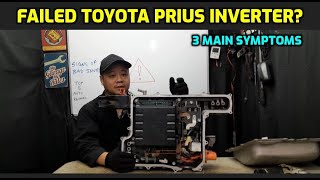
The 2012-2017 Toyota Prius V, along with 2010-2015 standard Prius models, is known to have a higher-than-normal failure rate of the Intelligent Power Module (IPM) within the hybrid inverter. The failure is often due to thermal stress on the IPM's internal components. The issue is 🎬 Watch: Common symptoms of a failing hybrid inverter so well-documented that Toyota, as part of a class-action settlement (McCarthy v. Toyota), issued multiple Technical Service Bulletins (TSBs) and a Customer Confidence Program (23TE03) to address it. This program extends the warranty coverage for this specific failure to 20 years with unlimited mileage, making a dealer diagnosis the essential first step for any owner 🎬 Learn how the 3rd Gen Prius hybrid system works seeing this code.
Diagnostic Flowchart
Tap your situation to follow the diagnostic path that matches what you're seeing on this vehicle.
Symptoms You May Notice

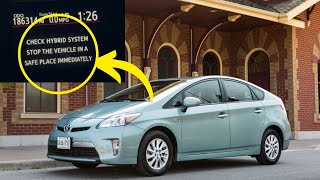
- Multiple warning lights on the dashboard, including the 'Check Hybrid System' message, Master Warning Light (red triangle), and Check Engine Light.
- Vehicle enters 'Fail-Safe' (limp) mode with significantly reduced acceleration and speed.
- The vehicle may stall while driving, or in some cases, shut down completely.
- The vehicle may fail to start or enter 'Ready' mode, sometimes accompanied by a clicking sound from the rear of the vehicle.
- The 12V auxiliary battery is not being charged by the hybrid system, leading to a dead 12V battery.
- Replacing the 12V auxiliary battery. While a weak 12V battery can cause numerous electrical issues in a Prius, and a P3004 fault will prevent the 12V from charging, it is not the root cause of a P3004 code, which points specifically to a high-voltage system fault.
- Replacing the main hybrid battery pack. The P3004 code and its associated TSBs point directly to the inverter assembly or the connection between the battery and inverter, not the battery cells themselves. A dealer-level diagnosis is required to differentiate the two.
Most Likely Causes

- Failed Intelligent Power Module (IPM) 🔴 High Probability This is a well-documented component failure for this vehicle platform due to thermal stress, leading Toyota to create specific warranty extension programs as part of a class-action settlement.
How to confirm: A Toyota dealer must use a specialized diagnostic tool (like Techstream) to confirm the IPM failure, as indicated by DTC P3004 and often accompanied by P0A94, P324E, or P0A1A. The dealer will follow the diagnostic flowchart in T-SB-0003-21 to determine which specific components inside the inverter need replacement.
Typical fix: Following the procedure in TSB T-SB-0003-21, a technician will replace the IPM transistor kit within the inverter assembly. In some cases, the entire inverter with converter assembly may be replaced. This repair is often covered under Toyota's Customer Confidence Program 23TE03, which includes parts, labor, and potentially a loaner vehicle.
Est. part cost: $0 (if covered by warranty) - $4000+
Rare But Worth Checking
- Failed Inverter Cooling Pump: While less common than direct IPM failure, a failing inverter cooling pump can cause the inverter to overheat, leading to IPM damage and triggering code P3004. Symptoms include a lack of coolant turbulence in the inverter reservoir. This is a more common cause for the related code P0A93.
- Failed Hybrid Battery Contactor (Relay): A failure in one of the high-voltage relays (contactors) within the hybrid battery assembly can prevent power from reaching the inverter, triggering a P3004 code. A technician can diagnose this by manually commanding the relays and listening for an audible 'click'; silence indicates a failed contactor. This can sometimes be misdiagnosed as an inverter failure.
- Improper HV Battery Service: In some DIY scenarios, failing to properly reconnect grounds or torque bus bars after servicing the hybrid battery pack can lead to a P3004 code, as the system detects a power delivery issue. One owner on PriusChat found the code was caused by a ground lug for the battery being stuck under a plate, preventing a proper connection.
Diagnosis Steps
- Confirm the presence of P3004 and any other codes (P0A94, P324E, P0A1A) using an OBD-II scanner.
- Check the inverter coolant level in the plastic reservoir under the hood. A low level could indicate a leak or a failed pump, which can cause overheating and lead to this code.
- Contact a Toyota dealership and provide your vehicle's VIN. Specifically mention Customer Confidence Program 23TE03 and code P3004 to check for coverage.
- If you do not feel safe driving, arrange for the vehicle to be towed to the dealer. The cost may be covered under the settlement program.
- A technician will perform a detailed diagnostic using Toyota's Techstream software to read freeze frame data and confirm the specific fault within the inverter assembly, following the procedure in TSB T-SB-0003-21.
- The technician will inspect the inverter and related components, potentially measuring resistance at the inverter terminals to check for an internal short.
- After repair (e.g., replacing the IPM), the technician will clear all DTCs and perform a test drive to confirm the fix.
Parts You'll Likely Need
- Intelligent Power Module (IPM) Transistor Kit
(OEM #04899-47021 (superseded by 04899-47070))— This is the specific component within the inverter that is known to fail and is the primary target of the repair procedures outlined in Toyota's TSBs. The original part number 04899-47021 has been replaced by 04899-47070.
Trusted brands: Toyota Genuine
OEM price range: $800-$1500
Aftermarket price range: Not Recommended - Inverter with Converter Assembly
(OEM #G9200-47141 (Part number varies by VIN, confirm with dealer))— In cases of severe damage or if required by the diagnostic procedure, the entire inverter assembly is replaced. This is the most comprehensive fix. Part numbers are specific to production dates and must be verified by VIN.
Trusted brands: Toyota Genuine
OEM price range: $2000-$3000+
Aftermarket price range: Not Recommended
Related Codes That Often Appear With This One
- P0A94 — This code, for 'DC/DC Converter Performance', is frequently stored with P3004 as they both relate to malfunctions within the same inverter with converter assembly and are explicitly listed together in Toyota's service bulletins.
- P324E — Another code related to the hybrid inverter malfunction, often cited in the same TSBs (T-SB-0003-21, 23TE03) as P3004.
- P0A1A — This code for 'Generator Control Module' also points to a fault within the inverter assembly and is commonly seen with P3004 as part of the same known failure pattern.
Technical Service Bulletins (TSBs) & Recalls
- 23TE03: Details the Customer Confidence Program, extending warranty coverage for IPM failure indicated by DTCs including P3004 to 20 years/unlimited miles.
- T-SB-0003-21: Provides the updated repair procedure for dealers to diagnose and replace specific components (like the IPM) within the inverter assembly for codes P0A94, P324E, P0A1A, and/or P3004.
- 20TE10: An earlier, now superseded, Customer Support Program that also identified P3004 with IPM failure but offered a 15-year warranty extension.
Platform-Specific Known Issues
- Toyota's Customer Confidence Program 23TE03 extends the warranty for the Intelligent Power Module (IPM) failure to 20 years from the vehicle's date of first use, with no mileage limitation. This covers the repair at no cost to the owner.
- The program is the result of the 'McCarthy v. Toyota' class-action settlement regarding the inverter issue and provides for complimentary towing and a loaner vehicle if the repair meets certain conditions.
- This program superseded earlier, less comprehensive programs like 20TE10, which had a 15-year coverage limit.
Mechanic-Grade Diagnostic Values
- System Main Resistor resistance — expected: 18 to 22 Ω. Failure: A reading outside this range indicates a fault in the resistor, which is part of the high-voltage pre-charge circuit.
- Insulation resistance between high-voltage terminals and body ground — expected: 100 MΩ or higher (using a megohmmeter). Failure: A low resistance reading indicates a high-voltage leak to the chassis, which is a critical safety and operational fault.
- Techstream Freeze Frame Data: Post-boost vs. Pre-boost Voltage — expected: The difference between HV battery voltage (Power Resource VB) and pre-boost voltage (VL) should be less than 50V, and post-boost voltage (VH) should be above 50V.. Failure: A difference greater than 50V or a post-boost voltage below 50V points to a failure in the pre-charge sequence, often related to the main relays or pre-charge resistor.
Hidden / Shadow Codes Worth Checking
- P3004-131: High Voltage Power Resource. Indicates a failure during the pre-charge sequence (e.g., open service plug, failed relay, open pre-charge resistor, or open HV cable). (see via Toyota Techstream or equivalent advanced diagnostic scanner under the 'Hybrid Control' ECU menu.)
- P3004-132: High Voltage Power Resource Malfunction. Points to an inverter voltage sensor malfunction or an increase in limiter resistance. (see via Toyota Techstream or equivalent advanced diagnostic scanner under the 'Hybrid Control' ECU menu.)
- P3004-803: Power Cable Malfunction. Specifically indicates a problem with the high-voltage wiring between the battery and inverter. (see via Toyota Techstream or equivalent advanced diagnostic scanner under the 'Hybrid Control' ECU menu.)
Scan Tool Commands That Help
- Toyota Techstream: Active Test: HV Battery Contactors/Relays — When diagnosing a P3004 no-start condition. A technician can command each of the three main HV relays (SMRB, SMRP, SMRG) to close individually. An audible 'click' should be heard for each. Silence from one relay indicates it has failed mechanically or electrically, preventing HV power from reaching the inverter.
- Toyota Techstream: Data List / Freeze Frame Analysis — This is the primary diagnostic step. A technician reviews the detailed data captured at the moment the fault occurred, paying close attention to parameters like 'Power Resource VB', 'VL-Voltage before Boosting', and 'VH-Voltage after Boosting' to pinpoint where in the pre-charge sequence the failure happened.
Wiring & Ground Locations

- Power Management Control ECU — Located behind the right side of the dashboard.. This is the main computer for the hybrid system. It monitors the inverter and HV battery and sets the P3004 code. All diagnostic communication for this system goes through this ECU.
- Inverter Ground Cable — A primary ground cable runs from the inverter/converter assembly case to a bolt on the vehicle's chassis, typically on the passenger side of the engine bay.. A loose or corroded main ground for the inverter can cause a variety of high-voltage errors and control issues, as the DC-DC converter inside the inverter is the primary 12V power source for the vehicle when it is 'Ready'.
- Instrument Panel J/B (Junction Block) — Located behind the left end of the dashboard, near the driver's kick panel.. This junction block contains multiple fuses and relays that are critical for powering up various ECUs, including those needed for the hybrid system to initialize.
Real Owner Repair Stories
- Automotive diagnostic case study (Toyota Prius (similar platform)) — Vehicle recovered as a non-start, would not enter 'Ready' mode. P3004-131 code stored.
❌ Tried (didn't work) Initial checks of 12V battery and brake switch were normal.
✅ What actually fixed it Using a scan tool's Active Test, the technician commanded the three HV battery contactors (relays) individually. Two produced an audible 'click', but the third was silent. The technician diagnosed a failed contactor within the HV battery junction block. Replacing the single failed contactor resolved the P3004 code and allowed the vehicle to start and drive normally. - PriusChat user (2010 Toyota Prius, 135,000 miles) — After stopping on a hot day, car would not start. Multiple warning lights, 'Check Hybrid System' message, and code P3004.
✅ What actually fixed it The vehicle was towed to a Toyota dealer. The dealer diagnosed a failed Intelligent Power Module (IPM) and performed the repair under warranty by replacing the 'IPM Transistor Kit' (P/N 04899-47070), thermal grease, and associated seals inside the inverter.
OEM Part Supersession History
04899-47020, 04899-47021→04899-47070— Component revision and improvement to address the thermal stress and failure issues of the original Intelligent Power Module (IPM) transistors.
Model Year Variations Within This Range
- 2015-2017 (Facelift): The 2015 model year marked a 'facelift' for the Prius V. Changes relevant to a technician include a redesigned front bumper, a higher-resolution Multi-Function Display (MFD) that does not use the failure-prone 2012-2014 Harman expansion box for Bluetooth/GPS, and a different instrument cluster. Engines from late 2014 onward also received updated piston rings to mitigate oil consumption issues.
Helpful Videos
We Have This Part in Stock



The information in this article is provided for general reference and educational purposes only. Vehicle specifications, procedures, and part compatibility can vary by production date, trim level, and region. Always consult your vehicle's factory service manual and verify part numbers before purchasing or performing repairs. Safety-critical components such as airbags, seat belts, and braking systems should be installed by a qualified professional.
- Toyota PRIUS V:
- 🎬 Helpful Videos
- 🛍️ Shop This Part
- What's Unique About the 2012-2016 Toyota PRIUS V
- Diagnostic Flowchart
- Symptoms You May Notice
- Most Likely Causes
- Rare But Worth Checking
- Diagnosis Steps
- Parts You'll Likely Need
- Related Codes That Often Appear With This One
- Technical Service Bulletins (TSBs) & Recalls
- Platform-Specific Known Issues
- Mechanic-Grade Diagnostic Values
- Hidden / Shadow Codes Worth Checking
- Scan Tool Commands That Help
- Wiring & Ground Locations
- Real Owner Repair Stories
- OEM Part Supersession History
- Model Year Variations Within This Range
- 🎟️ Get 5% Off