

P3004 on 2010-2015 Toyota Prius: Inverter Failure Causes and Fixes
Code P3004 on a 2010-2015 Prius indicates a critical failure in the high-voltage hybrid system, almost always caused by a faulty Intelligent Power Module (IPM) inside the inverter assembly. This is a known issue covered by several Toyota warranty extensions. The only fix is to replace the inverter, a very expensive repair if not covered by warranty.
- P3004 on a 2010-2015 Prius is a critical code indicating a failure in the hybrid inverter, making the car unsafe to drive.
- Before paying for any repairs, contact a Toyota dealer with your VIN to check for coverage under Customer Confidence Program 23TE03, which covers this specific, known issue for 20 years with unlimited mileage.
- This is not a DIY repair. The high-voltage system is extremely dangerous and requires a trained professional.
- The fix is to replace the inverter assembly or its internal IPM, a costly repair that should be free if performed at a dealer under Toyota's support program.
What's Unique About the 2010-2015 Toyota PRIUS

The third-generation Prius (2010-2015) is widely known for this specific failure. The Intelligent Power Module (IPM), a key component within the inverter, is susceptible to heat-related stress and failure. This is believed to be caused by differential thermal expansion between the transistors and the heat sink they are mounted on, leading to solder joint failure under high-load conditions. Toyota acknowledged this design or manufacturing flaw by issuing multiple TSBs and Customer Support Programs, effectively extending the warranty for this specific part due to its high failure rate. The most significant is Customer Confidence Program 23TE03, which extends coverage for the IPM failure to 20 years with unlimited mileage from the vehicle's first use date.
Diagnostic Flowchart

Tap your situation to follow the diagnostic path that matches what you're seeing on this vehicle.
Symptoms You May Notice

- "Check Hybrid System" warning on the dashboard.
- Multiple warning lights illuminated (MIL, VSC, ABS, Master Warning Light).
- Vehicle enters a low-power "limp" or "Fail Safe" mode.
- Car is stuck in Park and cannot be shifted into Drive or Reverse. 🎬 Watch: Troubleshooting a Prius stuck in Park with code P3004.
- Vehicle stalls while driving and will not restart.
- A clicking sound from the rear of the vehicle for a few seconds on startup attempt.
- Replacing the 12V auxiliary battery. While a weak 12V battery can cause various electrical issues, it will not directly cause a P3004 code related to the high-voltage inverter. A Reddit user confirmed replacing their 12V battery did not fix the P3004 issue.
- Replacing the main Hybrid Battery Pack. A failing HV battery typically sets different codes related to cell voltage imbalance (P0A80). A technician in one documented case replaced the battery pack only to find the P3004 code remained, confirming the inverter was the actual problem. Another owner was told by a dealer that the battery needed replacement, but after getting a second opinion and a regenerated battery, the P3004 code pointed back to the inverter.
Most Likely Causes

- Failed Intelligent Power Module (IPM) in the Inverter Assembly 🔴 High Probability This is a well-documented factory defect. The IPM, a set of transistors, is prone to overheating, causing solder points to fail due to thermal stress and differential expansion, leading to an internal short or open circuit within the inverter. Toyota's Customer Confidence Program 23TE03 directly addresses this failure.
How to confirm: Diagnosis with a Toyota Techstream scan tool will show P3004, often accompanied by P0A94, P324E, and/or P0A1A. The presence of info code 800 (overcurrent during precharge) is a strong indicator. A dealer will follow the diagnostic flowchart in TSB T-SB-0003-21 to confirm the IPM failure.
Typical fix: Replacement of the entire 'Inverter with Converter Assembly' is the most common fix. While TSBs mention replacing individual components like the IPM transistor kit (P/N 04899-47021), the full assembly replacement is often performed, especially under warranty. The repair must be done at an authorized Toyota dealer to be covered by the warranty extension.
Est. part cost: $1900-$4000
Rare But Worth Checking
- Failed HV Battery Contactor/Relay: A diagnostic blog detailed a case where a stuck or failed relay (contactor) in the hybrid battery junction block prevented voltage from reaching the inverter, triggering a P3004 code. The technician confirmed this by manually testing the contactors and hearing one that did not 'click'. This is less common than inverter failure but possible.
- Damaged High-Voltage Wiring: An open or short in the thick orange cables connecting the HV battery to the inverter can cause this code. This is usually the result of physical damage, corrosion, or improper installation after a previous repair.
- Failed A/C Compressor: The A/C compressor runs on the high-voltage circuit. A short circuit within the compressor can disrupt the entire HV system and trigger a P3004 code. Diagnostic procedures for P3004 on the related Lexus CT200h include checking the compressor assembly. A related code, B1498/98, points to a communication error with the A/C inverter that can also be a factor.
Diagnosis Steps
- First, and most importantly, contact a Toyota dealer with your vehicle's VIN. Ask them to check for coverage under Customer Confidence Program 23TE03. This program covers the IPM failure for 20 years with unlimited mileage. If covered, all diagnosis and repair at the dealer will be free.
- If not covered, a professional diagnosis is required. Read the codes with a Toyota-compatible scanner (like Techstream) to confirm P3004 and any related codes (P0A94, P324E, P0A1A) and, crucially, any 'info codes' or 'detail codes' like 800 or 132.
- A technician must follow high-voltage safety protocols, including wearing insulated gloves and disconnecting the service plug to de-energize the system, then waiting at least 10 minutes for capacitors to discharge.
- Follow the diagnostic procedure outlined in Toyota TSB T-SB-0003-21, which involves checking for physical damage and testing specific components based on the logged codes and info codes.
- In most cases, these steps will confirm an internal failure of the inverter assembly, necessitating its replacement. 🎬 See this step-by-step walkthrough for replacing the inverter assembly. A Reddit user described this exact process: car wouldn't start, threw P3004, they took it to the dealer, mentioned the warranty extension, and the dealer diagnosed and replaced the inverter at no charge.
Parts You'll Likely Need
- Inverter with Converter Assembly
(OEM #G9200-47210, G9200-47230)— This is the complete unit that houses the failing Intelligent Power Module (IPM). It is replaced as a single assembly to resolve the P3004 code. Note that part numbers may be superseded and compatibility is key; an inverter from a Prius V (e.g., G9200-47161) may not be plug-and-play with a standard Prius.
Trusted brands: Toyota (OEM)
OEM price range: $2700-$4000
Aftermarket price range: $500-$1900 (Used or Remanufactured)
Related Codes That Often Appear With This One
- P0A94 — This code for 'DC/DC Converter Performance' is listed in the same TSBs as P3004 and points to a failure within the same inverter assembly.
- P324E — This code for 'MG ECU Power Relay Intermittent Circuit' is also part of the group of codes indicating an internal inverter failure, as per Toyota's service bulletins.
- P0A1A — This code for 'Generator Control Module' is another indicator of the same internal inverter/IPM failure, frequently appearing alongside P3004.
Technical Service Bulletins (TSBs) & Recalls

- 23TE03: Details a Customer Confidence Program that superseded previous programs. It covers the failure of the IPM inside the inverter assembly for 20 years/unlimited miles, indicated by DTCs including P3004. This is the most critical document for owners to reference.
- 20TE10: Describes a previous 15-year warranty enhancement program for the same IPM failure condition. This program has been superseded by 23TE03 as of February 2023.
- T-SB-0003-21: Provides the official repair procedure for a MIL ON condition with DTCs including P3004, indicating a malfunction in the inverter assembly. It instructs technicians on how to diagnose the issue and determine which components to replace.
Platform-Specific Known Issues
- Toyota has issued multiple Technical Service Bulletins and Customer Support Programs (Warranty Extensions) specifically for this issue on 2010-2015 Prius models. Bulletins 20TE10, 23TE03, and TSB-0003-21 all directly address the IPM failure within the inverter that causes code P3004 and others.
- The most current and important program is Customer Confidence Program 23TE03, which resulted from a class-action settlement. It provides a 20-year, unlimited mileage warranty extension for the specific IPM failure, including free towing and a loaner vehicle.
Mechanic-Grade Diagnostic Values
- Insulation Resistance Test (Megger Test) of MG1/MG2 Windings — expected: Greater than 10 MΩ (Megaohms), ideally infinite resistance (550 MΩ or higher is a common good reading).. Failure: A reading close to zero, or significantly below 10 MΩ, indicates a short to ground in the motor windings or connecting cables, which can trigger a P3004.
- System Main Resistor Resistance — expected: 18 to 22 Ω (Ohms).. Failure: A reading outside this range can indicate a problem with the pre-charge circuit, which is checked when diagnosing P3004-132.
Hidden / Shadow Codes Worth Checking
- P3004-800: Indicates an 'Excessive overcurrent during precharge'. This means the system detected a dead short when trying to energize the high-voltage components, strongly pointing to a failed inverter IPM. (see via Toyota Techstream or a compatible advanced scan tool.)
- P3004-131: Indicates the high voltage from the HV battery is not being seen at the inverter. This can be caused by a failed HV battery contactor (relay), a break in the main HV cables, or a disconnected service plug. (see via Toyota Techstream or a compatible advanced scan tool.)
- P3004-132: Indicates an inverter voltage sensor malfunction or that the pre-charge resistor's value has increased. The ECU is not seeing the voltage it expects during the pre-charge sequence. (see via Toyota Techstream or a compatible advanced scan tool.)
Scan Tool Commands That Help
- Toyota Techstream: Reading Freeze Frame Data for P3004 — Crucial for diagnosis. The freeze frame data for P3004 will contain values for 'Power Resource IB' (battery current), 'Power Resource VB' (battery voltage), and pre-boost/post-boost voltages. A high 'IB' value with P3004-800 confirms an overcurrent event. Low or mismatched voltage readings can point towards contactor or wiring issues with P3004-131.
- Toyota Techstream: Active Test: Powering HV Contactors — When diagnosing P3004-131, a technician can use the scan tool to command each of the three HV battery contactors to close individually. By listening for an audible 'click' from each relay, a failed/silent contactor can be identified as the root cause.
Wiring & Ground Locations
- Inverter Connectors (I10, H15) — The main connectors on the Inverter with Converter assembly, located under the hood.. Diagnostic procedures for P3004 often require disconnecting these to isolate and test the wiring harness between the inverter and the Hybrid Vehicle Control ECU.
- HV Battery Junction Block — Located at the HV battery pack in the rear of the vehicle. It houses the main system relays (contactors).. This is a critical point of failure for code P3004-131. A stuck or failed contactor in this block will prevent power from reaching the inverter. Technicians check for secure connections and signs of arcing here.
- Frame Wire (High Voltage Cable) — The thick, orange high-voltage cable running between the HV Battery Junction Block and the Inverter with Converter Assembly.. Damage or a loose connection on this main power cable is a primary cause for P3004-131, as it directly interrupts the power resource the code is named for.
Real Owner Repair Stories
- Garry's Garage (Diagnostic Blog) (Toyota Prius (Gen 3 implied)) — No 'Ready' mode, vehicle would not start or drive.
❌ Tried (didn't work) Initial assumption was a failed inverter, as is common.
✅ What actually fixed it The vehicle had code P3004-131. Using a scan tool's active test to command the HV battery contactors, the technician found one of the three relays was silent and not closing. Replacing the single failed contactor (relay) in the HV battery junction block resolved the code and restored vehicle operation. - PriusChat user 'alinica2001' (2011 Toyota Prius) — 'Check Hybrid System' message, car would not start.
❌ Tried (didn't work) Initial diagnosis and code reading.
✅ What actually fixed it The car had code P3004-800. The owner confirmed a dead short (0 ohms) at the inverter's high voltage input terminals. The final fix was replacing the original inverter (P/N G9200-47140) with a newer-generation used inverter (P/N G9200-47190) from a 2017 Toyota Auris, which resolved the problem.
OEM Part Supersession History
G9200-47140 (2010-2011 Prius)→G9200-47210, G9200-47230, G9200-47190— Revisions to address the IPM failure and improve reliability.
Heads up: A forum user confirmed that a newer inverter from a 2017 Auris (G9200-47190) was a direct fit and functional replacement for the original G9200-47140 in a 2011 Prius, suggesting good backward compatibility for these later revisions. However, always verify specific part number compatibility by VIN, as Prius V models used different inverters (e.g., G9200-47161).
Model Year Variations Within This Range
- 2010-2014: Models from 2010 through early 2014 are noted as having higher risks for other non-inverter issues like excessive oil consumption and head gasket failure compared to the 2015 model year, which received revised engine components. While not directly related to P3004, it's a key consideration for overall vehicle health.
Helpful Videos

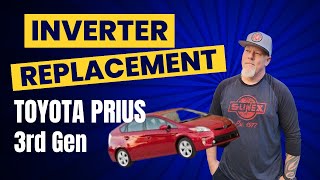
We Have This Part in Stock



The information in this article is provided for general reference and educational purposes only. Vehicle specifications, procedures, and part compatibility can vary by production date, trim level, and region. Always consult your vehicle's factory service manual and verify part numbers before purchasing or performing repairs. Safety-critical components such as airbags, seat belts, and braking systems should be installed by a qualified professional.
- Toyota PRIUS:
- 🎬 Helpful Videos
- 🛍️ Shop This Part
- What's Unique About the 2010-2015 Toyota PRIUS
- Diagnostic Flowchart
- Symptoms You May Notice
- Most Likely Causes
- Rare But Worth Checking
- Diagnosis Steps
- Parts You'll Likely Need
- Related Codes That Often Appear With This One
- Technical Service Bulletins (TSBs) & Recalls
- Platform-Specific Known Issues
- Mechanic-Grade Diagnostic Values
- Hidden / Shadow Codes Worth Checking
- Scan Tool Commands That Help
- Wiring & Ground Locations
- Real Owner Repair Stories
- OEM Part Supersession History
- Model Year Variations Within This Range
- 🎟️ Get 5% Off