

OBD-II Code P2906: Clutch Actuator Temperature Too High
The Ultimate 2026 Guide to P2906: Causes, Pro-Level Diagnosis, and Real-World Fixes
- P2906 specifically flags an overheating clutch actuator in Hyundai and Kia 7-speed dry dual-clutch transmissions (DCT).
- Check for Technical Service Bulletins (TSBs) like Hyundai's 21-AT-014H before replacing parts, as a $150 TCM software update often resolves the code.
- Stop driving immediately when this code triggers; every 20°F increase above 200°F halves transmission fluid life and risks a $4,000+ transmission failure.
- Modify driving habits in heavy traffic by shifting to Neutral during stops longer than 15 seconds to prevent the dry clutch from slipping and overheating.
- Never skip the mandatory 'Clutch Adaptive Learning' procedure with a bidirectional scanner after replacing DCT components, or the new parts will fail prematurely.
What Does P2906 Mean?

P2906 is a manufacturer-specific diagnostic trouble code (DTC) primarily used by Hyundai and Kia. It signifies the Transmission Control Module (TCM) detected excessive heat in the clutch actuator of the dual-clutch transmission (DCT). The computer logs this code and triggers a warning light to protect sensitive transmission components from irreversible heat damage.
Technical definition: The official definition for P2906 on Hyundai and Kia vehicles with a dual-clutch transmission is 'Clutch Actuator Temperature Too High'. The TCM sets this code when the temperature value received from the clutch actuator's internal temperature sensor surpasses a critical, manufacturer-defined threshold for a specific period, triggering protective limp mode.
Can I Drive With P2906?
No — Do Not Drive. Driving is not recommended. The transmission enters a 'limp mode' with severely reduced power and shifting to prevent catastrophic damage. Continuing to drive risks a sudden loss of power in traffic and guarantees complete transmission failure. Every 20°F increase in temperature above 200°F cuts the transmission fluid's life in half, leading to rapid internal destruction. A full transmission replacement costs between $4,000 and $8,000.
Common Causes

- TCM Software Glitch or Outdated Logic (Very Common) — Corrupt or outdated software in the Transmission Control Module (TCM) causes erratic clutch engagement, misinterprets sensor data, and uses incorrect parameters. This leads to unnecessary friction and heat. Most manufacturer Technical Service Bulletins (TSBs) for this issue require a simple software update.
- Worn or slipping clutch pack (Very Common) — As the clutch friction material wears down, the clutch slips. This slippage creates intense friction and heat far beyond normal operating temperatures, which the actuator's temperature sensor detects. This is the primary mechanical failure point in dry clutch DCTs.
- Improper driving habits in traffic (Common) — Prolonged operation in heavy stop-and-go traffic, aggressive driving on steep hills, or 'creeping' forward places a continuous high load on the clutch system. This prevents the dry clutch from cooling and directly causes overheating. 🎬 Watch: How the Hyundai dual-clutch transmission system works
- Low or degraded transmission fluid (Common) — Transmission fluid cools and lubricates the DCT. If the fluid is below the recommended level, old, or contaminated, it loses its ability to dissipate heat effectively, causing the clutch actuator to overheat under normal operation.
- Faulty clutch actuator (Common) — The electric motor or internal mechanisms of the clutch actuator fail over time. A failing actuator works harder, binds, or responds slowly, generating excessive heat that triggers the code.
- Faulty clutch actuator temperature sensor (Less Common) — The sensor itself fails and sends erroneously high temperature readings to the TCM. The actuator isn't actually overheating, but the computer thinks it is and triggers the code as a precaution.
- Failing Electric Oil Pump (EOP) (Less Common) — In 8-speed wet clutch DCT models, a failing high-pressure electric oil pump causes a drop in fluid pressure. This eliminates adequate cooling and lubrication, contributing to overheating codes and power loss.
- Damaged wiring or connectors (Rare) — Frayed wires, loose pins, or corroded connectors in the circuit between the clutch actuator sensor and the TCM create high resistance. This leads to false high-temperature readings or actuator motor faults.
Symptoms

- Transmission warning light is on — A transmission temperature warning light (a gear icon with a thermometer) or a check engine light illuminates. Dashboard messages like 'Transmission temp. is high! Stop safely' frequently appear.
- Hesitation or shuddering on acceleration — The vehicle hesitates, shudders, or vibrates violently when accelerating from a stop. This classic DCT symptom worsens in hot weather or heavy traffic.
- Harsh, delayed, or failed shifting — Gear shifts become jerky, slow, or feel like they are slipping. The transmission often refuses to engage reverse or drops into neutral unexpectedly.
- Burning smell — A distinct, acrid burning odor from the transmission area indicates overheating fluid and actively burning clutch material.
- Loss of power / Limp mode (also visible on scanner) — The vehicle suddenly loses power and exhibits extremely slow acceleration. The computer limits engine output to prevent catastrophic transmission damage.
Diagnostic Flowchart
Tap your situation to follow the diagnostic path that matches what you're seeing on this code.
Common Fixes & Costs
- TCM Software Update — Parts: $0, Labor: $150-$200, ~1.0 hr book time (Professional)
- Transmission Fluid and Filter Change
— Parts: $80-$150, Labor: $120-$200, ~1.5 hr book time
(Intermediate)
Hyundai/Kia 7-Speed DCT (2016-2022): OEM ['00232-19108 (TGO-10, 70W GL-4)'] (Alt: Red Line MT-LV 70W/75W GL-4 Gear Oil) - Replace Clutch Actuator
— Parts: $400-$1000, Labor: $400-$800, ~3.5 hr book time
(Professional)
Hyundai Tucson (2016-2018): OEM ['41470-2D211'] (Alt: Valeo 855507) - Replace Dual Clutch Assembly
— Parts: $1000-$1500, Labor: $1000-$1500, ~8.5 hr book time
(Professional)
Hyundai/Kia 7-Speed DCT (2016-2022): OEM ['41200-2D220'] (Alt: LuK, Sachs) - Transmission Rebuild or Replacement — Parts: $2500-$5000, Labor: $1500-$3000, ~12.0 hr book time (Professional)
Used vs. New Parts: Buying Guide
When a used part is worth it: For a high-cost part like a clutch actuator, a used part from a low-mileage vehicle (under 50K miles) scrapped for non-drivetrain reasons is a budget-conscious choice. Never buy a used friction clutch disc.
Donor-vehicle mileage cap: roughly under 50000 miles for the part to have meaningful remaining life.
Donor quality checklist:
- Verify the donor vehicle's VIN to ensure it wasn't scrapped for a transmission issue.
- Match the part number exactly; updated parts are common for these components.
- Inspect for external damage, fluid leaks, or scorch marks on the actuator.
Decision logic:
- If The vehicle is under powertrain warranty or a specific warranty extension → Use new OEM parts installed by a dealer to ensure coverage.
- If The vehicle is high-mileage (>120K miles) and you plan to sell it soon → A used actuator is a justifiable short-term solution, but accept the higher risk of premature failure.
- If The part is a high-wear item like the clutch pack itself → Always buy new. The labor cost to replace it is too high to risk using a worn part.
Warranty tradeoff: Used parts typically come with a 30-90 day functional warranty that does not cover labor. New OEM parts installed by a dealer are warrantied for 12 months/12,000 miles.
Worst-case if a used part fails: $1500-$3000 if a used part fails, as you must pay for repeat labor plus another replacement part.
What Happens If You Wait — Timeline
- 0-2 months: Intermittent, mild shudder from a stop in hot weather. P2906 code may be pending, but the check engine light is off. (MPG impact: 0-2%% · Added cost: $0)
- 2-6 months: Shudder becomes frequent. Transmission warning light illuminates, triggering limp mode. Fluid begins to degrade from heat. (MPG impact: 3-8%% · Added cost: $200-$400 (A software update or fluid change might still fix it).)
- 6-12 months: Shifting becomes harsh and jerky. A burning smell is present. The clutch pack is glazed and slipping, and the actuator is damaged from excessive strain. (MPG impact: 10-20%% · Added cost: $2,000-$3,500 (A clutch and actuator replacement is required).)
- 12+ months: Catastrophic failure. The vehicle refuses to move or gets stuck in gear. The entire transmission assembly is compromised. (MPG impact: 25%+% · Added cost: $4,000-$8,000 (Complete transmission replacement is the only option).)
Cost of Not Fixing It
- 0-1 month: Intermittent limp mode, worsening shudder and hesitation in traffic. Increased stress on transmission fluid. (Added cost: Negligible, but risk of being stranded increases.)
- 1-6 months: Accelerated wear of the clutch pack and actuator due to constant slipping. Transmission fluid degrades rapidly, losing protective properties. (Added cost: $2000-$3500 (Clutch and actuator replacement becomes mandatory).)
- 6+ months: Catastrophic failure of the dual-clutch assembly, actuator, and internal transmission bearings. The vehicle becomes undrivable. (Added cost: $4000-$8000 (Full transmission replacement required).)
Diagnosis Steps
- Check for Technical Service Bulletins (TSBs)
Before touching the vehicle, research TSBs for your specific year, make, and model. Manufacturers frequently release bulletins with updated software flashes for known DCT issues, saving hours of diagnostic time and preventing unnecessary parts replacement.
Tools: Online Access, Vehicle VIN (Beginner) - Scan for All Trouble Codes
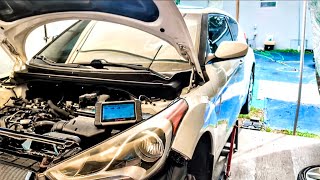
Use a professional-grade OBD-II scanner capable of reading the Transmission Control Module (TCM). Check for any codes accompanying P2906. Codes related to actuator circuits (like P0902) point to electrical faults rather than mechanical overheating.
Tools: Advanced OBD-II Scanner (Beginner) - Monitor Live Sensor Data
View the live data stream (PIDs) for the clutch actuator temperature sensor. On a cold engine, the reading must match ambient air temperature. A reading immediately at maximum (e.g., 300°F+) indicates a shorted sensor or circuit. A reading that climbs abnormally fast during light use confirms a slipping clutch.
Tools: Advanced OBD-II Scanner (Intermediate) - Inspect Transmission Fluid Level and Condition
Check the transmission fluid level on a level surface. On Hyundai/Kia 7-speed DCTs, remove the 17mm fill plug; fluid should sit level with the bottom threads. Fluid that is dark black, smells burnt, or contains metallic debris confirms severe internal wear.
Tools: Gloves, Rag, Level Surface, 17mm socket/wrench (Intermediate) - Inspect Wiring Harness and Connectors
Visually inspect the wiring harness and all connectors routing to the clutch actuator and the TCM. Look for melted insulation, corrosion, or loose pins that distort the sensor signal.
Tools: Flashlight, Inspection Mirror (Intermediate) - Pro Tip: Test Temperature Sensor Circuit
Disconnect the clutch actuator connector and use a multimeter to test the temperature sensor circuit. Verify a 5-volt reference from the TCM and continuity to ground. Measure the sensor's internal resistance when cold (typically ~2,500 Ohms at 77°F). Infinite or zero resistance confirms a dead sensor.
Tools: Digital Multimeter, Wiring Diagram, Service Manual (Advanced) - Advanced Step: Perform Clutch Judder Test
For Hyundai/Kia vehicles, use a dealer-level scan tool to perform a 'Judder Measurement' test. This automated test analyzes clutch engagement and definitively proves if the clutch pack is worn out, separating a software issue from a hardware failure.
Tools: Hyundai GDS-M Scan Tool (or equivalent bidirectional scanner) (Advanced) - Pro Tip: Analyze Sensor Waveform
For intermittent issues, graph the temperature sensor's signal wire with an oscilloscope. A healthy sensor produces a clean, steady line. A faulty sensor or chafed wire produces a noisy waveform with sharp, illogical spikes.
Tools: Automotive Oscilloscope (Professional) - Perform Clutch Relearn/Calibration
If you replace the fluid, actuator, or clutch assembly, a clutch 'adaptive learning' procedure is mandatory. Use a bidirectional scan tool to reset the learned clutch engagement points. Skipping this destroys the new parts.
Tools: Bidirectional Scan Tool (Advanced)
When This Code Triggers (Freeze-Frame Conditions)
- Transmission Fluid Temp: 250-300°F+ (Exceeding the normal operating range, triggering limp mode.)
- Vehicle Speed: 0-10 mph (Code sets during low-speed, stop-and-go driving or when holding on an incline.)
- Engine RPM: 1000-1800 RPM (Occurs during clutch-slipping events like creeping in traffic.)
- Engine Load: 40-70% (High load at low speed, such as accelerating from a stop on a hill.)
Related Codes
- P2787 — This is a generic OBD-II code for 'Clutch Temperature Too High'. It is functionally identical to P2906 and is used by other manufacturers (like Ford) for the exact same overheating issue.
- P0700 — This is a general 'Transmission Control System Malfunction' code. It acts as a notification telling you the TCM has stored a specific fault like P2906.
- P0711 — This code means 'Transmission Fluid Temperature Sensor Circuit Range/Performance'. It appears with P2906 if the computer sees conflicting data between the main fluid sensor and the actuator's sensor.
- P0902 — This code means 'Clutch Actuator Circuit Low'. It indicates a direct electrical short within the clutch actuator motor circuit, which causes the actuator to fail and overheat.
Climate & Environmental Factors
- Stop-and-Go Traffic: Constant creeping forces the DCT to continuously slip the clutch, generating massive friction and heat. This is the primary trigger for P2906.
- High Ambient Temperature: Hot weather reduces the transmission's ability to dissipate heat, making dry DCTs highly vulnerable to overheating during normal operation.
- Steep Inclines: Holding the car on a hill by feathering the throttle instead of using the brake forces the clutch to slip under maximum load, guaranteeing an overheat warning.
How to Talk to a Mechanic About This Code
Say this: "I have a P2906 code and transmission shuddering. I'd like to schedule a diagnostic appointment. Please check for any available TSBs related to a TCM software update for this issue before quoting major hardware replacement. I'd also like to see the live data for the clutch actuator temperature."
This signals you are an informed consumer. It directs the shop to the cheapest fix first (software), requests verifiable data (live temp readings), and sets the expectation that you won't blindly accept a high-cost repair quote.
Avoid saying:
- 'My transmission is acting weird.' (Too vague, invites an expensive diagnosis)
- 'Just fix whatever is wrong, I need the car back.' (Gives the shop a blank check)
- 'A friend told me I need a new transmission.' (Anchors the conversation on the most expensive repair)
Questions to ask before authorizing the repair:
- Did you check for TSBs? Is there a software update available for the TCM?
- What did the live data for the clutch actuator temperature show during your test drive?
- Is the transmission fluid level correct and what is its condition?
- If you are recommending a clutch replacement, what specific test confirmed this? (e.g., a failed judder test)
- Does this repair estimate include performing the mandatory clutch adaptive learning procedure afterward?
- What is the warranty on the parts and labor for this specific repair?
Where to Take It: Dealer vs Independent vs Chain
- Dealer:
Best for: Vehicles under warranty or with an active service campaign/recall., First diagnostic step to check for TSBs and perform TCM software updates., Complex diagnostics requiring manufacturer-specific tools (like Hyundai GDS-M).
Downsides: Highest labor rates., Defaults to replacing entire assemblies rather than smaller components. (Typical cost: +50% vs. baseline) - Independent Shop:
Go to the dealer FIRST to rule out software issues and check for warranty extensions. If a major hardware replacement is confirmed and the car is out of warranty, get a second quote from an independent transmission specialist.
Best for: Out-of-warranty vehicles where the owner has confirmed no TSB/software fix is available., Shops specializing in transmissions or specific makes., Standard hardware replacements like fluid changes or actuator swaps.
Downsides: May lack proprietary tools for software updates or advanced calibration., Quality varies widely; ASE certification in transmissions is mandatory. (Typical cost: +0% vs. baseline) - Chain Shop:
AVOID for this code. The risk of misdiagnosis and improper repair is extremely high. They cannot handle the specific software and calibration needs of a DCT.
Best for: Simple jobs like oil changes or tire rotations.
Downsides: Technicians lack specialized training for complex DCT diagnostics., High pressure to upsell; frequently misdiagnoses the issue., Lacks manufacturer-specific software or relearn capabilities. (Typical cost: -10% vs. baseline)
When to Walk Away From the Repair
If the estimated repair cost exceeds 50% of the car's private-party value, strongly consider selling or trading it in rather than repairing it.
- Car worth $10000, fix is $280: Fix it. A software update is a tiny fraction of the car's value.
- Car worth $8000, fix is $3800: Borderline. This is nearly 50% of the car's value. Get a second opinion before proceeding.
- Car worth $5000, fix is $4500: Walk away. The repair costs almost as much as the car is worth. Do not fix it.
What Scan Tool You Need for This Code

Minimum: A scanner that reads manufacturer-specific codes from the Transmission Control Module (TCM) and displays live data PIDs, specifically 'Clutch Actuator Temperature'.
A basic $20 code reader only shows engine codes and cannot access the TCM. You will not see the P2906 code or the live temperature data needed to determine if the fault is electrical or mechanical.
Budget: BlueDriver Pro (~$90) — Reads enhanced codes from the TCM for specific brands and displays live data streams for transmission temperature. This diagnoses whether the sensor is faulty or if a mechanical issue is causing rapid temperature rise. It cannot perform the final clutch relearn procedure.
Mid-range: Foxwell NT510 Elite / Launch CRP129E (~$150) — Provides brand-specific diagnostics, allowing deep access to TCM data and live graphing of temperature sensors. It lacks full bidirectional clutch calibration capabilities.
Professional: Autel MaxiCOM MK808BT / XTOOL D7 (~$450-600) — Offers full bidirectional control. This is critical for P2906 because after replacing a clutch or actuator, you MUST perform the 'Clutch Adaptive Learning' procedure. These scanners initiate that function and provide OE-level diagnostics.
Rent vs buy: For diagnosis only, an AutoZone rental scanner capable of reading live data is sufficient. If you plan to replace the actuator or clutch yourself, you MUST buy a 'Pro Pick' with bidirectional capabilities to perform the mandatory final calibration.
How to Clear the Code After You Fix It
- Use an advanced OBD-II scan tool to clear the code from the TCM.
- Perform the manufacturer-specific 'Clutch Adaptive Learning' procedure.
- Complete a full drive cycle to allow the system to verify the repair.
Drive cycle (~30 minutes): Cold start, idle for 5 minutes. Drive in stop-and-go traffic for 10 minutes. Drive at a steady speed of 55 mph for 10 minutes. Allow the vehicle to cool completely. This helps the TCM relearn clutch behavior.
Readiness monitors affected: Comprehensive Component Monitor, Catalyst Monitor
Before emissions retest: drive at least 100 miles to fully set monitors.
Watch out for:
- Clearing the code with a basic scanner without performing the clutch relearn causes the code to return immediately.
- Failing to fix the root cause (e.g., worn clutch) results in the code reappearing as soon as the transmission overheats again.
Will This Fail Emissions / State Inspection?
Yes — this code typically fails an OBD-II emissions inspection.
- California: An active Check Engine Light results in an automatic failure of the smog check. All OBD-II readiness monitors must be in a 'Ready' state.
- New York: The NYS DMV emissions inspection includes an OBD-II scan. A code like P2906 causes an automatic failure.
- Texas: In the 17 counties requiring emissions testing, an illuminated Check Engine Light is an automatic failure for registration renewal.
Manufacturer-Specific Notes

- Hyundai/Kia (2016-2022): This code is the hallmark of the 7-speed dry DCT used in 1.6L Turbo models (Tucson, Veloster, Forte). The issue is so widespread that numerous TSBs exist (e.g., 21-AT-014H) recommending a TCM software update as the mandatory first step.
- Ford (2011-2016): Ford's DPS6 PowerShift transmission is infamous for identical overheating symptoms. Under Customer Satisfaction Program 14M02, Ford extended the TCM warranty for affected Focus and Fiesta models to 10 years or 150,000 miles.
- Volkswagen/Audi: VW's dry clutch DSG (DQ200) exhibits similar overheating in traffic. Owners must adopt a specific driving style: shift to Neutral during stops longer than 15 seconds and use Manual mode to hold 1st gear on steep inclines to prevent clutch slip.
Real Owner Stories
2017 Hyundai Tucson, 7-Speed DCT, 68,000 miles
Owner experienced severe shuddering when accelerating from a stop in summer traffic. The transmission warning light illuminated, and the car entered limp mode.
What they tried:
- Independent shop quoted $4,000 for a new clutch and actuator.
- Owner declined and went to a Hyundai dealership for a second opinion.
Outcome: The dealership identified TSB 21-AT-014H. They performed the TCM software update and a clutch adaptive learning procedure. Total cost was $280. The shuddering resolved completely.
Lesson: Always check for Technical Service Bulletins (TSBs) before agreeing to expensive hardware replacement. A software update is the most common fix for this issue on 2016-2020 Hyundai/Kia DCTs.
2016 Hyundai Veloster Turbo, 7-Speed DCT, 95,000 miles
Check engine light appeared. The car occasionally refused to go into reverse and shifted harshly between 1st and 2nd gear.
What they tried:
- Local mechanic recommended a transmission fluid change.
- Fluid was changed, but the problem returned within a week.
Outcome: A transmission specialist analyzed live data, showing the clutch actuator temperature climbing instantly during light engagement. The clutch pack was worn out. The dual-clutch assembly and actuator were replaced for $3,800, solving the problem.
Lesson: By the time P2906 sets due to a worn clutch, the damage is permanent. A fluid change cannot fix mechanical slippage and wastes money.
2019 Kia Forte GT, 7-Speed DCT, 45,000 miles
Owner noticed a burning smell and a 'Transmission temp. is high!' message after a 45-minute traffic jam. After cooling down, the car drove normally.
What they tried:
- Researched DCT driving techniques.
- Dealer checked fluid and codes; no codes were stored.
Outcome: The owner adopted a new driving style: shifting to Neutral (N) during stops longer than 15 seconds and using 'Auto Hold'. The overheating warning never returned over the next 30,000 miles.
Lesson: For dry DCTs, overheating in heavy traffic is a characteristic of the design. Modifying driving habits to prevent constant clutch slipping is a free, highly effective preventative measure.
How to Prevent This Code From Triggering
- Shift to Neutral at long stops (Daily habit in traffic) — In Drive, a DCT keeps the clutch partially engaged, generating constant friction. Shifting to Neutral for stops over 15 seconds fully disengages the clutches, allowing them to cool.
- Use 'Auto Hold' or the parking brake on hills (Every time you stop on an incline) — Feathering the gas pedal to hold the car on a hill causes massive clutch slip and instantly triggers an overheat warning. Using the brake keeps the clutches disengaged.
- Avoid 'creeping' in stop-and-go traffic (Daily habit in traffic) — Instead of inching forward continuously, let a small gap open, then accelerate gently. This forces the TCM to fully engage the clutch rather than constantly slipping it.
- Perform DCT fluid service on schedule (Every 40,000 miles) — DCT fluid acts as a vital coolant. Over time, it shears and loses its ability to transfer heat away from the clutch and actuator.
Frequently Asked Questions
What is the most common misdiagnosis for P2906?
A common mistake is immediately quoting a costly clutch replacement without checking for Technical Service Bulletins (TSBs). In many Hyundai/Kia cases, the root cause is a software glitch. This is fixed with a cheap TCM reflash at a dealership.
My mechanic quoted thousands to fix this. Is that normal?
Yes, major hardware repairs for this code are expensive. If the clutch actuator or dual-clutch assembly fails from prolonged overheating, parts and labor require removing the transmission. Quotes of $2,500 to $4,500 for actuator and clutch replacement are standard.
How can I prevent my DCT from overheating?
Avoid 'creeping' in heavy traffic by leaving a small gap and accelerating gently. When stopped for more than 15 seconds, shift into Neutral (N) to disengage the clutches. On steep hills, use the brake hold feature instead of feathering the gas.
Will changing the transmission fluid fix a P2906 code?
If caught early, a fluid change fixes issues caused by degraded fluid for $150-$300. However, if the actuator or clutch pack is already damaged from running too hot, new fluid is a temporary band-aid. It will not solve the underlying mechanical failure.
What's the difference between a 'wet' and 'dry' dual-clutch transmission?
A 'dry' DCT uses single clutch plates cooled by air, making them prone to overheating in heavy traffic. A 'wet' DCT bathes the clutch packs in oil, providing superior cooling and higher power handling. Dry DCTs are common in economy cars for fuel efficiency.
Is this repair covered under warranty or a recall?
Coverage depends on your specific warranty and active service campaigns. Standard powertrain warranties (like Hyundai's 10-year/100,000-mile) usually cover the transmission. Always check your VIN with a dealer to see if warranty extensions apply to your vehicle.
Why does my DCT shudder or jerk in slow traffic?
A dry DCT is essentially an automated manual transmission. At very low speeds, the computer slips the clutch to simulate the 'creep' of a traditional automatic, causing friction and heat. While mild juddering is normal, excessive shuddering indicates a worn clutch or outdated software.
Key Takeaways
- P2906 specifically flags an overheating clutch actuator in Hyundai and Kia 7-speed dry dual-clutch transmissions (DCT).
- Check for Technical Service Bulletins (TSBs) like Hyundai's 21-AT-014H before replacing parts, as a $150 TCM software update often resolves the code.
- Stop driving immediately when this code triggers; every 20°F increase above 200°F halves transmission fluid life and risks a $4,000+ transmission failure.
- Modify driving habits in heavy traffic by shifting to Neutral during stops longer than 15 seconds to prevent the dry clutch from slipping and overheating.
- Never skip the mandatory 'Clutch Adaptive Learning' procedure with a bidirectional scanner after replacing DCT components, or the new parts will fail prematurely.
Helpful Videos


The information in this article is provided for general reference and educational purposes only. Vehicle specifications, procedures, and part compatibility can vary by production date, trim level, and region. Always consult your vehicle's factory service manual and verify part numbers before purchasing or performing repairs. Safety-critical components such as airbags, seat belts, and braking systems should be installed by a qualified professional.
- 🎬 Helpful Videos
- What Does P2906 Mean?
- Can I Drive With P2906?
- Common Causes
- Symptoms
- Diagnostic Flowchart
- Common Fixes & Costs
- Used vs. New Parts: Buying Guide
- What Happens If You Wait — Timeline
- Cost of Not Fixing It
- Diagnosis Steps
- When This Code Triggers (Freeze-Frame Conditions)
- Related Codes
- Climate & Environmental Factors
- How to Talk to a Mechanic About This Code
- Where to Take It: Dealer vs Independent vs Chain
- When to Walk Away From the Repair
- What Scan Tool You Need for This Code
- How to Clear the Code After You Fix It
- Will This Fail Emissions / State Inspection?
- Manufacturer-Specific Notes
- Real Owner Stories
- 2017 Hyundai Tucson, 7-Speed DCT, 68,000 miles
- 2016 Hyundai Veloster Turbo, 7-Speed DCT, 95,000 miles
- 2019 Kia Forte GT, 7-Speed DCT, 45,000 miles
- How to Prevent This Code From Triggering
- Frequently Asked Questions
- What is the most common misdiagnosis for P2906?
- My mechanic quoted thousands to fix this. Is that normal?
- How can I prevent my DCT from overheating?
- Will changing the transmission fluid fix a P2906 code?
- What's the difference between a 'wet' and 'dry' dual-clutch transmission?
- Is this repair covered under warranty or a recall?
- Why does my DCT shudder or jerk in slow traffic?
- Key Takeaways
- 🎟️ Get 5% Off