

OBD-II Code P2895: Transmission Fluid Pressure Control Solenoid 'G' Stuck On
The Ultimate Guide to P2895: Meaning, Pro-Level Diagnosis, and Fixes
- P2895 indicates Transmission Pressure Control Solenoid 'G' is stuck open, forcing maximum hydraulic pressure and causing violent, damaging gear shifts.
- Stop driving immediately; driving even 50 miles with maximum line pressure destroys internal seals and turns a $300 repair into a $4,000+ transmission rebuild.
- Dirty transmission fluid causes 40% of these failures, making a $150 fluid and filter change the mandatory first diagnostic step.
- Replacing the valve body on Nissan, Ford, or GM vehicles requires a mandatory TCM software recalibration using a pro-level scanner to prevent the code from returning.
- Professional diagnosis requires an advanced OBD-II scanner to monitor live TCM duty cycles and verify if the solenoid is electrically commanded off but mechanically stuck.
What Does P2895 Mean?
The Transmission Control Module (TCM) detects that Pressure Control Solenoid 'G' is stuck in the 'on' (open) position. This creates maximum hydraulic pressure inside the transmission circuit, causing violent shifting and immediate internal damage.
Technical definition: The SAE/OBD-II definition for P2895 is 'Transmission Fluid Pressure Control Solenoid 'G' Stuck On'. The TCM commands the solenoid to close, but feedback indicates it remains open, resulting in unregulated, maximum fluid pressure in its designated circuit.
Can I Drive With P2895?
No — Do Not Drive. Do not drive. The 'stuck on' solenoid creates maximum hydraulic pressure, causing violent, damaging shifts. Driving even 50 miles under these conditions destroys internal seals and clutches, turning a $300 solenoid repair into a $4,000+ transmission replacement.
Common Causes
- Contaminated or Low Transmission Fluid (Very Common) — Dirty or degraded transmission fluid is the primary cause. Metal shavings and clutch debris physically jam the solenoid's internal valve open.
- Failed Pressure Control Solenoid 'G' (Very Common) — The solenoid mechanically binds (stuck plunger) or fails electrically (shorted coil), preventing it from regulating pressure as commanded.
- Faulty Transmission Valve Body (Common) — The valve body's internal passages become blocked with sludge, or the aluminum valve bores wear out, causing pressure leaks that mimic a stuck solenoid.
- Wiring or Connector Shorts (Common) — The transmission wiring harness frays or shorts to power, sending a constant 12V signal to the solenoid and holding it open permanently.
- Incorrect TCM Calibration Data (Common) — Replacing a valve body without performing the mandatory TCM software recalibration (like Nissan's 'Write IP Characteristics') causes the computer to misinterpret solenoid feedback and trigger false codes.
- Internal Transmission Wear (Less Common) — Hardened internal seals and worn clutch packs cause pressure losses. The TCM overcompensates by maxing out the solenoid duty cycle, triggering a 'stuck on' code.
- Poor Module Ground or Low Voltage (Less Common) — A corroded TCM ground connection or failing alternator provides unstable voltage, causing erratic solenoid operation.
- Faulty Transmission Control Module (TCM) (Rare) — A burnt internal driver circuit inside the TCM sends continuous, uncommanded voltage to the solenoid.
Symptoms
- Harsh, Abrupt, or Banging Shifts — The vehicle violently jolts or 'bangs' into gear during acceleration, deceleration, or when shifting from Park to Drive.
- Vehicle Enters 'Limp Mode' — The TCM locks the transmission into a single gear (usually 2nd or 3rd) to prevent catastrophic internal damage, severely limiting acceleration.
- Check Engine Light / Transmission Warning Light On — The dashboard illuminates the Malfunction Indicator Lamp (MIL) or a specific transmission warning message.
- Transmission Slipping or Flaring RPMs — Engine RPMs spike between shifts without a corresponding increase in vehicle speed due to erratic hydraulic pressure.
- Transmission Overheating — Maximum hydraulic pressure generates extreme heat, breaking down the fluid and triggering a dashboard temperature warning. 🎬 Watch: 10 common symptoms of a failing transmission solenoid.
Diagnostic Flowchart
Tap your situation to follow the diagnostic path that matches what you're seeing on this code.
Common Fixes & Costs
- Transmission Fluid and Filter Change — Parts: $75-$200, Labor: $150-$300, ~1.5 hr book time (Intermediate)
- Replace Pressure Control Solenoid 'G'
— Parts: $40-$150, Labor: $250-$500 (includes fluid and gasket), ~3 hr book time
(Advanced)
: OEM Part of Valve Body Assembly (Alt: {"brand": "Various (for RE0F10A/JF011E kit)", "part_number": "N/A (Kit)", "price_range": "$50-$100"})
: OEM Part of Valve Body Assembly - Replace Transmission Valve Body
— Parts: $500-$2000, Labor: $400-$800, ~4 hr book time
(Professional)
: OEM 31705-28X0B, 31705-29X0C (Alt: {"brand": "Various (Remanufactured)", "part_number": "JF016E, JF018E", "price_range": "$250-$500"})
: OEM 24049466, 24287422 (Alt: {"brand": "ACDelco (Remanufactured)", "part_number": "24287422", "price_range": "$600-$1000"}) - Repair Wiring Harness or Connector — Parts: $20-$100, Labor: $150-$500, ~3.5 hr book time (Intermediate)
- Reprogram or Replace Transmission Control Module (TCM) — Parts: $500-$1500, Labor: $100-$300, ~1.5 hr book time (Professional)
Used vs. New Parts: Buying Guide
When a used part is worth it: Buying a used valve body is extremely risky, especially for Nissan CVTs. It is only viable if the donor vehicle has very low mileage and was scrapped for a rear-end collision.
Donor-vehicle mileage cap: roughly under 50000 miles for the part to have meaningful remaining life.
Donor quality checklist:
- Verify the exact part number matches; superseded numbers require TCM reprogramming.
- For Nissan CVTs, confirm the valve body includes the correct QR code tag for calibration.
- Inspect electrical connectors for corrosion or bent pins.
Decision logic:
- If The part is for a high-failure-rate transmission (e.g., Nissan CVT or GM 10-speed). → Buy a remanufactured unit. Remanufacturers correct original factory design flaws.
- If The vehicle is high-value or you plan to keep it long-term. → Buy a new OEM or high-quality remanufactured part for maximum longevity and warranty coverage.
- If The vehicle is old, has high mileage, and your budget is extremely tight. → A low-mileage used part is a gamble, but serves as a short-term budget fix.
Warranty tradeoff: Used salvage parts offer a 30-day part-only warranty. Remanufactured parts include a 1-3 year warranty with limited labor coverage. New OEM parts carry a 12-month/12,000-mile warranty.
Worst-case if a used part fails: $600-$1200. If a used part fails, you pay for a second replacement part plus full labor costs again.
What Happens If You Wait — Timeline
- 0-1 week: The Check Engine Light illuminates. You experience an occasional, surprisingly hard shift when the transmission is cold. (MPG impact: 0-2%% · Added cost: $0)
- 1 week - 1 month: Harsh shifts become consistent with every gear change. The vehicle intermittently enters 'limp mode,' locking into a single gear. (MPG impact: 3-8%% · Added cost: $200 - $800 (Violent shifting destroys engine mounts, transmission mounts, and CV axles).)
- 1-3 months: Excessive pressure causes severe overheating. The transmission fluid turns black and smells burnt. Internal seals blow out and clutch packs warp. (MPG impact: 10-15%% · Added cost: $1,500 - $2,500 (Damage spreads beyond the valve body, requiring a complete transmission rebuild).)
- 3+ months: Catastrophic transmission failure. The vehicle loses all forward gears, grinds heavily, and leaves you stranded. (MPG impact: 20%+% · Added cost: $3,500 - $7,000+ (Requires a full replacement with a new or remanufactured transmission).)
Cost of Not Fixing It
- 0-1 Month (Immediate): Violent shifting destroys drivetrain components. The vehicle enters limp mode, severely limiting speed. (Added cost: $500 - $1,500 (Replaces shattered engine mounts, transmission mounts, and CV axles).)
- 1-3 Months: Constant maximum pressure overheats the fluid, destroying internal seals and warping clutch plates. (Added cost: $3,500 - $7,000 (Escalates from a valve body repair to a complete transmission rebuild).)
- 3+ Months: Complete transmission failure. The unit grinds heavily and loses all forward gears, leaving you stranded. (Added cost: $4,500 - $8,000+ (Requires a full replacement with a new or remanufactured transmission).)
Diagnosis Steps
- Check Transmission Fluid Level and Condition
Pull the transmission dipstick (if equipped) or use the overflow plug. The fluid must be bright red and at the correct level. Dark brown, black, or burnt-smelling fluid confirms severe internal wear and requires immediate attention.
Tools: Rag, Transmission fluid dipstick or fluid level check plug (Beginner) - Scan for Codes and Review Live Data
Connect an advanced scanner and monitor the TCM live data. Compare the commanded state for Solenoid 'G' against the actual pressure feedback. If the TCM commands 0% duty cycle (OFF) but pressure remains high, the solenoid is mechanically stuck or shorted to power.
Tools: Advanced OBD-II Scanner (with TCM live data) (Intermediate) - Inspect Wiring and Connectors
Examine the main transmission wiring harness connector. Look for fluid intrusion, bent pins, or corrosion. Perform a 'wiggle test' on the harness while monitoring live scanner data to expose intermittent electrical shorts.
Tools: Flashlight (Intermediate) - Test Solenoid Coil Resistance
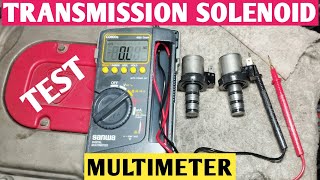
Disconnect the TCM connector. Use a multimeter to measure the resistance of the Solenoid 'G' circuit. Pressure control solenoids typically read 3 to 10 ohms. A reading of 'OL' indicates an open circuit; a reading near zero indicates a short.
Tools: Multimeter, Vehicle-specific wiring diagram (Advanced) - Perform a Voltage Drop Test
Back-probe the solenoid power wire and connect the positive multimeter lead to the battery positive. Command the solenoid ON with a scanner. A reading above 0.5 volts indicates excessive resistance (corrosion or broken wire) in the power circuit.
Tools: Multimeter, Advanced OBD-II Scanner, Back-probe kit (Professional) - Test the Solenoid Directly
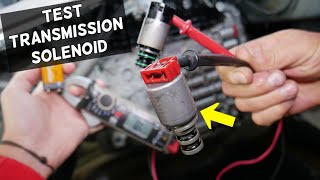
Remove the transmission oil pan to access the solenoid. Apply a fused 12V power source directly to the solenoid's pins. A sharp 'click' indicates it is functioning mechanically. A sluggish sound or no click confirms a stuck plunger.
Tools: Multimeter, Fused jumper wires, Socket set, Oil drain pan (Advanced) - Analyze Solenoid Command with an Oscilloscope
Connect an oscilloscope to the solenoid command wire to view the Pulse Width Modulation (PWM) signal. If the TCM sends a flat 0V signal (OFF) but the transmission shifts harshly, the solenoid is mechanically jammed open.
Tools: Oscilloscope, Wiring diagram (Professional) - Inspect the Valve Body
With the oil pan removed, inspect the aluminum valve body for sludge, metal shavings, or scoring inside the Solenoid 'G' bore. A worn bore leaks pressure and perfectly mimics a failed solenoid.
Tools: Flashlight, Torque wrench (Advanced)
When This Code Triggers (Freeze-Frame Conditions)
- Engine Coolant Temp: 180-200°F (Triggers when the engine and transmission reach full operating temperature and fluid viscosity normalizes.)
- Engine RPM: 1500-2500 RPM (Sets during light acceleration or steady cruising when the TCM actively commands pressure adjustments.)
- Engine Load: 30-60% (Moderate engine load requires precise pressure control, exposing solenoid faults to the TCM.)
- Vehicle Speed: 35-55 mph (Detected at cruising speeds where the transmission expects stable gear engagement and flags unexpected pressure spikes.)
Related Codes
- P2808 — The direct opposite of P2895. Solenoid 'G' is 'Stuck Off', causing a lack of hydraulic pressure and resulting in transmission slipping rather than harsh shifts.
- P0700 — A generic gateway code indicating the TCM has stored a fault and requested the Check Engine Light. It always accompanies specific codes like P2895.
- P17F0 / P17F1 — Nissan-specific codes for 'CVT Judder'. These indicate deeper mechanical wear or a valve body calibration mismatch, often requiring the same diagnostic path as P2895.
- P0776 — Indicates 'Pressure Control Solenoid B Stuck Off'. Frequently seen alongside P2895, pointing to systemic fluid contamination or a failing valve body.
Climate & Environmental Factors
- Cold Weather: Freezing temperatures thicken transmission fluid, causing sluggish solenoid operation and temporary pressure spikes upon startup.
- High Humidity / Water Intrusion: Moisture wicks into the main transmission harness connector, causing electrical shorts that mimic internal mechanical failures.
How to Talk to a Mechanic About This Code
Say this: "I have a P2895 code and I'm experiencing harsh shifting. I'd like to schedule a diagnostic. Please start by checking the transmission fluid condition, and then use a scanner to check live data for the pressure control solenoid 'G' command versus actual pressure. I want to rule out a fluid or electrical issue before discussing a valve body replacement."
This signals you are an informed customer. It directs the mechanic to follow a logical diagnostic path instead of immediately quoting a costly transmission replacement.
Avoid saying:
- My transmission is acting weird.
- The check engine light is on, can you just fix it?
- A guy online said I need a new transmission.
Questions to ask before authorizing the repair:
- What were the specific pressure readings from the scan tool for solenoid 'G'?
- Did you find any contamination or metal shavings in the transmission fluid?
- If the valve body needs replacement, does your estimate include the mandatory TCM relearn procedure?
- What is the warranty on the parts and labor for this specific repair?
Where to Take It: Dealer vs Independent vs Chain
- Dealer:
Recommended for Nissan, Ford, or GM vehicles where complex software relearn procedures are mandatory after a valve body replacement.
Best for: Vehicles under powertrain or extended warranty, Vehicles with known TSBs or recalls related to P2895 (especially Nissan & GM), Repairs requiring mandatory, proprietary software recalibration
Downsides: Highest labor rates, Defaults to full valve body or transmission replacement instead of diagnosing a simpler wiring fault (Typical cost: +50% vs. baseline) - Independent Shop:
A good option ONLY if it is a dedicated transmission specialty shop equipped to perform the required TCM relearn for your vehicle.
Best for: Out-of-warranty vehicles where the owner has a trusted relationship with the shop, Diagnosing and repairing wiring issues or straightforward solenoid swaps
Downsides: Quality varies greatly; must be a transmission specialist, not a general mechanic., Often lacks the expensive, manufacturer-specific scan tools required for post-repair programming. (Typical cost: +0% vs. baseline) - Chain Shop:
AVOID for diagnosis and repair of P2895. They lack the specialized skills and equipment required.
Best for: Basic fluid and filter changes
Downsides: Technicians are not transmission specialists., Lacks the advanced diagnostic or programming tools required., High pressure to upsell services. (Typical cost: -10% vs. baseline)
When to Walk Away From the Repair
If the estimated transmission repair cost exceeds 50% of the car's private-party value, seriously consider selling the vehicle as-is or trading it in.
- Car worth $5000, fix is $2800: Walk away. The repair cost is over 50% of the car's value. It is not a sound investment.
- Car worth $15000, fix is $3000: Fix it. The repair is 20% of the vehicle's value and restores its primary function.
- Car worth $3000, fix is $2500: Walk away. The repair cost is nearly the entire value of the car.
What Scan Tool You Need for This Code
Minimum: A scanner that reads manufacturer-specific transmission codes (TCM) and views live transmission data, such as solenoid command and fluid temperature.
A basic $20 code reader only shows a generic P0700 code. It cannot access the specific P2895 code from the TCM or view the live pressure data needed to verify a stuck solenoid.
Budget: BlueDriver Pro (~$100) — Reads and clears specific transmission fault codes for most manufacturers and views basic live data. It cannot perform relearn procedures.
Mid-range: Foxwell NT604 Elite / NT510 Elite (~$150) — Reads transmission codes and displays live data streams, allowing you to graph fluid temperature and solenoid status to diagnose the fault.
Professional: Autel MaxiCOM MK808S / MK808BT Pro (~$500-700) — Provides full bidirectional control. It reads all system codes, views extensive live data, and performs the mandatory 'relearn' functions required after replacing a valve body.
Rent vs buy: Renting is not viable. Free rental tools at auto parts stores are basic code readers that cannot perform transmission diagnostics. Buy a mid-range tool for diagnosis, or a pro-level tool if you plan to perform the relearn procedure yourself.
How to Clear the Code After You Fix It
- Ensure all connectors are securely fastened and the battery is reconnected.
- Use a compatible OBD-II scan tool to erase the P2895 fault code from the TCM.
- Perform a complete transmission drive cycle to allow the readiness monitors to run.
Drive cycle (~30 minutes): Start the vehicle cold and idle for 5 minutes. Drive for 20 minutes mixing stop-and-go city traffic with steady highway speeds above 45 mph. Include several light accelerations and decelerations.
Readiness monitors affected: Comprehensive Component Monitor, Catalyst Monitor, Evaporative System Monitor
Before emissions retest: drive at least 100 miles to fully set monitors.
Watch out for:
- Disconnecting the battery resets readiness monitors but does not reliably clear hard codes from the TCM.
- If the mechanical fault remains, the code returns immediately during the first drive cycle.
- Failing to perform a mandatory TCM relearn procedure after replacing a valve body prevents readiness monitors from setting.
Will This Fail Emissions / State Inspection?
Yes — this code typically fails an OBD-II emissions inspection.
- California: An illuminated Check Engine Light causes an automatic smog check failure. The vehicle must complete a full drive cycle to set all readiness monitors to 'Ready' before re-testing.
- New York: A vehicle fails inspection if the Check Engine Light is on. After clearing the code, 2001 and newer vehicles can pass with exactly one readiness monitor 'Not Ready'.
- Texas: In emissions-testing counties, an active P2895 code causes an automatic failure. The Check Engine Light must be off and readiness monitors set.
Most Commonly Affected Vehicles
- Nissan Altima / Rogue (2013-2017) — Prone to CVT valve body failures. Replacing the valve body requires a mandatory 'Write IP Characteristics' TCM recalibration. Nissan extended the CVT warranty to 84 months/84,000 miles for many VINs.
- Nissan Sentra / Versa (2013-2021) — CVT7 models suffer from severe judder and pressure codes. Valve body replacement is common, and warranty extensions apply to many models.
- Chevrolet Silverado / Sierra (2019-2022) — The 10-speed automatic suffers from premature valve body wear causing harsh shifting. NHTSA Recall 24V797 addresses a control valve issue that locks up the rear wheels.
- Ford F-150 / Explorer / Fusion (2011-2023) — 6F and 6R transmissions require a 'Solenoid Body Strategy' relearn after replacing the valve body. Skipping this step guarantees poor shift quality.
- Ford Focus (2012-2018) — The DPS6 'PowerShift' transmission exhibits similar harsh engagement symptoms, but the root cause is mechanical binding in the dry dual-clutch actuators, not hydraulic pressure.
- Honda Pilot (2017-2018) — Harsh shifting is often caused by a faulty torque converter (P0741), not a stuck solenoid. Honda issued TSB 23-078 extending the warranty for this issue.
- Chevrolet Cruze (2011-2017) — Coolant from a leaking sensor wicks through the wiring harness into the ECM, causing electrical shorts that trigger false transmission codes.
- GMC / Cadillac Yukon / Escalade (2019-2022) — Equipped with the same 10-speed transmission as the Silverado, these models share the same valve body wear and recall issues.
Manufacturer-Specific Notes
- Nissan: CVT calibration is critical. Replacing a valve body requires the 'Write IP Characteristics' procedure using a QR code or CD. Skipping this step causes the fault code to return immediately.
- General Motors (Chevrolet/GMC): 10-speed automatics suffer from widespread valve body wear. Multiple recalls (NHTSA 24V797, 25V148) address valve failures that cause rear-wheel lockup. Fixes require redesigned valve bodies or TCM software updates.
- Ford: Modern transmissions use a 'Solenoid Body Strategy'. Each valve body has a unique 13-digit calibration file. This number must be programmed into the TCM using FORScan or dealer tools after replacement.
- Honda: A 'Transmission System Problem' warning with harsh shifting is rarely a stuck solenoid. It is usually linked to a failing torque converter lock-up system (P0741) covered under warranty extensions.
Real Owner Stories
2015 Nissan Sentra with slipping and hesitation
The check engine light illuminated after the transmission slipped and hesitated on takeoff. The owner replaced the CVT valve body with a new OEM unit, but the code immediately returned.
What they tried:
- Replaced the CVT valve body solenoids.
- Installed a brand new OEM CVT valve body.
Outcome: A transmission specialist diagnosed the issue as a missing software calibration. The owner failed to perform the mandatory 'Write IP Characteristics' relearn procedure after installing the new valve body.
Lesson: Replacing hardware on modern transmissions (especially Nissan, Ford, and GM) is only half the job. Skipping the mandatory TCM software recalibration guarantees the repair will fail and the code will return.
2018 Chevy Silverado, 49K miles, with intermittent hard shifting
The truck intermittently shifted violently from 1st to 2nd gear. The owner debated taking it to the dealer before the powertrain warranty expired.
What they tried:
- Checked the Mass Airflow (MAF) sensor for bent pins.
- Performed a full transmission fluid flush.
Outcome: The fluid flush resolved the harsh shifting temporarily, but a dealer visit confirmed early valve body wear, a known issue on the GM 10-speed, requiring a valve body replacement under warranty.
Lesson: Intermittent hard shifting on GM trucks often points to premature valve body wear. Always utilize powertrain warranties before attempting DIY fixes on complex 10-speed transmissions.
2014 Nissan Sentra, 76K miles, stuck in 1st gear
The car locked into first gear with a whining noise and severe jerking. The owner pulled the transmission pan and found heavy sludge.
What they tried:
- Disassembled the valve body for cleaning.
- Attempted to install aftermarket solenoids, but they did not fit.
- Soaked the original solenoids in carburetor cleaner.
Outcome: Cleaning the original solenoids and valve body temporarily restored function, proving that physical debris was jamming the solenoid open.
Lesson: Contaminated fluid is the primary killer of transmission solenoids. Visible debris on the transmission strainer guarantees the solenoids are clogged. Avoid cheap aftermarket solenoids; they rarely fit or function correctly.
How to Prevent This Code From Triggering
- Regular Transmission Fluid and Filter Changes (Every 30,000 to 60,000 miles.) — Fresh fluid maintains lubrication and cooling, while a new filter removes the metal shavings and clutch material that physically jam solenoid valves open.
- Use ONLY the Manufacturer-Specified Fluid (Every time fluid is added or changed.) — Using 'universal' fluid causes seal swelling, improper hydraulic pressure, and clutch slippage. Always use the exact OEM fluid (e.g., Nissan NS-3, Ford Mercon LV).
- Install an Auxiliary Transmission Cooler (One-time installation for towing or hot climates.) — Heat destroys automatic transmissions. An auxiliary cooler stabilizes fluid temperatures, preventing the fluid breakdown that burns out solenoid coils.
- Avoid Aggressive Driving and Excessive Idling (Daily habit.) — Hard acceleration puts extreme heat and stress on clutch packs. Gentle driving reduces internal wear and extends the life of the valve body and solenoids.
Frequently Asked Questions
What are common misdiagnosis mistakes for P2895?
A common mistake is replacing the solenoid when the true fault lies in a worn valve body bore or a corroded wire. Another major pitfall is replacing hardware but failing to perform the mandatory TCM recalibration, which causes the code to return immediately.
Is P2895 a 'hard code' that can't be cleared?
Yes, it clears after a repair on most vehicles. However, on systems like Nissan CVTs, related pressure codes are 'hard codes'. They cannot be erased until the mechanical issue is resolved and the TCM confirms the fix through its own diagnostic routines.
My scanner only shows P0700. How do I find the P2895 code?
The P0700 code is a generic fault code requested by the Transmission Control Module (TCM). It simply means there is a transmission problem. To find the specific P2895 code, you need an advanced diagnostic scanner that communicates directly with the TCM.
What does it mean for a solenoid to be 'stuck on'?
A solenoid is an electro-magnetic valve. 'Stuck on' means it is stuck in the open position, allowing transmission fluid to flow continuously when it should be regulating pressure. This results in maximum line pressure, causing harsh, banging shifts.
Can I just replace the one bad solenoid?
Sometimes, but often no. If the individual solenoid is available and serviceable, it can be replaced. However, many modern vehicles integrate solenoids directly into the valve body assembly, requiring the entire unit to be replaced.
Will changing the transmission fluid fix a P2895 code?
It is possible, but unlikely to be a permanent fix. If the solenoid is mechanically stuck due to dirty fluid, a fluid change sometimes frees it up. If the code returns, a mechanical or electrical failure is confirmed.
What is the difference between a TCM 'reprogram' and 'relearn'?
A 'reprogram' updates the TCM's core software to a newer version from the manufacturer to fix bugs. A 'relearn' is a procedure to make the existing software adapt to the specific flow characteristics of new hardware, like a replacement valve body.
How can I prevent this code from happening again?
The best prevention is strict adherence to maintenance schedules. Change your transmission fluid and filter every 30,000 to 60,000 miles using only the manufacturer-specified fluid. This prevents the fluid breakdown and contamination that destroys solenoids.
Key Takeaways
- P2895 indicates Transmission Pressure Control Solenoid 'G' is stuck open, forcing maximum hydraulic pressure and causing violent, damaging gear shifts.
- Stop driving immediately; driving even 50 miles with maximum line pressure destroys internal seals and turns a $300 repair into a $4,000+ transmission rebuild.
- Dirty transmission fluid causes 40% of these failures, making a $150 fluid and filter change the mandatory first diagnostic step.
- Replacing the valve body on Nissan, Ford, or GM vehicles requires a mandatory TCM software recalibration using a pro-level scanner to prevent the code from returning.
- Professional diagnosis requires an advanced OBD-II scanner to monitor live TCM duty cycles and verify if the solenoid is electrically commanded off but mechanically stuck.
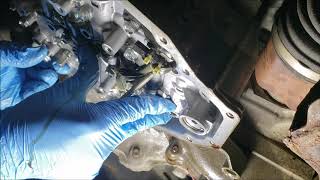
Helpful Videos







The information in this article is provided for general reference and educational purposes only. Vehicle specifications, procedures, and part compatibility can vary by production date, trim level, and region. Always consult your vehicle's factory service manual and verify part numbers before purchasing or performing repairs. Safety-critical components such as airbags, seat belts, and braking systems should be installed by a qualified professional.
- 🎬 Helpful Videos
- What Does P2895 Mean?
- Can I Drive With P2895?
- Common Causes
- Symptoms
- Diagnostic Flowchart
- Common Fixes & Costs
- Used vs. New Parts: Buying Guide
- What Happens If You Wait — Timeline
- Cost of Not Fixing It
- Diagnosis Steps
- When This Code Triggers (Freeze-Frame Conditions)
- Related Codes
- Climate & Environmental Factors
- How to Talk to a Mechanic About This Code
- Where to Take It: Dealer vs Independent vs Chain
- When to Walk Away From the Repair
- What Scan Tool You Need for This Code
- How to Clear the Code After You Fix It
- Will This Fail Emissions / State Inspection?
- Most Commonly Affected Vehicles
- Manufacturer-Specific Notes
- Real Owner Stories
- 2015 Nissan Sentra with slipping and hesitation
- 2018 Chevy Silverado, 49K miles, with intermittent hard shifting
- 2014 Nissan Sentra, 76K miles, stuck in 1st gear
- How to Prevent This Code From Triggering
- Frequently Asked Questions
- What are common misdiagnosis mistakes for P2895?
- Is P2895 a 'hard code' that can't be cleared?
- My scanner only shows P0700. How do I find the P2895 code?
- What does it mean for a solenoid to be 'stuck on'?
- Can I just replace the one bad solenoid?
- Will changing the transmission fluid fix a P2895 code?
- What is the difference between a TCM 'reprogram' and 'relearn'?
- How can I prevent this code from happening again?
- Key Takeaways
- 🎟️ Get 5% Off