

OBD-II Code P2857: Clutch 'A' Pressure Engagement Performance/Too Low
What P2857 means, why it triggers, and how to fix it
- Code P2857 indicates hydraulic pressure in transmission 'Clutch A' has dropped below the required 150-250 psi threshold, causing severe shifting issues.
- Check your transmission fluid first; low or burnt fluid is the easiest fix, costing $150-$300, before assuming major mechanical failure.
- For 2012-2021 Nissan CVTs, this code frequently points to a failed valve body requiring a $1,150-$1,950 replacement, or a destroyed CVT belt requiring a $5,000+ transmission.
- Do not drive with an active P2857 code; continuing to drive causes internal clutches to slip and burn, turning a $300 solenoid repair into a $5,000 transmission replacement.
What Does P2857 Mean?

Code P2857 means the Transmission Control Module (TCM) detects hydraulic pressure for 'Clutch A' is too low. This clutch engages specific gears in an automatic or CVT transmission. Without adequate pressure, the transmission slips, fails to shift, and sustains rapid internal damage.
Technical definition: The SAE/OBD-II definition is "Clutch 'A' Pressure Engagement Performance/Too Low". The TCM registers that actual hydraulic pressure in the Clutch 'A' circuit falls below the specified threshold (typically 150-250 psi in standard automatics, or up to 900 psi under load in CVTs). The system commands a specific pressure, and this code sets when the physical measurement fails to meet that command.
Can I Drive With P2857?
No — Do Not Drive. Do not drive. The vehicle enters a protective 'limp mode' with severely reduced power, making it unsafe in traffic. Continuing to drive with low hydraulic pressure causes internal components like the CVT belt or clutch packs to slip and burn. This generates intense heat, rapidly destroying the transmission and adding thousands to your repair bill.
Common Causes

- Low or Degraded Transmission Fluid (Very Common) — Transmission fluid creates the hydraulic pressure. If the fluid level is low due to a leak, or degraded and full of debris, it loses its hydraulic properties and cannot generate the pressure required to engage the clutch.
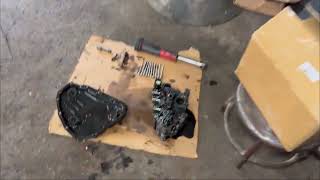
- Faulty Transmission Control Valve Body (Very Common) — The valve body directs hydraulic fluid through complex passages. If it warps, has stuck valves, or clogged passages, it cannot build pressure for the clutch circuit. This is the most frequent mechanical failure point for this code in Nissan CVTs. 🎬 See this step-by-step Nissan CVT valve body replacement walkthrough
- Faulty Clutch Pressure Control Solenoid (Common) — This electrically controlled valve manages fluid flow to the clutch. An internal short, mechanical failure, or stuck open/closed position disrupts fluid flow, causing an immediate low-pressure condition.
- Damaged CVT Belt or Pulleys (Common) — In Nissan CVTs, prolonged operation with low pressure causes the internal steel belt to slip and score the pulleys. Once this physical damage occurs, the transmission cannot hold pressure and requires full replacement.
- Damaged Wiring or Connectors (Less Common) — Corroded, broken, or loose wires between the TCM and transmission solenoids cause voltage drops. This prevents the solenoid from opening fully. On 2016-2022 Honda Pilots, this code specifically indicates an open or short circuit in the wiring harness. 🎬 Watch: Diagnosing P2857 electrical issues on a Honda Pilot
- Internal Hydraulic Leak (Less Common) — Worn clutch plates, failing piston seals, or cracks in the internal clutch housing create a leak, preventing the system from holding the required pressure even if the pump and valve body are working.
- Failing Transmission Fluid Pump (Rare) — The main hydraulic pump generates initial pressure for the entire system. A weak pump cannot supply enough fluid volume, leading to low pressure across multiple circuits simultaneously.
Symptoms

- Transmission Slipping or Delayed Shifts — Engine RPMs flare up without a corresponding increase in vehicle speed, or there is a 2-3 second pause before the transmission engages Drive or Reverse.
- Hesitation, Shuddering, or Jerking — The vehicle physically shakes or judders when accelerating from a stop. This is the direct result of the internal clutch or CVT belt slipping and grabbing.
- Vehicle Enters 'Limp Mode' — The computer restricts engine power and locks the transmission into a single gear to prevent further catastrophic damage.
- Check Engine Light — The Malfunction Indicator Lamp (MIL) illuminates immediately when the pressure drops below the threshold.
- Whining or Grinding Noises — A high-pitched whine indicates fluid starvation at the pump, while grinding signals severe metal-on-metal internal damage.
- Incorrect Pressure Readings on Scan Tool (scan-tool only — no driver-felt sign) — Live data shows the 'Actual Clutch A Pressure' PID lagging significantly behind the 'Commanded Clutch A Pressure' PID.
Diagnostic Flowchart
Tap your situation to follow the diagnostic path that matches what you're seeing on this code.
Common Fixes & Costs
- Replace Transmission Fluid and Filter
— Parts: $75-$150, Labor: $100-$200, ~1.5 hr book time
(DIY)
Nissan Versa/Sentra (CVT): OEM Nissan NS-3 CVT Fluid (999MP-NS300P) (Alt: Idemitsu CVT Type N3)
Honda Pilot (9-speed AT): OEM Honda ATF Type 3.1 (08200-9017) (Alt: Valvoline MaxLife Multi-Vehicle ATF) - Replace Transmission Control Valve Body
— Parts: $700-$1200, Labor: $450-$750, ~4.0 hr book time
(Professional)
Nissan Versa/Sentra (CVT): OEM Nissan 31705-3MX0C (varies by VIN) (Alt: Remanufactured RE0F11A / JF015E Valve Body) - Replace Clutch Pressure Control Solenoid
— Parts: $100-$250, Labor: $150-$300, ~2.5 hr book time
(Intermediate)
Honda Pilot (9-speed AT): OEM Honda 28500-RT4-003 (Alt: Standard Motor Products TCS179) - Replace the Entire Transmission Assembly — Parts: $3500-$5500, Labor: $1000-$2500, ~10.0 hr book time (Professional)
- TCM Reprogram/Re-flash — Parts: $0, Labor: $150-$300, ~1.0 hr book time (Professional)
Used vs. New Parts: Buying Guide
When a used part is worth it: A used valve body or transmission from a low-mileage donor makes sense for vehicles over 10 years old where a new $5,000 transmission exceeds the car's value.
Donor-vehicle mileage cap: roughly under 60000 miles for the part to have meaningful remaining life.
Donor quality checklist:
- Verify the donor vehicle wasn't scrapped due to transmission failure.
- Match the part number and revision codes exactly.
- Inspect the part for external damage, burnt fluid smell, or tampering.
Decision logic:
- If Vehicle is under 8 years old and has less than 100,000 miles → Buy a new OEM or remanufactured part for the longer service life and warranty.
- If Vehicle is over 10 years old or has more than 150,000 miles → Buy a warrantied used part to keep repair costs proportionate to vehicle value.
- If The part is a known high-failure item (e.g., Nissan CVT valve body) → Avoid used parts. Buy a professionally remanufactured unit with updated, stronger components.
Warranty tradeoff: Used parts offer 30-90 day part-only warranties. If it fails, you pay labor again. Remanufactured transmissions offer 1-3 year warranties that often include labor coverage.
Worst-case if a used part fails: $1,500. If a used valve body fails, you pay for the part again plus full labor for a second installation.
What Happens If You Wait — Timeline
- 0-1 month: Code P2857 sets. Slight delay shifting from Park to Drive. Occasional minor RPM flare. (MPG impact: 1-5%% · Added cost: $0. The window for a $300 fluid or solenoid fix is open.)
- 1-3 months: Shuddering during acceleration. Transmission slipping is pronounced. Faint burning odor. (MPG impact: 5-10%% · Added cost: $150 in wasted fuel. Internal friction accelerates wear on clutch packs.)
- 3-6 months: Vehicle frequently enters limp mode. Harsh clunking noises. In Nissans, the steel belt actively scores the pulleys. (MPG impact: 10-20%% · Added cost: $1,150-$1,950. The valve body is damaged and requires replacement.)
- 6+ months: Catastrophic failure. Complete loss of drive power. Metal debris destroys the pump and torque converter. (MPG impact: N/A% · Added cost: $4,500-$8,000+. The entire transmission assembly must be replaced.)
Cost of Not Fixing It

- 0-1 month: Noticeable hesitation, shuddering, and transmission slipping. Increased friction burns the clutch plates and CVT belt. (Added cost: $0, but the window for a $300 solenoid repair is closing.)
- 1-6 months: Accelerated wear destroys the valve body and internal seals. The steel CVT belt scores the pulleys, and the vehicle unpredictably enters limp mode. (Added cost: $1,150-$1,950 for a valve body replacement.)
- 6+ months: Catastrophic transmission failure. The CVT belt snaps or clutch packs burn out completely, resulting in total loss of drive power and metal debris contaminating the entire system. (Added cost: $4,500-$8,000+ for full transmission replacement.)
Diagnosis Steps
- Scan for Codes and Review Freeze Frame Data
Use an OBD-II scanner to confirm P2857 and check for related codes (like P0776 or P2858). Review the freeze-frame data to see the exact vehicle speed, RPM, and fluid temperature when the fault occurred.
Tools: OBD-II Scanner (Beginner) - Check Transmission Fluid Level and Condition
Verify the fluid is at the correct level and is not dark, burnt, or full of metal shavings. Follow the manufacturer's specific, temperature-sensitive procedure for sealed transmissions.
Tools: Gloves, Rag, Dipstick or Fluid Level Tube, Service Manual (Beginner) - Monitor Live Data with an Advanced Scan Tool
Compare 'Commanded Clutch A Pressure' to 'Actual Clutch A Pressure' while driving. A significant gap where actual pressure fails to meet the commanded value confirms a hydraulic or mechanical failure.
Tools: Advanced OBD-II Scanner (Intermediate) - Inspect Wiring and Connectors
Visually inspect the transmission wiring harness for corrosion, broken wires, or loose pins. This is the mandatory first step for Honda Pilots, where P2857 is an electrical circuit code.
Tools: Flashlight, Multimeter (Intermediate) - Perform Solenoid Active Test and Voltage Drop
Use a bi-directional scanner to command the Clutch 'A' solenoid ON and OFF. Listen for a click. Apply 12V directly to the solenoid and measure the voltage drop; a reading above 2V indicates a healthy coil.
Tools: Advanced OBD-II Scanner, Multimeter, Power Probe (Advanced) - Test Solenoid Resistance
Disconnect the solenoid and measure resistance across its terminals. Compare the reading to the service manual (e.g., ~5.3 Ω for Jatco CVT line pressure solenoids). An open or short circuit confirms a failed solenoid.
Tools: Multimeter, Service Manual (Advanced) - Perform a Transmission Line Pressure Test
Connect a mechanical pressure gauge to the transmission test port. Compare idle and stall-test readings to factory specs. This definitively proves if the main pump is failing or if the issue is isolated to the valve body.
Tools: Transmission Pressure Gauge Set, Service Manual (Advanced) - Perform Borescope Inspection of CVT Belt (Nissan)
Remove the valve body and insert a borescope to inspect the CVT belt for scoring or flaking. Any visible damage to the belt mandates a full transmission replacement.
Tools: Borescope, Service Manual, Hand Tools (Professional)
When This Code Triggers (Freeze-Frame Conditions)
- Engine Coolant Temp: 180-200°F (82-93°C) (The fault appears after the vehicle reaches full operating temperature, when fluid viscosity is lowest.)
- Engine RPM: 1500-2500 RPM (Sets during steady-state cruising or light acceleration when the transmission attempts to hold a gear.)
- Vehicle Speed: 35-55 mph (56-88 km/h) (Manifests at city or highway cruising speeds during expected smooth shifts.)
- Transmission Fluid Temperature: 150-220°F (65-104°C) (Pressure leaks are more pronounced when the fluid is hot and thin.)
Related Codes
- P2858, P2859, P285A — These indicate pressure performance issues in Clutch 'B' and other circuits. Seeing them alongside P2857 confirms a widespread hydraulic failure, almost certainly a faulty valve body or main pump.
- P17F0, P17F1 — These are 'CVT Judder' codes on Nissan vehicles. P2857 is the root cause (low pressure), while P17F0 is the symptom (belt slippage). Having both guarantees severe internal damage.
- P0776 — Indicates a 'stuck off' condition in Pressure Control Solenoid B. Seeing this with P2857 suggests a major valve body failure. Nissan TSBs provide specific diagnostic paths for this combination.
- P0841 — Transmission Fluid Pressure Sensor Circuit. If live data shows pressure stuck at zero, the sensor (P0841) is bad. If pressure changes but misses the target, the issue is hydraulic (P2857).
Climate & Environmental Factors
- Cold Weather: Extreme cold thickens transmission fluid, increasing viscosity. This makes it harder for the hydraulic pump to build adequate pressure quickly upon startup, triggering P2857. The issue often resolves as the vehicle warms up.
- High Temperature / Heavy Towing: Sustained high temperatures accelerate fluid breakdown. Degraded fluid loses its hydraulic properties, leading to an inability to maintain pressure and causing clutch slippage.
How to Talk to a Mechanic About This Code
Say this: "I have a P2857 code on my vehicle. Please check for any technical service bulletins, inspect the fluid condition, and compare the commanded versus actual clutch 'A' pressure using a scan tool."
Directs the mechanic to perform key diagnostic steps rather than guessing, preventing immediate upsells to full transmission replacements without evidence.
Avoid saying:
- 'My car is jerking, just fix it.'
- 'My check engine light is on, can you look at it?'
- 'I think I need a new transmission.'
Questions to ask before authorizing the repair:
- What were the results of the live data test for commanded vs. actual pressure?
- If it's a Nissan CVT, did you perform the borescope inspection of the belt, and can you show me the images?
- Is this repair covered by any warranty extension or technical service bulletin?
- What is the warranty on the proposed repair, and does it cover both parts and labor?
Where to Take It: Dealer vs Independent vs Chain
- Dealer:
Recommended for Nissan or Honda vehicles, or any car under powertrain warranty. They have access to critical TSBs and diagnostic flowcharts.
Best for: Vehicles under warranty or covered by a known TSB/warranty extension., Manufacturer-specific quirks, like the P2857 electrical issue on Honda Pilots., Complex jobs requiring specialized tools (e.g., Nissan CONSULT scanner).
Downsides: Highest labor rates., Defaults to full transmission replacement per factory procedure, even if a component repair is possible. (Typical cost: +50% vs. baseline) - Independent Shop:
Good fit ONLY if it's an ASE-certified shop explicitly specializing in transmission repair. Ask if they have experience with P2857 on your model.
Best for: Out-of-warranty vehicles where cost is a major factor., Finding a shop that specializes in transmission rebuilding.
Downsides: A general mechanic lacks the specific knowledge for modern CVTs., May not have access to the latest manufacturer software. (Typical cost: +0% vs. baseline) - Chain Shop:
AVOID. The complexity of P2857 is beyond the scope of most chain shops. The risk of them using the wrong fluid or procedure is high.
Best for: Simple fluid changes (use with caution).
Downsides: Technicians are not equipped for complex internal transmission diagnostics., High pressure to upsell without performing detailed diagnostics. (Typical cost: -10% vs. baseline)
When to Walk Away From the Repair
If the estimated repair cost exceeds 50% of the car's current private-party value, sell the car as-is or trade it in.
- Car worth $8000, fix is $3500: Borderline. The repair is 44% of the car's value. Get a second opinion, but fixing it is reasonable if the rest of the car is excellent.
- Car worth $15000, fix is $4000: Fix it. The repair cost is well below the 50% threshold, preserving a higher-value asset.
- Car worth $4000, fix is $3800: Walk away. The repair cost is 95% of the car's value. It makes no financial sense to proceed.
What Scan Tool You Need for This Code
Minimum: A scanner that reads manufacturer-specific transmission codes and views live data PIDs for the TCM.
A basic $20 code reader only shows the code. It cannot display 'Commanded vs. Actual Clutch Pressure', which is essential to confirm a hydraulic failure.
Budget: Kingbolen S608 / Mucar BT200 (~$70) — Reads full system codes and displays live data streams on your smartphone. The minimum required to see pressure PIDs.
Mid-range: Foxwell NT510 Elite / Xtool D7 (~$150) — Provides live data and bi-directional control. Allows you to command the pressure control solenoid on and off to test its function.
Professional: Autel MaxiCOM MK808 / Launch X431 (~$450-1000) — Offers full bidirectional control and performs the transmission relearn/adaptation procedures required after replacing a valve body.
Rent vs buy: Buy. Rental scanners from parts stores are basic code readers lacking the live data and bidirectional functions needed for P2857 diagnosis.
How to Clear the Code After You Fix It
- Use a professional OBD-II scan tool to clear the DTC from the TCM.
- Perform a transmission fluid level check and top-off using the factory temperature procedure.
- Perform the manufacturer-specific transmission relearn or adaptive learning procedure using a bi-directional scan tool.
- Conduct a test drive including multiple stops, starts, and shifts through all gears.
Drive cycle (~30 minutes): 1) Cold start and idle for 3 minutes. 2) Drive in stop-and-go traffic for 15 minutes to shift through lower gears. 3) Drive at a steady 55 mph for 10 minutes. 4) Stop and idle. 5) Shift through P, R, N, D, holding each for 5 seconds.
Readiness monitors affected: Transmission Component Monitor, Comprehensive Component Monitor (CCM)
Before emissions retest: drive at least 50 miles to fully set monitors.
Watch out for:
- Clearing the code without fixing the root cause results in immediate code return.
- Failing to perform the transmission adaptive learning procedure after replacing a valve body causes continued harsh shifting.
- Disconnecting the battery clears the code but resets all readiness monitors, failing emissions tests.
Will This Fail Emissions / State Inspection?
Yes — this code typically fails an OBD-II emissions inspection.
- California: An active P2857 triggers the Check Engine Light, resulting in an automatic Smog Check failure.
- New York: The NYS OBD-II scan detects P2857 and fails the emissions inspection.
- Texas: In emissions-testing counties, an active P2857 code fails the OBD-II portion of the state inspection.
Most Commonly Affected Vehicles
- Nissan Versa (2012-2021) — Uses a Jatco CVT highly prone to valve body failure. TSB NTB19-040h mandates a borescope inspection; if the belt is damaged, the entire CVT requires replacement.
- Nissan Sentra (2013-2019) — Widely known for CVT issues. Code P2857 is a primary indicator of a failing valve body or complete transmission failure.
- Nissan Kicks (2018-2021) — Per TSBs NTB19-040E and NTB22-021, the presence of this code often mandates a full CVT assembly replacement due to systemic internal failure.
- Honda Pilot (2016-2022) — P2857 is defined as 'Clutch Pressure Regulator Low Current'. This points to an electrical issue (open circuit or short) in the wiring harness, not a mechanical pressure failure.
- Ford Focus (2012-2018) — Models with the DSP6 PowerShift DCT log this code for clutch engagement performance issues, often related to faulty solenoids or leaking input shaft seals.
- Honda HR-V (2016-2020) — Indicates problems with clutch engagement that frequently require clutch pack or valve body replacement.
- Chevrolet Cruze (2012-2019) — Caused by issues within the Transmission Electro-Hydraulic Control Module (TEHCM), specific pressure control solenoids, or internal hydraulic leaks.
- Subaru Crosstrek (2013-2020) — Models using the Lineartronic CVT experience this code due to a failing valve body or pressure control solenoid.
Manufacturer-Specific Notes

- Nissan: TSBs like NTB19-040h dictate a strict path: if P2857 is stored, technicians must borescope the CVT belt. If the belt shows scoring, the entire CVT must be replaced. Some 2015-2018 models have extended warranties (84 months/84,000 miles) due to class-action settlements.
- Honda: On 2016-2022 Pilots, P2857 means 'Clutch Pressure Regulator Low Current'. This is an electrical circuit problem (open wire or short), not a mechanical pressure issue. Diagnosis must start with multimeter continuity checks on the harness.
- Ford: In the DSP6 PowerShift transmission, P2857 is triggered by leaking input shaft seals that contaminate the dry clutches with fluid, or by faulty clutch actuator motors.
- General Motors (GM): Caused by a cracked or failing TEHCM (Transmission Electro-Hydraulic Control Module) located inside the transmission. The plastic components become brittle, leading to internal pressure loss.
Real Owner Stories
2019 Nissan Sentra SV at 113K miles
Transmission exhibited RPM flaring, poor MPG, and heavy shifts, triggering P2857.
What they tried:
- Took the car to a transmission shop, quoted $6,500 for a full rebuild.
- Considered a software update, but symptoms indicated mechanical failure.
Outcome: The owner faced a repair bill equal to the car's value. Rebuilding a Jatco CVT is risky; full replacement with a remanufactured unit was the only reliable option.
Lesson: For high-mileage Nissan CVTs, P2857 is severe. Treat rebuild quotes with skepticism; a factory-remanufactured unit is a safer long-term investment.
2016 Honda Pilot with P2857
Check Engine Light illuminated, but the vehicle drove perfectly. Code defined as 'Clutch Pressure Regulator Low Current'.
What they tried:
- Researched the Honda-specific definition pointing to an electrical fault.
- Inspected the transmission wiring harness.
Outcome: Traced to a faulty connection in the wiring harness. Repaired the wiring without replacing any transmission components.
Lesson: Always check manufacturer-specific definitions. On 2016-2022 Pilots, P2857 is electrical. Inspect wiring before assuming hydraulic failure.
2014 Nissan Sentra with multiple codes
Presented with P2857, P0846 (Pressure Sensor), and P0965 (Solenoid B Circuit). Symptoms included 5,000 RPM flares and harsh shifts.
What they tried:
- Planned to get a CVT software update recall performed.
Outcome: The combination of performance, sensor, and circuit codes pointed to a systemic valve body failure. A software update could not fix the mechanical damage.
Lesson: Multiple transmission codes signal complex failure. This scenario requires professional diagnosis and a valve body or full transmission replacement.
How to Prevent This Code From Triggering
- Change transmission fluid every 30,000-40,000 miles. (Every 30,000-40,000 miles.) — Clean fluid maintains hydraulic properties and removes wear debris. Degraded fluid causes solenoid and valve body failure.
- Install an auxiliary transmission cooler. (One-time installation.) — Maintains stable fluid temperature (around 175°F), preventing fluid breakdown and reducing stress on internal seals.
- Adopt smooth driving habits. (Daily habit.) — Gentle acceleration allows the hydraulic system to build pressure smoothly, preventing CVT belt slippage.
- Allow the vehicle to warm up before aggressive driving. (Every drive.) — Cold, viscous fluid doesn't lubricate or apply pressure efficiently. Warming up reduces wear on all components.
Frequently Asked Questions
Can I fix P2857 myself?
Checking and topping off transmission fluid is DIY-friendly. However, replacing a valve body, solenoid, or transmission requires advanced tools and electronic relearn procedures. Tow the vehicle to a transmission specialist for these repairs.
How much does it cost to fix P2857?
A fluid change costs $150-$300. Replacing a faulty valve body ranges from $1,150 to $1,950. If the transmission requires full replacement, expect a bill between $4,500 and $8,000 depending on the vehicle.
Will clearing the code make it go away?
No. The code returns immediately once the transmission attempts to build pressure and fails. Ignoring it guarantees severe mechanical damage.
Is it safe to drive with code P2857?
No. The vehicle enters a low-power limp mode, making it unsafe in traffic. Driving with low hydraulic pressure burns up the internal clutches and destroys the transmission.
What is the difference between P2857 and P2858?
P2857 indicates low pressure in 'Clutch A', while P2858 indicates low pressure in 'Clutch B'. Seeing both simultaneously confirms a systemic failure like a bad valve body or failing main hydraulic pump.
Does my car qualify for a free CVT repair?
Nissan extended the CVT warranty on specific 2015-2018 models to 84 months or 84,000 miles due to class-action settlements. Contact a dealer with your VIN to verify if your vehicle qualifies for a free repair.
What is 'Clutch A' in an automatic transmission?
Automatic transmissions use multiple internal clutch packs to engage different gears. 'Clutch A' is the manufacturer's designation for one specific hydraulic circuit. When it lacks pressure, the transmission cannot shift into the gears controlled by that clutch.
Can a bad battery cause a P2857 code?
A weak battery causes various electronic glitches, but rarely triggers a direct hydraulic pressure code like P2857. However, low voltage impairs solenoid performance. Always ensure your battery outputs at least 12.4V before starting deep transmission diagnostics.
Key Takeaways
- Code P2857 indicates hydraulic pressure in transmission 'Clutch A' has dropped below the required 150-250 psi threshold, causing severe shifting issues.
- Check your transmission fluid first; low or burnt fluid is the easiest fix, costing $150-$300, before assuming major mechanical failure.
- For 2012-2021 Nissan CVTs, this code frequently points to a failed valve body requiring a $1,150-$1,950 replacement, or a destroyed CVT belt requiring a $5,000+ transmission.
- Do not drive with an active P2857 code; continuing to drive causes internal clutches to slip and burn, turning a $300 solenoid repair into a $5,000 transmission replacement.
Helpful Videos



The information in this article is provided for general reference and educational purposes only. Vehicle specifications, procedures, and part compatibility can vary by production date, trim level, and region. Always consult your vehicle's factory service manual and verify part numbers before purchasing or performing repairs. Safety-critical components such as airbags, seat belts, and braking systems should be installed by a qualified professional.
- 🎬 Helpful Videos
- What Does P2857 Mean?
- Can I Drive With P2857?
- Common Causes
- Symptoms
- Diagnostic Flowchart
- Common Fixes & Costs
- Used vs. New Parts: Buying Guide
- What Happens If You Wait — Timeline
- Cost of Not Fixing It
- Diagnosis Steps
- When This Code Triggers (Freeze-Frame Conditions)
- Related Codes
- Climate & Environmental Factors
- How to Talk to a Mechanic About This Code
- Where to Take It: Dealer vs Independent vs Chain
- When to Walk Away From the Repair
- What Scan Tool You Need for This Code
- How to Clear the Code After You Fix It
- Will This Fail Emissions / State Inspection?
- Most Commonly Affected Vehicles
- Manufacturer-Specific Notes
- Real Owner Stories
- 2019 Nissan Sentra SV at 113K miles
- 2016 Honda Pilot with P2857
- 2014 Nissan Sentra with multiple codes
- How to Prevent This Code From Triggering
- Frequently Asked Questions
- Can I fix P2857 myself?
- How much does it cost to fix P2857?
- Will clearing the code make it go away?
- Is it safe to drive with code P2857?
- What is the difference between P2857 and P2858?
- Does my car qualify for a free CVT repair?
- What is 'Clutch A' in an automatic transmission?
- Can a bad battery cause a P2857 code?
- Key Takeaways
- 🎟️ Get 5% Off