

OBD-II Code P2837: Shift Fork 'B' Position Circuit Range/Performance
The Ultimate Guide to P2837: What It Means, Why It Triggers, and How to Fix It for Good
- Code P2837 indicates the Transmission Control Module (TCM) lost track of the shift fork controlling reverse and even gears (2, 4, 6), causing limp mode or a total loss of reverse.
- On 2011-2018 Ford Focus and Fiesta models, this code is almost always caused by a failed TCM or a broken internal shift drum locating tab.
- Before replacing a $600 TCM on a Ford DPS6 transmission, remove the module and perform the 'clock gear test' by rotating the exposed upper gear 6.5 turns to rule out a broken internal tab.
- Always test the battery to ensure it holds at least 12.4V and clean the main transmission ground strap, as voltage drops frequently trigger false P2837 codes.
- Do not drive with an active P2837 code; forcing the transmission to shift poorly generates excessive heat that destroys the $1,500 dual-clutch pack within weeks.
What Does P2837 Mean?

The Transmission Control Module (TCM) detected an unexpected position for shift fork 'B'. In dual-clutch transmissions, electric motors move these forks to engage gears. Code P2837 means the fork controlling Reverse, 2nd, 4th, and 6th gears is out of position, causing severe shifting failures.
Technical definition: SAE/OBD-II defines P2837 as "Shift Fork 'B' Position Circuit Range/Performance". The TCM detects the sensor monitoring shift fork 'B' is reporting a voltage signal outside the expected 0.5V–4.5V range or failing to match the commanded gear position.
Can I Drive With P2837?
Yes, But With Caution. You can drive short distances, but it is strongly discouraged. The transmission defaults to limp mode, locking into a single gear and creating a safety hazard in traffic. Driving above 40 mph in limp mode overheats the transmission, destroying internal clutches and adding thousands to the repair cost.
Common Causes

- Faulty Transmission Control Module (TCM) (Very Common) — The TCM is the most frequent culprit, especially in Ford DPS6 transmissions. 🎬 Watch: Common DPS6 transmission issues causing P2837 and P287B codes. Internal circuit failures, software corruption, or lost calibration prevent it from correctly controlling or reading the shift fork's position.
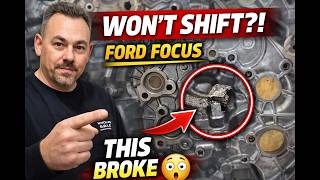
- Broken Internal Shift Drum Locating Tab (Common) — On Ford DPS6 transmissions, a small cast aluminum tab inside the transmission case acts as a stop for the shift drum. When it breaks, the drum over-rotates, throwing the fork position out of range. This is frequently misdiagnosed as a bad TCM.
- Low Battery Voltage or Poor Ground Connection (Common) — A weak battery or a corroded ground wire provides unstable voltage to the TCM. This causes erratic electronic behavior and triggers a P2837 code without an actual transmission fault.
- Outdated TCM Software (Common) — The TCM's operating software often contains bugs. Manufacturers release Technical Service Bulletins (TSBs) with software updates to fix shifting logic, improve sensor tolerance, and prevent false codes.
- Damaged Wiring or Connectors (Common) — The wiring harness between the TCM and the transmission frays or corrodes at the connector pins. This distorts the voltage signal from the shift fork position sensor.
- Failed Shift Fork 'B' Position Sensor (Less Common) — The sensor tracking the physical location of the shift fork fails, sending a voltage signal outside the normal 0.5V–4.5V operating range.
- Internal Transmission Mechanical Failure (Less Common) — A bent shift fork, worn actuator motor, damaged synchronizer rings, or heavy metal debris in the fluid physically prevents the fork from moving to the correct position.
Symptoms

- Transmission Stuck in One Gear (Limp Mode) — The vehicle defaults to a single gear (often 2nd or 3rd) to prevent damage, severely limiting speed and acceleration.
- Inability to Select Reverse or Even Gears — Because the 'B' fork controls reverse and gears 2, 4, and 6, the vehicle fails to engage these specific gears.
- Harsh, Clunking, or Delayed Shifting — The car jerks, hesitates, or makes loud clunking noises when changing gears as the TCM struggles to find the correct position.
- Vehicle Shudders on Acceleration — A noticeable shaking or vibration occurs from a stop or at low speeds when the clutch fails to engage smoothly.
- Check Engine Light Illuminated — The primary indicator that the TCM has logged a critical fault.
Diagnostic Flowchart

Tap your situation to follow the diagnostic path that matches what you're seeing on this code.
Common Fixes & Costs
- Replacing the Transmission Control Module (TCM)
— Parts: $300-$600, Labor: $150-$300, ~2.0 hr book time
(Intermediate)
Ford Focus/Fiesta (DPS6): OEM AE8Z-7Z369-F (Alt: Dorman 609-029, Cardone 73-81101)
Dodge Dart (C635 DDCT): OEM 68210293AA (Alt: Remanufactured units via MAKS Enterprises) - Reprogramming or Updating TCM Software — Parts: $0, Labor: $125-$200, ~1.5 hr book time (Professional)
- Repairing Damaged Wiring or Cleaning Grounds — Parts: $10-$50, Labor: $100-$300, ~1.5 hr book time (Intermediate)
- Replacing the Transmission Case Half (Broken Tab)
— Parts: $250-$500, Labor: $1500-$2500, ~12.0 hr book time
(Professional)
Ford Focus/Fiesta (DPS6): OEM Dealer lookup required by VIN (Alt: N/A) - Replacing Shift Fork and Actuator Motor Assembly
— Parts: $150-$400, Labor: $1200-$1800, ~9.0 hr book time
(Professional)
Ford Focus/Fiesta (DPS6): OEM AE8Z-7515-C (Alt: LUK RepSet) - Replacing the Entire Transmission Assembly — Parts: $3500-$7000, Labor: $1000-$2000, ~8.0 hr book time (Professional)
Used vs. New Parts: Buying Guide
When a used part is worth it: A remanufactured TCM is highly recommended for older vehicles. Remanufactured units often correct OEM design flaws and offer better warranties than used salvage parts.
Donor-vehicle mileage cap: roughly under 80000 miles for the part to have meaningful remaining life.
Donor quality checklist:
- Source from reputable recyclers providing the donor VIN.
- Match the part number exactly, accounting for superseded versions (e.g., AE8Z-7Z369-F).
- Prioritize remanufactured units with at least a 1-year warranty.
Decision logic:
- If Vehicle is under a warranty extension (e.g., Ford 14M02) → Use a new OEM part installed by the dealer at no cost.
- If Budget is tight and the vehicle has over 120k miles → Purchase a remanufactured TCM. It balances cost and reliability better than a raw used part.
- If The failed part is internal (shift fork, case half) → Buy new OEM. The labor cost is too high to risk installing a used internal component.
Warranty tradeoff: Used parts offer 30-90 days. Remanufactured TCMs offer 1-year to lifetime. New OEM offers 1-2 years but at the highest price.
Worst-case if a used part fails: $400 for repeat labor and programming if a used TCM fails.
What Happens If You Wait — Timeline
- 0-1 month: Intermittent hesitation or a single harsh clunk. Check Engine Light illuminates. Reverse gear may occasionally fail. (MPG impact: 0-2%% · Added cost: $0)
- 1-3 months: Shuddering on acceleration becomes consistent. Transmission enters limp mode frequently. Clutches begin to glaze. (MPG impact: 3-8%% · Added cost: $150)
- 3-6 months: Vehicle reliably fails to engage reverse or forward gears. Secondary mechanical wear destroys the clutch pack. (MPG impact: 10-15%% · Added cost: $1500)
- 6+ months: Catastrophic failure. Metal debris contaminates the transmission, destroying synchronizers and gears. Vehicle is undrivable. (MPG impact: 20%% · Added cost: $5000)
Cost of Not Fixing It
- 0-1 month: Harsh shifting, shuddering, and high risk of being stranded when the transmission enters limp mode. (Added cost: $0)
- 1-6 months: Harsh shifting glazes and destroys the clutch pack, requiring a full clutch replacement. (Added cost: $1200-$2500)
- 6+ months: Excessive heat and metal debris destroy synchronizers and gears, requiring a complete transmission replacement. (Added cost: $4500-$8000)
Diagnosis Steps
- Scan Codes & Review Freeze Frame Data
Use an OBD-II scanner to confirm P2837. Look for companion codes like P287B, P090C, or P2832. Review freeze frame data to identify vehicle speed and RPM when the code triggered.
Tools: OBD-II Scanner (Beginner) - Inspect Battery and Grounds
Verify the battery holds at least 12.4V with the engine off. Locate and inspect the main chassis and transmission ground straps for corrosion. Clean them with a wire brush.
Tools: Voltmeter, Wire Brush, Basic Hand Tools (Beginner) - Check for Software Updates (TSBs)
Search for Technical Service Bulletins (TSBs) for your specific VIN. Manufacturers frequently issue TCM software updates to resolve this exact code.
Tools: Internet Access (Beginner) - Perform the 'Clock Gear Test' (Ford DPS6 Only)
Remove the TCM (four bolts). Expose the two 'clock gears'. Rotate the upper gear (Fork B) with a socket. It must stop after approximately 6.5 turns. If it spins endlessly, the internal shift drum tab is broken, requiring a mechanical repair, not a new TCM.
Tools: Socket Set, Basic Hand Tools (Advanced) - Inspect Wiring and Connectors
Visually inspect the wiring harness connecting to the TCM. Check the main transmission connector for chafing, melted wires, or green corrosion on the pins.
Tools: Flashlight (Intermediate) - Analyze Live Data PIDs and Waveforms
Use an advanced scan tool to monitor the 'TRPS_B' (Transmission Shift Fork Position Sensor B) PID. Command gear changes. The voltage must transition smoothly between 0.5V and 4.5V. Erratic or flat-lined voltage indicates a bad sensor or wiring.
Tools: Advanced Scan Tool or Oscilloscope (Advanced) - Check Sensor Circuit Integrity
Perform a pin-out test at the TCM connector. Verify the 5V reference signal and ground. Check continuity on the signal wire; resistance must be under 0.1 Ω.
Tools: Multimeter, Vehicle-Specific Wiring Diagram (Advanced) - Inspect Internal Transmission Components
If electrical tests pass and the clock gear test fails, remove and disassemble the transmission to inspect the shift forks, actuator motors, and synchronizers.
Tools: Transmission Jack, Advanced Mechanical Tools (Professional)
When This Code Triggers (Freeze-Frame Conditions)
- Engine Coolant Temp: 180-210°F (The fault frequently appears once the vehicle reaches full operating temperature.)
- RPM: 1200-2500 RPM (Triggers during light acceleration or when attempting 2-3 or 3-4 shifts.)
- Vehicle Speed: 20-45 mph (Sets during city driving conditions involving frequent gear changes.)
- TCM Voltage: 13.2-14.5V (While low voltage causes the code, the freeze frame often captures normal alternator output at the exact moment of failure.)
Related Codes
- P287B — 'Shift Fork A Calibration Not Learned'. A common companion to P2837 in Ford DPS6 transmissions. Seeing both strongly indicates a broken internal shift drum stop tab or a completely failed TCM.
- P090C — 'Clutch B Actuator Control Circuit Low'. An electrical fault. If paired with P2837, the root cause is electrical (bad TCM, wiring, or ground) rather than mechanical.
- P2832 — 'Shift Fork A Position Circuit Range/Performance'. The identical fault for the opposite fork. If both appear, the issue is a global failure like a bad TCM or power supply, not an isolated mechanical break.
- P2836 — 'Shift Fork B Position Circuit'. Indicates a hard electrical failure (open/short). P2837 is a performance code, meaning a signal exists but is incorrect.
Climate & Environmental Factors
- Cold Weather: Low temperatures thicken transmission fluid, increasing mechanical resistance on shift forks and exacerbating weak actuators during cold starts.
- High Humidity / Water Intrusion: Moisture corrodes external TCM connector pins, creating high resistance or short circuits in the position sensor circuit.
How to Talk to a Mechanic About This Code
Say this: "I have a P2837 code on my vehicle and am experiencing no reverse and harsh shifting. I need a diagnostic. For a Ford, please check the battery, grounds, and perform the 'clock gear test' to rule out a broken internal tab before quoting a TCM replacement."
Directs the mechanic to the most common failure points and prevents the costly misdiagnosis of replacing a TCM when the internal tab is actually broken.
Avoid saying:
- 'My transmission is acting weird.'
- 'My check engine light is on, can you look at it?'
- 'Just fix whatever's wrong, I need it back ASAP.'
Questions to ask before authorizing the repair:
- Did you check for TCM software updates (TSBs)?
- What was the result of the battery load test and ground inspection?
- For a Ford DPS6, did the clock gear spin freely or stop after 6.5 turns?
- Does the estimate include the mandatory transmission adaptive learning procedure?
Where to Take It: Dealer vs Independent vs Chain
- Dealer:
Recommended only if warranty coverage applies.
Best for: Vehicles under warranty or extended coverage (e.g., Ford 14M02)., Complex software reprogramming.
Downsides: Highest labor rates., Quick to recommend full transmission replacements. (Typical cost: +50% vs. baseline) - Independent Shop:
Best fit for out-of-warranty cases. Find a trusted local transmission specialist.
Best for: Out-of-warranty vehicles., Shops specializing in transmission repair.
Downsides: May lack the latest manufacturer-specific software update tools. (Typical cost: +0% vs. baseline) - Chain Shop:
Avoid. P2837 requires deep transmission-specific knowledge.
Best for: Basic code scanning only.
Downsides: Lack specialized transmission expertise., Cannot perform complex internal repairs or TCM programming. (Typical cost: -10% vs. baseline)
When to Walk Away From the Repair
If the estimated repair cost exceeds 50% of the car's current private-party value, seriously consider selling the vehicle.
- Car worth $4000, fix is $2200: Walk away. The repair cost is over 50% of the car's value.
- Car worth $10000, fix is $900: Fix it. The repair cost is under 10% of the vehicle's value.
What Scan Tool You Need for This Code
Minimum: A scan tool that reads manufacturer-specific transmission codes and performs the 'Transmission Adaptive Learning' procedure.
A basic $20 reader cannot perform the mandatory adaptive relearn after a TCM or clutch replacement, rendering the repair incomplete.
Budget: FORScan with compatible OBD2 adapter (~$50) — Provides dealer-level diagnostics for Ford vehicles, including the critical TCM adaptive learning procedure.
Mid-range: Autel MaxiCheck MX808S (~$300) — Offers full system diagnostics, live data graphing, and the special function for Transmission Adaptive Learning.
Professional: Autel MaxiCOM MK808 (~$500) — Provides full professional functions, advanced coding, and all necessary relearn procedures.
Rent vs buy: Rent for diagnosis only. Buy if you plan to perform the repair yourself, as you must have a capable tool to complete the adaptive relearn.
How to Clear the Code After You Fix It
- Reconnect the battery if disconnected.
- Use an OBD-II scan tool to clear P2837 and related codes.
- Perform the mandatory transmission adaptive learning procedure specific to the vehicle using an advanced scan tool.
Drive cycle (~30 minutes): Perform a cold start, idle for 3 minutes, drive 20 minutes in mixed city/highway conditions ensuring shifts through all gears, and allow the vehicle to cool completely.
Readiness monitors affected: Comprehensive Component Monitor, Catalyst Monitor, Evaporative System Monitor
Before emissions retest: drive at least 100 miles to fully set monitors.
Watch out for:
- Disconnecting the battery clears the code temporarily but resets readiness monitors, guaranteeing an emissions failure.
- Failing to perform the adaptive learning procedure after replacing a TCM guarantees continued harsh shifting and immediate code return.
Will This Fail Emissions / State Inspection?
Yes — this code typically fails an OBD-II emissions inspection.
- California: An active P2837 code automatically fails the smog check. All readiness monitors must be 'Ready' after repairs.
- New York: Fails NYVIP3 inspection if the Check Engine Light is on. Only one readiness monitor can be 'Not Ready'.
- Texas: An illuminated Check Engine Light from P2837 is an automatic failure in emissions-testing counties.
Most Commonly Affected Vehicles
- Ford Focus (2012-2018) — Equipped with the DPS6 transmission. Extremely prone to TCM failures and broken internal shift drum locating tabs.
- Ford Fiesta (2011-2019) — Uses the same DPS6 transmission as the Focus, suffering identical TCM and internal mechanical faults.
- Ford EcoSport (2013-2021) — DPS6-equipped models share the exact same TCM and shift fork vulnerabilities.
- Dodge Dart (2013-2016) — Models with the C635 DDCT experience frequent TCM and actuator motor failures.
- Hyundai Veloster, Elantra, Tucson (2016-2020) — 7-speed EcoShift DCT models experience shift fork actuator and control logic failures.
- Volkswagen Jetta, Golf, Passat (2006-2020) — DSG transmissions suffer mechatronic unit failures that trigger shift position codes.
- Kia Forte, Soul, Seltos (2016-2021) — Shares the 7-speed DCT with Hyundai, making them susceptible to identical actuator faults.
- Nissan Sentra, Versa, Altima (2012-2019) — CVT valve body or step motor failures generate similar position circuit codes.
Manufacturer-Specific Notes
- Ford: On DPS6 transmissions, a broken internal shift drum locating tab causes P2837 and perfectly mimics a bad TCM. Always perform the 'clock gear test' before replacing the module. Ford issued program 14M02, extending TCM warranties to 10 years/150,000 miles for specific VINs.
- Hyundai/Kia: Multiple TSBs require updating TCU logic and replacing the dual-clutch pack and fork actuators to resolve engagement problems triggering position faults.
- Volkswagen/Audi: The 'mechatronic' unit (combined TCM and valve body) is the primary failure point. Cracked pressure accumulators cause hydraulic loss, preventing gear changes.
- Dodge: The Dart DDCT mounts the TCM directly to the transmission. Heat and vibration fracture internal solder joints, causing circuit failures.
Real Owner Stories
2013 Ford Focus, 100K miles - The Classic Misdiagnosis
Transmission shuddered, lost reverse gear, and threw codes P2837 and P287B.
What they tried:
- Shop quoted $1200 for a new TCM.
- Owner requested the 'clock gear test' before authorizing the repair.
Outcome: The clock gear test failed (gear spun endlessly). The actual issue was a broken internal shift drum tab. The repair required a $2000 case half replacement. The new TCM would not have fixed the car.
Lesson: Always demand the clock gear test on a Ford DPS6 before paying for a TCM replacement.
2016 Ford Focus, 114K miles - The Sudden Battery Swap Failure
Car ran perfectly until the battery died. Immediately after installing a new battery, the car entered limp mode with code P2837.
What they tried:
- Disconnected battery to reset computer; code returned instantly.
- Verified new battery voltage.
Outcome: The voltage spike during the battery swap destroyed the TCM. Replacing the TCM and performing the adaptive relearn cost $850.
Lesson: Ford TCMs are highly sensitive to voltage drops. Always use a memory saver when changing the battery.
2014 Ford Fiesta - The Easy Fix Everyone Skips
Intermittent harsh shifting and P2837 code, worsening on hot days.
What they tried:
- Prepared for a $1000+ TCM repair.
- Checked transmission ground straps first.
Outcome: Found the main transmission-to-chassis ground heavily corroded. Cleaned it with a wire brush and tightened the bolt. The code never returned. Total cost: $5.
Lesson: Check the grounds first. Bad grounds mimic expensive TCM failures perfectly.
How to Prevent This Code From Triggering
- Change transmission fluid every 40,000 miles. (Every 40,000 miles.) — Clean fluid lubricates moving parts, reducing mechanical resistance on shift forks and actuators.
- Avoid 'creeping' in stop-and-go traffic. (Daily driving habit.) — Creeping slips the dry dual-clutch, generating massive heat that damages the clutch pack and stresses the shift actuators.
- Clean battery terminals and ground straps. (Annually.) — Prevents voltage drops that trigger false P2837 codes and damage the TCM.
- Request TCM software updates during service. (Annually.) — Updates refine shifting logic and prevent premature component wear.
Frequently Asked Questions
What is the most common misdiagnosis for a P2837 code?
On Ford Focus and Fiesta models, mechanics often mistakenly replace the TCM without performing the 'clock gear test'. A broken internal shift drum tab causes identical symptoms but requires a transmission case half replacement.
Can I just clear the P2837 code and keep driving?
You can clear the code, but it returns within a few drive cycles. Ignoring it causes expensive secondary damage to the clutches and internal gears.
Is the Transmission Control Module (TCM) covered by a warranty?
Ford extended TCM warranty coverage to 10 years or 150,000 miles for 2012-2016 Focus and 2011-2016 Fiesta models under program 14M02. Check with a Ford dealership using your VIN to verify active coverage.
Why did this code appear right after I changed my car battery?
Voltage spikes or drops during a battery change damage the sensitive electronics in the TCM, triggering P2837. Always use a memory saver when swapping batteries on these vehicles.
My car is shuddering and shaking, is that related to P2837?
Yes, shuddering occurs when the clutch pack engages incorrectly because the shift fork is out of position. This causes the clutch to slip or grab erratically during low-speed acceleration.
What is the most common fix for P2837?
For Ford Focus and Fiesta models, the fix is replacing a faulty TCM or a broken internal shift drum tab. For other vehicles, it is usually a failed shift fork position sensor or outdated TCM software.
Does P2837 mean I need a whole new transmission?
No, a complete transmission replacement is a last resort. Most fixes involve the TCM, wiring, or a specific internal part like a shift fork or case half.
Can a worn-out clutch cause a P2837 code?
A worn clutch causes slipping but does not directly trigger P2837. However, the harsh engagement from a failing clutch stresses the shift forks over time, contributing to their eventual failure.
Key Takeaways
- Code P2837 indicates the Transmission Control Module (TCM) lost track of the shift fork controlling reverse and even gears (2, 4, 6), causing limp mode or a total loss of reverse.
- On 2011-2018 Ford Focus and Fiesta models, this code is almost always caused by a failed TCM or a broken internal shift drum locating tab.
- Before replacing a $600 TCM on a Ford DPS6 transmission, remove the module and perform the 'clock gear test' by rotating the exposed upper gear 6.5 turns to rule out a broken internal tab.
- Always test the battery to ensure it holds at least 12.4V and clean the main transmission ground strap, as voltage drops frequently trigger false P2837 codes.
- Do not drive with an active P2837 code; forcing the transmission to shift poorly generates excessive heat that destroys the $1,500 dual-clutch pack within weeks.
Helpful Videos



The information in this article is provided for general reference and educational purposes only. Vehicle specifications, procedures, and part compatibility can vary by production date, trim level, and region. Always consult your vehicle's factory service manual and verify part numbers before purchasing or performing repairs. Safety-critical components such as airbags, seat belts, and braking systems should be installed by a qualified professional.
- 🎬 Helpful Videos
- What Does P2837 Mean?
- Can I Drive With P2837?
- Common Causes
- Symptoms
- Diagnostic Flowchart
- Common Fixes & Costs
- Used vs. New Parts: Buying Guide
- What Happens If You Wait — Timeline
- Cost of Not Fixing It
- Diagnosis Steps
- When This Code Triggers (Freeze-Frame Conditions)
- Related Codes
- Climate & Environmental Factors
- How to Talk to a Mechanic About This Code
- Where to Take It: Dealer vs Independent vs Chain
- When to Walk Away From the Repair
- What Scan Tool You Need for This Code
- How to Clear the Code After You Fix It
- Will This Fail Emissions / State Inspection?
- Most Commonly Affected Vehicles
- Manufacturer-Specific Notes
- Real Owner Stories
- 2013 Ford Focus, 100K miles - The Classic Misdiagnosis
- 2016 Ford Focus, 114K miles - The Sudden Battery Swap Failure
- 2014 Ford Fiesta - The Easy Fix Everyone Skips
- How to Prevent This Code From Triggering
- Frequently Asked Questions
- What is the most common misdiagnosis for a P2837 code?
- Can I just clear the P2837 code and keep driving?
- Is the Transmission Control Module (TCM) covered by a warranty?
- Why did this code appear right after I changed my car battery?
- My car is shuddering and shaking, is that related to P2837?
- What is the most common fix for P2837?
- Does P2837 mean I need a whole new transmission?
- Can a worn-out clutch cause a P2837 code?
- Key Takeaways
- 🎟️ Get 5% Off