

OBD-II Code P2832: Shift Fork 'A' Position Circuit Range/Performance
The Ultimate 2026 Guide to Meaning, Diagnosis, and Repair
- P2832 indicates a position or performance fault in the circuit for shift fork 'A', which controls odd gears (1, 3, 5) in a dual-clutch transmission.
- On 2011-2019 Ford Focus and Fiesta models, fix this code first by sanding the main chassis ground connection to bare metal, which costs $0 and resolves the issue in many cases.
- Test your battery to ensure it delivers 13.7V to 14.7V while running, as voltage drops below 12.4V at rest cause the TCM to malfunction and trigger false P2832 codes.
- Never drive with an active P2832 code; continued operation forces the transmission into limp mode and destroys the clutch packs, turning a $150 electrical repair into a $3,000 mechanical rebuild.
What Does P2832 Mean?

P2832 means the Transmission Control Module (TCM) detects an out-of-range electrical reading or performance issue from the shift fork 'A' position circuit. In a dual-clutch transmission (DCT), shift fork 'A' engages odd-numbered gears (1, 3, 5). This code indicates the TCM cannot verify the fork's exact position, causing erratic shifting, hesitation, or total failure to engage gears.
Technical definition: The SAE/OBD-II definition for P2832 is "Shift Fork 'A' Position Circuit Range/Performance". This signifies the TCM registers a discrepancy between the commanded position of shift fork 'A' and the actual position reported by its sensor. The fault stems from an electrical short/open, a software glitch, or a mechanical bind preventing the fork from reaching its target.
Can I Drive With P2832?
Yes, But With Caution. You can drive the vehicle, but it carries significant risk. Continued driving forces the transmission into 'limp mode,' locking it in 2nd or 3rd gear. More importantly, driving with a malfunctioning shift fork circuit accelerates wear on clutch packs and internal gears, turning a $150 electrical repair into a $3,000 internal transmission failure. Limit driving strictly to reaching a repair shop.
Common Causes

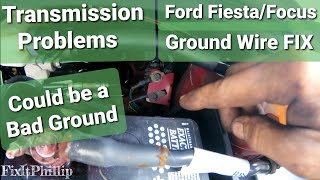
- Poor Chassis Ground Connection (Very Common) — A weak or corroded ground connection between the battery and chassis is the primary cause of this code on Ford Fiesta and Focus models. The TCM requires stable voltage; a poor ground causes erratic behavior mimicking component failure. 🎬 Watch: How to clean and fix the chassis ground connection.
- Faulty Transmission Control Module (TCM) (Very Common) — The TCM is the transmission's brain. On Ford DPS6 units, the TCM mounts directly to the transmission, exposing it to intense heat and vibration that destroy internal circuit boards.
- Outdated TCM/PCM Software (Very Common) — Manufacturers release software calibrations to fix shifting logic and resolve bugs that falsely trigger P2832.
- Wiring or Connector Issues (Common) — The wiring harness between the TCM and transmission degrades from heat and vibration. Corroded or loose connector pins interrupt signals from the shift fork position sensors.
- Broken Internal Locator Pin/Shift Drum Stop (Less Common) — Inside the transmission case (e.g., Ford DPS6), a metal locator pin provides a hard stop for the shift mechanism. When it breaks, the shift drum spins freely, causing the TCM to lose its reference point.
- Failing Shift Actuator Motor (Less Common) — Electric motors moving the shift forks burn out or develop high internal resistance. A slow-responding motor fails to move the fork within the TCM's expected time window.
- Sticking Internal Solenoids or Debris (Less Common) — On transmissions like the C8 Corvette DCT, microscopic fluid debris causes hydraulic solenoids to stick, preventing correct hydraulic pressure from moving the shift fork.
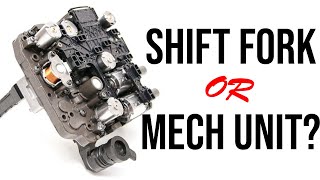
- Failing Shift Fork Position Sensor (Uncommon) — The sensor reading the fork's position fails. In modern DCTs (like VW/Audi DSG), these sensors integrate directly into the mechatronics unit, requiring complete unit replacement. 🎬 Watch: A mechanic explains shift fork malfunctions in modern DCTs.
Symptoms

- Check Engine Light or Wrench Light On — The Malfunction Indicator Lamp (MIL) or a transmission-specific warning light illuminates on the dashboard.
- Harsh Shifting and Shuddering — The vehicle exhibits rough, jerky, or delayed gear shifts, particularly noticeable during 1-2 and 2-3 upshifts.
- Transmission Gets Stuck in Gear (Limp Mode) — The TCM puts the transmission into a fail-safe mode to prevent damage, locking it into a single gear (often 2nd or 4th).
- Hesitation or Delay from a Stop — When accelerating from a standstill, a noticeable pause occurs before the transmission engages first gear, followed by a sudden lurch.
- Flashing 'PRNDS' Indicator — On Volkswagen and Audi models with DSG transmissions, the gear selector indicator flashes, signaling a mechatronics unit fault.
- Increased Fuel Consumption (also visible on scanner) — Inefficient shifting forces the engine to operate outside its optimal RPM range, decreasing fuel economy.
Diagnostic Flowchart
Tap your situation to follow the diagnostic path that matches what you're seeing on this code.
Common Fixes & Costs
- Repairing Chassis Ground Connection — Parts: $5, Labor: $50-$150, ~0.8 hr book time (Beginner)
- Reprogramming the TCM/PCM — Parts: $0, Labor: $100-$250, ~1 hr book time (Professional)
- Replacing the Transmission Control Module (TCM)
— Parts: $400-$800, Labor: $150-$350, ~1.5 hr book time
(Professional)
Ford Focus/Fiesta: OEM
Ford Focus/Fiesta: OEM - Replacing the Transmission Clutch and Actuator Assembly
— Parts: $800-$1500, Labor: $1000-$1800, ~9 hr book time
(Professional)
Ford Focus/Fiesta (DPS6): OEM
Ford Focus/Fiesta (DPS6): OEM - Replacing/Rebuilding the Mechatronics Unit (VW/Audi)
— Parts: $1200-$2500, Labor: $500-$800, ~4 hr book time
(Professional)
VW/Audi (DQ200 7-Speed DSG): OEM - Replacing the Transmission Case Half (for broken stop pin) — Parts: $300-$500, Labor: $1200-$2000, ~12 hr book time (Professional)
Used vs. New Parts: Buying Guide
When a used part is worth it: A used TCM from a low-mileage, accident-damaged vehicle is a cost-effective option if new parts are back-ordered. However, used TCMs have an unknown history and a high failure rate.
Donor-vehicle mileage cap: roughly under 60000 miles for the part to have meaningful remaining life.
Donor quality checklist:
- For Ford TCMs, look for a label with revision 'K05' or newer, indicating a redesigned unit.
- Verify the part number matches exactly.
- Avoid parts with physical damage, corrosion, or from flood-damaged vehicles.
Decision logic:
- If The vehicle is a Ford Focus/Fiesta eligible for the 14M02 warranty extension. → Use a new OEM part from the dealer; it is free.
- If Budget is the primary concern and the vehicle's value is low. → A used TCM is a viable risk, but prepare for potential failure.
- If Reliability is the top priority. → Buy a new OEM or a high-quality remanufactured unit from a reputable supplier.
Warranty tradeoff: Used parts from a salvage yard typically have a 30-90 day warranty covering only the part. New OEM and quality remanufactured parts offer a 1-year to limited lifetime warranty.
Worst-case if a used part fails: $400-$800 if a used TCM fails after installation, accounting for repeat labor and diagnostic fees.
What Happens If You Wait — Timeline
- 0-1 month: Check Engine Light appears. Intermittent, subtle hesitation or slightly firm shifts, especially on the 1-2 upshift. (MPG impact: 0-2%% · Added cost: $0)
- 1-3 months: Shifting becomes noticeably harsh. A distinct 'shudder' or vibration is felt when accelerating from a stop. The transmission occasionally enters 'limp mode' but resets after restarting. (MPG impact: 3-8%% · Added cost: $50-$150 in wasted fuel. A software or TCM fix is still possible.)
- 3-6 months: Severe shuddering and clunking noises during shifts. The car frequently enters limp mode. Slipping clutches overheat, causing a burning smell and accelerating wear on the clutch material. (MPG impact: 10-15%% · Added cost: $1,800-$3,300. The problem progresses to a mandatory mechanical repair (clutch and/or actuator replacement).)
- 6+ months: Catastrophic failure. A shift fork breaks, or the clutch assembly is destroyed. Metal debris circulates through the transmission, requiring a full rebuild or replacement. (MPG impact: 15-25%+% · Added cost: $3,500-$7,000+. A simple TCM or ground wire fix becomes a complete transmission replacement.)
Cost of Not Fixing It
- 0-1 month: Erratic shifting, vehicle shudder, and entering 'limp mode' at any time, creating a safety risk. Noticeable drop in fuel economy. (Added cost: Negligible, but safety is compromised.)
- 1-6 months: Continued operation with a faulty TCM or slipping fork causes excessive wear on clutch friction material and mechanical fork components, turning an electrical issue into an expensive clutch replacement. (Added cost: $1800-$3300)
- 6+ months: Severe mechanical damage. A broken shift fork or damaged gears sends metal debris throughout the transmission, requiring a complete rebuild or replacement. (Added cost: $3000-$7000)
Diagnosis Steps

- Perform a Comprehensive Battery and Ground System Check
Dual-clutch transmissions require perfect voltage. Test the battery and alternator (expect 12.6V off, 13.7V-14.7V running). On Ford Focus/Fiesta models, unbolt the primary chassis ground point near the battery, sand away the paint to bare metal, and reconnect.
Tools: Wrench Set, Wire Brush, Sandpaper, Multimeter (Beginner) - Scan for Codes and Review Live Data
Use a professional OBD-II scanner to confirm P2832 and observe live data for the shift fork position sensors. Normal values for 'SHIFT_FORK_A_POS' change smoothly as gears are commanded. A value that is stuck, erratic, or reads 'N/A' confirms a circuit or sensor fault.
Tools: Advanced OBD-II Scanner (Beginner) - Check for Technical Service Bulletins (TSBs)
Check for manufacturer TSBs before replacing parts. Ford TSB 13-4-6 addresses P2832 on 2012-2013 Focus models with a software update. Chevy TSB 21-NA-070 outlines a cleaning procedure for 2020-2021 Corvettes.
Tools: Online Access or Phone Call to Dealer (Beginner) - Inspect Wiring Harness and Connectors
Visually inspect the wiring harness leading to the TCM for chafing, melting, or corrosion. Disconnect the main TCM connector and check for bent, pushed-out, or corroded pins.
Tools: Flashlight, Inspection Mirror (Intermediate) - Pro Tip: Test Shift Actuator Motor Resistance
With the TCM disconnected, measure the resistance between the two pins for the shift fork 'A' actuator motor. The Ford DPS6 specification is 1.5 to 2.2 ohms. Infinite resistance or a short to ground requires motor replacement.
Tools: Multimeter, Service Manual with Pinout Diagram (Advanced) - Pro Tip: Check Actuator Motor Voltage
With the TCM connector unplugged and the key on, probe the voltage supply pin for the shift actuator motor. A reading significantly lower than battery voltage (e.g., 7-8V) points to a wiring issue, poor ground, or a failing TCM.
Tools: Multimeter, Service Manual with Pinout Diagram (Advanced) - Pro Tip: Manually Test Shift Drum Rotation
For Ford Focus/Fiesta with the TCM removed, attempt to rotate the gear for the upper fork (Fork A). It must hit a firm stop in both directions. If it spins indefinitely, the internal shift drum stop is broken, requiring internal mechanical repair.
Tools: Basic Hand Tools (Advanced) - Perform Dealer-Level Hydraulic Cleaning Procedure
For specific models like the C8 Corvette, run the 'Hydraulic System Cleaning Procedure' using a dealer-level scan tool to cycle solenoids and dislodge internal debris before condemning hardware.
Tools: OEM Diagnostic Scan Tool (e.g., GDS) (Professional) - Professional TCM and Mechatronics Diagnosis
If all other steps pass, the fault lies within the TCM or mechatronics unit. A specialist shop performs advanced bench tests to identify internal circuit board failures.
Tools: Specialized Testing Equipment (e.g., VCDS, Oscilloscope) (Professional)
When This Code Triggers (Freeze-Frame Conditions)
- Engine Coolant Temp: 185-210°F (85-99°C) (The engine is at full operating temperature. Heat is a major factor in TCM failures.)
- RPM: 1200-2500 (During a gear shift event, especially low-speed 1-2 or 2-3 shifts under light to moderate acceleration.)
- Engine Load: 20-50% (The code sets under normal driving conditions, not necessarily heavy acceleration.)
- Vehicle Speed: 10-45 mph (15-70 km/h) (Triggered during city or suburban driving where frequent shifting occurs.)
Related Codes
- P2831 — This code is for 'Shift Fork 'A' Position Circuit'. It is a hard circuit fault (like a short or open), whereas P2832 is a 'Range/Performance' fault. P2831 makes a wiring or sensor problem more likely.
- P2837 — This is the equivalent code for shift fork 'B' (even gears). Seeing P2832 and P2837 together strongly points to a systemic problem affecting both forks, such as a faulty TCM, outdated software, or a power/ground issue.
- P287B — This code means 'Shift Fork 'B' Stuck'. It is a purely mechanical code indicating the fork is physically jammed. Paired with P2832, it strongly indicates a broken internal part like the shift drum stop pin.
- P0607 — This code means 'Control Module Performance' and points to a general failure of the PCM or TCM. If P0607 appears alongside P2832, the TCM itself is faulty and requires replacement.
Climate & Environmental Factors
- High Ambient Heat: On models like the Ford Focus/Fiesta, the TCM mounts directly to the transmission case. Heat cycling is a primary cause of internal solder joint failure, leading to P2832.
- Humidity and Moisture: High humidity and winter road salt accelerate corrosion. This degrades critical chassis ground points, causing voltage irregularities that trigger performance codes.
- Cold Weather: Symptoms of a failing clutch actuator motor, such as shifting hesitation, are more pronounced on cold starts (below 50°F / 10°C) due to fluid thickening or increased internal motor resistance.
How to Talk to a Mechanic About This Code
Say this: "I have a P2832 code on my [Vehicle Year, Make, Model]. I'd like to schedule a diagnostic appointment. Based on my research, I'd like you to first check for any available TCM software updates and thoroughly inspect the battery and main chassis ground connections before looking at major hardware."
This signals to the shop that you are an informed consumer. It directs them to check the most common, cheapest fixes first (software and grounds) before quoting expensive part replacements, saving you hundreds on diagnostic time.
Avoid saying:
- 'My transmission is acting weird.' (too vague)
- 'Just fix the check engine light.' (invites unnecessary repairs)
- 'A guy on the internet said it's the TCM, just replace it.' (discounts the need for proper diagnosis)
Questions to ask before authorizing the repair:
- Did you check for software TSBs for the TCM/PCM?
- What were the voltage readings for the battery and the ground drop test?
- If you are recommending a TCM/clutch/mechatronics replacement, what specific tests did you perform to condemn the old part?
- Does your quoted price include the mandatory post-replacement 'Transmission Adaptive Learning' procedure?
- What is the warranty on the parts AND the labor for this repair?
Where to Take It: Dealer vs Independent vs Chain
- Dealer:
Necessary for warranty work or specific TSBs. For out-of-warranty cars, get a diagnostic here but consider getting a repair quote elsewhere.
Best for: Vehicles potentially still under warranty or covered by a specific program (like Ford's 14M02)., Vehicles requiring a manufacturer-specific procedure (like the C8 Corvette hydraulic cleaning TSB)., Complex software programming and updates.
Downsides: Highest labor rates., Often quick to recommend replacement of major, expensive assemblies (e.g., entire mechatronics unit) instead of repair. (Typical cost: +50% vs. baseline) - Independent Shop:
A good choice if they are a transmission specialist. A general mechanic lacks the specific expertise for complex DCTs.
Best for: Out-of-warranty vehicles where cost is a factor., Diagnosing and repairing common, well-documented issues like the Ford ground point problem., Access to both OEM and quality aftermarket parts.
Downsides: Quality and expertise vary widely; must find a shop with proven transmission experience., May not have the latest, most expensive manufacturer-specific diagnostic tools. (Typical cost: +0% vs. baseline) - Chain Shop:
AVOID for P2832 diagnosis and repair. They are not equipped for this level of complexity.
Best for: Simple services like battery replacement or oil changes.
Downsides: Technicians are generally not equipped or trained for complex transmission diagnostics or repair., High pressure to upsell services; risk of misdiagnosis is very high for this code. (Typical cost: -10% vs. baseline)
When to Walk Away From the Repair
If the estimated repair cost exceeds 50% of the vehicle's current market value, sell or trade it in as-is.
- Car worth $5000, fix is $2800: Walk away. The repair cost is 56% of the car's value. It is not a financially sound investment.
- Car worth $15000, fix is $3000: Fix it. The repair cost is only 20% of the car's value and will restore its function.
- Car worth $3000, fix is $3500: Walk away. The repair costs more than the car is worth.
What Scan Tool You Need for This Code
Minimum: A scanner that reads manufacturer-specific transmission codes and views live data for the Transmission Control Module (TCM).
A basic $20 code reader only shows the P2832 code. It cannot read crucial live data like shift fork position sensor voltage or perform the necessary 'Transmission Adaptive Learning' procedure required after repairs.
Budget: Ancel BD310 / Motopower MP69033 (~$60) — Basic code reading and clearing. Confirms the P2832 code is present but offers no diagnostic data beyond that. Insufficient for a full diagnosis.
Mid-range: Foxwell NT510 Elite / Innova 5610 / Autel MaxiCOM MK808S (~$150-350) — Reads transmission-specific codes, views live data streams for shift fork positions, and performs bidirectional control to initiate the 'Transmission Adaptive Learning' procedures required after replacing a TCM or clutch.
Professional: Autel MaxiSys Elite II Pro / LAUNCH X431 Series (~$1200-2500) — Provides OE-level diagnostics, including ECU coding and programming. Reprograms a new TCM, performs advanced adaptations, and accesses all manufacturer-specific functions.
Rent vs buy: For P2832, buying is necessary. Parts stores rent basic scanners, but they do not offer the bidirectional tools needed for the post-repair relearn procedure. If replacing a TCM or clutch yourself, you must own a capable mid-range scanner.
How to Clear the Code After You Fix It
- Reconnect battery if disconnected for repair.
- Use an OBD-II scan tool to clear all fault codes.
- Perform the manufacturer-specific Transmission Adaptive Learning procedure.
Drive cycle (~20 minutes): After clearing codes and performing the stationary relearn, start the vehicle and allow it to warm up. Drive with light to medium acceleration, allowing the transmission to shift naturally through all gears. Include several stop-and-go cycles. Avoid aggressive driving for the first 50-100 miles.
Readiness monitors affected: Comprehensive Component Monitor, Catalyst Monitor, Evaporative System Monitor
Before emissions retest: drive at least 100 miles to fully set monitors.
Watch out for:
- Clearing the code without fixing the root cause guarantees it returns within minutes.
- Skipping the mandatory 'Transmission Adaptive Learning' procedure after replacing a TCM or clutch causes harsh shifting and triggers new codes.
- Disconnecting the battery clears codes but resets all adaptive memory and readiness monitors, failing emissions tests.
Will This Fail Emissions / State Inspection?
Yes — this code typically fails an OBD-II emissions inspection.
- California: An active Check Engine Light for a transmission fault code like P2832 is an automatic failure of the smog check's OBD-II inspection.
- New York: The NYS DMV emissions inspection includes an OBD-II scan. Any powertrain-related trouble code results in a test failure.
- Texas: In the 17 Texas counties requiring emissions testing, an illuminated Check Engine Light for P2832 causes the vehicle to fail the inspection.
Most Commonly Affected Vehicles

- Ford Focus (2012-2018) — Extremely common on models with the DPS6 PowerShift transmission. Caused by TCM failure, poor grounds, or internal mechanical issues. TSB 13-4-6 calls for a TCM reprogram for 2012-2013 models.
- Ford Fiesta (2011-2019) — Equipped with the DPS6 transmission, suffering from the same TCM, ground, and internal failures as the Focus. The chassis ground cleaning fix is highly effective.
- Chevrolet Corvette (2020-2023) — On C8 models with the TR-9080 DCT, TSB 21-NA-070 addresses P2832 caused by internal debris. The fix is a dealer-performed hydraulic system cleaning procedure.
- Dodge Dart (2013-2016) — Models with the C635 Dual Dry Clutch Transmission (DDCT) are susceptible. Causes involve the TCM, wiring, or shift actuator motors.
- Volkswagen Golf, Jetta, Passat (with DSG) (2008-2017) — On VW's Direct-Shift Gearbox (DSG), P2832 points to a failure within the mechatronics unit. Symptoms include a flashing PRNDS light.
- Audi A3, A6, TT (with S-Tronic) (2008-2019) — Audi's S-Tronic is mechanically similar to VW's DSG, and P2832 indicates a faulty mechatronics unit. Seek a specialist opinion before replacing the entire transmission.
- Mitsubishi Lancer Evolution / Ralliart (2008-2015) — The Getrag TC-SST dual-clutch transmission develops issues with shift forks, solenoids, or the valve body that trigger this code.
- Nissan GT-R (R35) (2009-Present) — The GR6 dual-clutch transmission sets this code for problems with valve body solenoids or pistons, requiring diagnosis by a GT-R specialist.
Manufacturer-Specific Notes
- Ford: The single most important first step for a P2832 code on a Focus or Fiesta is cleaning the main battery-to-chassis ground points. Factory paint overspray creates a poor connection causing dozens of electrical gremlins.
- Ford: Under Customer Satisfaction Program 14M02, the TCM warranty for affected Focus/Fiesta models was extended. Ford offers a one-time TCM replacement available through June 30, 2025. Contact a dealer with your VIN.
- Chevrolet: On 2020-2023 Corvettes, do not immediately assume a hardware failure. TSB 21-NA-070 prescribes a 'Shift Fork Hydraulic Control System Cleaning Procedure' using a dealer scan tool to clear fluid debris.
- Volkswagen/Audi: Shift fork position sensors integrate into the expensive mechatronics unit. Specialists repair the electronic portion of the mechatronics unit for a fraction of the cost of a full dealer replacement.
- Dodge: While P2832 affects dual-clutch (DDCT) models, manual transmission Darts have warranty extension X62 covering the hydraulic clutch master cylinder for 5 years/60,000 miles, highlighting a history of clutch issues.
Real Owner Stories
2011 Ford Fiesta at 110K miles - The 'Easy Fix'
Car began shuddering from 1st to 2nd gear, with high RPMs before shifting and the check engine light on. Autozone scan confirmed P2832.
What they tried:
- Owner was concerned about driving to the dealership and causing more damage.
Outcome: The owner disconnected the negative battery terminal, sanded the paint off the main grounding post to ensure a bare-metal connection, and cleared the codes. This completely resolved the shuddering and the code did not return.
Lesson: On a Ford DPS6 transmission, always check the chassis ground connection before any other repair. A poor ground due to factory paint is a very common cause of P2832 and is fixed for nearly free.
2014 Ford Focus at 122K miles - A Misdiagnosis Story
Car suddenly stopped working on the highway with a 'transmission overheating' message. A transmission shop rebuilt the transmission, replacing clutches and actuators for around $3,000.
What they tried:
- The initial repair was a full transmission rebuild costing ~$3,000.
Outcome: A month later, codes P2832 and P287B ('Shift Fork Stuck') appeared. The return of the codes suggests the initial problem was the TCM or an internal stop pin, not just the clutches.
Lesson: Throwing parts at a P2832 code is expensive. The presence of P287B (Fork Stuck) strongly points to a mechanical issue like a broken shift drum stop pin, which is not fixed by a standard clutch replacement.
2019 Audi A6 at 80K miles - The 'Dealer Overkill' Story
Car drove perfectly but suddenly went into limp mode (2nd and 4th gears only) with codes P2831 and P2832.
What they tried:
- Owner took the car to an Audi dealership for diagnosis.
Outcome: The dealership quoted $25,000 for a full transmission replacement without performing deeper diagnostics. The owner found an independent specialist who rebuilt the mechatronics unit for $7,000.
Lesson: For VW/Audi DSG/S-Tronic transmissions, a P2832 code often leads dealers to quote a full replacement. Always seek a second opinion from an independent European car specialist who repairs mechatronics units.
How to Prevent This Code From Triggering
- Change DCT fluid and filter. (Every 40,000 miles, or as per manufacturer schedule.) — Clean fluid is essential for hydraulic operation and heat dissipation. It prevents clutch pack glazing on wet-clutch systems and stops debris from sticking in solenoids.
- Avoid 'creeping' in traffic. (Daily driving habit.) — Constantly inching forward forces dry clutches to slip continuously, generating excessive heat and causing premature wear. Leave a gap and move up decisively.
- Use the foot brake on hills, not the accelerator. (Every time you stop on an incline.) — Holding the car on a hill by 'feathering' the gas causes significant clutch slip and heat, rapidly wearing out the friction material. Always use the foot brake.
- Use manual mode in slow-moving (parking lot) situations. (When driving under 5 mph for extended periods.) — Locking the transmission in 1st gear prevents the TCM from constantly shifting between 1st and 2nd, reducing clutch wear and heat buildup.
- Maintain a healthy battery and clean ground connections. (Check annually.) — The TCM is extremely sensitive to voltage. Low voltage from a weak battery or high resistance from a corroded ground causes the TCM to malfunction and trigger false codes.
Frequently Asked Questions
Can I still drive my car with a P2832 code?
It is highly inadvisable. Continued driving forces the transmission into limp mode or prevents gear selection, creating a severe safety hazard. It also causes mechanical damage, turning a simple electrical fix into a multi-thousand dollar transmission overhaul.
Will clearing the code fix the problem?
No. Clearing the code only erases the fault from the module's memory. The TCM detects the performance issue again within minutes of driving, and the check engine light returns.
What is the most common misdiagnosis for P2832?
The most common and costly mistake is replacing the transmission or clutch assembly without ruling out simple electrical causes. Technicians must check for software updates and thoroughly test the battery and ground systems before condemning hardware.
Can a bad battery cause a P2832 code?
Absolutely. A weak battery provides unstable voltage (below 12.4V at rest), causing the highly sensitive TCM to malfunction and generate false performance codes. Always test the battery and charging system as a primary diagnostic step.
How much does it cost to fix P2832?
Costs range from $0 for a DIY ground cleaning to $250 for a software update. A TCM replacement typically costs $800 to $1,300. Internal mechanical failures or mechatronics unit replacements easily exceed $3,000.
Is P2832 covered under a recall or extended warranty?
For many 2011-2019 Ford Focus and Fiesta vehicles, Ford's Customer Satisfaction Program 14M02 extended the TCM warranty. The final deadline for a one-time replacement for out-of-warranty vehicles is June 30, 2025. Contact a dealership with your VIN to verify active coverage.
What is the difference between shift fork 'A' and 'B'?
In a dual-clutch transmission, Fork 'A' manages the odd-numbered gears (1, 3, 5) and Fork 'B' manages the even-numbered gears (2, 4, 6) plus Reverse. P2832 indicates a problem with Fork 'A', while P2837 indicates an issue with Fork 'B'.
Key Takeaways
- P2832 indicates a position or performance fault in the circuit for shift fork 'A', which controls odd gears (1, 3, 5) in a dual-clutch transmission.
- On 2011-2019 Ford Focus and Fiesta models, fix this code first by sanding the main chassis ground connection to bare metal, which costs $0 and resolves the issue in many cases.
- Test your battery to ensure it delivers 13.7V to 14.7V while running, as voltage drops below 12.4V at rest cause the TCM to malfunction and trigger false P2832 codes.
- Never drive with an active P2832 code; continued operation forces the transmission into limp mode and destroys the clutch packs, turning a $150 electrical repair into a $3,000 mechanical rebuild.
Helpful Videos


The information in this article is provided for general reference and educational purposes only. Vehicle specifications, procedures, and part compatibility can vary by production date, trim level, and region. Always consult your vehicle's factory service manual and verify part numbers before purchasing or performing repairs. Safety-critical components such as airbags, seat belts, and braking systems should be installed by a qualified professional.
- 🎬 Helpful Videos
- What Does P2832 Mean?
- Can I Drive With P2832?
- Common Causes
- Symptoms
- Diagnostic Flowchart
- Common Fixes & Costs
- Used vs. New Parts: Buying Guide
- What Happens If You Wait — Timeline
- Cost of Not Fixing It
- Diagnosis Steps
- When This Code Triggers (Freeze-Frame Conditions)
- Related Codes
- Climate & Environmental Factors
- How to Talk to a Mechanic About This Code
- Where to Take It: Dealer vs Independent vs Chain
- When to Walk Away From the Repair
- What Scan Tool You Need for This Code
- How to Clear the Code After You Fix It
- Will This Fail Emissions / State Inspection?
- Most Commonly Affected Vehicles
- Manufacturer-Specific Notes
- Real Owner Stories
- 2011 Ford Fiesta at 110K miles - The 'Easy Fix'
- 2014 Ford Focus at 122K miles - A Misdiagnosis Story
- 2019 Audi A6 at 80K miles - The 'Dealer Overkill' Story
- How to Prevent This Code From Triggering
- Frequently Asked Questions
- Can I still drive my car with a P2832 code?
- Will clearing the code fix the problem?
- What is the most common misdiagnosis for P2832?
- Can a bad battery cause a P2832 code?
- How much does it cost to fix P2832?
- Is P2832 covered under a recall or extended warranty?
- What is the difference between shift fork 'A' and 'B'?
- Key Takeaways
- 🎟️ Get 5% Off