

OBD-II Code P2821: Pressure Control Solenoid 'J' Stuck On
What P2821 means, why it triggers, and how to fix it
- Check your transmission fluid first; replacing dark, burnt fluid resolves P2821 in roughly 30% of cases without requiring internal repairs.
- Stop driving immediately if you experience harsh shifting or slipping; driving more than 20 miles with uncontrolled hydraulic pressure destroys clutch packs and turns a $400 solenoid fix into a $3,500 rebuild.
- Test the solenoid's electrical resistance with a multimeter (typically 5-25 Ohms) before opening the transmission pan to rule out external wiring faults.
- Verify if your vehicle allows individual solenoid replacement (like most Hyundai/Kia models) or requires a complete $800+ valve body/TEHCM assembly (common in GM and Ford).
What Does P2821 Mean?

Your car's Transmission Control Module (TCM) detected that a specific electronic valve inside the transmission is stuck open. This valve, Pressure Control Solenoid 'J', manages the flow and pressure of transmission fluid to execute smooth gear changes. When stuck on, it continuously forces fluid pressure into a hydraulic circuit, causing the computer to lose control over that shifting process and resulting in erratic, damaging gear engagements.
Technical definition: The official SAE/OBD-II definition is "Pressure Control Solenoid 'J' Stuck On". The TCM commands the solenoid to open and close to regulate hydraulic pressure for clutch application. This code sets when the TCM detects the solenoid failed to close when commanded off, resulting in uncontrolled maximum pressure in a specific hydraulic circuit.
Can I Drive With P2821?
Yes, But With Caution. You can drive, but doing so is strongly discouraged. Continued driving forces the transmission to operate with incorrect hydraulic pressure, causing harsh shifting, slipping, and significant overheating. This causes catastrophic internal damage within as little as 50 miles. Limit driving to short, essential trips (under 20 miles) to a repair shop. Ignoring this escalates a $400 solenoid repair into a $3,500+ transmission replacement.
Common Causes

- Low, dirty, or contaminated transmission fluid (Very Common) — Old fluid breaks down and collects clutch material, forming a thick sludge that physically jams the solenoid's internal plunger open. A clogged transmission filter also restricts flow, causing pressure drops and forcing contaminants to bypass the filter and jam the solenoids.
- Defective Pressure Control Solenoid 'J' (Common) — The solenoid itself fails electrically or mechanically. The internal valve mechanism wears out and sticks, the return spring breaks, or the electronic coil develops a short circuit, causing it to remain permanently energized.
- Wiring or connector issues (Common) — The external wiring harness going to the transmission suffers damage from road debris or exhaust heat. Connectors corrode or have pins back out, creating a short circuit to power that keeps the solenoid energized even when the computer commands it off.
- Metal debris from internal wear (Less Common) — Metal shavings from excessive clutch or gear wear circulate in the fluid and lodge in the solenoid's valve body. Finding significant metal in the transmission pan indicates a severe internal failure requiring a full rebuild, not just a solenoid replacement.
- Faulty valve body (Less Common) — The valve body contains a maze of hydraulic passages. These passages become blocked with hard debris, or the aluminum bores where solenoids sit become scored and worn, preventing proper pressure regulation even if a brand-new solenoid is installed.
- Failing Transmission Control Module (TCM) (Rare) — A faulty driver circuit within the transmission computer continuously supplies voltage to the solenoid, forcing it to stick on. This is diagnosed only after ruling out wiring shorts and testing the solenoid directly.
- Incorrect transmission fluid type (Rare) — Using a generic transmission fluid instead of the OEM-specified fluid alters the viscosity and friction characteristics. This causes improper hydraulic performance and solenoid stress. Always use the exact OEM fluid (e.g., Honda DW-1, Hyundai SP-IV). 🎬 Watch: Diagnosing the P2821 code on a Honda Pilot.
Symptoms
- Check Engine Light is on — The computer illuminates the check engine light immediately upon detecting the pressure fault. A dedicated transmission warning light (gear icon) may also illuminate.
- Harsh, delayed, or erratic shifting — The transmission bangs or jerks violently into gear, or experiences noticeable delays and RPM flares (engine revs high before catching the next gear).
- Transmission slipping — Engine RPMs increase but the vehicle fails to accelerate proportionally, feeling like a manual transmission with a worn-out clutch.
- Vehicle enters 'Limp Mode' — To prevent self-destruction, the computer limits engine power and locks the transmission in a single gear (usually 2nd or 3rd), capping top speed around 30-40 mph.
- Transmission overheating — Improper fluid pressure and slipping clutches generate massive friction. You will likely smell burnt transmission fluid, and a dashboard temperature warning may appear.
- Inability to engage certain gears — The vehicle refuses to shift into or out of a specific gear, or fails to engage Drive or Reverse entirely from a stop.
Diagnostic Flowchart
Tap your situation to follow the diagnostic path that matches what you're seeing on this code.
Common Fixes & Costs

- Transmission Fluid and Filter Change — Parts: $75-$150, Labor: $150-$250, ~1.5 hr book time (Intermediate)
- Replace Pressure Control Solenoid 'J' — Parts: $50-$150, Labor: $250-$450, ~3.5 hr book time (Professional)
- Repair or Replace Transmission Wiring Harness — Parts: $20-$150, Labor: $150-$350, ~2.5 hr book time (Intermediate)
- Replace Solenoid Pack/Valve Body Assembly — Parts: $400-$900, Labor: $300-$600, ~4.0 hr book time (Professional)
- Replace Transmission Control Module (TCM) — Parts: $300-$800, Labor: $150-$300, ~2.0 hr book time (Professional)
Used vs. New Parts: Buying Guide
When a used part is worth it: For a single, externally accessible solenoid on a high-mileage vehicle (>150k miles) where budget is the primary concern. Buying a used valve body is highly risky due to hidden internal wear and sludge.
Donor-vehicle mileage cap: roughly under 80000 miles for the part to have meaningful remaining life.
Donor quality checklist:
- Verify the donor vehicle was not scrapped due to a front-end collision that cracked the transmission case.
- Match the part number exactly; multiple incompatible versions exist for the same model year.
- Ensure the donor fluid was red, not black or burnt.
Decision logic:
- If Vehicle is < 100K miles and you plan to keep it → Buy a new OEM or high-quality aftermarket solenoid/valve body for reliability and warranty.
- If Vehicle is > 150K miles and the repair cost approaches the vehicle's value → A used solenoid from a low-mileage donor is a reasonable risk to extend the vehicle's life.
- If The part is a complex assembly like a valve body or TEHCM → Strongly favor a new or professionally remanufactured unit with a solid warranty over a used one.
Warranty tradeoff: Used parts from salvage yards typically offer a 30-90 day part-only warranty, meaning you pay labor costs again if the part fails. New aftermarket parts carry a 1-year warranty. New OEM parts carry a 12-month/12,000-mile warranty.
Worst-case if a used part fails: $500-$1000 if a used solenoid or valve body fails after installation, covering repeat labor costs and the price of another replacement part.
What Happens If You Wait — Timeline
- 0-2 weeks: Check Engine Light illuminates with code P2821. Shifting feels slightly harsher than normal, but is often intermittent. Vehicle occasionally hesitates. (MPG impact: 0-5%% · Added cost: $0)
- 2 weeks - 3 months: Harsh shifting becomes frequent. Transmission begins to slip between gears (RPMs flare up). Vehicle enters 'limp mode' intermittently. (MPG impact: 5-10%% · Added cost: $50-$150 in wasted fuel. Risk of internal component wear increases.)
- 3-6 months: Sustained incorrect pressure and slipping generates significant heat, burning the fluid. Clutch packs glaze and wear out. Overheating warnings appear. (MPG impact: 10-15%% · Added cost: $1,500-$3,500 as burnt clutches and internal components now require replacement. A simple solenoid fix is no longer sufficient.)
- 6+ months: Catastrophic internal failure. Clutches are destroyed, the valve body is scored, and hard parts are damaged by heat and debris. The transmission fails to engage gears entirely. (MPG impact: 15-25%+% · Added cost: $3,500-$8,000+ for a complete transmission rebuild or replacement.)
Cost of Not Fixing It
- 0-1 month: Noticeable harsh shifting and a drop in fuel economy of 5-10% due to inefficient operation and limp mode engagement. (Added cost: Negligible, other than increased fuel costs.)
- 1-6 months: Sustained high hydraulic pressure and slipping generates excessive heat, burning the transmission fluid and prematurely wearing clutch packs. Severe slipping and overheating warnings begin. (Added cost: $1500-$3000 to replace burnt clutch packs and damaged internal components.)
- 6+ months: Catastrophic transmission failure. Internal components, including clutches, bands, and the torque converter, are destroyed by heat and friction. The vehicle fails to move. (Added cost: $3500-$6000+ for a complete transmission rebuild or replacement.)
Diagnosis Steps
- Check Transmission Fluid Condition and Level
Check the fluid level using the dipstick (if equipped) with the engine running at operating temperature. Healthy fluid is bright red. Dark brown/black fluid or a burnt smell confirms internal wear and overheating, requiring an immediate fluid change.
Tools: Rag/paper towel (Beginner) - Scan for Codes and Review Freeze Frame Data
Use an OBD-II scanner to check for accompanying transmission codes (e.g., P2820, P2822). Multiple solenoid codes point to a wiring harness or TCM failure rather than a single bad solenoid. Review freeze frame data to see the exact vehicle speed and RPM when the code triggered.
Tools: OBD-II scanner (Beginner) - Inspect External Wiring and Connectors
Safely raise the vehicle and visually inspect the main wiring harness going to the transmission. Look for chafed, melted, or broken wires. Unplug the main connector and check for green corrosion, moisture, or backed-out pins.
Tools: Jack and jack stands, flashlight (Intermediate) - Test Solenoid Electrical Circuit at TCM
Using a wiring diagram, identify the wires for solenoid 'J' at the TCM connector. Unplug it and use a multimeter to check resistance. A healthy solenoid reads between 5 and 25 ohms (verify exact spec in service manual). Infinite resistance means an open circuit; 0 ohms means a short.
Tools: Digital multimeter, vehicle-specific wiring diagram (Advanced) - Measure Solenoid Resistance at the Transmission
If the TCM test fails, disconnect the main transmission harness connector to test the solenoid directly. Measure resistance between the specific pins for Solenoid 'J'. If it tests good here but failed at the TCM, the external wiring harness is damaged. If it fails here, the internal harness or solenoid is dead.
Tools: Digital multimeter, service manual with pinout diagram (Advanced) - Command Solenoid with a Bi-Directional Scan Tool
Use a professional scan tool to command solenoid 'J' on and off while the engine is off but the key is on. Listen closely to the transmission pan. A functional solenoid produces a distinct 'click'. No click confirms a mechanical jam or electrical failure.
Tools: Advanced bi-directional scan tool (Professional) - Test Transmission Fluid Pressure
Connect a 0-400 psi pressure gauge to the transmission's line pressure test ports. Compare idle and stall speed pressures to manufacturer specs. Higher-than-normal pressure in the affected circuit when commanded off definitively confirms a hydraulic/mechanical stuck valve.
Tools: Transmission pressure gauge set, service manual (Professional) - Inspect Internal Components and Bench Test
Drain the fluid and remove the transmission pan to access the valve body. Remove the solenoid and apply 12V power briefly using jumper wires. If it fails to click forcefully, or if the valve body shows heavy scoring, replace the components.
Tools: Socket set, drain pan, torque wrench, 12V battery, jumper wires (Professional)
When This Code Triggers (Freeze-Frame Conditions)
- Engine Coolant Temp: 180-210°F (The engine is at full operating temperature, thinning the fluid and exposing pressure leaks.)
- RPM: 1500-2500 RPM (Occurs during a gear shift command under light to moderate acceleration.)
- Engine Load: 30-60% (The vehicle is accelerating or cruising under load, requiring precise line pressure.)
- Vehicle Speed: 35-55 mph (The fault is frequently detected during 3rd-to-4th or 4th-to-5th gear shifts at cruising speeds.)
Related Codes
- P2820 — Pressure Control Solenoid J Performance/Stuck Off. This is the exact opposite of P2821. The solenoid is stuck closed, causing a lack of pressure and severe slipping rather than harsh engagement.
- P2822 — Pressure Control Solenoid J Control Circuit Low. Indicates an electrical short to ground. Diagnosis focuses entirely on finding a shorted wire or a melted coil inside the solenoid using a multimeter.
- P2823 — Pressure Control Solenoid J Control Circuit High. Indicates an open electrical circuit. This is usually a broken wire, an unplugged connector, or a completely burned-out solenoid coil.
- P0700 — A generic transmission fault code. It simply means the TCM detected a fault (like P2821) and requested the main computer to illuminate the Check Engine Light. It provides no specific diagnostic value on its own.
Climate & Environmental Factors
- Extreme Cold: Cold weather thickens transmission fluid, increasing baseline hydraulic pressure. This exacerbates a sticky solenoid, making it fail to close properly and triggering the code during initial morning driving.
- Extreme Heat: High ambient temperatures and stop-and-go traffic accelerate fluid breakdown. This destroys the fluid's lubricating properties, rapidly forming the sludge that jams solenoids.
- High Humidity / Coastal Regions: Moisture enters the transmission through vents, accelerating fluid contamination. Salty coastal air corrodes external TCM connectors, causing the electrical shorts that trigger solenoid codes.
How to Talk to a Mechanic About This Code
Say this: "I have a P2821 code, which points to a pressure control solenoid stuck on. I'd like to schedule a diagnostic to confirm the cause. Please start by checking the transmission fluid condition and test the solenoid's electrical circuit before recommending a major repair."
This signals you understand the most common, cheapest causes. It directs the shop to perform a logical, step-by-step diagnosis rather than immediately quoting a $4,000 transmission replacement.
Avoid saying:
- 'My car is shifting funny, can you fix it?' (too vague)
- 'Just replace the transmission.' (invites the most expensive repair without diagnosis)
- 'A guy on the internet said to replace the solenoid.' (shows reliance on non-professional advice)
Questions to ask before authorizing the repair:
- What was the condition of the transmission fluid? Was it burnt or were there metal shavings in the pan?
- Did you test the solenoid's resistance and did it pass? Did you test the wiring harness?
- If the solenoid needs to be replaced, is the new part OEM or aftermarket, and what is the warranty on the part and labor?
- Can you provide a written estimate that breaks down the cost of parts and labor before you begin the work?
Where to Take It: Dealer vs Independent vs Chain
- Dealer:
Recommended if the vehicle is under warranty or has a known manufacturer-specific TSB that requires proprietary tools (e.g., GM TEHCM replacement).
Best for: Vehicles still under the powertrain warranty., Complex manufacturer-specific issues, like programming a new TCM or TEHCM on GM vehicles.
Downsides: Typically the highest labor rates., Quicker to recommend replacing a large assembly (like a valve body or whole transmission) rather than a smaller component. (Typical cost: +50% vs. baseline) - Independent Shop:
Best fit for most cases, especially out-of-warranty vehicles. Seek an independent shop specializing in transmissions. They are more likely to perform a component-level repair (like a single solenoid) than a dealer.
Best for: Out-of-warranty vehicles where cost is a major factor., Shops that specialize in transmission repair, as they have deep expertise in diagnosing and rebuilding.
Downsides: Quality and expertise vary widely; vetting the shop's reputation is crucial., May lack the expensive, dealer-level tools required for programming certain modules. (Typical cost: +0% vs. baseline) - Chain Shop:
Use with caution. Acceptable for a fluid change as a first step, but AVOID for the main diagnosis or internal repair. Always get a second opinion before approving a major repair at a chain.
Best for: A basic transmission fluid and filter change if you don't have a trusted independent shop.
Downsides: Technician skill for internal transmission work is highly inconsistent., Some chains are notorious for upselling customers on unnecessary full rebuilds. (Typical cost: -10% vs. baseline)
When to Walk Away From the Repair
If the estimated repair cost exceeds 50% of the car's private-party value, seriously consider selling the car as-is or trading it in.
- Car worth $5000, fix is $800: Fix it. The repair cost is a small fraction of the car's value.
- Car worth $4000, fix is $2200: Borderline. The repair cost is over 50% of the car's value. Get a second opinion and evaluate the car's overall health before proceeding.
- Car worth $3000, fix is $3500: Walk away. The repair costs more than the car is worth. It is not a sound financial decision.
What Scan Tool You Need for This Code

Minimum: A scanner that reads manufacturer-specific transmission codes (not just generic P07xx codes) and views live transmission fluid temperature data.
A cheap $20 scanner only shows the generic P0700 'Transmission Fault' code, not the specific P2821. It cannot view live data or command solenoids, leaving you guessing at the problem.
Budget: BlueDriver Pro Scan Tool (~$100) — Reads and clears transmission-specific codes for many domestic and Asian vehicles. Displays live data, but lacks the bi-directional control needed to test the solenoid.
Mid-range: Foxwell NT510 Elite (~$180) — Provides full-system diagnostics including transmission live data. Crucially, it offers bi-directional control to command individual shift solenoids on and off, allowing you to hear if the solenoid 'clicks'.
Professional: Autel MaxiCOM MK808S / MK808Z (~$450) — Offers extensive bi-directional control to test solenoids. Provides advanced live data graphing to analyze solenoid performance and performs transmission relearn procedures after a repair.
Rent vs buy: If this is a one-time diagnosis, auto parts stores scan codes for free. However, their tools cannot perform bi-directional tests. Buying a mid-range tool is recommended for any serious DIYer to pinpoint the failure between the solenoid, wiring, or TCM.
How to Clear the Code After You Fix It
- Use an OBD-II scan tool to clear the P2821 and any related fault codes.
- Perform a complete OBD-II drive cycle to allow the vehicle's readiness monitors to run.
- Perform a transmission adaptive relearn procedure using a bi-directional scanner if the valve body or TCM was replaced.
Drive cycle (~30 minutes): A universal drive cycle includes a cold start (engine off for 6+ hours), a 2-5 minute idle, 15-20 minutes of mixed city and highway driving (including steady speeds around 55 mph), and several coast-down periods without braking.
Readiness monitors affected: Transmission-related monitors, Catalyst (CAT) monitor, Evaporative (EVAP) System monitor, Oxygen (O2) Sensor monitor
Before emissions retest: drive at least 100 miles to fully set monitors.
Watch out for:
- Simply clearing the code does not fix the problem; the code returns as soon as the TCM commands the faulty solenoid.
- Taking the vehicle for an emissions test immediately after clearing codes results in an automatic rejection because readiness monitors show as 'incomplete'.
- Failing to perform a transmission relearn after replacing parts results in harsh shifting even with a fixed solenoid.
Will This Fail Emissions / State Inspection?
Yes — this code typically fails an OBD-II emissions inspection.
- California: An active Check Engine Light results in an automatic smog check failure. For model year 2001+ vehicles, only one non-continuous readiness monitor can be 'incomplete' to pass.
- New York: A vehicle automatically fails the emissions portion of the NYS inspection if the Check Engine Light is on. Clearing the code right before the test leads to a rejection.
- Texas: In the 17 counties requiring emissions testing, an illuminated Check Engine Light is an automatic failure. The OBD-II system is scanned to ensure readiness monitors are set.
Most Commonly Affected Vehicles
- Honda Pilot (2016-2022) — Prone to this code due to deteriorated fluid. TSB 16-091 notes that judder issues are often caused by fluid breakdown, recommending a 'triple flush' procedure as a first step.
- Honda Civic (2013-2015) — Shows a high rate of solenoid codes caused by old, sludgy fluid causing the internal plunger to stick. A fluid flush is the standard first repair attempt.
- Acura RDX, TL (2010-2018) — Shares platforms with Honda and experiences identical solenoid failures. Some RDX models had torque converter recalls presenting similar transmission warnings.
- Hyundai Sonata, Elantra, Santa Fe, Tucson (2010-2022) — The A6MF1 6-speed automatic is known for solenoid issues. TSB 14-AT-003 explicitly instructs technicians to replace the individual solenoid or internal harness, NOT the entire transmission.
- Kia Optima, Sorento, Sportage (2011-2022) — Uses the same Hyundai-built 6-speed automatics and is subject to identical solenoid failures. Using the correct SP-IV fluid is critical to prevent recurrence.
- Ford Focus (2012-2018) — The DPS6 'PowerShift' automatic has widespread issues with its TCM and clutch actuators that cause identical symptoms (harsh shifting, loss of gears) to a stuck solenoid.
- Nissan Various with CVT (2010-2019) — Nissan CVTs are notorious for premature valve body failure. The integrated solenoids fail, leading to a host of shifting and pressure-related codes requiring full valve body replacement.
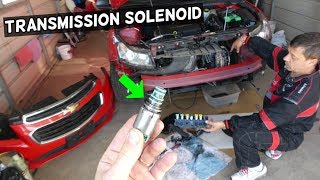
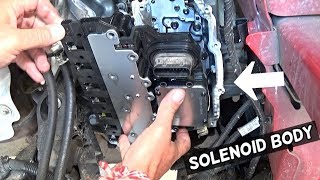
- Chevrolet Cruze, Sonic, Trax (2011-2019) — Equipped with 6T30/6T40 transmissions that experience frequent TEHCM (integrated TCM and solenoid block) failures. A single bad solenoid requires replacing the entire $800+ TEHCM assembly.
Manufacturer-Specific Notes
- Honda/Acura: Honda requires its proprietary HDS scan tool to perform specific relearn procedures after replacing a solenoid or valve body. Skipping this step results in terrible shift quality even with new parts.
- Hyundai/Kia: TSB 14-AT-003 explicitly states not to replace the entire transmission for solenoid codes. Individual solenoids and internal wiring harnesses are available separately and are the prescribed, cost-effective fix.
- Ford: On DPS6 transmissions (Focus/Fiesta), symptoms mirroring a stuck solenoid are almost always caused by a faulty TCM or binding clutch actuators. Ford issued multiple extended warranty programs (14M01, 14M02) for these specific components.
- GM/Chevrolet: On 6-speed automatics (like the Cruze's 6T40), the TCM and solenoids are integrated into a single unit called the TEHCM. A single solenoid failure requires replacing this entire expensive assembly. Check for GM Special Coverage Adjustment 14476.
Real Owner Stories
2016 Honda Pilot with 6-speed Automatic
Check Engine Light came on with codes P2821 and P084C. Owner noticed no major shifting issues but data stream showed erratic pressure readings.
What they tried:
- Performed two transmission fluid changes, driving between each one, to rule out fluid quality. The code remained.
Outcome: A shop diagnosed an internal issue with the switch on the valve body. The owner opted for a full transmission rebuild given the labor involved to access the component. In a similar case, another owner found the code was caused by a slow leak from the transmission output seal, leading to low fluid levels.
Lesson: Even without severe symptoms, a persistent P2821 code points to an internal component failure. Low fluid from an unseen leak is a highly possible and less severe cause that must be investigated first.
2024 GMC Canyon Denali at 12,000 miles
Experienced rough shifting, followed by a Check Engine Light with code P2821.
What they tried:
- Immediately scheduled an appointment with the dealership.
Outcome: As a new vehicle under warranty, the dealer diagnosed a faulty TEHCM assembly and replaced it entirely at no cost to the owner.
Lesson: If your vehicle is under powertrain warranty, do not attempt DIY repairs or fluid changes. Document the symptoms and take it to the dealer immediately to ensure the issue is resolved for free.
Misdiagnosis leading to unnecessary expense
Car presented with transmission codes and harsh shifting.
What they tried:
- A chain shop immediately recommended replacing the entire transmission for $4,500, assuming catastrophic internal damage.
Outcome: The owner sought a second opinion at an independent transmission specialist. The specialist found a damaged external wiring harness. Repairing the wires cost $250 and permanently resolved the code.
Lesson: The most common misdiagnosis for P2821 is condemning the entire transmission. Always start with the cheapest potential causes (fluid, wiring) and get a second opinion before agreeing to a full replacement.
How to Prevent This Code From Triggering

- Regularly change transmission fluid and filter. (Every 30,000 to 60,000 miles, or per manufacturer recommendation.) — Prevents the buildup of sludge and contaminants that cause solenoids to physically stick. Fresh fluid maintains proper lubricating and cooling properties.
- Use only the OEM-specified transmission fluid type. (Every fluid change.) — Incorrect fluid alters viscosity and friction characteristics, causing improper hydraulic pressure, shifting problems, and solenoid stress.
- Avoid aggressive driving habits. (Daily habit.) — Hard acceleration, frequent towing beyond capacity, and abrupt stops generate excessive heat. Heat is the primary cause of fluid breakdown and solenoid failure.
- Install an external transmission cooler. (One-time modification.) — For vehicles used for towing or in hot climates, an auxiliary cooler keeps fluid temperatures stable, preventing premature breakdown and solenoid damage.
- Address fluid leaks immediately. (As soon as noticed.) — A low fluid level causes incorrect line pressure and overheating, quickly damaging solenoids and internal clutch packs.
Frequently Asked Questions
What is the most common misdiagnosis for a P2821 code?
The most common mistake is immediately condemning the entire transmission. P2821 is frequently caused by a cheaper component like a single solenoid, wiring harness, or dirty fluid. A thorough step-by-step diagnosis prevents thousands in wasted money.
Can I just clean the solenoid instead of replacing it?
If the solenoid is merely stuck due to sludge, cleaning it with brake cleaner restores function temporarily. However, if the solenoid has internal electrical wear, cleaning fails. Replacement is the only reliable, long-term fix.
How urgent is a P2821 code?
This code is highly urgent. While you can drive short distances, ignoring it causes excessive heat and clutch wear. Continued driving destroys the transmission, requiring a full rebuild.
Can a transmission fluid change really fix this?
Yes, if dirty fluid is causing the solenoid to stick, a complete fluid and filter change resolves the issue. It is the most cost-effective first step in the repair process.
Where is the 'J' solenoid located?
Pressure control solenoids mount directly to the valve body inside the transmission. Accessing them requires draining the fluid and removing the transmission oil pan. This internal location makes replacement a professional-level job.
Can I replace the solenoid myself?
Replacing a solenoid is an advanced DIY job requiring a torque wrench, service manual, and strict cleanliness. Incorrectly torquing valve body bolts causes warping and severe leaks. Most drivers should leave this to a professional transmission shop.
What happens if I just clear the code and keep driving?
The code returns within a few drive cycles because clearing it does not fix the mechanical or electrical fault. Continuing to drive forces the transmission to operate with incorrect pressure. This accelerates internal wear and guarantees catastrophic failure.
Key Takeaways
- Check your transmission fluid first; replacing dark, burnt fluid resolves P2821 in roughly 30% of cases without requiring internal repairs.
- Stop driving immediately if you experience harsh shifting or slipping; driving more than 20 miles with uncontrolled hydraulic pressure destroys clutch packs and turns a $400 solenoid fix into a $3,500 rebuild.
- Test the solenoid's electrical resistance with a multimeter (typically 5-25 Ohms) before opening the transmission pan to rule out external wiring faults.
- Verify if your vehicle allows individual solenoid replacement (like most Hyundai/Kia models) or requires a complete $800+ valve body/TEHCM assembly (common in GM and Ford).
Helpful Videos


The information in this article is provided for general reference and educational purposes only. Vehicle specifications, procedures, and part compatibility can vary by production date, trim level, and region. Always consult your vehicle's factory service manual and verify part numbers before purchasing or performing repairs. Safety-critical components such as airbags, seat belts, and braking systems should be installed by a qualified professional.
- 🎬 Helpful Videos
- What Does P2821 Mean?
- Can I Drive With P2821?
- Common Causes
- Symptoms
- Diagnostic Flowchart
- Common Fixes & Costs
- Used vs. New Parts: Buying Guide
- What Happens If You Wait — Timeline
- Cost of Not Fixing It
- Diagnosis Steps
- When This Code Triggers (Freeze-Frame Conditions)
- Related Codes
- Climate & Environmental Factors
- How to Talk to a Mechanic About This Code
- Where to Take It: Dealer vs Independent vs Chain
- When to Walk Away From the Repair
- What Scan Tool You Need for This Code
- How to Clear the Code After You Fix It
- Will This Fail Emissions / State Inspection?
- Most Commonly Affected Vehicles
- Manufacturer-Specific Notes
- Real Owner Stories
- 2016 Honda Pilot with 6-speed Automatic
- 2024 GMC Canyon Denali at 12,000 miles
- Misdiagnosis leading to unnecessary expense
- How to Prevent This Code From Triggering
- Frequently Asked Questions
- What is the most common misdiagnosis for a P2821 code?
- Can I just clean the solenoid instead of replacing it?
- How urgent is a P2821 code?
- Can a transmission fluid change really fix this?
- Where is the 'J' solenoid located?
- Can I replace the solenoid myself?
- What happens if I just clear the code and keep driving?
- Key Takeaways
- 🎟️ Get 5% Off