

OBD-II Code P2753: Transmission Fluid Cooler Control Circuit/Open
An Expert Guide to Diagnosing and Fixing P2753
- Code P2753 indicates a broken electrical circuit disabling your transmission cooler, requiring immediate attention to prevent overheating.
- Do not drive the vehicle, as operating without the cooler active pushes transmission fluid temperatures past 220°F, causing irreversible clutch damage.
- On 2011-2018 Audi and VW models, this code is almost exclusively caused by a leaking N82 control valve that destroys the wiring harness with coolant.
- Diagnose the solenoid by measuring its internal resistance with a multimeter; a healthy valve reads between 5 and 30 Ohms, while an 'O.L.' reading confirms a dead part.
What Does P2753 Mean?

Your car's Powertrain Control Module (PCM) or Transmission Control Module (TCM) detected a break ('open') in the electrical circuit controlling the transmission fluid cooler solenoid. Think of it as a cut wire to a critical switch. Because the circuit is open, the computer cannot command the cooler valve to open, preventing transmission fluid from cooling. This guarantees transmission overheating under normal operation.
Technical definition: The SAE/OBD-II definition is "Transmission Fluid Cooler Control Circuit/Open". This indicates the control module detected a loss of continuity from the circuit operating the transmission cooler control solenoid. The module expected a specific voltage or resistance and received none, triggering the fault code.
Can I Drive With P2753?
No — Do Not Drive. Do not drive. The control circuit for your transmission cooler is disabled, causing the transmission to overheat rapidly. This leads to irreversible internal clutch damage, transmission failure costing upwards of $4,000, and documented cases of vehicle stalling.
Common Causes

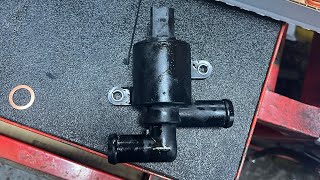
- Failed Transmission Fluid Cooler Control Valve (Solenoid) (Very Common) — The solenoid is an electronically controlled valve. The internal wire coil breaks, creating an open circuit. It also fails mechanically by getting stuck, or leaks coolant internally into its own electrical connector.
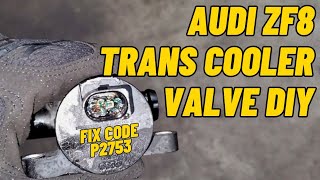
- Coolant Contamination of Electrical Parts (Audi/VW) (Very Common On Specific Makes) — On many Audi and VW models, the control valve (N82/N509) notoriously leaks coolant internally. 🎬 See how coolant wicks into the connector on Audi models. This coolant wicks up the wiring harness, causing severe corrosion and circuit faults. If ignored, it destroys the Transmission Control Module (TCM). 🎬 Watch: Diagnosing a faulty Audi coolant control valve.
- Damaged, Broken, or Corroded Wiring/Connectors (Very Common) — Wires exposed to heat and vibration become brittle and break. They rub against the chassis, or connector pins corrode from moisture, creating high resistance or an open circuit.
- Poor or Broken Ground Connection (Common) — The circuit requires a solid ground to the vehicle's chassis. A corroded, loose, or broken ground wire interrupts the electrical path, triggering P2753. This frequently occurs after unrelated repair work where a ground is left detached.
- Blown Fuse or Fusible Link (Less Common) — The control circuit is protected by a fuse. A blown fuse cuts all power, creating an open circuit. This signals a deeper issue, like a short circuit, requiring investigation.
- Failed Powertrain or Transmission Control Module (PCM/TCM) (Rare) — The internal driver circuit within the control module that sends the signal to the valve burns out. Consider this only after exhaustively ruling out the valve, wiring, and grounds.
Symptoms

- Check Engine Light or Transmission Warning Light — The light illuminates on the dashboard immediately when the PCM/TCM logs the P2753 fault.
- Harsh, Delayed, or Erratic Shifting — Overheated transmission fluid loses viscosity and lubricating properties. The transmission shifts roughly, hesitates, slips between gears, or gear hunts.
- Limp Mode Activation — To protect the transmission from catastrophic damage, the computer enters a 'limp-home' mode, drastically reducing engine power and limiting available gears.
- Burning Smell — A distinct smell like burnt toast or burnt oil indicates the transmission fluid is overheating and breaking down chemically.
- Transmission Overheating and Warning Message (also visible on scanner) — A high transmission temperature warning appears on the instrument cluster. Fluid temperatures climb above the normal 180°F (82°C) range, exceeding 210°F (99°C) under load.
Diagnostic Flowchart

Tap your situation to follow the diagnostic path that matches what you're seeing on this code.
Common Fixes & Costs
- Replace Transmission Cooler Control Valve/Solenoid — Parts: $100-$250, Labor: $150-$300, ~1.2 hr book time (Intermediate)
- Repair Wiring and/or Replace Connector Pigtail — Parts: $30-$80, Labor: $150-$300, ~1.5 hr book time (Intermediate)
- Clean or Repair Ground Connection — Parts: $5-$20, Labor: $75-$150, ~0.5 hr book time (DIY)
- Replace Blown Fuse and Investigate Cause — Parts: $1-$10, Labor: $0-$75, ~0.3 hr book time (DIY)
- Replace Powertrain/Transmission Control Module (PCM/TCM) — Parts: $600-$1200, Labor: $150-$300, ~2.5 hr book time (Professional)
Used vs. New Parts: Buying Guide
When a used part is worth it: Buying a used cooler control valve is never recommended. The failure stems from internal wear and seal degradation. A used part has an unknown history and high likelihood of premature failure.
Donor-vehicle mileage cap: roughly under 20000 miles for the part to have meaningful remaining life.
Donor quality checklist:
- Avoid used valves entirely. If mandatory, source from a low-mileage vehicle wrecked for non-powertrain reasons.
- Never buy a used valve showing corrosion or moisture around the electrical connector.
- Match the part number exactly (e.g., 4H0121671D).
Decision logic:
- If The part is the cooler control valve solenoid. → Buy a new OEM or high-quality aftermarket part (e.g., Febi, Gates). The risk of a used part failing is too high.
- If The part is a Transmission Control Module (TCM). → A used, cloned OEM module is cost-effective but requires a specialist to program it to your VIN. Avoid cheap aftermarket TCMs.
- If The part is a wiring connector pigtail. → New is the only option. Used connectors are brittle and prone to failure.
Warranty tradeoff: Used parts carry a 30-90 day warranty. New aftermarket parts offer 1-2 years, while new OEM parts offer lifetime warranties from select retailers. The peace of mind from a new valve justifies the cost.
Worst-case if a used part fails: $450 if a used valve fails shortly after installation, requiring repeat labor and a new part.
What Happens If You Wait — Timeline
- 0-1 month: Code P2753 is stored and the Check Engine Light is on. Transmission fluid temperature rises above normal (175-195°F) during heavy use but triggers no warning light. No symptoms are noticeable in gentle driving. (MPG impact: 0-2%% · Added cost: $0)
- 1-3 months: Fluid consistently runs hot (>220°F), oxidizing and breaking down. A faint burning smell is present. Shifting becomes harsher. The transmission overheat warning light flickers during long drives. (MPG impact: 3-5%% · Added cost: $50 in wasted fuel)
- 3-6 months: Fluid temperature regularly exceeds 240-260°F. Fluid is brown/black and smells burnt. Varnish forms, internal seals harden, the vehicle enters 'limp mode,' and clutch slipping becomes evident. (MPG impact: 8-15%% · Added cost: $1,800 - $3,500 (Internal damage to clutches and seals requires a transmission rebuild).)
- 6+ months: Catastrophic failure. Temperatures over 300°F cause hard seals to fail, leading to major pressure loss. Clutch packs burn out, and hard parts warp. On Audi/VW models, migrated coolant destroys the TCM. (MPG impact: 15-25%% · Added cost: $4,000 - $8,000+ (Complete transmission replacement is necessary, plus potential TCM replacement).)
Cost of Not Fixing It
- 0-1 Month: Transmission fluid overheats during normal driving, leading to poor shift quality, hesitation, and a burning smell. Internal clutch and seal wear accelerates. (Added cost: $0 to $100. Risk of minor internal wear begins.)
- 1-6 Months: Continued overheating chemically breaks down transmission fluid, causing clutch pack slipping, seal damage, and frequent 'limp mode' activation. (Added cost: $1,800 - $3,500 for a transmission rebuild if damage is contained to clutches and seals.)
- 6+ Months: Catastrophic transmission failure. Extreme heat warps gears, drums, and the torque converter. On Audi/VW models, migrating coolant destroys the TCM. (Added cost: $4,000 - $8,000+ for a complete transmission replacement, plus potential TCM replacement costs.)
Diagnosis Steps
- Scan for Codes and Review Freeze Frame Data
Use an OBD-II scanner to confirm P2753. Record related codes like P2755 (Circuit High), P0700 (TCM Fault), or P0218 (Transmission Over Temperature). Review freeze frame data to identify vehicle conditions when the code set.
Tools: OBD-II Scanner (Beginner) - Perform a Thorough Visual Inspection
Locate the transmission cooler control valve. Inspect the wiring harness and connector for frayed wires, heat damage, or corrosion. On Audis, unplug the connector and look for pink coolant inside.
Tools: Flashlight, Inspection Mirror (Beginner) - Pro Tip: Test the Control Valve Solenoid Resistance
Disconnect the valve's electrical connector. Set a multimeter to Ohms (Ω). Measure the resistance between the two pins on the valve. A healthy solenoid reads between 5 and 30 Ohms. A reading of 'O.L.' confirms the internal coil is broken, requiring replacement.
Tools: Multimeter, Service Manual (Intermediate) - Pro Tip: Test the Circuit for Power and Ground
With the valve disconnected and the key 'ON' (engine off), test the harness connector. Use a multimeter to check the ground pin for continuity to the chassis (less than 1 Ohm). Check the power pin for voltage. Consult a service manual to confirm if the TCM supplies constant power or a pulsed 12V signal.
Tools: Multimeter, Service Manual (Intermediate) - Check Fuses and Ground Connections
Locate the fuse for the transmission control circuits and visually inspect it. Locate the main ground strap for the transmission and control module. Ensure it is clean, tight, and free of corrosion.
Tools: Owner's Manual, Fuse Puller, Basic Hand Tools (Beginner) - Perform a Commanded Test with a Bi-Directional Scan Tool
Command the cooler valve 'ON' using an advanced scan tool. Listen for an audible 'click' from the valve. Verify the TCM sends the ~12V signal on the control wire using a multimeter. If the signal arrives but the valve doesn't click, the valve is dead.
Tools: Advanced Bi-Directional Scan Tool, Multimeter (Advanced) - Pro Tip: Perform a 'Wiggle Test'
With the multimeter connected to measure resistance or voltage, gently wiggle the wiring harness at the connector, along its path, and near the TCM. Wildly fluctuating readings pinpoint the exact location of an intermittent break.
Tools: Multimeter (Intermediate) - Pro Tip: Load Test the Circuit
Connect a headlight bulb to the power and ground wires of the solenoid connector. Command the solenoid on with a scan tool. A brightly lit bulb confirms the circuit carries necessary current. A dim or unlit bulb indicates high resistance in the wiring.
Tools: Test Light or Headlight Bulb, Jumper Wires, Advanced Scan Tool (Advanced) - Advanced: Validate TCM Voltage Output
Connect a multimeter to the control wire at the harness connector. Command the cooler valve ON. A healthy TCM outputs approximately 12V. A 0V reading confirms an open circuit or a dead TCM driver. Readings below 5V suggest a failing TCM driver.
Tools: Advanced Bi-Directional Scan Tool, Multimeter, Service Manual (Advanced) - Advanced: Monitor Live Data PIDs
Monitor the Transmission Fluid Temperature (TFT) PID. Normal operating temperature is 175°F to 195°F. With P2753, the temperature climbs steadily past 210°F (99°C) under load, verifying the mechanical consequence of the electrical fault.
Tools: Advanced Scan Tool (Advanced)
When This Code Triggers (Freeze-Frame Conditions)
- Engine Coolant Temp: 180-210°F (82-99°C) (Vehicle is at full operating temperature.)
- RPM: 1500-2500 (During steady cruise, light acceleration, or when climbing a grade.)
- Engine Load: 30-60% (The engine is working under a moderate load, demanding transmission cooling.)
- Vehicle Speed: 35-65 mph (Occurs during city or highway driving after the transmission warms up.)
Related Codes
- P2755 — Means 'Transmission Fluid Cooler Control Circuit High'. It indicates a short to power, sharing root causes like a faulty solenoid or damaged wiring with P2753.
- P0700 — A generic informational code set by the ECM indicating the TCM stored a fault. P0700 tells you to scan the TCM for the specific transmission code (P2753).
- P0218 — Means 'Transmission Over Temperature Condition'. It is a direct consequence of P2753 disabling the cooler. Fixing the P2753 circuit resolves P0218.
- P2754 — Means 'Transmission Fluid Cooler Control Circuit Low', indicating a short to ground. Diagnosis involves looking for a wire rubbing on the chassis.
Climate & Environmental Factors
- Road Salt / Corrosive Environments: In the 'Salt Belt', salt spray accelerates corrosion of the wiring harness, connector pins, and valve body. Moisture penetrates failing wire insulation, creating high resistance or an open circuit.
- High Humidity & Temperature Cycling: Frequent temperature swings cause condensation inside transmission components. Moisture seeps into unsealed electrical connectors, leading to corrosion and circuit faults.
How to Talk to a Mechanic About This Code
Say this: "I have an OBD-II code P2753 for the transmission cooler control circuit. I'd like to schedule a diagnostic. Please start by testing the resistance of the control solenoid and inspecting its electrical connector for corrosion or fluid contamination. On my vehicle, I know a leaking valve is a very common cause."
This signals you are an informed customer. It directs them to the most common failure points (valve and wiring), preventing them from immediately suggesting an expensive diagnosis of the TCM or transmission.
Avoid saying:
- 'My check engine light is on, can you look at it?'
- 'My transmission is acting weird.'
- 'Just fix whatever you think is wrong.'
Questions to ask before authorizing the repair:
- What was the resistance reading across the solenoid's pins? Was it within specification?
- Did you find evidence of corrosion, moisture, or coolant inside the electrical connector?
- If the valve needs replacement, does your quote include replacing the connector pigtail to prevent a repeat failure?
- What is the warranty on the parts and labor for this specific repair?
Where to Take It: Dealer vs Independent vs Chain
- Dealer:
Best for: Vehicles still under powertrain warranty., Audi or VW models where a known recall (e.g., 80B8/80B9) or TSB applies., Complex cases involving TCM replacement.
Downsides: Highest labor rates, often 1.5-2x more than an independent shop., Less willing to perform simple wiring repairs, preferring to replace large harness sections. (Typical cost: +50% vs. baseline) - Independent Shop:
Excellent choice. Seek a shop specializing in your vehicle's brand (e.g., a German auto specialist for an Audi) to ensure they know the specific failure patterns.
Best for: Out-of-warranty vehicles, especially Audi/VW where the P2753 fix is routine., Owners wanting a personal relationship with their mechanic.
Downsides: Quality varies. A general mechanic lacks specific brand knowledge, leading to misdiagnosis. (Typical cost: +0% vs. baseline) - Chain Shop:
AVOID. This is not a simple parts-swapping job. The risk of an incorrect diagnosis or incomplete repair is very high.
Best for: Simple maintenance like oil changes, tires, and brake pads.
Downsides: Technicians lack specialized diagnostic training for complex electrical codes., High pressure to sell parts leads to incorrect recommendations., Unlikely to have experience with brand-specific issues like the Audi coolant leak. (Typical cost: -10% vs. baseline)
When to Walk Away From the Repair
If the estimated repair cost exceeds 50% of the car's current private-party market value, seriously consider selling the car as-is or trading it in.
- Car worth $15000, fix is $850: Fix it. The repair cost is a small fraction of the car's value and is necessary for operation.
- Car worth $5000, fix is $3500: Walk away. The repair cost is 70% of the car's value. The damage from overheating is extensive, and a transmission rebuild is not economically sound.
- Car worth $9000, fix is $4200: Borderline. The cost approaches 50% of the vehicle's value. Get a second opinion to confirm a full transmission replacement is truly needed.
What Scan Tool You Need for This Code
Minimum: A code reader that accesses Transmission Control Module (TCM) codes and displays live data, specifically the Transmission Fluid Temperature (TFT) sensor.
A basic $20 scanner only shows engine codes and misses P2753 stored in the TCM. Proper diagnosis requires bi-directional control to command the solenoid.
Budget: BlueDriver Pro (~$100) — Reads P2753 from the TCM and displays live data for transmission fluid temperature. It lacks bi-directional control needed to command the solenoid.
Mid-range: Innova 5610 / Autel MaxiCOM MK808S (~$300-400) — Ideal for DIYers. Offers bi-directional control, allowing you to command the cooler control valve ON and OFF to verify its function electrically.
Professional: Autel MaxiCOM MK906BT / XTOOL D7 (~$500-1200) — Provides full OEM-level diagnostics, advanced bi-directional control, wiring diagrams, and TCM programming capabilities.
Rent vs buy: Buy a mid-range scanner. Free rental scanners at auto parts stores typically cannot read transmission codes or perform bi-directional tests required for P2753.
How to Clear the Code After You Fix It
- Reconnect battery (if disconnected for repair).
- Use an OBD-II scan tool to erase the P2753 fault code from the TCM/PCM.
- Perform a complete drive cycle to allow the vehicle's readiness monitors to reset.
Drive cycle (~20 minutes): Start the vehicle from a cold start. Idle for 2-3 minutes. Drive in stop-and-go city traffic for 10-15 minutes, including several complete stops. Drive at a steady highway speed (55-65 mph) for 5-10 minutes. Allow the vehicle to cool down completely.
Readiness monitors affected: Comprehensive Component Monitor (CCM), Transmission
Before emissions retest: drive at least 50 miles to fully set monitors.
Watch out for:
- Disconnecting the battery clears the code but fails to reset readiness monitors required for emissions testing.
- The code returns immediately if the underlying electrical fault is not repaired.
- Some vehicles require a specific TCM reset procedure using a bi-directional scan tool.
Will This Fail Emissions / State Inspection?
Yes — this code typically fails an OBD-II emissions inspection.
- California: An illuminated Check Engine Light results in an automatic smog check failure. The Comprehensive Component Monitor remains 'not ready' until a full drive cycle is completed post-repair.
- New York: The NYS DMV inspection includes an OBD-II scan. P2753 is a guaranteed failure, preventing registration renewal until repaired and cleared.
- Texas: In the 17 counties requiring emissions testing, an active P2753 code fails the OBD portion of the annual safety inspection.
Most Commonly Affected Vehicles

- Audi A6, A7, S6, S7 (2012-2018) — Extremely common. The control valve (P/N 4H0121671D) leaks coolant into the harness connector (P/N 8K0973702). Requires replacing the valve and connector pigtail to prevent TCM destruction.
- Audi A8, S8 (2011-2013) — Subject to Safety Recall 80B8 / 80B9 for the coolant control valve leaking into the wiring harness, causing vehicle stalling.
- Audi Q7 (2011-2015) — Shares the problematic control valve design. Covered under Technical Product Information (TPI) 2033325/2 for coolant contamination.
- Audi A4, A5, Q5 (2011-2016) — Included in TSBs (TPI 2033806, 2033325/2) for failure of the cooler control valve (N82/N509) and resulting wiring damage.
- Volkswagen Golf (Mk7), Touareg (2013-2020) — Uses a similar valve design (N82, N509, N488) that fails and causes this code. Diagnosis is identical to Audi.
- Ford F-150, Explorer (2008-2022) — Diagnosis focuses on standard electrical checks, as it is not linked to a single widespread component design flaw.
- Chevrolet / GMC Silverado, Equinox (2007-2022) — Not considered a common pattern failure. Standard electrical diagnosis focusing on wiring integrity and solenoid function is required.
- Toyota Tacoma, Camry (2005-2023) — The cause is typically wiring damage or a failed solenoid, not a specific recurring design flaw.
Manufacturer-Specific Notes
- Audi / Volkswagen: The cooler control valve (N82/N509) leaks coolant internally through the electrical connector pins. Coolant wicks up the wiring harness, causing corrosion. If ignored, coolant destroys the TCM, turning a $400 repair into a multi-thousand dollar one. Relevant campaigns include Safety Recall 80B8/80B9 and TSBs 2033806 & 2033325.
- Subaru: Subaru CVTs (TR580) experience valve body and solenoid electrical issues presenting as 'Circuit High' codes. TSB 16-149-25 notes moisture intrusion into the main valve body connector requires a new valve body and improved connector cover.
- General (Ford, GM, Toyota, etc.): On modern CAN bus vehicles, P2753 is sometimes triggered by issues in unrelated modules. A faulty ground affects multiple systems, requiring a specialized scanner to view network-wide communication errors.
- Any Make/Model: A highly common cause for 'open circuit' codes is a forgotten ground strap after an engine or transmission replacement. Always verify all ground wires are properly reattached to the engine block and chassis.
Real Owner Stories
2012 Audi A6 3.0T at 98k miles - The Classic Audi Failure
Check Engine Light came on, storing code P2753. No immediate shifting problems or overheating symptoms were noticed during normal driving.
What they tried:
- Owner discovered the common failure of the cooler control valve (solenoid).
- They replaced the solenoid valve (P/N 4H0-121-671-D), the connector housing (P/N 1J0-973-702), and the repair wires.
- After clearing the code, the Check Engine Light returned within a couple of days.
Outcome: The problem persisted because coolant migrating up the wiring harness was not fully addressed. The correct procedure requires cutting back the harness until clean, uncorroded copper wire is found before splicing in the new connector pigtail.
Lesson: On an Audi/VW with P2753, replacing only the valve is not enough. You must replace the connector pigtail and inspect the harness for coolant contamination to prevent the code from returning.
2013 Audi A8 - The Misdiagnosis
P2753 code appeared. The owner took the car to an independent shop to avoid high dealer costs.
What they tried:
- The shop initially suspected a complex wiring issue or a faulty TCM.
- A more experienced technician correctly identified the common failure pattern for Audis.
- They inspected the N82 valve connector and found it full of pink coolant and corrosion.
Outcome: The shop replaced the failed valve and the contaminated connector pigtail. Total cost was $450, significantly less than the dealer quote of nearly $700.
Lesson: Don't immediately assume a bad TCM. On affected vehicles, the leaking valve is the most likely culprit. An experienced independent mechanic performs this common repair for much less than a dealership.
Generic Vehicle - An Easy Fix
Check Engine Light with code P2753 appeared shortly after major engine work at a repair shop.
What they tried:
- The owner checked the transmission circuit fuse, which was intact.
- They performed a visual inspection of the wiring harness around the transmission and engine.
- They discovered a main ground strap for the transmission was loose and not making a clean connection to the chassis.
Outcome: The owner cleaned the contact point with a wire brush, tightened the ground strap, and cleared the code. P2753 did not return.
Lesson: If a fault code appears immediately after a different repair, inspect the area where work was done. A forgotten ground strap is a highly common cause of new electrical issues.
How to Prevent This Code From Triggering
- Apply Dielectric Grease to At-Risk Connectors (Every 2-3 years or during any related service) — Applying non-conductive dielectric grease to the cooler valve connector seal creates a barrier against moisture and salt, preventing corrosion that leads to open circuits.
- Perform Regular Cooling System Flushes (Every 30,000 to 50,000 miles) — Clean coolant with fresh anti-corrosion additives protects the seals inside the cooler control valve. Contaminated coolant degrades seals, leading to internal leaks.
- Inspect Wiring Harness for Chafing (During every oil change) — The wiring harness routes near hot exhaust components. Visual inspection spots areas where plastic loom has worn away, preventing wires from rubbing against the chassis and breaking.
- Install an Upgraded Auxiliary Transmission Cooler (Once, for vehicles used for towing or in hot climates) — Reducing thermal load keeps fluid temperature stable, reducing stress on the control valve and seals. An aftermarket cooler drops temperatures by 20-30°F.
Frequently Asked Questions
What does 'Circuit Open' actually mean for my car?
Think of it like a light switch with a cut wire. An 'open' circuit is an electrical path with a break, preventing electricity from flowing. This is usually caused by a physically broken wire, a disconnected plug, a blown fuse, or an internally failed solenoid.
My mechanic replaced the valve, but P2753 came back. What's next?
This happens when the old valve leaked coolant, corroding the connector pins and wicking up the wires. The only correct fix is replacing both the valve and the connector pigtail, splicing it into clean, uncorroded wire. Failing to replace the pigtail guarantees the code will return.
What happens if I ignore code P2753?
Ignoring this code causes your transmission fluid to overheat, breaking it down and accelerating wear on clutches and seals. This leads to catastrophic transmission failure, a repair often costing $4,000 or more. On certain vehicles, it also destroys the TCM or causes the engine to stall.
Can I fix P2753 myself to save money?
DIY repair is possible for intermediate mechanics equipped with a multimeter, jack stands, and wire splicing tools. Replacing the control valve and connector pigtail requires safely lifting the vehicle, draining coolant, and executing weatherproof wire splices. Diagnosing a faulty TCM or complex CAN bus issue requires a professional.
My aftermarket warranty denied the claim for P2753. Why?
Many powertrain warranties only cover 'internally lubricated parts' of the transmission. Because the cooler control valve is often mounted on the exterior of the transmission, the warranty company uses this technicality to deny the claim. Always read the fine print of your policy carefully.
Will a transmission fluid flush fix code P2753?
No. P2753 is a purely electrical fault code. While you must top off or replace fluid as part of the repair process, a fluid change by itself will not fix a broken wire, a bad solenoid, or a faulty computer.
What does a flashing transmission temperature light mean with a P2753 code?
A flashing light indicates the PCM/TCM detected the abnormal circuit condition and is actively trying to protect the transmission. The computer is warning you that the cooling system is offline. It limits performance to prevent catastrophic heat damage.
Key Takeaways
- Code P2753 indicates a broken electrical circuit disabling your transmission cooler, requiring immediate attention to prevent overheating.
- Do not drive the vehicle, as operating without the cooler active pushes transmission fluid temperatures past 220°F, causing irreversible clutch damage.
- On 2011-2018 Audi and VW models, this code is almost exclusively caused by a leaking N82 control valve that destroys the wiring harness with coolant.
- Diagnose the solenoid by measuring its internal resistance with a multimeter; a healthy valve reads between 5 and 30 Ohms, while an 'O.L.' reading confirms a dead part.
Helpful Videos

The information in this article is provided for general reference and educational purposes only. Vehicle specifications, procedures, and part compatibility can vary by production date, trim level, and region. Always consult your vehicle's factory service manual and verify part numbers before purchasing or performing repairs. Safety-critical components such as airbags, seat belts, and braking systems should be installed by a qualified professional.
- 🎬 Helpful Videos
- What Does P2753 Mean?
- Can I Drive With P2753?
- Common Causes
- Symptoms
- Diagnostic Flowchart
- Common Fixes & Costs
- Used vs. New Parts: Buying Guide
- What Happens If You Wait — Timeline
- Cost of Not Fixing It
- Diagnosis Steps
- When This Code Triggers (Freeze-Frame Conditions)
- Related Codes
- Climate & Environmental Factors
- How to Talk to a Mechanic About This Code
- Where to Take It: Dealer vs Independent vs Chain
- When to Walk Away From the Repair
- What Scan Tool You Need for This Code
- How to Clear the Code After You Fix It
- Will This Fail Emissions / State Inspection?
- Most Commonly Affected Vehicles
- Manufacturer-Specific Notes
- Real Owner Stories
- 2012 Audi A6 3.0T at 98k miles - The Classic Audi Failure
- 2013 Audi A8 - The Misdiagnosis
- Generic Vehicle - An Easy Fix
- How to Prevent This Code From Triggering
- Frequently Asked Questions
- What does 'Circuit Open' actually mean for my car?
- My mechanic replaced the valve, but P2753 came back. What's next?
- What happens if I ignore code P2753?
- Can I fix P2753 myself to save money?
- My aftermarket warranty denied the claim for P2753. Why?
- Will a transmission fluid flush fix code P2753?
- What does a flashing transmission temperature light mean with a P2753 code?
- Key Takeaways
- 🎟️ Get 5% Off