

OBD-II Code P2727: Pressure Control Solenoid 'E' Control Circuit / Open
What P2727 means, why it triggers, and how to fix it
- Code P2727 indicates a complete electrical break (infinite resistance) in the Pressure Control Solenoid 'E' circuit, requiring immediate repair to prevent transmission failure.
- Do not drive with P2727; on 2019-2020 GM trucks, this code frequently precedes sudden rear-wheel lock-up at low speeds due to a faulty TCM.
- Before replacing any internal transmission parts, verify the solenoid resistance falls within OEM specs (typically 5.0-5.5 Ohms) to rule out external wiring faults.
- For 2011-2018 Kia and Hyundai 6-speed models, replace the entire internal solenoid wiring harness (part #46307-3B650) rather than a single solenoid to prevent repeat failures.
What Does P2727 Mean?
The Transmission Control Module (TCM) detected a complete electrical break in the Pressure Control Solenoid 'E' circuit. This solenoid acts as a computer-controlled valve managing transmission fluid pressure for smooth gear shifts. An 'open circuit' means the electrical signal is entirely disconnected, preventing the solenoid from operating.
Technical definition: The SAE/OBD-II definition is "Pressure Control Solenoid 'E' Control Circuit/Open". The TCM detects infinite resistance on the control circuit for the 'E' pressure control solenoid, indicating a severed electrical path.
Can I Drive With P2727?
No — Do Not Drive. Do not drive. This code indicates a severe transmission electrical fault that causes sudden shifting issues, internal damage, or low-speed rear-wheel lock-up in certain GM vehicles. Continuing to operate the vehicle guarantees catastrophic transmission failure.
Common Causes
- Faulty Transmission Control Module (TCM) (Very Common) — On 2019-2020 GM trucks, the TCM itself is the primary cause due to internal driver circuit failures documented in TSB 23-NA-018. 🎬 Watch: How to replace a faulty GM transmission control module. The module stops sending power to the solenoid, creating a false open circuit that causes severe symptoms like wheel lock-up.
- Failed Internal Solenoid Harness or Solenoid 'E' (Common) — The solenoid's internal copper coil breaks, or the internal wiring harness connecting the solenoids to the main plug fails. On 2011-2018 Kia and Hyundai models, the entire internal wire harness assembly is a known high-failure component.
- Damaged External Wiring or Loose Connectors (Common) — The external wiring harness leading to the transmission frays, melts against the exhaust, or corrodes. A loose or poorly seated main connector at the TCM or transmission breaks the electrical connection, a specific issue noted in GM TSB 19-NA-228. 🎬 See how to repair a damaged wiring harness connector.
- Unstable System Voltage or Poor Grounds (Less Common) — A dying battery (dropping below 12.0V) or a corroded main chassis ground cable causes severe voltage instability. This tricks the TCM into misreading circuit resistance and setting false open circuit codes.
- Internal Transmission Mechanical Failure (Rare) — Burnt clutches or shattered hard parts create metallic debris that circulates through the fluid. This debris physically severs internal solenoid wiring or shorts out the connections on the valve body.
- Chronically Low or Dirty Transmission Fluid (Rare) — While fluid issues rarely cause an electrical 'open circuit' directly, severe overheating from low fluid melts internal solenoid wiring insulation, leading to an eventual circuit break.
Symptoms
- Rear Wheels Locking Up — In 2019-2020 GM vehicles, this code precedes a TCM failure that causes the rear wheels to lock up at low speeds, creating an extreme safety hazard.
- Transmission Stuck in Gear ('Limp Mode') — The vehicle locks into a single gear (usually 2nd or 3rd) and refuses to shift up or down to prevent further internal damage.
- Harsh, Jerky, or Delayed Shifting — The transmission slams violently into gear or hesitates for several seconds before engaging.
- Check Engine / Transmission Warning Light — The dashboard illuminates the Check Engine Light or a specific 'Service Transmission' message.
- Increased Fuel Consumption — Because the transmission cannot utilize overdrive or shift efficiently, the engine runs at higher RPMs, dropping fuel economy by 15-25%.
- Transmission Overheating (also visible on scanner) — Incorrect line pressures cause clutches to slip, generating excess heat that triggers an overheat warning or a burning fluid smell.
Diagnostic Flowchart
Tap your situation to follow the diagnostic path that matches what you're seeing on this code.
Common Fixes & Costs
- Replace Transmission Control Module (TCM) — Parts: $350-$600, Labor: $150-$300, ~2.0 hr book time (Professional)
- Replace Internal Solenoid Harness / Solenoid 'E' — Parts: $75-$200, Labor: $300-$600, ~3.5 hr book time (Advanced)
- Repair or Replace External Wiring Harness — Parts: $20-$200, Labor: $150-$500, ~3.0 hr book time (Professional)
- Replace Transmission Valve Body — Parts: $600-$1200, Labor: $300-$600, ~4.0 hr book time (Professional)
- Change Transmission Fluid and Filter — Parts: $50-$150, Labor: $100-$200, ~1.5 hr book time (DIY)
Used vs. New Parts: Buying Guide
When a used part is worth it: Only consider used parts for external wiring harnesses or if replacing the entire transmission assembly on a vehicle worth less than $4,000.
Donor-vehicle mileage cap: roughly under 60000 miles for the part to have meaningful remaining life.
Donor quality checklist:
- Verify the donor vehicle was scrapped for a rear-end collision, not a front-end crash or transmission failure.
- Ensure the part numbers match exactly; superseded parts will not communicate with your PCM.
Decision logic:
- If The part is a TCM for a 2019-2020 GM truck → Buy new OEM. Used modules contain the exact same factory defect and will fail again.
- If The part is an internal solenoid harness for a Kia/Hyundai → Buy new OEM. This is a known wear item; a used harness is a ticking time bomb.
- If The vehicle is over 15 years old and the budget is extremely tight → A used valve body from a low-mileage donor is an acceptable risk.
Warranty tradeoff: Salvage yards offer 30-day part-only warranties. New OEM parts offer 1-2 year warranties. If a used internal part fails, you pay the $500+ labor cost twice.
Worst-case if a used part fails: $1000 (Cost of repeat labor and fluid replacement if a used internal component fails immediately)
What Happens If You Wait — Timeline
- Immediate (0-1 week): Check Engine Light illuminates. Shifting becomes harsh or delayed. Vehicle enters limp mode. (MPG impact: 15%% · Added cost: $200 (Towing fees))
- 1 week - 2 months: Incorrect line pressure causes clutches to slip, generating extreme heat and shedding friction material into the fluid. (MPG impact: 20%% · Added cost: $150 (Wasted fuel and accelerated wear))
- 2 - 6 months: Abrasive clutch debris destroys the valve body. Transmission overheats frequently. (MPG impact: 25%% · Added cost: $2,500 (Requires valve body replacement and partial rebuild))
- 6+ months: Catastrophic failure. Hard parts warp, clutches burn completely, and the transmission ceases to function. (MPG impact: N/A% · Added cost: $5,000 (Complete transmission replacement required))
Cost of Not Fixing It
- Immediate (0-1 month): Unpredictable shifting, limp mode, and severe safety risks from sudden rear-wheel lock-up on affected GM trucks. (Added cost: $200-$500 (Towing and emergency diagnostic fees))
- Short Term (1-6 months): Incorrect fluid pressure causes clutches to slip and burn. Abrasive clutch material contaminates the fluid, destroying the valve body. (Added cost: $1,500-$3,500 (Requires a valve body replacement or partial rebuild instead of a simple electrical repair))
- Long Term (6+ months): Catastrophic mechanical failure. The transmission overheats, hard parts warp, and the unit ceases to function entirely. (Added cost: $4,000-$8,000 (Complete transmission replacement required))
Diagnosis Steps
- Scan Codes and Check TSBs
Use an OBD-II scanner to confirm P2727 and check for related codes. Search for Technical Service Bulletins (TSBs) for your specific VIN. For example, GM TSB 23-NA-018 dictates replacing the TCM immediately without further solenoid testing.
Tools: OBD-II Scanner (Beginner) - Inspect External Wiring and Connectors
Visually inspect the transmission wiring harness for chafing, melting, or corrosion. Disconnect the main electrical connector at the transmission and the TCM, check for bent pins, spray with contact cleaner, and ensure they lock firmly upon reconnection.
Tools: Flashlight, Electrical Contact Cleaner (Intermediate) - Check Battery, Grounds, and Fluid
Test the battery to ensure it provides 12.4V+ (engine off) and 13.7V-14.7V (engine running). Clean the main chassis and transmission ground connections until resistance is under 0.5 Ω. Check the transmission fluid; if it smells burnt or contains metal flakes, stop electrical testing—the transmission requires a mechanical rebuild.
Tools: Multimeter, Wire Brush, Rag (Beginner) - Perform Bidirectional Solenoid Actuation Test
Using a professional scan tool, command the 'E' solenoid ON and OFF. Listen closely to the transmission pan. A distinct 'click' confirms the wiring and TCM are intact, and the solenoid moves. No click means the circuit is broken or the solenoid is dead.
Tools: Professional Bidirectional Scan Tool (Advanced) - Test Solenoid Circuit Continuity and Voltage
Disconnect the TCM and transmission connectors. Use a multimeter to check for continuity (near 0 Ω) on the control wire between the two connectors. Next, turn the key ON (engine off) and measure voltage at the solenoid power feed wire at the transmission connector; it must show battery voltage (~12.4V).
Tools: Multimeter, Vehicle-specific Wiring Diagram (Advanced) - Drop Transmission Pan for Internal Inspection
If external wiring passes, drain the fluid and drop the transmission pan. Inspect the magnet for excessive metal shavings. Heavy metal debris dictates a full transmission replacement. If clean, proceed to test the internal components.
Tools: Socket Set, Drain Pan, Gasket Scraper (Advanced) - Test Solenoid Resistance at the Source
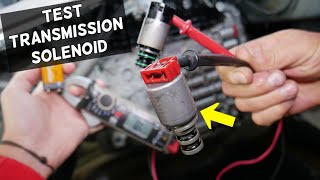
Unplug the solenoid from the internal harness. Measure resistance across the solenoid's pins. Compare to OEM specs (e.g., GM 10L80 solenoids are 5.0-5.4 Ohms). A reading of 'OL' (infinite resistance) confirms a broken internal coil, requiring solenoid replacement.
Tools: Multimeter, OEM Specifications (Advanced) - Analyze Solenoid Command Signal
For intermittent faults, back-probe the solenoid control wire at the TCM with an oscilloscope. Drive the vehicle. A Pulse-Width Modulated (PWM) solenoid must show a clean square wave. A flat line during a commanded shift proves a failed TCM driver.
Tools: Oscilloscope (Lab Scope), Back-probe Pins (Professional)
When This Code Triggers (Freeze-Frame Conditions)
- Engine Coolant Temp: 180-210°F (The code typically sets when the vehicle reaches full operating temperature, as heat increases electrical resistance and exposes weak connections.)
- Vehicle Speed: 35-55 mph (The TCM actively monitors solenoid circuits during gear shifts and steady cruising.)
- Engine Load: 20-50% (Triggers under moderate load when the TCM commands specific line pressures that require the 'E' solenoid to activate.)
Related Codes
- P0700 — A generic code indicating the TCM requested the Check Engine Light to turn on. It provides no diagnostic value; focus entirely on P2727.
- P2728 — Pressure Control Solenoid 'E' Performance. The circuit is intact, but the solenoid is mechanically stuck or operating outside expected voltage ranges.
- P2729 — Pressure Control Solenoid 'E' Circuit Low. Indicates a short to ground, usually caused by a bare wire touching the transmission case, rather than a complete break.
- P2726 — Pressure Control Solenoid 'E' Intermittent. The open circuit happens sporadically, pointing to a loose connector or a wire that loses contact only when hot.
Climate & Environmental Factors
- High Ambient Temperature: Heat increases electrical resistance in copper coils. A solenoid that is already failing may test fine when cold but exceed resistance limits and trigger an open circuit code once the transmission reaches 200°F.
- Road Salt and Moisture: Vehicles in winter climates suffer from accelerated corrosion on external transmission connectors and chassis grounds, leading directly to broken electrical circuits.
How to Talk to a Mechanic About This Code
Say this: "I have a P2727 code and harsh shifting. I need a diagnostic to test the solenoid circuit continuity and verify if the issue is the TCM, the wiring harness, or the solenoid itself."
This proves you understand the electrical nature of the code and prevents the shop from immediately quoting a $5,000 transmission replacement without testing the wires.
Avoid saying:
- 'My transmission is broken, how much for a new one?'
- 'My check engine light is on, can you just fix it?'
- 'I got a quote for a new transmission, can you beat it?'
Questions to ask before authorizing the repair:
- Did you perform a bidirectional test and measure the circuit resistance?
- Have you checked for any Technical Service Bulletins related to this code for my VIN?
- If replacing a solenoid, are you also replacing the internal wiring harness?
Where to Take It: Dealer vs Independent vs Chain
- Dealer:
Mandatory for GM trucks needing TCM programming. Otherwise, too expensive for basic solenoid or wiring repairs.
Best for: Vehicles under warranty, 2019-2020 GM trucks requiring TCM replacement and programming
Downsides: Highest labor rates ($150-$250/hr), Will often refuse to repair wiring and insist on replacing entire expensive harnesses (Typical cost: +40% vs. baseline) - Independent Shop:
Take the vehicle to an independent shop that specifically advertises 'Transmission Repair'. General mechanics often misdiagnose this code.
Best for: Out-of-warranty vehicles, Kia/Hyundai internal harness replacements
Downsides: May lack the $5,000 OEM scan tools required to program new TCMs or valve bodies (Typical cost: +0% vs. baseline) - Chain Shop:
Avoid completely. They will likely clear the code, charge a diagnostic fee, and tell you to go to a transmission specialist anyway.
Best for: Oil changes and tires
Downsides: Lack specialized transmission diagnostic equipment, High pressure to upsell full transmission replacements (Typical cost: -10% vs. baseline)
When to Walk Away From the Repair
If the repair cost exceeds 50% of the vehicle's current private-party value, sell the vehicle.
- Car worth $4000, fix is $4500: Walk away. The transmission requires a full rebuild, exceeding the car's value.
- Car worth $15000, fix is $900: Fix it. Replacing a TCM or internal harness is a standard repair that restores full value.
What Scan Tool You Need for This Code
Minimum: A scanner with bidirectional controls capable of commanding transmission solenoids ON and OFF.
A $20 code reader only tells you the circuit is open. You need bidirectional control to test if the TCM can actually communicate with the solenoid.
Budget: BlueDriver Pro (~$100) — Reads OEM transmission codes and provides live fluid temperature data, but lacks bidirectional control.
Mid-range: Foxwell NT716 (~$180) — Provides live transmission data and limited bidirectional controls to test solenoid actuation.
Professional: Autel MaxiCOM MK808S (~$450) — Offers full bidirectional control to click the solenoids, views live TCM command data, and performs transmission adaptation resets after repairs.
Rent vs buy: Buy the Autel if you plan to DIY the repair. Otherwise, pay a shop $150 for a professional diagnostic rather than buying a cheap scanner that can't test the circuit.
How to Clear the Code After You Fix It
- Reconnect battery and ensure terminals are tight
- Use an OBD-II scan tool to clear all diagnostic trouble codes
- Perform a complete transmission drive cycle to reset readiness monitors
Drive cycle (~30 minutes): Start the engine cold and idle for 3 minutes. Drive at a steady 45-55 mph for 15 minutes. Perform 5-10 complete stops and accelerations in city traffic. Let the vehicle cool completely and repeat.
Readiness monitors affected: Comprehensive Component Monitor
Before emissions retest: drive at least 100 miles to fully set monitors.
Watch out for:
- Clearing the code without fixing the broken wire guarantees the code returns the moment you shift into gear.
- Failing to complete the drive cycle leaves the Comprehensive Component Monitor 'Incomplete', causing an automatic emissions test failure.
Will This Fail Emissions / State Inspection?
Yes — this code typically fails an OBD-II emissions inspection.
- California: An active P2727 is an automatic failure. After repair, you must drive up to 200 miles to set the Comprehensive Component Monitor before retesting.
- New York: Causes an automatic OBD-II failure. If you fail due to incomplete monitors after a repair, you can apply for a 10-day extension to complete the drive cycle.
Most Commonly Affected Vehicles
- Chevrolet Silverado 1500 (2019-2020) — A faulty TCM causes rear wheel lock-up. GM TSB 23-NA-018 dictates replacing the TCM (part #24043411).
- GMC Sierra 1500 (2019-2020) — Shares the identical TCM failure and wheel lock-up symptoms as the Silverado.
- Kia / Hyundai Optima, Sorento, Sonata, Santa Fe (2011-2018) — The internal solenoid wire harness fails frequently. Replace the entire harness assembly, not individual solenoids.
- Ford F-150, Mustang, Explorer (2017-2021) — 10-speed (10R80) transmissions experience valve body and lead frame failures. Always check for PCM software updates first.
- Subaru Outback, Forester, Crosstrek (2010-2019) — TR580/TR690 CVTs suffer from solenoid failures. The official repair requires replacing the entire valve body assembly.
- Dodge / Ram 1500, Charger, Durango (2013-2021) — ZF 8-speed transmissions log circuit faults due to individual solenoid failures within the mechatronics unit.
- Honda / Acura Odyssey, Pilot, MDX (2003-2015) — Open circuits in pressure control solenoids are common and usually resolved by replacing the external solenoid pack.
- BMW 3-Series, 5-Series, X5 (2006-2013) — ZF 6HP/8HP transmissions suffer from cracked mechatronics adapter sleeves causing connectivity issues and open circuit codes.
Manufacturer-Specific Notes
- General Motors (Chevrolet/GMC): TSB #23-NA-018 states that on 2019-2020 trucks, P2727 is caused by an internal TCM failure leading to rear wheel lock-up. Replace the TCM, not the solenoid. Also check TSB #19-NA-228 for poorly seated TCM connectors.
- Kia / Hyundai: Solenoid codes on 6-speed automatics are almost always caused by a faulty internal transmission wire harness. Do not replace the entire transmission for this code.
- Ford: On 10R80 transmissions, replacing the valve body requires downloading a specific 13-digit solenoid strategy code into the PCM, or the transmission will shift violently.
- Subaru: Subaru does not sell individual solenoids for their CVTs. While aftermarket solenoids exist, they fail rapidly. Replacing the complete valve body is the only reliable fix.
Real Owner Stories
2019 Chevy Silverado 1500 with rear wheel lock-up
The owner experienced the rear wheels locking up when accelerating from a stoplight. The 'Service Transmission' light illuminated with code P2727.
Outcome: The owner found TSB 23-NA-018 online and took the truck to a dealer. The dealer replaced and programmed the TCM (part #24043411), permanently resolving the wheel lock-up and clearing the code.
Lesson: On 2019-2020 GM trucks, P2727 is almost certainly a faulty TCM. Do not authorize internal transmission repairs without verifying TSB 23-NA-018.
2014 Kia Sorento stuck in 3rd gear
The vehicle slammed into gear and locked into limp mode. Codes P2727 and P0700 were present.
Outcome: A transmission specialist diagnosed a failed internal wiring harness. They replaced the harness assembly (part #46307-3B650) for $850, restoring perfect shifting.
Lesson: Never accept a full transmission replacement quote for a solenoid code on a Kia/Hyundai without getting a second opinion from a transmission specialist.
2013 Subaru Outback with multiple transmission codes
The car bogged down heavily, logging P2727 and P2762.
Outcome: The aftermarket solenoid failed within two weeks. The owner ultimately paid $1,100 to have the dealer install a complete OEM valve body assembly, which fixed the issue permanently.
Lesson: Subaru does not sell individual CVTs solenoids for a reason. Cheap aftermarket solenoids fail rapidly; replace the entire valve body.
How to Prevent This Code From Triggering
- Perform regular transmission fluid and filter changes (Every 30,000-60,000 miles) — Clean fluid prevents abrasive debris from clogging solenoid passages and prevents overheating that melts internal wiring.
- Maintain a healthy battery and clean electrical grounds (Annually) — Stable voltage prevents the TCM from misreading circuit resistance and triggering false open circuit codes.
- Install available TCM/PCM software updates (During routine dealer service visits) — Software updates refine shift logic, reducing unnecessary electrical and mechanical stress on solenoids.
Frequently Asked Questions
Can I just clear the P2727 code and keep driving?
No. Clearing the code does not fix the broken electrical circuit, and the code will return immediately. Continuing to drive risks severe transmission damage and sudden wheel lock-up in certain vehicles.
How much does it cost to fix code P2727?
Repair costs range from $150 for a simple wiring repair to $1,100 for a new Transmission Control Module (TCM). Replacing an internal solenoid harness typically costs $600-$900. A full transmission replacement exceeds $4,000 if the vehicle was driven extensively with the code.
I have a Kia/Hyundai with a solenoid code. Do I need a new transmission?
No. These vehicles suffer from a known high-failure internal solenoid wiring harness. Replacing this specific harness assembly resolves the issue for a fraction of the cost of a new transmission.
Can a weak battery cause a P2727 code?
Yes, indirectly. While P2727 indicates a hard electrical break, low or unstable voltage from a dying battery causes the TCM to misread circuit resistance and trigger false codes. Always verify battery health before replacing transmission parts.
What are the most common misdiagnoses for P2727?
Mechanics frequently replace the solenoid when the actual fault is a failed TCM (especially on 2019-2020 GM trucks) or a broken external wire. Another common error is condemning the entire transmission when only an inexpensive internal harness failed.
Is replacing a transmission solenoid a DIY job?
No, unless you have advanced mechanical experience. The job requires draining fluid, dropping the pan, working in a sterile environment to prevent valve body contamination, and torquing delicate components to precise specifications.
Will a transmission fluid change fix a P2727 code?
No. P2727 is a hard electrical fault (like a cut wire), not a hydraulic issue caused by old fluid. However, changing the fluid and filter is mandatory when opening the transmission to replace the failed electrical component.
Key Takeaways
- Code P2727 indicates a complete electrical break (infinite resistance) in the Pressure Control Solenoid 'E' circuit, requiring immediate repair to prevent transmission failure.
- Do not drive with P2727; on 2019-2020 GM trucks, this code frequently precedes sudden rear-wheel lock-up at low speeds due to a faulty TCM.
- Before replacing any internal transmission parts, verify the solenoid resistance falls within OEM specs (typically 5.0-5.5 Ohms) to rule out external wiring faults.
- For 2011-2018 Kia and Hyundai 6-speed models, replace the entire internal solenoid wiring harness (part #46307-3B650) rather than a single solenoid to prevent repeat failures.
Helpful Videos

The information in this article is provided for general reference and educational purposes only. Vehicle specifications, procedures, and part compatibility can vary by production date, trim level, and region. Always consult your vehicle's factory service manual and verify part numbers before purchasing or performing repairs. Safety-critical components such as airbags, seat belts, and braking systems should be installed by a qualified professional.
- 🎬 Helpful Videos
- What Does P2727 Mean?
- Can I Drive With P2727?
- Common Causes
- Symptoms
- Diagnostic Flowchart
- Common Fixes & Costs
- Used vs. New Parts: Buying Guide
- What Happens If You Wait — Timeline
- Cost of Not Fixing It
- Diagnosis Steps
- When This Code Triggers (Freeze-Frame Conditions)
- Related Codes
- Climate & Environmental Factors
- How to Talk to a Mechanic About This Code
- Where to Take It: Dealer vs Independent vs Chain
- When to Walk Away From the Repair
- What Scan Tool You Need for This Code
- How to Clear the Code After You Fix It
- Will This Fail Emissions / State Inspection?
- Most Commonly Affected Vehicles
- Manufacturer-Specific Notes
- Real Owner Stories
- 2019 Chevy Silverado 1500 with rear wheel lock-up
- 2014 Kia Sorento stuck in 3rd gear
- 2013 Subaru Outback with multiple transmission codes
- How to Prevent This Code From Triggering
- Frequently Asked Questions
- Can I just clear the P2727 code and keep driving?
- How much does it cost to fix code P2727?
- I have a Kia/Hyundai with a solenoid code. Do I need a new transmission?
- Can a weak battery cause a P2727 code?
- What are the most common misdiagnoses for P2727?
- Is replacing a transmission solenoid a DIY job?
- Will a transmission fluid change fix a P2727 code?
- Key Takeaways
- 🎟️ Get 5% Off