

OBD-II Code P2718: Pressure Control Solenoid 'D' Control Circuit / Open
The Ultimate Guide to What P2718 Means, Why It Triggers, and How to Fix It for Good
- P2718 indicates a complete electrical break in the transmission's pressure control solenoid 'D' circuit, preventing the computer from regulating hydraulic pressure.
- The transmission immediately enters 'limp mode,' locking into 2nd or 3rd gear and causing violently harsh shifts to prevent internal damage.
- On 2018-2019 GM 8-speed vehicles, do not replace the solenoid; TSB N182193520 dictates dropping the pan to reseat a loose factory connector.
- Always test solenoid resistance at the main external transmission connector before authorizing a $1,000+ internal teardown.
- Driving in limp mode for more than a few miles overheats the transmission, turning a $300 wiring fix into a $4,000 complete rebuild.
What Does P2718 Mean?

Your vehicle's Powertrain Control Module (PCM) or Transmission Control Module (TCM) detected a complete electrical break in the circuit for the 'D' pressure control solenoid. This solenoid is an electronic valve that regulates hydraulic fluid pressure to execute smooth gear shifts. When the circuit breaks (opens), the computer loses control of the solenoid, resulting in immediate shifting failures and potential mechanical damage.
Technical definition: The SAE/OBD-II definition is "Pressure Control Solenoid 'D' Control Circuit/Open". The Transmission Control Module (TCM) measures infinite resistance (an open circuit) in the electrical path for solenoid 'D'. Without electrical continuity, the TCM cannot command the solenoid to regulate the hydraulic line pressure required to engage or disengage specific clutch packs.
Can I Drive With P2718?
Yes, But With Caution. You can drive, but it is strongly discouraged. The transmission enters a 'limp home' mode, locking into 2nd or 3rd gear and causing violently harsh shifts. This mode exists solely to get you to a repair facility at speeds below 30 mph. Continuing to drive overheats the transmission, turning a $300 electrical repair into a $4,000 complete transmission rebuild.
Common Causes

- Unseated Internal Transmission Connector (GM 8-Speed) (Very Common) — On 2018-2019 GM vehicles with 8L45/8L90 transmissions, a factory defect leaves an internal connector unseated. This breaks the circuit and triggers P2718. GM Technical Service Bulletin (TSB) N182193520 documents this exact failure.
- Damaged External Wiring or Corroded Connectors (Very Common) — Transmission wiring harnesses endure extreme heat, vibration, and road debris. Melted insulation, severed wires, or corroded pins at the main transmission connector create a hard open circuit.
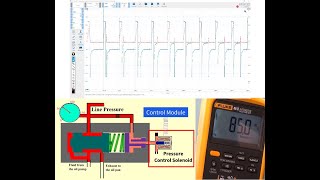
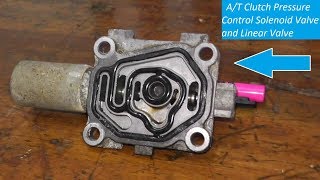
- Failed Pressure Control Solenoid 'D' (Common) — The solenoid's internal electromagnetic coil winding breaks over time due to heat and thermal cycling, resulting in infinite resistance and a dead solenoid. 🎬 Watch: How to test and diagnose pressure control solenoids
- Low, Dirty, or Incorrect Transmission Fluid (Common) — Low fluid starves the pump, while old, metal-contaminated fluid clogs the filter and valve body passages. This restricts hydraulic pressure, overheating the solenoids and accelerating electrical failure.
- Faulty Transmission Valve Body (Less Common) — The valve body houses the solenoids. Internal cracks, warped mating surfaces, or severely clogged hydraulic channels prevent pressure regulation, sometimes damaging the integrated solenoid circuits.
- Faulty Powertrain/Transmission Control Module (PCM/TCM) (Rare) — The internal driver circuit inside the TCM responsible for grounding solenoid 'D' burns out. This creates an open circuit at the computer level.
Symptoms

- Transmission in 'Limp Mode' — The vehicle locks into a single gear (usually 2nd or 3rd) to prevent internal damage, severely limiting top speed and acceleration.
- Violently Harsh Shifting — Without pressure regulation, the transmission slams into gear at maximum line pressure. Shifts feel like the vehicle is being rear-ended.
- Check Engine Light is On — The PCM illuminates the Malfunction Indicator Lamp (MIL) immediately upon detecting the open circuit.
- Transmission Slipping — Engine RPMs spike without the vehicle accelerating, indicating the clutch packs lack the hydraulic pressure to fully engage.
- Engine Stalls When Stopping — The transmission fails to disengage the torque converter clutch when coming to a halt, choking the engine.
Diagnostic Flowchart
Tap your situation to follow the diagnostic path that matches what you're seeing on this code.
Common Fixes & Costs

- Reseat Internal Transmission Connector (GM TSB N182193520) — Parts: $80-$150 (fluid, filter, gasket), Labor: $250-$450, ~2.5 hr book time (Professional)
- Replace Pressure Control Solenoid 'D' — Parts: $40-$150, Labor: $300-$600, ~3.0 hr book time (Professional)
- Repair or Replace Damaged Wiring Harness — Parts: $20-$100, Labor: $150-$300, ~2.0 hr book time (Intermediate)
- Transmission Fluid and Filter Change — Parts: $80-$150, Labor: $100-$200, ~1.0 hr book time (DIY)
- Replace Valve Body or TCM Assembly — Parts: $500-$1200, Labor: $300-$500 (includes programming), ~4.0 hr book time (Professional)
DIY vs Professional
- Transmission Fluid and Filter Change — Beginner:
Tools: Socket set, drain pan, fluid pump, torque wrench, new fluid/filter. - Repair External Wiring Harness — Beginner:
Tools: Multimeter, wire strippers, soldering iron, heat shrink tubing. - Replace Pressure Control Solenoid / Valve Body — Beginner:
Tools: Extensive socket set, inch-pound torque wrench, drain pan, bi-directional scan tool.
Used vs. New Parts: Buying Guide
When a used part is worth it: Never buy a used individual solenoid. Used parts only make sense if you are replacing an entire valve body assembly on a strict budget, and the donor vehicle has verified low mileage.
Donor-vehicle mileage cap: roughly under 50000 miles for the part to have meaningful remaining life.
Donor quality checklist:
- Exact part number match is mandatory; transmission variations are highly specific.
- Fluid drained from the donor unit must be red and free of burnt odors or metal flakes.
- Purchase from a recycler offering at least a 90-day warranty.
Decision logic:
- If The fix is a single solenoid costing under $150 → Buy new OEM. The labor to access it is too high to risk a used part.
- If The fix requires a $1,200 integrated mechatronics unit → Buy a professionally remanufactured unit with a warranty over a junkyard pull.
- If The vehicle is worth less than $4,000 → A used valve body is an acceptable risk to keep the car on the road cheaply.
Warranty tradeoff: Used parts carry 30-90 day warranties covering the part only. If it fails, you pay the $400 labor bill again. New OEM parts offer 1-2 year warranties.
Worst-case if a used part fails: $800 (cost of the used part plus paying for labor twice).
What Happens If You Wait — Timeline
- 0-1 week: Check Engine Light illuminates. The transmission enters limp mode, locking into 3rd gear. Shifts into Drive or Reverse are violently harsh. (MPG impact: 15%% · Added cost: $0)
- 1-4 weeks: Harsh engagements slam the internal components. The transmission begins to slip, and fluid temperatures spike due to uncontrolled line pressure. (MPG impact: 25%% · Added cost: $800 - $1,500 (burnt clutch packs))
- 1-3 months: Catastrophic failure. Overheating warps steel plates. Abrasive clutch material circulates, destroying the pump and valve body. The vehicle loses all forward gears. (MPG impact: N/A (undrivable)% · Added cost: $3,500 - $6,000+ (complete rebuild))
Cost of Not Fixing It
- Immediate: Vehicle locks into limp mode. Shifts are violently harsh, top speed is capped under 40 mph, and fuel economy drops by 15%. (Added cost: $0)
- 1-4 weeks: Harsh engagements slam the internal clutch packs and bands. The transmission slips and overheats rapidly due to uncontrolled line pressure. (Added cost: $800 - $1,500 (burnt clutch packs))
- 1-3 months: Catastrophic transmission failure. Overheating warps steel plates and circulates abrasive clutch material through the pump and valve body, destroying the unit. (Added cost: $3,500 - $6,000+ (complete rebuild or replacement))
Diagnosis Steps

- Check for Technical Service Bulletins (TSBs)
Search for TSBs related to your specific VIN. For 2018-2019 GM 8-speed vehicles, TSB N182193520 dictates reseating an internal connector rather than replacing parts.
Tools: Internet access, VIN (Beginner) - Scan All Powertrain Codes
Read all stored and pending codes. If P2718 appears alongside U0101 (Lost Communication), prioritize the communication error. If it appears with P2720, it confirms a hard wiring fault.
Tools: OBD-II Scanner (Beginner) - Check Transmission Fluid Level and Condition
Verify the fluid is at the correct level and is pink/red. Black, burnt-smelling fluid or fluid thick with metal shavings indicates severe internal mechanical failure requiring a rebuild, not just a solenoid.
Tools: Rag, gloves, dipstick (if equipped) (Beginner) - Inspect External Wiring and Connectors
Examine the wiring harness from the TCM to the transmission. Look for melted insulation near the exhaust, rodent damage, or green corrosion on the main transmission connector pins.
Tools: Flashlight, inspection mirror (Intermediate) - [PRO TIP] Test Solenoid Resistance at the Main Connector
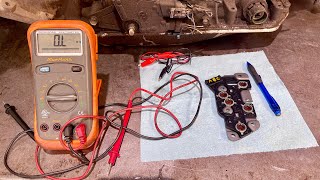
Disconnect the main transmission harness. Identify the pins for Solenoid 'D' using a wiring diagram. Measure resistance. A reading of 'OL' (infinite resistance) confirms the open circuit is inside the transmission. A reading outside OEM specs (e.g., 4.5-5.5 Ohms for GM 8L90) means the solenoid is dead.
Tools: Digital Multimeter, vehicle-specific wiring diagram (Advanced) - [PRO TIP] Perform a Commanded Bi-Directional Test
Use a pro-level scan tool to command Solenoid 'D' ON and OFF. Monitor the live data for voltage/current changes, and listen for an audible 'click' from the transmission pan. No click and no current change confirms a circuit failure.
Tools: Bi-directional scan tool (Advanced) - Inspect Internal Components (Pan Drop)
If external tests point inward, drain the fluid and remove the oil pan. Inspect the internal wiring harness. For GM vehicles, firmly seat the main valve body connector until it clicks.
Tools: Socket set, drain pan, new gasket, new fluid, torque wrench (Advanced) - Test the TCM Output
If the solenoid and all wiring test perfectly, back-probe the TCM output pin. Command the solenoid via scan tool. If the TCM outputs no ground signal despite having good power and ground itself, the TCM is fried.
Tools: Multimeter, back-probe kit, scan tool (Professional) - [PROFESSIONAL] Conduct a Line Pressure Test
Attach a 400 PSI gauge to the transmission test port. Measure pressure at idle in Park, Reverse, and Drive. Compare to OEM specs (e.g., 55-189 PSI for GM 4L60-E). Low pressure indicates a failing pump; high pressure indicates a stuck regulator.
Tools: Transmission pressure gauge kit, service manual (Professional)
When This Code Triggers (Freeze-Frame Conditions)
- Transmission Fluid Temperature: 150-220°F (65-104°C) (The TCM actively monitors solenoid circuits once the fluid reaches normal operating temperature.)
- Vehicle Speed: 35-55 mph (56-88 km/h) (Occurs during cruising speeds when the TCM actively commands gear changes and pressure adjustments.)
- Engine RPM: 1500-2500 RPM (Sets during steady-state driving or light acceleration.)
Related Codes
- P2719 — Pressure Control Solenoid 'D' Range/Performance. The circuit is electrically intact, but the solenoid is mechanically stuck or fluid passages are blocked.
- P2720 — Pressure Control Solenoid 'D' Control Circuit Low. Indicates a short to ground. On 2018-2019 GM vehicles, this is triggered by the exact same loose connector as P2718.
- P2721 — Pressure Control Solenoid 'D' Control Circuit High. Indicates a short to a power source, requiring you to trace the wire for voltage where there should be none.
- P2714 — Pressure Control Solenoid 'D' Stuck Off. The solenoid is mechanically jammed closed, preventing fluid flow.
- U0101 — Lost Communication with TCM. If present with P2718, the entire transmission computer is offline due to a blown fuse, severed main harness, or dead module.
Climate & Environmental Factors
- High Ambient Heat: Sustained high temperatures break down transmission fluid faster and degrade the delicate copper windings inside the solenoid, accelerating electrical failure.
- Road Salt and Moisture: Winter road salt penetrates external transmission connectors, corroding the metal pins until the electrical connection breaks entirely.
How to Talk to a Mechanic About This Code
Say this: "I have a P2718 code on my [Make, Model, Year] and it's in limp mode. Please check for relevant TSBs, inspect the external wiring, and test the solenoid circuit resistance at the connector before recommending internal parts."
This proves you understand the code is an electrical circuit fault. It forces the shop to perform proper multimeter diagnostics rather than blindly quoting a $1,500 valve body replacement.
Avoid saying:
- 'My transmission is slipping.' (Invites a quote for a complete rebuild)
- 'Just replace the solenoid.' (Authorizes an expensive repair without confirming it's the root cause)
- 'Do whatever it takes to fix it.' (Writes a blank check)
Questions to ask before authorizing the repair:
- Did you check for TSBs? (Crucial for 2018-2019 GM owners)
- What was the exact resistance measurement for the solenoid circuit?
- Is the open circuit located in the external wiring or inside the transmission pan?
- Will this repair require a scan tool relearn procedure afterward?
Where to Take It: Dealer vs Independent vs Chain
- Dealer:
Recommended only if under warranty or if your vehicle requires complex TCM programming after the repair.
Best for: Vehicles under warranty., 2018-2019 GM vehicles affected by TSB N182193520., Modern German vehicles requiring proprietary TCM programming.
Downsides: Highest labor rates ($150-$250/hr)., Dealers often replace entire assemblies (valve bodies) rather than individual solenoids. (Typical cost: +40% vs. baseline) - Independent Shop:
The best choice for out-of-warranty vehicles, provided you select an ASE-certified shop specializing in transmissions.
Best for: Out-of-warranty vehicles., Targeted repairs like replacing a single solenoid or splicing a wire.
Downsides: Must verify they have a high-end bi-directional scanner to perform transmission relearns. (Typical cost: +0% vs. baseline) - Chain Shop:
AVOID. P2718 requires multimeter diagnostics and internal transmission work that general lube chains cannot handle.
Best for: Fluid changes and tire rotations.
Downsides: Lacks the specialized diagnostic tools and training required for internal transmission electrical faults. (Typical cost: -10% vs. baseline)
When to Walk Away From the Repair
If the repair estimate exceeds 50% of the vehicle's private-party value, sell or trade the vehicle.
- Car worth $6000, fix is $500: Fix it. A $500 solenoid or wiring repair is standard maintenance to keep the car running.
- Car worth $5000, fix is $2500: Borderline. If the car needs tires or brakes soon, walk away. If it's otherwise pristine, fix it.
- Car worth $3000, fix is $4000: Walk away. The transmission rebuild costs more than the car is worth.
What Scan Tool You Need for This Code
Minimum: A scanner capable of reading manufacturer-specific transmission codes and displaying live Transmission Fluid Temperature.
A $20 code reader cannot view live fluid temperatures or command the solenoid ON/OFF, leaving you guessing whether the fault is mechanical or electrical.
Budget: BlueDriver Pro (~$100) — Reads transmission codes, displays live fluid temperature, and links to a database of verified TSBs.
Mid-range: Innova 5610 (~$350) — Offers live data plus basic bi-directional controls to command certain transmission actuators, helping confirm circuit integrity.
Professional: Autel MaxiCOM MK808BT (~$500) — Full bi-directional control. Allows you to command Solenoid 'D' ON/OFF to listen for the click, and performs the mandatory transmission relearn procedure after replacing parts.
Rent vs buy: Buy the BlueDriver. Free auto parts store scans will not give you the live transmission data required to diagnose P2718 properly.
How to Clear the Code After You Fix It
- Clear the DTCs using an OBD-II scan tool. Disconnecting the battery will not clear adaptive memory on modern TCMs.
- Perform a transmission 'Fast Learn' or solenoid characterization procedure using a bi-directional scan tool if required by the manufacturer.
- Drive the vehicle through a complete drive cycle to verify smooth shifting and set readiness monitors.
Drive cycle (~30 minutes): Start cold, idle for 3 minutes. Drive in stop-and-go city traffic for 15 minutes, ensuring the transmission shifts through all lower gears. Transition to steady highway driving at 55-60 mph for 10 minutes.
Readiness monitors affected: Comprehensive Component Monitor, Transmission
Before emissions retest: drive at least 50 miles to fully set monitors.
Watch out for:
- Skipping the scan tool relearn procedure after replacing a solenoid guarantees continued harsh shifting.
- Clearing the code without fixing the open circuit causes the Check Engine Light to return the moment you shift into Drive.
Will This Fail Emissions / State Inspection?
Yes — this code typically fails an OBD-II emissions inspection.
- California: An active P2718 triggers an automatic smog check failure. You must repair the fault and complete a drive cycle to set the Transmission monitor to 'Ready'.
- New York: Vehicles automatically fail the emissions inspection if the MIL is commanded on. Clearing the code right before the test results in a 'Not Ready' rejection.
- Texas: In emissions-testing counties, P2718 causes an immediate OBDII failure.
Most Commonly Affected Vehicles
- Chevrolet Colorado / Silverado 1500 (2018-2019) — Extremely susceptible to the unseated internal connector defect (TSB N182193520) on 8L45 and 8L90 transmissions.
- GMC Canyon / Sierra 1500 (2018-2019) — Shares the 8-speed transmission defect with Chevrolet, requiring a pan drop to reseat the connector.
- Chevrolet Camaro / Corvette (2018-2019) — Included in TSB N182193520 for the loose internal connector on 8-speed automatics.
- Ford Focus / Fusion / F-150 (2009-2019) — Common on 6F35 and Powershift transmissions. Diagnosis usually points to a failed solenoid body assembly requiring complete replacement.
- Toyota Sienna / Camry (2007-2018) — Affects U660E/U760E transmissions. Usually caused by high-mileage fluid degradation or a dead Denso solenoid.
- BMW 3-Series / X5 (2006-2018) — On ZF 6HP/8HP transmissions, this code often precedes mechatronics unit failure. The plastic mechatronics sealing sleeve frequently leaks and damages the connector.
- Honda Accord / Odyssey (2003-2015) — Triggered by internal solenoid failure or severely degraded fluid clogging the screens.
Manufacturer-Specific Notes
- General Motors (Chevrolet, GMC, Cadillac): TSB N182193520 is the definitive quirk. Thousands of 2018-2019 8-speed vehicles throw P2718 because a factory connector wiggles loose. The fix is pushing the connector until it clicks, not replacing a $200 solenoid.
- Ford: On the 6F35 transmission, Ford integrates the solenoids into a single 'solenoid body'. You cannot replace just Solenoid 'D'; you must replace the entire $400+ assembly.
- BMW / ZF Transmissions: P2718 is frequently caused by the plastic mechatronics adapter sleeve leaking fluid directly onto the electrical connector pins, shorting out the communication lines.
Real Owner Stories
2018 Chevy Colorado at 40K miles - The Classic GM TSB Case
The truck suddenly went into limp mode with a Check Engine Light. Shifting became violently harsh and top speed was capped.
What they tried:
- Owner took the vehicle to the dealership.
Outcome: The dealer pulled P2718 and referenced TSB N182193520. They dropped the pan, clicked the loose internal connector back into place, and refilled the fluid. The issue was resolved completely under warranty with zero parts replaced.
Lesson: If you own a 2018-2019 GM 8-speed, insist the shop checks for this TSB before they try to sell you a new valve body.
2015 C7 Corvette at 75K miles - Intermittent Electrical Gremlins
The car entered limp mode on startup with P2718, accompanied by random climate control and temperature sensor glitches.
What they tried:
- Restarting the car temporarily cleared the code.
- Dealership diagnosed a faulty solenoid and quoted $800.
Outcome: The owner load-tested the battery, finding it severely degraded by the hot climate. Replacing the $200 battery stabilized the system voltage, and the P2718 code never returned.
Lesson: If P2718 appears alongside unrelated electrical faults, load-test your battery before authorizing transmission work. Low voltage wreaks havoc on control modules.
2008 Chevy Silverado - Pothole Impact Misdiagnosis
After hitting a massive pothole, the truck threw P2718, U0101, and lost the speedometer.
What they tried:
- Replaced the vehicle speed sensor based on parts store advice (failed).
- Considered buying a $300 TCM.
Outcome: A visual inspection revealed the pothole impact had partially ripped the main transmission wiring harness out of its bracket, severing the ground wire. Splicing the wire fixed all codes for $10.
Lesson: When multiple codes appear immediately after a physical impact, prioritize inspecting the external wiring harness for physical damage before buying sensors.
How to Prevent This Code From Triggering
- Change transmission fluid and filter every 40,000 to 60,000 miles. (Every 40,000 to 60,000 miles.) — Clean fluid dissipates heat efficiently. Old fluid breaks down, overheating the solenoid's delicate internal coil windings until they snap and create an open circuit.
- Install an auxiliary transmission fluid cooler. (Once, if towing frequently.) — Excessive heat is the primary killer of transmission electronics. A cooler keeps fluid temperatures stable, protecting the solenoids from thermal degradation.
- Inspect the external transmission wiring harness. (Annually during oil changes.) — Securing a loose harness prevents it from rubbing against the hot exhaust or driveshaft, avoiding severed wires.
Frequently Asked Questions
What is the most common mistake when fixing P2718?
The biggest mistake is immediately replacing the solenoid without testing resistance at the external connector. On 2018-2019 GM vehicles, this wastes hundreds of dollars because the true cause is a loose factory connector (TSB N182193520). Always rule out external wiring first.
Can I just clear the P2718 code and keep driving?
No. Because P2718 is a hard electrical fault (an open circuit), the code returns the moment you shift into Drive. Ignoring it forces the transmission to slip and overheat, destroying the clutch packs.
Could a bad ground cause code P2718?
Yes. An 'open circuit' means a break anywhere in the loop, including the ground path. A corroded or broken ground strap for the transmission or TCM interrupts the circuit and triggers the code.
Is the pressure control solenoid inside or outside the transmission?
In modern automatic transmissions, the solenoids are mounted internally on the valve body. Accessing them requires draining the fluid and removing the transmission oil pan.
How much does it cost to fix code P2718?
Repairing a broken external wire costs $150-$300. Reseating the GM connector or replacing a single solenoid costs $350-$600. Replacing a complete Ford or BMW mechatronics unit exceeds $1,200.
Will a transmission fluid flush fix a P2718 code?
No. A fluid flush cannot repair a severed wire, a loose connector, or a burnt-out electrical coil. Flushes only help with mechanical sticking codes (like P2719), not electrical open circuits.
Key Takeaways
- P2718 indicates a complete electrical break in the transmission's pressure control solenoid 'D' circuit, preventing the computer from regulating hydraulic pressure.
- The transmission immediately enters 'limp mode,' locking into 2nd or 3rd gear and causing violently harsh shifts to prevent internal damage.
- On 2018-2019 GM 8-speed vehicles, do not replace the solenoid; TSB N182193520 dictates dropping the pan to reseat a loose factory connector.
- Always test solenoid resistance at the main external transmission connector before authorizing a $1,000+ internal teardown.
- Driving in limp mode for more than a few miles overheats the transmission, turning a $300 wiring fix into a $4,000 complete rebuild.
Helpful Videos

The information in this article is provided for general reference and educational purposes only. Vehicle specifications, procedures, and part compatibility can vary by production date, trim level, and region. Always consult your vehicle's factory service manual and verify part numbers before purchasing or performing repairs. Safety-critical components such as airbags, seat belts, and braking systems should be installed by a qualified professional.
- 🎬 Helpful Videos
- What Does P2718 Mean?
- Can I Drive With P2718?
- Common Causes
- Symptoms
- Diagnostic Flowchart
- Common Fixes & Costs
- DIY vs Professional
- Used vs. New Parts: Buying Guide
- What Happens If You Wait — Timeline
- Cost of Not Fixing It
- Diagnosis Steps
- When This Code Triggers (Freeze-Frame Conditions)
- Related Codes
- Climate & Environmental Factors
- How to Talk to a Mechanic About This Code
- Where to Take It: Dealer vs Independent vs Chain
- When to Walk Away From the Repair
- What Scan Tool You Need for This Code
- How to Clear the Code After You Fix It
- Will This Fail Emissions / State Inspection?
- Most Commonly Affected Vehicles
- Manufacturer-Specific Notes
- Real Owner Stories
- 2018 Chevy Colorado at 40K miles - The Classic GM TSB Case
- 2015 C7 Corvette at 75K miles - Intermittent Electrical Gremlins
- 2008 Chevy Silverado - Pothole Impact Misdiagnosis
- How to Prevent This Code From Triggering
- Frequently Asked Questions
- What is the most common mistake when fixing P2718?
- Can I just clear the P2718 code and keep driving?
- Could a bad ground cause code P2718?
- Is the pressure control solenoid inside or outside the transmission?
- How much does it cost to fix code P2718?
- Will a transmission fluid flush fix a P2718 code?
- Key Takeaways
- 🎟️ Get 5% Off