

OBD-II Code P2708: Shift Solenoid 'F' Stuck On
What P2708 means, why it triggers, and how to fix it
- Code P2708 indicates Shift Solenoid 'F' is stuck on, triggering harsh shifts, gear lockouts, and an illuminated Check Engine or Wrench light.
- On 2017-2023 Ford and Lincoln vehicles with the 10R80 transmission, P2708 almost always points to a catastrophic CDF clutch drum failure rather than a simple bad solenoid.
- Stop driving immediately; continuing to drive with a P2708 code circulates metal debris through the transmission, turning a $2,000 valve body repair into a $9,000 full replacement.
- Repair costs range from $300 for a fluid service to over $8,000 for a complete transmission overhaul, depending on internal damage.
- Check Ford TSB 24-2254 before authorizing any repairs, as it outlines a specific hydraulic leak test to diagnose the CDF drum without a full teardown.
What Does P2708 Mean?
P2708 means the Transmission Control Module (TCM) detects that 'Shift Solenoid F' is stuck in the 'on' position. This solenoid is a computer-controlled valve that directs hydraulic fluid to change gears. When the TCM commands the solenoid off but it remains active, it disrupts hydraulic pressure, causing severe drivability and shifting issues.
Technical definition: The official SAE/OBD-II definition for code P2708 is "Shift Solenoid 'F' Stuck On". This indicates the Transmission Control Module (TCM) commanded the 'F' shift solenoid to turn off, but detected through its monitoring circuit that the solenoid or its hydraulic circuit remained energized or active.
Can I Drive With P2708?
No — Do Not Drive. You can drive a short distance, but doing so risks catastrophic transmission failure. Your transmission will shift harshly, get stuck in one gear, or enter 'limp mode' with reduced power. Continued driving circulates clutch material through the fluid, turning a targeted repair into a full transmission replacement costing upwards of $9,000.
Common Causes
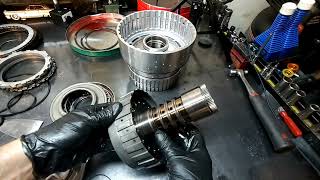
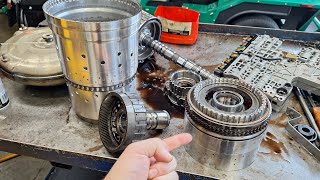
- Internal Mechanical Failure (CDF Clutch Drum) (Very Common) — On Ford 10R80 transmissions, a failed CDF clutch drum is the primary cause. A bushing inside the drum slides out of place and uncovers a hydraulic passage, causing a massive pressure leak that the computer misinterprets as a stuck solenoid. 🎬 Watch: Teardown showing the CDF drum bushing failure.
- Faulty Transmission Valve Body (Common) — The shift solenoid lives inside the valve body, the transmission's hydraulic control center. Blocked passages, scored cylinder walls, or sticking valves cause pressure drops that trigger P2708.
- Low, Dirty, or Incorrect Transmission Fluid (Common) — Low fluid starves the pump, while dirty fluid binds solenoids and valves. The 10R80 transmission is hyper-sensitive to fluid condition and requires exact levels of Mercon ULV fluid; 🎬 Watch: A Ford tech explains common 10-speed transmission issues. incorrect fluid immediately triggers solenoid codes.
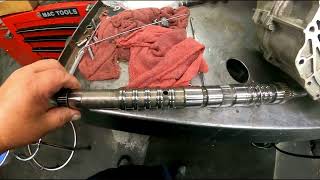
- Missing Input Shaft End Plug (Less Common) — On some 10R80 transmissions, a small press-fit plug inside the input shaft that seals the 'F' clutch hydraulic circuit blows out. This creates a massive 🎬 See a detailed breakdown of P2707 and P2708 codes. hydraulic leak triggering P2707 or P2708.
- Failed Shift Solenoid 'F' (Less Common) — The solenoid itself fails electrically (coil burnout) or mechanically (piston jams). Debris in the fluid physically wedges the solenoid in the 'on' position.
- Wiring or Connector Issues (Rare) — Corroded, loose, or damaged wiring harnesses cause a short circuit to power, keeping the solenoid energized when the computer commands it off.
- Faulty Transmission Control Module (TCM) or Software (Rare) — The TCM fails or runs corrupted software, sending incorrect signals to the solenoid. Ford has issued multiple TSBs requiring software updates to address shifting logic.
Symptoms
- Harsh, Delayed, or Erratic Shifting — You feel a violent 'clunk' or a long pause when changing gears, especially between 3rd, 4th, and 5th gears.
- Transmission Stuck in Gear — The vehicle locks into a single gear and refuses to shift, or feels like it drops into neutral between shifts.
- Failure to Engage Reverse — The vehicle refuses to shift into Reverse, often requiring an engine restart to temporarily regain the gear.
- Vehicle Enters 'Limp Mode' — The computer limits engine power and locks the transmission in 2nd or 3rd gear to prevent further internal destruction.
- Transmission Slipping or Shuddering — Engine RPMs spike without the vehicle accelerating, accompanied by a vibration under load.
- Check Engine Light or Wrench Light is On (also visible on scanner) — The Malfunction Indicator Lamp or a transmission-specific wrench symbol illuminates on the dashboard.
Diagnostic Flowchart
Tap your situation to follow the diagnostic path that matches what you're seeing on this code.
Common Fixes & Costs
- Transmission Overhaul (CDF Drum or Input Shaft) — Parts: $500-$1500, Labor: $4000-$5000, ~22.5 hr book time (Professional)
- Replace Transmission Valve Body — Parts: $800-$1200, Labor: $300-$600, ~3.8 hr book time (Professional)
- Replace Shift Solenoid 'F' — Parts: $50-$150, Labor: $200-$450, ~3.8 hr book time (Intermediate)
- Transmission Fluid and Filter Change — Parts: $150-$300, Labor: $150-$250, ~3.1 hr book time (Intermediate)
- Replace or Reprogram Transmission Control Module (TCM) — Parts: $600-$900, Labor: $150-$300, ~1.5 hr book time (Professional)
DIY vs Professional
- Transmission Fluid and Filter Change — Beginner:
Tools: Vehicle lift, infrared thermometer, fluid pump, 17mm box wrench. - Replace Shift Solenoid 'F' / Valve Body — Beginner:
Tools: Full socket set, torque wrench, fluid pump, advanced scan tool (FORScan), service manual. - Transmission Overhaul (CDF Drum Replacement) — Beginner:
Tools: Professional transmission shop equipment, transmission bench, press, specialty disassembly tools.
Used vs. New Parts: Buying Guide
When a used part is worth it: A used transmission from a low-mileage wrecked vehicle is a budget option, but highly risky for the 10R80 because even low-mileage units contain the inherent CDF drum flaw.
Donor-vehicle mileage cap: roughly under 50000 miles for the part to have meaningful remaining life.
Donor quality checklist:
- Verify the donor vehicle was scrapped for a collision, not transmission failure.
- Match the part and solenoid body strategy numbers exactly.
- Favor remanufactured parts over used ones, as remanufacturers install the updated CDF drum (JL3Z-7H351-B) correcting the design flaw.
Decision logic:
- If The root cause is the known CDF drum failure → Purchase a new OEM or quality remanufactured part containing the updated drum design. A used part will likely fail again.
- If Vehicle is high mileage (>100K miles) and budget is the primary concern → A used valve body or transmission is a viable but high-risk option.
- If You plan to keep the vehicle long-term → Invest in a new or remanufactured component for a longer lifespan and better warranty.
Warranty tradeoff: Used parts offer a 30-90 day warranty on the part only. Remanufactured components come with a 1-3 year nationwide warranty that includes labor coverage.
Worst-case if a used part fails: $2500-$4000 if a used transmission fails, requiring you to pay for a replacement part and labor a second time.
What Happens If You Wait — Timeline
- 0-1 month: Code P2708 sets. Driver notices subtle shift hesitation or a slightly harsher shift when the transmission is cold. (MPG impact: 0-5%% · Added cost: $0-$50 in wasted fuel.)
- 1-3 months: Harsh shifts and engagement delays become frequent, particularly on 3-4-5 shifts. Clutch friction material contaminates the fluid. (MPG impact: 5-10%% · Added cost: $50-$200 in accelerated fluid degradation.)
- 3-6 months: Transmission slips and engine RPMs flare between shifts. Contaminated fluid scores the valve body. Vehicle enters 'limp mode' unpredictably. (MPG impact: 10-15%% · Added cost: $1100-$2000 for a ruined valve body.)
- 6+ months: Catastrophic internal failure. Circulating debris destroys clutch packs, the torque converter, and the oil pump. The vehicle loses all gears. (MPG impact: 15-25%+% · Added cost: $6,000-$9,500 for a complete transmission replacement.)
Cost of Not Fixing It
- 0-1 month: Erratic shifting becomes frequent. Fuel economy decreases by 5-10% due to inefficient gear changes and slipping. (Added cost: $50-$150 in wasted fuel.)
- 1-6 months: Harsh shifting causes excessive wear on clutch packs, generating debris that destroys the valve body and other solenoids. (Added cost: $1100-$2000 for a replacement valve body.)
- 6+ months: Catastrophic internal failure. Metal debris destroys the torque converter, oil pump, and planetary gearsets. The transmission must be completely replaced. (Added cost: $6,000-$9,500 for a full transmission replacement.)
Diagnosis Steps
- Check Technical Service Bulletins (TSBs)
Check for manufacturer TSBs. For Ford models, TSBs 24-2254, 23-2250, and 23-2123 directly address P2708, pointing to a required software update, valve body overhaul, or CDF clutch drum failure.
Tools: Online Access or Subscription Service (Beginner) - Scan for All Trouble Codes
Use an advanced OBD-II scanner to read all PCM and TCM codes. Other solenoid (P07xx) or gear ratio (P07xx) codes alongside P2708 confirm a widespread hydraulic issue rather than an isolated solenoid fault.
Tools: Advanced OBD-II Scanner (Beginner) - Check Transmission Fluid Level and Condition
Check the fluid level. On the 10R80, the vehicle must be level and fluid must be exactly 206°F to 215°F (96°C to 101°C). Fluid must be clean Mercon ULV. Metal debris indicates internal failure.
Tools: Infrared Thermometer, Owner's Manual, Lift (Intermediate) - Perform Hydraulic Leak Test (Ford 10R80)
If TSB 24-2254 applies, perform the hydraulic circuit leak test on the CDF clutch cylinder. This requires dealer-level tools to pressurize valve body ports and measure leak-down rates to confirm CDF drum failure without a teardown.
Tools: Dealer-Level Diagnostic Tools, Air Pressure Regulator (Professional) - Check Transmission Line Pressure
Connect a pressure gauge to the line pressure port (M10x1.00 on a 10R80). Stock calibrations show 110-120 PSI at idle in gear. Low pressure confirms a major internal leak or failing pump.
Tools: Transmission Pressure Gauge Kit, Service Manual (Advanced) - Inspect External Wiring and Connectors
Visually inspect the transmission wiring harness. Look for frayed wires, corrosion on connector pins, or loose connections that cause electrical shorts.
Tools: Flashlight, Mirror (Intermediate) - Perform Solenoid Resistance Test
Measure the resistance of the Shift Solenoid 'F' circuit at the TCM connector. For a Ford 10R80, expect 5.0 to 5.4 Ohms at 68°F (20°C). Readings outside this range indicate a failed coil or wiring.
Tools: Multimeter, Wiring Diagram (Advanced) - Command Solenoid with Scan Tool
Use a bidirectional scan tool to command Shift Solenoid 'F' on and off. If the solenoid is commanded OFF but its status PID reads ON or current remains high, the fault is confirmed.
Tools: Advanced OBD-II Scanner (Advanced) - Inspect Internal Components
Remove the transmission pan. Inspect the valve body and check for excessive metal debris. On affected Fords, inspect the input shaft for the missing 'F' clutch plug.
Tools: Socket Set, Drain Pan, Gasket Scraper, Torque Wrench (Advanced)
When This Code Triggers (Freeze-Frame Conditions)
- Engine/Transmission Temp: 195-215°F (90-102°C) (Fully warmed up to normal operating temperature.)
- RPM: 1300-1600 (During light throttle acceleration as the transmission shifts through gears.)
- Engine Load: 15-40% (Light to moderate acceleration, not under heavy load or wide-open throttle.)
- Vehicle Speed: 30-55 mph (48-88 km/h) (Steady cruising or during the sequence of upshifts into higher gears.)
Related Codes
- P2707 — P2707 means 'Shift Solenoid F Stuck Off'. P2707 and P2708 are direct counterparts caused by the exact same root problem (CDF drum leak or missing input shaft plug). The TCM's timing determines which code sets.
- P0700 — A general transmission fault code indicating the TCM has stored a specific code (like P2708) and requested the Check Engine Light. It provides no diagnostic information on its own.
- P07xx (e.g., P0751, P0756, P0761) — Codes for other shift solenoids. When P2708 appears with these, it confirms a widespread hydraulic problem (CDF drum failure) rather than a single bad solenoid.
- P0729-P0736 — Incorrect gear ratio codes. They appear when a stuck solenoid or leaking clutch circuit prevents gear engagement, causing a mismatch between engine and output shaft speeds.
Climate & Environmental Factors
- Cold Weather: Cold temperatures severely worsen symptoms of the CDF drum failure. Cold, thick Mercon ULV fluid (below 150°F) struggles to pass the hydraulic restriction, causing a long delay followed by a violent 'bang' as pressure finally builds.
- High Altitude: High altitude slightly alters engine load calculations and shift points, but does not directly trigger code P2708.
- High Humidity: High humidity accelerates corrosion on external wiring connectors, potentially leading to electrical shorts.
How to Talk to a Mechanic About This Code
Say this: "I have a P2708 code on my [Vehicle Make/Model] with the 10-speed transmission. I know this is often caused by an internal hydraulic issue like the CDF drum, not just the solenoid. I'd like to schedule a diagnostic that includes checking for TSB 24-2254 and verifying line pressure before discussing parts replacement."
This signals you are an informed consumer. It directs the technician to perform a thorough diagnosis for a known issue, preventing them from replacing the inexpensive solenoid, which fails to fix the problem and leads to a second repair.
Avoid saying:
- 'My transmission is acting weird.'
- 'My check engine light is on, can you just fix it?'
- 'I think I need a new shift solenoid.'
Questions to ask before authorizing the repair:
- Did you check for Ford's Technical Service Bulletins for this code? Which ones apply?
- What was the line pressure reading at idle? Did it confirm a hydraulic leak?
- How did you rule out an internal mechanical failure like the CDF drum before recommending this repair?
- If this repair doesn't fix the code, what is the next step and will I be charged?
- What is the warranty on this specific repair, including parts and labor?
Where to Take It: Dealer vs Independent vs Chain
- Dealer:
Best for: Vehicles under powertrain warranty., Repairs involving manufacturer-specific TSBs (10R80 CDF drum issue)., Access to specialized diagnostic tools for hydraulic circuit leak tests.
Downsides: Highest labor rates., Defaults to full transmission replacement instead of an overhaul. (Typical cost: +50% vs. baseline) - Independent Shop:
A highly-rated, independent *transmission specialty shop* is an excellent choice. They rebuild transmissions daily and are more skilled at major internal repairs than a general mechanic.
Best for: Out-of-warranty vehicles where cost is a major factor., Finding a technician with deep experience overhauling specific transmissions.
Downsides: Quality varies dramatically; vetting is crucial., May lack access to the latest TSBs or specialized dealer tools. (Typical cost: +0% vs. baseline) - Chain Shop:
AVOID. This code's complexity and high potential for a major internal failure make chain shops unsuitable. The risk of an incorrect diagnosis is extremely high.
Best for: Reading the initial code.
Downsides: Technicians lack expertise for complex internal transmission diagnosis., High likelihood of misdiagnosis, leading to unnecessary part replacement. (Typical cost: -10% vs. baseline)
When to Walk Away From the Repair
If the estimated repair cost exceeds 50% of the car's private-party value, sell the vehicle as-is or trade it in.
- Car worth $25000, fix is $8000: Borderline. The repair is 32% of the value. If the truck is in excellent condition, fixing it is reasonable. If it has other issues, consider selling.
- Car worth $15000, fix is $8000: Walk away. The repair cost is 53% of the vehicle's value. It is not financially sound to proceed.
- Car worth $40000, fix is $8000: Fix it. The repair is 20% of the vehicle's value and well below the threshold.
What Scan Tool You Need for This Code
Minimum: A scanner that reads manufacturer-specific transmission codes and views live transmission data, such as fluid temperature and solenoid status.
A basic $20 code reader only shows the P2708 code. It cannot distinguish between a wiring fault, a bad solenoid, or a catastrophic internal failure. You need deeper diagnostic access to avoid wasting money.
Budget: FORScan with OBDLink EX Adapter (~$60) — The gold standard for Ford DIY diagnostics. Reads Ford-specific DTCs, monitors solenoid PIDs, and performs module-specific tests. Essential for diagnosing a 10R80 transmission.
Mid-range: BlueDriver Pro (~$100) — A Bluetooth scanner that reads enhanced codes and displays live transmission data, but lacks the bidirectional control of FORScan.
Professional: Autel MaxiCOM MK808S (~$450-600) — Offers bidirectional control to command individual solenoids on and off. Performs special functions like resetting transmission adaptive tables required after a major repair.
Rent vs buy: Rent from an auto parts store for a first look. For P2708, the diagnostic complexity justifies buying a capable tool like FORScan if you plan to troubleshoot yourself.
How to Clear the Code After You Fix It
- Use an advanced OBD-II scan tool to clear DTCs and reset the Transmission Adaptive Tables.
- Perform the specific manufacturer's adaptive learning drive cycle.
- Do not disconnect the battery, as this fails to clear TCM memory and resets all readiness monitors.
Drive cycle (~30 minutes): For a Ford 10R80: Warm vehicle to operating temp. With 15% throttle, accelerate from a stop, allowing upshifts 1-8 between 1300-1600 RPM. Continue to 55 mph for 9-10 shifts. Gently brake to a complete stop for 5 seconds. Perform P-N-R-N-D shift sequence. Repeat the entire process six times.
Readiness monitors affected: Comprehensive Component Monitor, Catalyst Monitor, Evaporative System Monitor
Before emissions retest: drive at least 50 miles to fully set monitors.
Watch out for:
- Clearing the code without resetting adaptive tables causes the problem to return immediately.
- Failing to perform the multi-step adaptive learning drive cycle results in continued poor shifting.
- Taking the vehicle for an emissions test before readiness monitors have set.
Will This Fail Emissions / State Inspection?
Yes — this code typically fails an OBD-II emissions inspection.
- California: An illuminated Check Engine Light results in an automatic failure. Clearing the code just before the test results in a 'Not Ready' failure.
- New York: Any diagnostic trouble code that turns on the Check Engine Light, including P2708, is an automatic failure.
- Texas: An illuminated Check Engine Light is an automatic fail. Inspectors check for recently cleared codes, causing a failure due to 'Not Ready' monitors.
Most Commonly Affected Vehicles
- Ford F-150 (2017-2023) — Highly prone to internal CDF clutch drum failure triggering this code, documented in TSB 23-2250 and TSB 24-2254.
- Ford Expedition (2018-2023) — Suffers from the same CDF clutch drum bushing failure causing hydraulic leaks. TSB 24-2254 covers 2022 models built before Aug 15, 2022.
- Ford Mustang (2018-2023) — Subject to the CDF clutch cylinder failure outlined in TSB 24-2254 and valve body issues in TSB 23-2123.
- Lincoln Navigator (2018-2023) — Uses the 10R80 transmission and suffers from high-probability internal hydraulic leaks from the input shaft or CDF drum.
- Ford Transit (2020-2023) — TSB 24-2254 calls out models built before Aug 15, 2022, for P2708 caused by axial movement of the CDF clutch cylinder sleeve.
- Ford Ranger (2019-2023) — Susceptible to the CDF drum and valve body issues outlined in multiple TSBs.
- Ford Explorer (2020-2023) — Equipped with the 10R60/10R80, listed in TSBs for CDF drum and valve body faults causing P2708.
- Hyundai i10, i20, i30 (2008-2019) — Code appears on Hyundai models related to failed solenoids, wiring, or internal transmission faults.
- Toyota Corolla, Aygo, C-HR (2014-2022) — P2708 appears on Toyota vehicles typically related to a failed solenoid or valve body issue.
Manufacturer-Specific Notes
- Ford / Lincoln: On 10R80 transmissions, P2708 is almost always caused by a major internal mechanical failure, not the solenoid. A bushing in the CDF clutch drum moves, causing a pressure loss the computer interprets as a stuck solenoid (TSB 24-2254).
- Ford / Lincoln (Input Shaft): A missing press-fit plug in the 10R80 input shaft for the 'F' clutch circuit causes a massive hydraulic leak, triggering P2707 or P2708. Technicians often weld these plugs in place during rebuilds to prevent repeat failures.
- Ford / Lincoln (Valve Body): Ford identified sticking valves within the main control valve body as a primary cause of P2708. TSBs 23-2123 and 20-2403 instruct dealers to overhaul or replace the entire valve body assembly.
- General Motors (GM): GM vehicles with the 10-speed transmission (10L80/10L90), co-developed with Ford, experience similar internal valve body and clutch failures leading to solenoid performance codes.
Real Owner Stories
2018 Ford F-150 3.5L at 108k miles
Owner experienced sloppy shifts between 3rd, 4th, and 5th gears. After a DIY fluid change, a wrench light appeared with code P2708, and the truck failed to engage Reverse until restarted.
Outcome: The symptoms point strongly to a pre-existing internal hydraulic issue (CDF drum or valve body failure). The fluid service coincided with the mechanical failure reaching a tipping point.
Lesson: On a 10R80, a fluid change will not fix harsh shifting and often coincides with the problem becoming severe enough to set a hard code like P2708.
Ford vehicle with 10R80 Transmission
Vehicle entered a transmission shop with code P2707 (Shift Solenoid 'F' Stuck Off), the direct counterpart to P2708.
Outcome: They discovered the press-fit plug for the 'F' clutch hydraulic circuit was completely missing from the input shaft, causing a massive leak. The fix required fabricating and welding a new plug.
Lesson: Codes P2707 and P2708 are caused by the exact same major hydraulic leak. Replacing the solenoid or valve body will not fix this root cause.
2021 Ford Transit with 10R80 Transmission
Vehicle presented with a 'clunk' when shifting into 3rd, 5th, or 8th gear.
Outcome: Teardown revealed the F-clutch had worn grooves into the outer shell, and the CDF drum bushing had slid down, exposing hydraulic passages. The fix required a complete overhaul with updated, redesigned parts.
Lesson: A subtle 'clunk' on specific shifts is the first sign of catastrophic internal failure. Address it immediately before widespread metal contamination destroys the entire transmission.
How to Prevent This Code From Triggering
- Change transmission fluid and filter every 30,000-60,000 miles. (Every 30,000-60,000 miles) — The 10R80 is highly sensitive to fluid contamination. Fresh Mercon ULV fluid prevents debris from clogging solenoid screens and valve body passages.
- Install an auxiliary transmission cooler. (One-time upgrade) — Keeping fluid temperatures below 220°F prevents fluid breakdown, clutch glazing, and seal damage, especially when towing.
- Disable the Auto Start-Stop feature. (Daily habit) — Repeated engine restarts force the transmission to rapidly re-pressurize hydraulic circuits, accelerating wear on the valve body and pressure control solenoids.
- Install TCM/PCM software updates. (During regular service visits) — Updates improve shift logic and adjust line pressures, preventing the computer from misinterpreting minor wear as a major fault.
Frequently Asked Questions
Can I just replace the 'F' solenoid to fix P2708?
While a bad solenoid causes this code, it is usually a symptom of a larger problem. On Ford vehicles, the actual cause is a major internal hydraulic leak, and replacing the solenoid will not fix the issue. Diagnose the root cause before replacing parts.
I replaced the solenoid and/or valve body, but the P2708 code came back. What now?
If the code returns after replacing the solenoid or valve body, the root cause is a major internal hydraulic leak. On Ford 10R80 transmissions, this points directly to a moved CDF clutch drum sleeve or a missing 'F' clutch plug in the input shaft. Both require a full transmission teardown to repair.
How much does it cost to fix code P2708?
Costs vary widely based on the root cause. A simple fluid change costs $300-$550, while a valve body replacement runs $1,100-$2,000. However, if the cause is the common internal CDF drum failure on a Ford 10R80, expect a transmission overhaul costing $4,500 to $9,000.
Will a transmission fluid flush fix P2708?
If the problem is dirty fluid or a sticky valve, a flush helps temporarily. It will not fix a failed solenoid, bad wiring, or a major internal mechanical failure. In high-mileage cases, a flush dislodges debris and makes problems worse.
What's the difference between a P2708 'Stuck On' and a P2707 'Stuck Off' code?
P2708 means the computer commanded the solenoid OFF, but it stayed ON, while P2707 means it was commanded ON but stayed OFF. A large hydraulic leak causes either code depending on the exact moment the computer runs its diagnostic test. Both codes typically point to the same serious internal failures.
What is a shift solenoid?
A shift solenoid is an electronically controlled valve inside your automatic transmission. The car's computer sends an electrical signal to open or close the valve, directing the flow of transmission fluid. This fluid pressure engages clutches to shift gears.
Is P2708 a serious problem?
Yes, it is a severe problem. Shifting becomes unpredictable and unsafe. Continuing to drive causes catastrophic damage to the transmission, turning a repair into a complete replacement.
What is the CDF clutch drum and why does it fail?
The CDF clutch drum houses multiple clutch packs in the Ford 10R80 transmission. A design flaw allows an internal metal sleeve to slide out of position, uncovering a hydraulic port and causing a massive pressure leak. Ford released an updated part (JL3Z-7H351-B) with a retaining lip to prevent this.
Key Takeaways
- Code P2708 indicates Shift Solenoid 'F' is stuck on, triggering harsh shifts, gear lockouts, and an illuminated Check Engine or Wrench light.
- On 2017-2023 Ford and Lincoln vehicles with the 10R80 transmission, P2708 almost always points to a catastrophic CDF clutch drum failure rather than a simple bad solenoid.
- Stop driving immediately; continuing to drive with a P2708 code circulates metal debris through the transmission, turning a $2,000 valve body repair into a $9,000 full replacement.
- Repair costs range from $300 for a fluid service to over $8,000 for a complete transmission overhaul, depending on internal damage.
- Check Ford TSB 24-2254 before authorizing any repairs, as it outlines a specific hydraulic leak test to diagnose the CDF drum without a full teardown.
Helpful Videos


The information in this article is provided for general reference and educational purposes only. Vehicle specifications, procedures, and part compatibility can vary by production date, trim level, and region. Always consult your vehicle's factory service manual and verify part numbers before purchasing or performing repairs. Safety-critical components such as airbags, seat belts, and braking systems should be installed by a qualified professional.
- 🎬 Helpful Videos
- What Does P2708 Mean?
- Can I Drive With P2708?
- Common Causes
- Symptoms
- Diagnostic Flowchart
- Common Fixes & Costs
- DIY vs Professional
- Used vs. New Parts: Buying Guide
- What Happens If You Wait — Timeline
- Cost of Not Fixing It
- Diagnosis Steps
- When This Code Triggers (Freeze-Frame Conditions)
- Related Codes
- Climate & Environmental Factors
- How to Talk to a Mechanic About This Code
- Where to Take It: Dealer vs Independent vs Chain
- When to Walk Away From the Repair
- What Scan Tool You Need for This Code
- How to Clear the Code After You Fix It
- Will This Fail Emissions / State Inspection?
- Most Commonly Affected Vehicles
- Manufacturer-Specific Notes
- Real Owner Stories
- 2018 Ford F-150 3.5L at 108k miles
- Ford vehicle with 10R80 Transmission
- 2021 Ford Transit with 10R80 Transmission
- How to Prevent This Code From Triggering
- Frequently Asked Questions
- Can I just replace the 'F' solenoid to fix P2708?
- I replaced the solenoid and/or valve body, but the P2708 code came back. What now?
- How much does it cost to fix code P2708?
- Will a transmission fluid flush fix P2708?
- What's the difference between a P2708 'Stuck On' and a P2707 'Stuck Off' code?
- What is a shift solenoid?
- Is P2708 a serious problem?
- What is the CDF clutch drum and why does it fail?
- Key Takeaways
- 🎟️ Get 5% Off