

P2707 on 2019-2023 Ford Ranger: Shift Solenoid 'F' Causes and Fixes
P2707 on a 2019-2023 Ford Ranger indicates a problem with the 'F' shift solenoid in the 10R80 transmission, often causing harsh or delayed shifts. The most common causes are internal transmission issues like sticking valves in the main control valve body or a failure of the CDF clutch drum sleeve, which are well-documented in Ford Technical Service Bulletins (TSBs). A less common but notable cause is a missing plug in the input shaft for the 'F' clutch circuit.
- P2707 on a 2019-2023 Ranger is a serious transmission code indicating a failure in the 'F' shift solenoid circuit.
- This is a known issue on the 10R80 transmission, often related to sticking valves in the main control valve body, as documented in Ford TSBs.
- Driving should be limited to avoid further damage. This is not a DIY-friendly repair.
- The most common fix is a professional repair or replacement of the transmission valve body, following the procedures in Ford's service bulletins.
- Always check for applicable TSBs, as Ford may have a specific repair procedure or updated parts available.
What's Unique About the 2019-2023 Ford RANGER

The 2019-2023 Ford Ranger uses the 10R80 10-speed automatic transmission, co-developed with GM. This transmission is known for several common failure points that can trigger a P2707 code. Ford has issued multiple Technical Service Bulletins (TSBs) for shift quality issues related to sticking valves in the main control valve body and, more significantly, a design flaw in the CDF clutch cylinder sleeve where a bushing can move out of place, causing hydraulic pressure loss. This CDF drum issue is a well-documented weakness in earlier 10R80 builds. Ford reportedly introduced an updated CDF drum with a machined lip to prevent this movement in vehicles built after August 15, 2022.
Diagnostic Flowchart

Tap your situation to follow the diagnostic path that matches what you're seeing on this vehicle.
Symptoms You May Notice

- Harsh or abrupt shifts, particularly in lower gears (e.g., 1-3, 3-5).
- Delayed gear engagement, especially when shifting from Park to Drive.
- Hesitation, flaring, or slipping between gears.
- Check Engine Light or wrench light is illuminated.
- Transmission may enter 'limp mode', limiting available gears.
- Clunking or grinding noises during shifts.
- Transmission fluid seen on the undercarriage or tailgate, indicating an overheat or overfill condition.
- Replacing only the transmission fluid without addressing the underlying mechanical or electrical fault. While correct fluid level is critical, it may not solve a sticking valve or failing solenoid.
- Replacing an individual solenoid when the root cause is a sticking valve within the valve body casting or a cross-leak from a failed CDF drum sleeve.
Most Likely Causes

- Sticking Valves in Main Control Valve Body 🔴 High Probability Ford TSBs 23-2123 and 22-2428 directly name sticking valves as a primary cause for harsh shifts and DTCs including P2707 on the 10R80 transmission. This can be due to fluid contamination or wear over time.
How to confirm: Diagnosis requires a professional scan tool to monitor solenoid commands vs. actual performance and to follow the diagnostic procedures outlined in the relevant TSB.
Typical fix: The fix involves overhauling or replacing the main control valve body assembly per Ford's TSB procedures, followed by programming the new solenoid strategy and performing an adaptive learning drive cycle.
Est. part cost: $500-$1200 - CDF Clutch Cylinder Sleeve Failure 🔴 High Probability A widely documented design flaw in 10R80 transmissions built before mid-August 2022 involves a bushing in the CDF drum that can slide out of position, exposing a fluid passage and causing a hydraulic leak. This leads to pressure loss for multiple clutches, including the 'F' clutch, triggering various shift codes like P2707.
How to confirm: This is a deep internal failure. A technician may suspect it based on the combination of DTCs and symptoms, but confirmation requires transmission disassembly to inspect the CDF drum.
Typical fix: Replacement of the CDF clutch cylinder assembly with the updated part (such as JL3Z-7H351-B), which has a machined lip to prevent the sleeve from moving. This is a major repair requiring transmission removal.
Est. part cost: $200-$500 for the drum, but labor costs for the transmission R&R and rebuild are significant. - Failed Shift Solenoid 'F' 🟡 Medium Probability While the entire valve body is often the culprit, an individual solenoid can fail electrically or mechanically. These are direct-acting linear force solenoids, and their resistance should be approximately 5.0-5.4 ohms.
How to confirm: A technician can perform electrical tests (resistance/voltage checks) on the solenoid circuit. A resistance reading outside the 5.0-5.4 ohm range indicates a faulty solenoid.
Typical fix: Replacement of the individual shift solenoid or the entire solenoid body/valve body assembly. The solenoids are located inside the transmission oil pan, attached to the valve body.
Est. part cost: $50-$300 - Low or Contaminated Transmission Fluid 🟡 Medium Probability While not specific to the Ranger, low or degraded fluid is a universal cause of solenoid performance issues as they rely on clean hydraulic fluid at the correct pressure. The specified fluid is Motorcraft MERCON ULV.
How to confirm: Check the transmission fluid level and condition. The 10R80 transmission in the Ranger does not have a traditional dipstick, so this must be done by a professional from underneath the vehicle according to a specific temperature-dependent procedure.
Typical fix: Perform a transmission fluid drain and fill or flush, and repair any leaks found. Using the correct Motorcraft MERCON ULV fluid is critical.
Est. part cost: $150-$400 - Internal Input Shaft Plug Failure ⚪ Low Probability
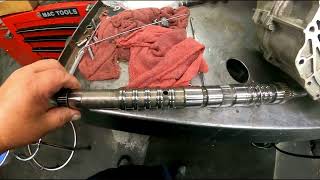
How to confirm: This is a deep internal issue found during a transmission teardown. A technician noted that a missing press-in plug in the input shaft for the 'F' clutch circuit can cause a pressure leak, triggering this code. This can be checked with a piece of wire inserted into the holes on the end of the input shaft; the wire should not pass all the way through.
Typical fix: This requires a complete transmission disassembly to inspect and replace the missing plug in the input shaft. Some specialists have resorted to welding the hole shut as a permanent repair.
Est. part cost: $5 (plug) - $2000+ (transmission rebuild)
Rare But Worth Checking
- Powertrain Control Module (PCM) or Software Issue: Sometimes, the issue isn't mechanical but is related to the software controlling the transmission. Ford has released numerous software updates (calibrations) to address shift quality and adaptive learning strategies.
- Damaged Wiring Harness: Corrosion or damage to the wiring leading to the transmission can interrupt the signal to the solenoid, mimicking a solenoid failure.
Diagnosis Steps
- Verify the code with a professional OBD-II scanner.
- Check for any related Technical Service Bulletins (TSBs) from Ford for your vehicle's VIN. Specifically look for TSB 23-2123 or similar.
- Have a professional check the transmission fluid level and condition. The fluid must be Motorcraft MERCON ULV.
- Inspect the transmission wiring harness and connectors for any visible damage, corrosion, or loose connections.
- Using an advanced scan tool (like Ford's IDS), monitor the commanded state and pressure of Shift Solenoid 'F' versus its actual state. Check for other related transmission DTCs.
- Follow the diagnostic path outlined in the relevant TSB. This may start with a PCM software update and adaptive learning reset.
- If symptoms persist, the TSB may direct the technician to test for and repair sticking valves in the main control body or inspect for the CDF clutch cylinder sleeve failure.
- If the solenoid circuit tests faulty, perform an electrical resistance check on the solenoid itself. The expected value is 5.0-5.4 ohms.
- During a transmission teardown for other reasons, inspect the input shaft for the missing 'F' clutch circuit plug as a potential rare cause.
Parts You'll Likely Need

- Transmission Valve Body Assembly
(OEM #JL3Z-7A100-B or JL3Z-7A100-C (verify by VIN))— This is the most common fix according to Ford's TSBs for shift quality issues, as it contains the solenoids and hydraulic passages that are prone to sticking.
Trusted brands: Motorcraft
OEM price range: $700-$1200
Aftermarket price range: $500-$900 - CDF Clutch Cylinder Assembly
(OEM #JL3Z-7H351-B (supersedes HL3Z-7H351-A))— If diagnosed with the common CDF drum sleeve failure, this part must be replaced. An updated version with a machined lip prevents recurrence.
Trusted brands: Motorcraft
OEM price range: $200-$500 - Shift Solenoid — If the issue is isolated to just the solenoid and not the entire valve body, replacing the individual solenoid is a more targeted repair.
Related Codes That Often Appear With This One
- P2700 — Transmission Clutch 'A' Application Time Range/Performance
- P2701 — Transmission Clutch 'B' Application Time Range/Performance
- P2702 — Transmission Clutch 'C' Application Time Range/Performance
- P0751 — Shift Solenoid 'A' Performance/Stuck Off
- P0756 — Shift Solenoid 'B' Performance/Stuck Off
- P0761 — Shift Solenoid 'C' Performance/Stuck Off
Technical Service Bulletins (TSBs) & Recalls
- TSB 24-2046: Supersedes previous TSBs. Addresses harsh/delayed shifts and a list of DTCs including P2707. Points to sticking valves in the main control valve body or axial movement of the CDF clutch cylinder sleeve as causes. The procedure involves diagnostics to determine if a valve body overhaul or CDF drum replacement is needed.
- TSB 22-2428: An earlier TSB, also covering harsh shifts and the same long list of DTCs. It identifies software, sticking valves, and the CDF clutch cylinder sleeve as potential causes.
- TSB 25-2134: Mentions P2707 in a list of DTCs related to transmission issues.
- TSB 25-2024: Lists P2707 with other codes for harsh/delayed shifts.
Platform-Specific Known Issues
- The 10R80 transmission in the 2019-2023 Ranger is known for shift quality complaints, leading Ford to issue several TSBs. TSB 24-2046 specifically addresses harsh/delayed shifts due to sticking valves in the main control valve body or issues with the CDF clutch cylinder sleeve.
- A significant number of these transmissions built before late 2022 are susceptible to the CDF clutch drum sleeve walking out of position, causing a hydraulic leak that triggers codes like P2707. Owners on forums like Ranger5G.com frequently discuss this as the root cause of their transmission failures.
- The provided NHTSA records (TSB 25-2134, TSB 25-2024, TSB 22-2428) all group P2707 with a large number of other transmission-related DTCs, indicating a common root cause often addressed by a comprehensive valve body repair or replacement.
Mechanic-Grade Diagnostic Values
- Shift Solenoid (A-F) Resistance — expected: 5.0 - 5.4 Ohms at 68°F (20°C). Failure: A reading outside of this range indicates a faulty solenoid coil.
- Torque Converter Clutch (TCC) Solenoid Resistance — expected: Around 20 Ohms. Failure: A significant deviation from 20 Ohms suggests a problem with the TCC solenoid.
Scan Tool Commands That Help
- Ford IDS, FORScan, or other J2534-capable tool: PCM – Transmission Strategy Download / Solenoid Body Strategy Programming — This is mandatory after replacing the transmission valve body or the entire transmission. The 13-digit strategy number from the new valve body must be programmed into the PCM/TCM to ensure the controller uses the correct electrical characteristics for the new solenoids.
- Ford IDS, FORScan, Topdon TopScan: TCM - Reset All Adaptations / Clear Transmission Adaptive Tables — This should be performed after any major transmission repair, fluid change, or to address poor shift quality. It erases the learned shift patterns, forcing the TCM to relearn based on the current mechanical state and driver habits. An adaptive learning drive cycle must be performed afterward.
Wiring & Ground Locations
- C175T / Transmission Case Connector — The main electrical connector on the transmission housing.. This is the primary connection point for all solenoids and sensors within the transmission. Checking for corrosion, damaged pins, or loose connections here is a critical first step in diagnosing any electrical transmission code. A pinout diagram is required to test the specific circuit for Shift Solenoid 'F'.
Real Owner Repair Stories
- YouTube channel 'Curmudgeon Transmission' (Ford 10R80 Transmission (specific vehicle not mentioned, but applies to Ranger)) — DTCs P2707 (Shift element 'F' stuck off) and/or P2708.
❌ Tried (didn't work) Initial diagnosis might point to the solenoid or valve body, but the actual cause is a deep internal leak.
✅ What actually fixed it The root cause was a missing press-in plug in the input shaft for the 'F' clutch circuit. There are four holes in the end of the input shaft; the one for the 'F' clutch was missing its plug, allowing hydraulic pressure to leak. The technician noted that attempting to install a new plug was difficult and instead recommended welding the hole shut (along with two others, leaving the lockup circuit hole open) as a permanent fix.
OEM Part Supersession History
HL3Z-7H351-A, JL3Z-7H351-A→JL3Z-7H351-B— The original CDF clutch cylinder was prone to the internal sleeve walking out of position. The updated JL3Z-7H351-B part features a machined lip to physically prevent the sleeve from moving, providing a permanent fix.JL3Z-7A100-A→JL3Z-7A100-C— Part revision for the valve body assembly. The specific changes are not documented in search results, but using the latest revision is recommended.
Heads up: When replacing a valve body, the 13-digit solenoid strategy code from the new part must be programmed into the vehicle's computer.
Model Year Variations Within This Range
- 2019 - Mid-2022: Vehicles built on or before August 15, 2022, are susceptible to the CDF clutch cylinder sleeve failure. Vehicles built after this date should have the updated drum with a machined lip from the factory.
- 2019 vs 2021-2023: Minor, non-mechanical changes were made over the years, such as the removal of the engine cover, hood struts, and some interior trim pieces on later models. These do not affect the diagnosis of P2707 but are notable differences within the generation.
Helpful Videos


We Have This Part in Stock


The information in this article is provided for general reference and educational purposes only. Vehicle specifications, procedures, and part compatibility can vary by production date, trim level, and region. Always consult your vehicle's factory service manual and verify part numbers before purchasing or performing repairs. Safety-critical components such as airbags, seat belts, and braking systems should be installed by a qualified professional.
- Ford RANGER:
- 🎬 Helpful Videos
- 🛍️ Shop This Part
- What's Unique About the 2019-2023 Ford RANGER
- Diagnostic Flowchart
- Symptoms You May Notice
- Most Likely Causes
- Rare But Worth Checking
- Diagnosis Steps
- Parts You'll Likely Need
- Related Codes That Often Appear With This One
- Technical Service Bulletins (TSBs) & Recalls
- Platform-Specific Known Issues
- Mechanic-Grade Diagnostic Values
- Scan Tool Commands That Help
- Wiring & Ground Locations
- Real Owner Repair Stories
- OEM Part Supersession History
- Model Year Variations Within This Range
- 🎟️ Get 5% Off