

P2704 on 2019-2023 Ford Ranger: 10R80 Transmission 'E' Clutch Fault Causes & Fixes
This code on the Ranger's 10R80 transmission indicates a serious internal fault, often related to a known issue with the CDF clutch drum or the main valve body, as outlined in Ford Technical Service Bulletins. This is not a DIY fix and can be costly, with valve body replacements ranging from $1,000-$1,800 and transmission rebuilds or replacements often exceeding $4,000. In many cases, a full transmission replacement is performed under warranty.
- P2704 on a 2019-2023 Ranger is a serious transmission code that should be addressed immediately to prevent further damage.
- The most likely causes are well-documented issues with the 10R80 transmission: a faulty main control valve body or a failed CDF clutch drum.
- Ford has issued multiple TSBs (like 22-2428) that guide technicians on diagnosing this exact problem.
- This is not a DIY repair. It requires professional diagnosis and internal transmission work.
- If a transmission rebuild is necessary, ensure the shop uses the updated/revised CDF drum from Ford to prevent a repeat failure.
What's Unique About the 2019-2023 Ford RANGER
The 10R80 transmission, co-developed by Ford and GM, is known for specific vulnerabilities that can trigger P2704 and a host of related codes. Ford has issued multiple Technical Service Bulletins (TSBs) acknowledging that harsh shifting, delayed engagement, and these codes often stem from a few key areas. The most notorious issue is a design flaw in the C-D-F clutch drum assembly, where an internal bushing can 'walk' or slide out of position, uncovering an oil passage and causing a critical loss of hydraulic pressure to the clutch packs. Sticking valves within the main control valve body are another widely recognized cause, which can sometimes be addressed without a full transmission removal.
Diagnostic Flowchart
Tap your situation to follow the diagnostic path that matches what you're seeing on this vehicle.
Symptoms You May Notice
- Harsh or slamming shifts, particularly between 1-3 and 3-5.
- Delayed engagement when shifting from Park to Drive or Reverse.
- Transmission slipping or flaring (engine RPMs flare up without an increase in speed), especially on the 4-5 shift.
- Shuddering at low speeds or under light load, sometimes described as driving over a rumble strip.
- Illuminated Check Engine Light or Wrench Light.
- Vehicle entering 'limp mode' with limited gear availability.
- Clunking noises during upshifts or downshifts.
- Failure to engage Reverse, acting as if in a neutral.
- Replacing the entire transmission when only a valve body or CDF drum was needed.
- Performing a transmission rebuild without addressing the root cause, such as failing to use the updated CDF drum part (JR3Z-7H351-B).
- Diagnosing a transmission hardware fault when the actual cause is an engine misfire.
- Replacing a new transmission but reusing the old, contaminated torque converter, which can introduce debris into the new valve body and cause the same symptoms to return.
Most Likely Causes
- Sticking Valves in the Main Control Valve Body 🔴 High Probability This is a primary cause identified by Ford in TSB 22-2428. Debris in the fluid or manufacturing tolerances can cause valves to stick, leading to incorrect hydraulic pressure and apply times. Cross-leaks within the valve body can starve clutches of necessary pressure.
How to confirm: A technician will check fluid for excessive contamination. A Ford-specific scan tool is used to perform a 'Main Control Break-In' procedure as outlined in TSB 22-2428. If the issue persists after the procedure, the valve body is deemed faulty.
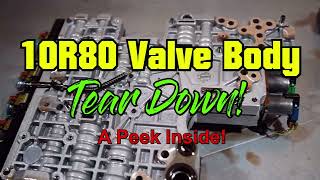
Typical fix: Replacement of the main control valve body assembly and new transmission fluid. In some cases, a re-flash and valve body service (rebuild) can resolve the issue without full replacement. 🎬 See a detailed teardown of the 10R80 valve body internals.
Est. part cost: $400-$900 for the valve body assembly. - CDF Clutch Drum Sleeve Failure 🔴 High Probability A widely documented design issue in early 10R80 transmissions where a bushing inside the CDF drum 'walks' out of position, uncovering oil passages and causing a major hydraulic pressure leak. This prevents clutches from applying correctly.
How to confirm: This can only be confirmed by removing and disassembling the transmission to inspect the CDF drum assembly. The failed part will have a visible gap where the sleeve has moved, exposing an oil port.
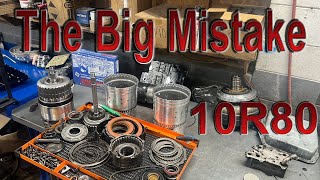
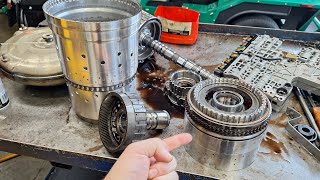
Typical fix: The transmission must be removed and rebuilt with a new, updated CDF clutch drum. Ford released a revised part (JR3Z-7H351-B) that has a machined lip to prevent the sleeve from moving 🎬 Watch: How the updated CDF drum fixes the design flaw., providing a permanent fix.
Est. part cost: $150-$250 for the drum, plus a rebuild kit ($400+) and significant labor. - Corrupt or Outdated PCM/TCM Software 🟡 Medium Probability The complex shift logic of the 10-speed transmission is sometimes improved with software updates. TSB 22-2428 lists a software re-flash as the very first step in the diagnostic procedure before any hardware is replaced.
How to confirm: A dealer or qualified shop with access to Ford's diagnostic software (FDRS) can check if the vehicle's Powertrain Control Module (PCM) or Transmission Control Module (TCM) has the latest software version.
Typical fix: Reprogramming the module with the latest Ford software and performing a transmission adaptive learning drive cycle.
Est. part cost: $0 (under warranty) - $200
Rare But Worth Checking
- Engine Misfire: In some cases, an engine misfire (from a bad spark plug, for example) can create erratic crankshaft signals that the TCM misinterprets as a transmission slip, incorrectly setting a P2704 code. This can lead to a costly misdiagnosis of the transmission, as one F-150 owner experienced where the slip was isolated to only 5th gear but was ultimately caused by a misfire.
- Damaged Oil Pump Gear: In some international Ranger models (Bi-Turbo diesel with 10R60), codes including P2704 have been linked to a physically broken oil pump gear, leading to a total loss of power and overheating.
Diagnosis Steps
- Verify the complaint and check for any Technical Service Bulletins (TSBs) related to the transmission, such as TSB 22-2428 or its successors (e.g., 23-2250, 24-2046).
- Use a professional scan tool (like Ford's FDRS) to read all codes from the PCM and TCM and check for available software updates. Reprogram if an update is available.
- Check the transmission fluid level and condition. Look for fluid that is dark, burnt-smelling, or contains excessive metallic debris ('glitter'), which indicates internal wear.
- If symptoms persist, perform the Main Control Valve Body break-in procedure as directed by the relevant TSB.
- If the break-in procedure fails to resolve the issue, the next step is the replacement of the main control valve body assembly.
- If a new valve body does not fix the problem, an internal mechanical failure is certain. The transmission must be removed and disassembled for inspection, with close attention paid to the CDF clutch drum for a dropped sleeve and the 'E' clutch pack for damage.
Parts You'll Likely Need
- Main Control Valve Body
(OEM #ML3Z-7A100-B (supersedes previous versions))— Identified in Ford TSBs as a primary cause of shifting issues and related codes due to sticking valves. Replacement is a key diagnostic step after software updates fail.
Trusted brands: Motorcraft
OEM price range: $400-$900 (plus a core charge of ~$200) - CDF Clutch Cylinder Drum
(OEM #JR3Z-7H351-B (updated, permanent fix part))— The original drum is prone to a bushing failure that causes catastrophic pressure loss. The updated part has a machined lip to prevent the failure and is required during a rebuild to permanently fix the issue.
Trusted brands: Motorcraft
OEM price range: $140-$250 - Transmission Filter Kit — Always replaced during any transmission service, especially when contamination from a failing part is suspected or a new valve body is installed.
Trusted brands: Motorcraft
OEM price range: $40-$70
Aftermarket price range: $20-$50
Related Codes That Often Appear With This One
- P0751, P0756, P0761, P2700-P2703, P0731-P0736 — These are all codes related to shift solenoids and gear ratio errors. They are frequently triggered alongside P2704 because the root causes (valve body issues, CDF drum failure) create widespread hydraulic control problems that affect multiple circuits. Ford's TSB 22-2428 lists P2704 among this large family of codes that share the same diagnostic path.
Technical Service Bulletins (TSBs) & Recalls
- TSB 22-2428: The primary document for diagnosing harsh/delayed shifts and codes like P2704. It outlines a clear procedure: 1) Reprogram PCM/TCM, 2) Perform valve body break-in, 3) Replace valve body, 4) Inspect/replace CDF drum.
- TSB 23-2250 / TSB 24-2046: These are superseding bulletins that update the procedure and vehicle lists from TSB 22-2428, but fol
Platform-Specific Known Issues
- The 10R80 transmission in 2019-2023 Rangers is susceptible to a failure of the CDF clutch drum, where an internal sleeve moves, damages a seal, and causes a significant loss of hydraulic pressure. Ford has issued revised parts to address this known weakness.
- Owner forums like Ranger5G.com contain numerous threads where members detail their experiences with 10R80 failures, often leading to dealer rebuilds or full transmission replacements under warranty.
Mechanic-Grade Diagnostic Values
- Shift Solenoid Resistance — expected: 5.0 - 5.4 Ohms at 20°C (68°F). Failure: A reading outside this range indicates a faulty solenoid coil.
- Friction Element 'E' Apply Time — expected: Typically 150–250 ms (milliseconds). Failure: A time significantly outside this window, as measured by a capable scan tool, triggers the P2704 fault.
Scan Tool Commands That Help
- Ford Diagnostic & Repair System (FDRS): Transmission Accelerated Main Control Break-in Routine — This is a key diagnostic step outlined in Ford TSBs. It's used after a software check to attempt to free sticking valves in the main control body before resorting to hardware replacement.
- Ford Diagnostic & Repair System (FDRS): Solenoid Strategy Programming — This function is required after replacing the valve body, TCM/PCM, or the entire transmission assembly. It programs the unique 13-digit solenoid strategy number from the new valve body into the control module to ensure proper operation.
Wiring & Ground Locations
- Main Chassis Ground — Located just behind the left headlight, a large bolt secures the main battery ground cable to the chassis.. A poor main ground can cause a variety of electrical issues, including erratic sensor readings and improper module function, which could potentially contribute to transmission control problems.
- Driver's Side Kick Panel Ground — Behind the driver's side kick panel, there is a substantial metal ground point used for the OEM trailer brake controller.. Interior modules rely on clean grounds. While not directly tied to the transmission harness, a fault here could cause communication issues on the CAN bus that might affect the TCM.
- Wiring Harness Chafe Point (3.2L Diesel Specific) — On international Ranger models with the 3.2L engine, a wiring harness runs across the top of the engine near the front timing cover and is known to rub.. While specific to the diesel engine not in all US models, this highlights a known pattern of harness chafe points. Any electrical fault from a shorted wire in a critical harness could lead to unexpected codes, including transmission faults.
Real Owner Repair Stories
- Gears Magazine Article (2019 Ford F-150 with 3.5L engine and 10R80 transmission) — Transmission slipped in 5th gear, setting codes P0735 (Gear Ratio Error in 5th) and P2704.
❌ Tried (didn't work) Complete transmission teardown and inspection (no visible faults found)., Re-assembly with a new OEM valve body and an updated CDF drum., Second transmission removal and inspection by a different builder, who replaced the 'E' clutch drum and piston as a precaution.
✅ What actually fixed it The root cause was ultimately found to be engine misfires on two cylinders caused by fouled spark plugs. Replacing the spark plugs resolved both the misfires and the transmission slipping symptoms. The technician noted that the crankshaft speed variations from the misfire were likely misinterpreted by the TCM as a transmission slip, but only in 5th gear, leading to the misdiagnosis.
OEM Part Supersession History
JR3Z-7H351-A→JR3Z-7H351-B— The original CDF clutch drum assembly was prone to an internal sleeve 'walking' out of place, causing a major hydraulic leak. The updated 'B' version has a machined lip on the inner half of the drum to physically prevent the sleeve from moving, providing a permanent fix.ML3Z-7A100-A→ML3Z-7A100-B— Supersession for the main control valve body. Reasons for updates typically include improvements to address valve-sticking issues and other performance complaints outlined in TSBs.
Heads up: When replacing, the new valve body's 13-digit solenoid strategy ID must be programmed into the TCM using a tool like FDRS for correct operation.
Model Year Variations Within This Range
- 2019 - Mid-2022: Vehicles built on or before August 15, 2022, may have the original CDF clutch drum design prone to sleeve failure. Vehicles built after this date are more likely to have the updated drum (JR3Z-7H351-B) from the factory.
Helpful Videos
We Have This Part in Stock


The information in this article is provided for general reference and educational purposes only. Vehicle specifications, procedures, and part compatibility can vary by production date, trim level, and region. Always consult your vehicle's factory service manual and verify part numbers before purchasing or performing repairs. Safety-critical components such as airbags, seat belts, and braking systems should be installed by a qualified professional.
- Ford RANGER:
- 🎬 Helpful Videos
- 🛍️ Shop This Part
- What's Unique About the 2019-2023 Ford RANGER
- Diagnostic Flowchart
- Symptoms You May Notice
- Most Likely Causes
- Rare But Worth Checking
- Diagnosis Steps
- Parts You'll Likely Need
- Related Codes That Often Appear With This One
- Technical Service Bulletins (TSBs) & Recalls
- Platform-Specific Known Issues
- Mechanic-Grade Diagnostic Values
- Scan Tool Commands That Help
- Wiring & Ground Locations
- Real Owner Repair Stories
- OEM Part Supersession History
- Model Year Variations Within This Range
- 🎟️ Get 5% Off