

P2702 on 2020-2023 Lincoln Aviator: Transmission Clutch Performance Explained
On a 2020-2023 Lincoln Aviator, code P2702 almost always points to an internal issue with the 10R60/10R80 transmission, specifically sticking valves in the main control valve body. This is a known issue covered by multiple Technical Service Bulletins (TSBs). The fix typically involves overhauling or replacing the valve body, which is a complex and costly repair best left to a professional. In some cases, a related internal failure of the CDF clutch drum can also be the cause.
- P2702 on a 2020-2023 Aviator is a serious code that points to a well-known transmission problem.
- The most likely cause is a faulty main control valve body, as confirmed by multiple Lincoln/Ford TSBs.
- Do not ignore this code. While the vehicle may be drivable, continued use can lead to more severe and expensive transmission damage.
- This is not a simple DIY fix. Due to the complexity of the repair, professional service at a dealership or qualified transmission shop is highly recommended.
- When seeking repairs, reference the numerous TSBs related to this issue to ensure the technician is aware of the manufacturer's recommended diagnostic path.
What's Unique About the 2020-2023 Lincoln AVIATOR
The 2020-2023 Lincoln Aviator uses a 10-speed automatic transmission (10R60 or 10R80) that is known to have issues with harsh or delayed shifting. Ford and Lincoln have released numerous Technical Service Bulletins (TSBs) acknowledging that sticking valves within the main control valve body are a common cause for these symptoms and a cluster of related trouble codes, including P2702. This makes a valve body problem a much higher probability on this specific vehicle compared to generic causes. TSB 22-2428 further expands the potential causes to include software issues and axial movement of the CDF clutch cylinder sleeve, another known weak point.
Diagnostic Flowchart
Tap your situation to follow the diagnostic path that matches what you're seeing on this vehicle.
Symptoms You May Notice
- Harsh, jerky, or delayed shifts.
- Slipping between gears.
- Vehicle lurching or clunking, especially at low speeds.
- Transmission failing to shift into gear.
- Illuminated Malfunction Indicator Lamp (Check Engine Light).
- Transmission entering "limp mode," where it stays in one gear.
- Rumbling or shuddering sensation during acceleration.
- Replacing individual shift solenoids when the issue is sticking valves or blockages within the valve body itself.
- Replacing the entire transmission when only the main control valve body needs to be serviced or replaced.
- Assuming the problem is mechanical clutch wear when it is a hydraulic control failure in the valve body.
Most Likely Causes
- Sticking Valves in the Main Control Valve Body 🔴 High Probability This is a widely documented issue for the 10R60/10R80 transmission used in the Aviator. Multiple TSBs (including TSB 21-2434, TSB 22-2102, and the superseding TSB 22-2428) directly cite sticking valves as the primary cause for P2702 and related codes. The aluminum valve body can be prone to wear, warping, and contamination, causing valves to stick.
How to confirm: A professional technician will use a high-end scan tool (like Ford's FDRS) to monitor transmission solenoid commands and apply times. Per TSB 22-2102, the first step is often to perform a "Transmission Accelerated Main Control Break In" routine to see if the valves can be freed. If this fails, the valve body must be overhauled or replaced.
Typical fix: Overhaul (clean and inspect) or replacement of the main control valve body. This is often followed by a PCM software update and an adaptive learning drive cycle.
Est. part cost: $700-$1500 - Low or Contaminated Transmission Fluid 🟡 Medium Probability While not specific to the Aviator, any transmission can develop leaks. The 10R80 is particularly sensitive to fluid level and condition. Only Motorcraft MERCON ULV fluid should be used 🎬 Watch: How to check your Aviator's transmission fluid level and dipstick location.; incorrect fluid can cause shifting problems.
How to confirm: Check the transmission fluid level and condition according to the manufacturer's procedure. The fluid should be at the correct level, red in color, and free of debris or a burnt smell. Metal shavings are a sign of serious internal wear.
Typical fix: Top off the fluid if low, or perform a complete fluid and filter change if the fluid is dirty. If the fluid is low, the source of the leak must be found and repaired.
Est. part cost: $150-$400 - Faulty Transmission Control Module (TCM) or Software ⚪ Low Probability Software-related shifting issues are common enough that Ford has issued numerous TSBs and software updates to address them. Often, a software update is the first step a dealer will take.
How to confirm: This is typically diagnosed by a dealer after all other mechanical and hydraulic causes have been ruled out. A diagnostic scan tool can check for communication errors and available software updates for the PCM/TCM.
Typical fix: Reprogramming the TCM/PCM with the latest software calibration. In rare cases, the TCM itself may need to be replaced.
Est. part cost: $0-$1200
Rare But Worth Checking
- Worn Internal Clutch Pack: While the code points to a clutch element, the issue is more often in the control system (valve body). However, if the vehicle has very high mileage or has been driven with low fluid, mechanical wear to the clutch itself is possible.
- Damaged Wiring or Connectors: An open or short in the wiring to the transmission solenoids can mimic an internal failure. A visual inspection of the harness is a key diagnostic step.
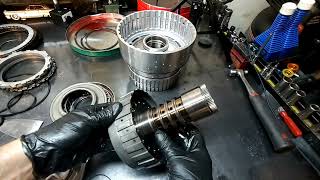
- Failed CDF Clutch Drum Bushing: A known failure point on earlier 10R80s is the bushing in the 'CDF' clutch drum, which can walk out of place, causing a pressure loss and catastrophic clutch failure. TSB 22-2428 acknowledges this as a potential cause for these symptoms. Ford introduced a revised part to fix this, and vehicles built after 12/23/2022 likely have the updated drum from the factory. 🎬 Watch: A detailed look at the common CDF clutch drum failure.
Diagnosis Steps
- Verify the code with a professional OBD-II scanner that can read transmission-specific codes.
- Check the transmission fluid level and condition. The fluid must be clean, at the correct level, not smell burnt, and be the correct type (Motorcraft MERCON ULV).
- Scan for any Technical Service Bulletins (TSBs) related to the vehicle's VIN. For the Aviator, TSBs like 22-2428 (which supersedes many others) are highly relevant.
- Inspect the transmission wiring harness and connectors for any visible damage, corrosion, or loose connections.
- Using a Ford-specific scan tool (FDRS), perform the "PCM - Transmission Accelerated Main Control Break In" routine as described in TSB 22-2102. This attempts to un-stick the valves electronically.
- If the break-in routine fails to resolve the issue, the next step is to remove, inspect, and overhaul or replace the main control valve body.
- After repair, perform the adaptive learning drive cycle to allow the TCM to relearn shift parameters.
Parts You'll Likely Need
- Main Control Valve Body
(OEM #ML3Z-7A100-B (Supersedes HL3Z-7A100-A/B))— This is the most common point of failure for this code on this vehicle, as documented in multiple manufacturer TSBs.
Trusted brands: Motorcraft
OEM price range: $700-$1500
Aftermarket price range: $500-$1200 (Remanufactured) - Transmission Fluid and Filter Kit
(OEM #XT-12-QULV (Fluid))— Required whenever the valve body is serviced or replaced. Approximately 11 quarts may be needed for a valve body service.
Trusted brands: Motorcraft
OEM price range: $150-$250
Aftermarket price range: $100-$200
Related Codes That Often Appear With This One
- P2700, P2701, P2703, P2704, P2705 — These codes are for other friction elements (A, B, D, E, F). When seen with P2702, it strongly suggests a systemic problem like the main valve body, not just one faulty clutch.
- P0751, P0756, P0761, P0766, P0771 — These are performance codes for specific shift solenoids. Their presence reinforces the diagnosis of a hydraulic control issue originating in the valve body.
- P0729, P0731-P0736 — These codes indicate incorrect gear ratios are being detected. They are a direct symptom of a clutch failing to apply correctly, which is the root cause of P2702.
Technical Service Bulletins (TSBs) & Recalls
- TSB 22-2428: Supersedes many previous TSBs and is a comprehensive guide. It lists sticking valves, software issues, and CDF clutch cylinder sleeve movement as potential causes for P2702 across many Ford/Lincoln models, including the Aviator.
- TSB 22-2102: Specifically for the 2020 Aviator/Explorer, points to sticking valves in the main co
Platform-Specific Known Issues
- TSB-Documented Valve Body Issues: Ford/Lincoln has issued multiple TSBs (e.g., TSB 20-2403, 21-2434, 22-2102) which have been superseded by newer ones like TSB 22-2428, all pointing to sticking valves in the main control valve body as the cause for P2702.
- Class Action Lawsuit: Multiple class-action lawsuits have been filed concerning the 10R80 transmission, alleging defects that cause harsh and erratic shifting, lunging, and hesitation, which are the exact symptoms associated with code P2702. The lawsuits allege Ford knew of the defects but continued to sell the vehicles.
- CDF Drum Bushing Failure: A secondary, but significant, known issue is the failure of the CDF clutch drum bushing, which can move out of position and cause pressure loss. TSB 22-2428 includes this as a possible cause to investigate.
Mechanic-Grade Diagnostic Values
- Shift Solenoid Resistance — expected: 5.0 - 5.4 Ohms at 68°F (20°C). Failure: A resistance reading outside of this range indicates a faulty solenoid coil.
- Transmission Fluid Temperature (TFT) Sensor Resistance — expected: Approximately 37k Ohms at 68°F (20°C) down to 0.8k Ohms at 266°F (130°C).. Failure: Readings that are wildly different from the expected value at a given temperature suggest a failed sensor.
Scan Tool Commands That Help
- Ford FDRS (Ford Diagnostic & Repair System): PCM – Transmission Strategy Download / Programmable Module Installation (PMI) — This is mandatory after replacing the main control valve body or the entire transmission. It requires entering the 12-digit Solenoid Body ID and 13-digit Solenoid Strategy number from the new part into the PCM to ensure correct shift pressures and timing.
- Ford FDRS or FORScan (licensed version): Clear Transmission Adaptive Tables — This service procedure should be performed after any transmission repair, especially valve body or solenoid replacement, to erase the old learned shift parameters.
- Ford FDRS: PCM - Transmission Accelerated Main Control Break In — This is a primary diagnostic step outlined in TSBs. It electronically cycles the solenoids to try and free up sticking valves in the main control valve body before recommending component replacement.
- N/A - Procedure: Adaptive Learning Drive Cycle — After clearing adaptive tables or programming a new valve body, a specific drive cycle must be performed to allow the PCM to relearn the hydraulic and mechanical characteristics of the transmission. Failure to do so can result in erratic shifting.
Wiring & Ground Locations
- Connector C175T (at PCM) — This is one of the main connectors at the Powertrain Control Module (PCM).. This connector is the interface between the PCM and the transmission harness. Technicians can test signals from transmission sensors and commands to solenoids here.
- C175T, Pin 19 (BN-YE wire) — At the Powertrain Control Module (PCM) connector.. This is the circuit for the Transmission Fluid Temperature (TFT) sensor signal. An incorrect temperature reading can affect shift strategy and pressure control, potentially contributing to performance codes.
- Connector C177 (Internal Transmission) — This connector is located inside the transmission, connecting the lead frame to the solenoids and sensors.. This is where the electrical signals are passed to the individual components. For P2702, the relevant pin is Pin 10 (Gray/Orange wire), which is the control circuit for Shift Solenoid C.
Real Owner Repair Stories
- Ford Expedition Forum (2018 Ford Expedition with 58,000 miles) — Vehicle shifted poorly and was slipping, specifically noting a poor third gear shift.
❌ Tried (didn't work) Not specified, but dealer diagnosis went straight to internal inspection.
✅ What actually fixed it The dealer dropped the transmission, identified an issue with the CDF drum, and replaced it. The owner reported that after the repair, 'All seems good now.' - Ford Expedition Forum (Ford vehicle with 10R80 transmission) — Shuddering in gears 3-4-5-6 under part throttle/moderate load, progressing to a 'neutral out' condition where the transmission would hang and not downshift for passing.
❌ Tried (didn't work) Multiple software reprograms by the dealer did not fix the shuddering.
✅ What actually fixed it The technician had to disassemble the transmission to find the failure. The CDF drum was replaced, which resolved the issue.
"I Checked Everything" — The Actual Cause
- For this transmission code, the equivalent of a 'smoke test clean' scenario is when the transmission fluid level is correct and the fluid is clean and not burnt, yet severe shifting problems and code P2702 persist. In these cases, owners and technicians report that the problem is almost always internal to the transmission. The two most common hidden causes are sticking valves in the main control valve body or a failing CDF clutch drum bushing, neither of which can be confirmed by a simple external inspection or fluid service.
OEM Part Supersession History
HL3Z-7A100-A / HL3Z-7A100-B→ML3Z-7A100-A / ML3Z-7A100-B— Part number evolution for newer model years and applications. The ML3Z- series parts are often specified for 2021+ vehicles, including hybrid models.
Heads up: While physically similar, using the wrong valve body assembly can cause issues as the solenoid strategy may not be compatible with the vehicle's PCM/TCM calibration. Always use the part number specified for the vehicle's VIN.CDF Clutch Drum with non-retained sleeve→CDF Clutch Drum with machined lip on inner half— The original design allowed an internal sleeve/bushing to 'walk' or move out of position, exposing hydraulic passages and causing pressure loss and shift failures. The updated design has a machined lip that physically prevents the sleeve from moving.
Heads up: Vehicles built after December 23, 2022, should have the updated drum from the factory. When rebuilding an older transmission, it is critical to use the updated drum to prevent a repeat failure.
Model Year Variations Within This Range
- 2020-2022 (before 12/23/2022): Vehicles built before late December 2022 are equipped with the original CDF clutch drum design, which is prone to a bushing failure that causes pressure loss and shifting issues. Vehicles built after this date have an updated drum with a machined lip to prevent this failure.
- 2020 (Hybrid models): TSB 20-2354 was issued for some 2020 Aviator Hybrids built on or before September 17, 2020, for harsh shifts or hesitation at low speeds with no DTCs. The fix was a specific PCM software update, indicating a calibration issue separate from the more common mechanical valve body/drum faults.
Helpful Videos
We Have This Part in Stock


The information in this article is provided for general reference and educational purposes only. Vehicle specifications, procedures, and part compatibility can vary by production date, trim level, and region. Always consult your vehicle's factory service manual and verify part numbers before purchasing or performing repairs. Safety-critical components such as airbags, seat belts, and braking systems should be installed by a qualified professional.
- Lincoln AVIATOR:
- 🎬 Helpful Videos
- 🛍️ Shop This Part
- What's Unique About the 2020-2023 Lincoln AVIATOR
- Diagnostic Flowchart
- Symptoms You May Notice
- Most Likely Causes
- Rare But Worth Checking
- Diagnosis Steps
- Parts You'll Likely Need
- Related Codes That Often Appear With This One
- Technical Service Bulletins (TSBs) & Recalls
- Platform-Specific Known Issues
- Mechanic-Grade Diagnostic Values
- Scan Tool Commands That Help
- Wiring & Ground Locations
- Real Owner Repair Stories
- "I Checked Everything" — The Actual Cause
- OEM Part Supersession History
- Model Year Variations Within This Range
- 🎟️ Get 5% Off