

P2681 on 2017-2019 Ford Escape: Engine Coolant Bypass Valve Circuit Causes and Fixes
On 2017-2019 Ford Escapes with the 1.5L or 2.0L engine, code P2681 is almost always caused by a blown 10-amp fuse F34 in the under-hood fuse box. This is typically due to a chafed and shorted wiring harness near the engine, a known issue covered by Ford's Technical Service Bulletins (SSM 48895, SSM 47575).
- P2681 on a 2017-2019 Escape almost always points to a blown 10A fuse F34.
- The root cause is usually a chafed wiring harness, a known issue identified in Ford TSBs.
- Before replacing any parts, carefully inspect the engine wiring harness for damage, especially near the engine block.
- Do not simply replace the fuse without finding the source of the short; it will just blow again.
- Other symptoms like an AWD fault or TC light are directly related to this single fuse blowing.
What's Unique About the 2017-2019 Ford ESCAPE

On the 2017-2019 Ford Escape, this code is uniquely and strongly tied to a specific, documented issue. The Engine Coolant Bypass Valve shares a circuit and a single fuse (F34) with several other critical components, including the A/C clutch, turbocharger wastegate, and cooling fans. Ford has issued Technical Service Bulletins (TSBs) acknowledging that the wiring harness for these components is prone to chafing against the engine or chassis. This chafing causes a short circuit, blows the 10A fuse F34, and can trigger P2681 along with a host of other seemingly unrelated codes and warning lights.
Diagnostic Flowchart

Tap your situation to follow the diagnostic path that matches what you're seeing on this vehicle.
Symptoms You May Notice

- Check Engine Light is on.
- All-Wheel Drive (AWD) fault warning message.
- Traction Control (TC) light is illuminated.
- Reduced or no heat in the cabin.
- Engine takes longer than usual to warm up.
- Fluctuating or inaccurate engine temperature gauge.
- Engine may enter a reduced power or 'limp' mode.
- Replacing the thermostat. The thermostat is a mechanical part, while P2681 is a purely electrical circuit code.
- Replacing the Engine Coolant Temperature (ECT) sensor. A bad ECT sensor would set its own specific trouble codes, not P2681.
Most Likely Causes

- Chafed and Shorted Wiring Harness 🔴 High Probability Ford TSBs #SSM 48895 and #SSM 47575 specifically call out improperly routed wiring harnesses that can chafe against the engine or chassis, causing a short to ground. The TSB identifies the specific harness part numbers as 12A690 (for the 1.5L engine) and 12C508 (for the 2.0L engine) running from the battery junction box (BJB) to the PCM.
How to confirm: Visually inspect the wiring harness running from the under-hood fuse box (BJB) to the PCM and various engine components. Look for areas where the loom is rubbing against metal parts (like A/C lines or engine brackets), has melted, or has exposed wires. The chafe point is often difficult to see without removing the airbox.
Typical fix: Repair the damaged section of the wiring harness using heat-shrink butt connectors and protective loom. Re-secure the harness away from sharp edges or hot surfaces using zip ties. Replace the blown fuse F34.
Est. part cost: $5-$25 - Blown Fuse F34 🔴 High Probability This 10-amp fuse in the under-hood fuse box is the direct electrical failure resulting from the short circuit described above. Because it powers multiple components, its failure is the key indicator that the issue is a short on the shared circuit rather than just a single failed part.
How to confirm: Locate fuse F34 in the engine compartment fuse box and check for continuity with a multimeter or visually confirm if the filament is broken.
Typical fix: Replace the fuse after diagnosing and fixing the underlying short circuit. Simply replacing the fuse without finding the short will cause it to blow again immediately upon turning the key.
Est. part cost: $1-$5 - Failed Engine Coolant Bypass Valve 🟡 Medium Probability The internal solenoid coil of the valve can fail, creating an open circuit. This is a common failure point on many modern Ford vehicles and can happen independently of the wiring harness issue.
How to confirm: Disconnect the valve's electrical connector. Use a multimeter to measure the resistance between the two pins on the valve itself. A healthy valve should read between 7 and 17 ohms. 🎬 Watch: How to test the bypass valve control circuit. An infinite resistance (OL) reading indicates a failed, open coil.
Typical fix: Replace the engine coolant bypass valve assembly. This involves draining some coolant, removing two 8mm bolts, 🎬 See this walkthrough for replacing the coolant bypass solenoid. and a hose clamp.
Est. part cost: $40-$90
Rare But Worth Checking
- Faulty Powertrain Control Module (PCM): This is very rare. The internal driver circuit in the PCM that controls the valve can fail. This should only be considered after all wiring and component-level faults have been definitively ruled out.
- Water Intrusion in Battery Junction Box (BJB): Though not directly cited for P2681, TSB 22-2044 describes how a poorly sealed BJB cover can allow water entry, causing a wide range of electrical faults and DTCs due to corrosion and short circuits. If P2681 is present with other bizarre electrical symptoms, inspecting the BJB for moisture or corrosion is worthwhile.
Diagnosis Steps
- Read the trouble codes with an OBD-II scanner to confirm P2681 and note any other codes present. The presence of other codes like P0034, P023A, etc., strongly points to the F34 fuse.
- Open the under-hood fuse box and locate fuse F34 (a 10-amp mini fuse). Visually inspect it or test it with a multimeter.
- If fuse F34 is blown, this confirms a short circuit on that line. This is the most common scenario. Do not replace it yet.
- Begin a thorough visual inspection of the engine wiring harness (P/N 12A690 for 1.5L, 12C508 for 2.0L), specifically the sections mentioned in TSB #SSM 48895. Look for any signs of chafing, melting, or damage where the harness might contact the engine block, A/C lines, or brackets. This may require removing the air filter housing for better access.
- If a damaged section is found, repair the wires securely. Use heat-shrink connectors and wrap the repaired section in protective loom or high-quality electrical tape. Ensure the harness is properly routed and secured away from the damage point with zip ties.
- If the harness appears intact, or if the fuse was not blown, proceed to test the bypass valve. Disconnect the valve's electrical connector.
- Measure the resistance across the two pins on the valve itself. A good valve will have a resistance of approximately 7-17 ohms. If you read open circuit (OL) or a value far outside this range, the valve's internal solenoid has failed and the valve must be replaced.
- If the fuse was blown and the harness looked good, you can perform a test. With the valve disconnected, install a new 10-amp fuse in F34 and turn the ignition to 'On' (engine off). If the fuse does not blow, the original bypass valve is likely internally shorted and needs replacement. If the fuse still blows, the short is in the wiring harness and requires more detailed inspection.
- After repairs are complete, replace fuse F34, clear all DTCs, and perform a drive cycle to ensure the code does not return.
Parts You'll Likely Need
- Engine Coolant Bypass Valve
(OEM #BM5Z-8C419-B (Motorcraft YG-780))— The valve's internal solenoid can fail, causing an open or short circuit. If the fuse is good but the code is present (and resistance is out of spec), or if the fuse only blows when the valve is connected, this is the likely culprit.
Trusted brands: Motorcraft, Dorman (P/N 902-055)
OEM price range: $70-$110
Aftermarket price range: $40-$90 - Mini Fuses (10 Amp) — Fuse F34 will be blown if the code is caused by a short circuit. You will need at least one to finalize the repair and may use several during diagnosis.
Trusted brands: Bussmann, Littlefuse
OEM price range: $5-$10 (for a pack)
Aftermarket price range: $5-$10 (for a pack)
Related Codes That Often Appear With This One
- P0034 — Shares the same power supply fuse (F34), as noted in TSB SSM 48895.
- P023A — Shares the same power supply fuse (F34), as noted in TSB SSM 48895.
- P0245 — Shares the same power supply fuse (F34), as noted in TSB SSM 48895.
- P0480 — Shares the same power supply fuse (F34), as noted in TSB SSM 48895.
- P0645 — Shares the same power supply fuse (F34), as noted in TSB SSM 48895.
Technical Service Bulletins (TSBs) & Recalls
- SSM 48895: Notes that 2017-2019 Escapes with 1.5L/2.0L engines may exhibit an open fuse F34 and various DTCs, including P2681, due to wiring harness chafing on harness P/N 12A690 (1.5L) or 12C508 (2.0L).
- SSM 47575: An earlier version of the bulletin describing the same issue of an open fuse F34 and associated codes from a chafed wiring harness.
Platform-Specific Known Issues
- TSB #SSM 48895 and #SSM 47575 document that on 2017-2019 Escapes with 1.5L or 2.0L engines, improperly installed wiring harness retainers can lead to chafing. This chafing causes a short, blowing fuse F34 and triggering P2681 and/or other codes.
Mechanic-Grade Diagnostic Values
- Engine Coolant Bypass Valve Solenoid Resistance — expected: 7 to 17 Ohms. Failure: An Open Line (OL) or infinite resistance reading indicates a failed solenoid. A brand new part may read around 10 Ohms.
- Voltage at Bypass Valve Harness Connector (from PCM) — expected: Pulsing 12V signal while the engine is running and valve is being commanded.. Failure: A steady 12V or 0V with no pulse when commanded indicates a potential wiring issue or a failed PCM driver.
Hidden / Shadow Codes Worth Checking
- P2681-13-6C: This is an extended code format that may be displayed on Ford's IDS or other high-level scan tools. The base code is P2681, while the '-13' may indicate a circuit open and the '-6C' is a counter. It confirms the same 'Circuit/Open' fault. (see via Professional-grade scan tools like Ford IDS or some high-end aftermarket scanners.)
Scan Tool Commands That Help
- Ford IDS, iCarsoft, high-end scanners: Coolant Bypass Valve Active Command / Bidirectional Control — Use this function to command the valve to open and close while monitoring its operation or voltage at the connector. This helps determine if the valve is physically stuck or if the control signal from the PCM is being sent correctly, isolating the fault between the wiring, the valve, and the PCM.
Wiring & Ground Locations
- G104 — Typically located on the right rear of the transmission or at the left front corner of the engine compartment, near the Battery Junction Box (BJB).. This is a primary engine compartment ground. A poor connection here can cause a variety of powertrain-related electrical issues, including intermittent circuit faults that could mimic an open circuit.
- G108 — Typically located on the front or left rear of the engine compartment.. Another critical engine ground. As the bypass valve is mounted to the engine, ensuring the engine block has a solid ground path back to the battery is essential for all engine-mounted sensors and actuators.
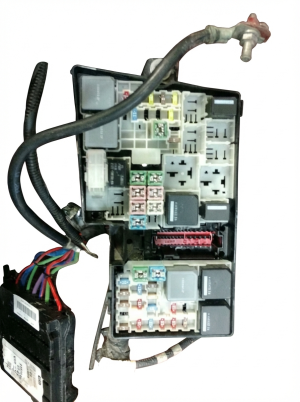
- Fuse F34 — In the under-hood fuse box, also known as the Battery Junction Box (BJB).. This 10A fuse is the direct power source for the Engine Coolant Bypass Valve circuit. Its failure is the most common symptom of the chafed wiring harness issue noted in Ford TSBs.
Real Owner Repair Stories
- YouTube channel 'Real Auto Solutions' (2017 Ford Kuga (European Ford Escape) with 1.6L engine, 137,000 km) — Check Engine Light with code P2681-13-6C (Engine Coolant Bypass Valve A Control Circuit Open). The code would log instantly.
❌ Tried (didn't work) Diagnosis was direct; no other parts were replaced.
✅ What actually fixed it The mechanic tested the resistance of the existing bypass valve and found it was open circuit (no continuity). A new valve measured 10.1 Ohms. Replacing the Engine Coolant Bypass Valve and clearing the code resolved the issue.
Helpful Videos
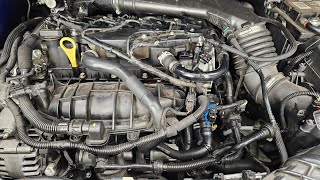
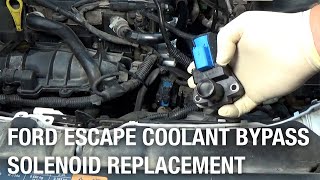
We Have This Part in Stock




The information in this article is provided for general reference and educational purposes only. Vehicle specifications, procedures, and part compatibility can vary by production date, trim level, and region. Always consult your vehicle's factory service manual and verify part numbers before purchasing or performing repairs. Safety-critical components such as airbags, seat belts, and braking systems should be installed by a qualified professional.
- Ford ESCAPE:
- 🎬 Helpful Videos
- 🛍️ Shop This Part
- What's Unique About the 2017-2019 Ford ESCAPE
- Diagnostic Flowchart
- Symptoms You May Notice
- Most Likely Causes
- Rare But Worth Checking
- Diagnosis Steps
- Parts You'll Likely Need
- Related Codes That Often Appear With This One
- Technical Service Bulletins (TSBs) & Recalls
- Platform-Specific Known Issues
- Mechanic-Grade Diagnostic Values
- Hidden / Shadow Codes Worth Checking
- Scan Tool Commands That Help
- Wiring & Ground Locations
- Real Owner Repair Stories
- 🎟️ Get 5% Off