

P2652 on 2017 Honda Pilot: Causes and Fixes for Rocker Arm Oil Pressure Switch B Stuck On
On a 2017 Honda Pilot, code P2652 almost always points to a failed rocker arm oil pressure switch for Bank 1. This is a common, inexpensive part to replace. Symptoms include a check engine light, rough or high idle, and potential limp mode. Before replacing the switch, always check that your engine oil is clean and at the correct level, as low or dirty oil can also trigger this code.
- P2652 on a 2017 Pilot means the Bank 1 (rear) rocker arm oil pressure switch is stuck on.
- Before buying parts, always check your engine oil. Low or dirty oil is a common cause.
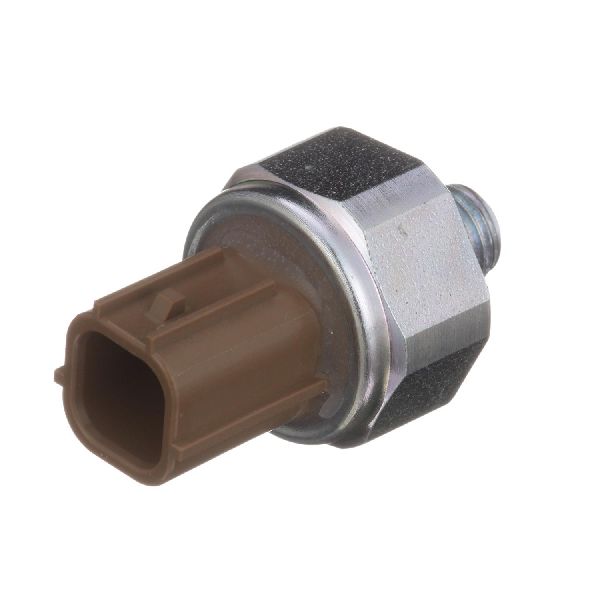
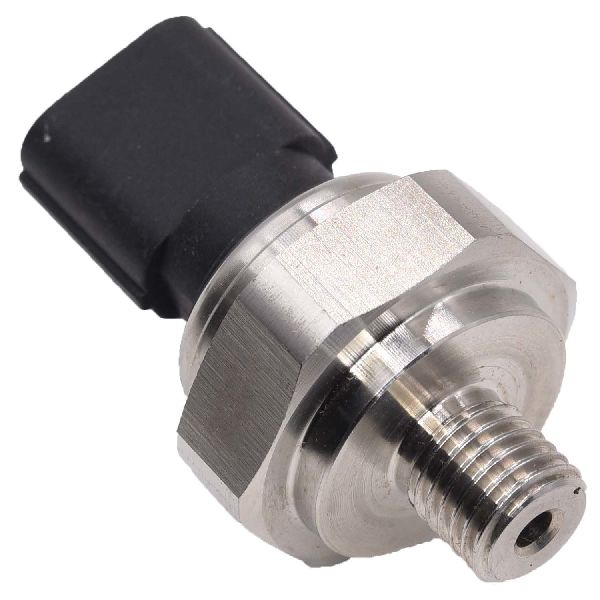
- The most likely fix is replacing the Bank 1 oil pressure switch (Part # 37240-R70-A04) and its O-ring.
- This is a DIY-friendly repair that requires basic tools, including a 24mm deep socket, and typically takes less than an hour.
- This code is often accompanied by P3400, which points to the same system and is usually resolved by the same repair.
What's Unique About the 2017-2017 Honda PILOT

The 2017 Honda Pilot uses the J35Y6 3.5L V6 engine, which relies heavily on its VCM and VTEC systems for a balance of power and efficiency. These systems are highly sensitive to oil pressure and cleanliness. As a result, issues with the rocker arm oil pressure switches are a well-documented and common point of failure. Honda has issued Technical Service Bulletins for this exact code on this platform, indicating a known pattern. This engine family was also subject to a large-scale NHTSA investigation (Recall 23V-751) for crankshaft manufacturing defects, further highlighting the platform's known sensitivities during this production period.
Diagnostic Flowchart

Tap your situation to follow the diagnostic path that matches what you're seeing on this vehicle.
Symptoms You May Notice
- Check Engine Light (Malfunction Indicator Light, MIL) is on
- Rough running engine or rough idle
- Abnormally high idle speed
- Reduced engine power, especially at higher RPMs
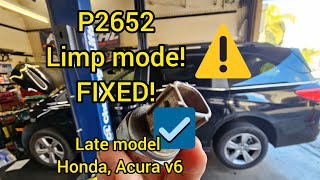
- Vehicle may enter 'limp mode,' unable to maintain highway speed 🎬 See how to fix limp mode on newer Honda V6 engines.
- Poor fuel economy
- Flashing 'P' (Park) indicator on the instrument cluster
- Replacing the wrong oil pressure switch. The P2652 code specifically refers to the 'B' switch on Bank 1, which is on the rear cylinder head near the firewall. There is another switch on the front bank (Bank 2). A forum user on r/hondapilot confirmed from experience that the switches for Bank 1 and Bank 2 were not interchangeable on their 2016 Pilot.
- Assuming the VTEC spool valve solenoid is bad. The pressure switch and the solenoid are often located on the same assembly, but P2652 points specifically to the switch circuit, not the solenoid itself.
Most Likely Causes

- Faulty Rocker Arm Oil Pressure Switch (Bank 1) 🔴 High Probability This is a very common failure point on Honda J-series V6 engines due to wear and tear or internal faults. Technicians report replacing them frequently on Pilots, Odysseys, and Ridgelines.
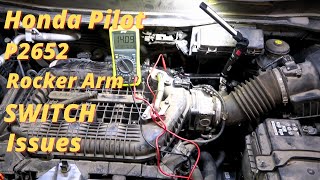
How to confirm: After verifying oil level and condition, perform an electrical test. 🎬 Watch: How to diagnose a rough idle and test the switch. Backprobe the switch connector with the engine running; if voltage remains high (around 12V) instead of dropping to near 0V, the switch is bad. Replacing the switch is the most common definitive fix.
Typical fix: Replace the Bank 1 (rear, near firewall) rocker arm oil pressure switch and its O-ring.
Est. part cost: $25-$60 - Low or Dirty Engine Oil 🟡 Medium Probability The VCM/VTEC system relies on clean oil at the proper pressure. Low levels or sludge can clog passages and cause the switch to malfunction or report incorrect pressures.
How to confirm: Check the engine oil dipstick. If the level is low or the oil appears very dark, gritty, or sludgy, this is a likely contributor.
Typical fix: Perform an oil and filter change using the manufacturer-recommended oil viscosity (e.g., 0W-20) and clear the code.
Est. part cost: $40-$80 - Clogged Oil Passages or Spool Valve Screen ⚪ Low Probability Oil sludge or debris can accumulate over time, especially if oil change intervals are extended, blocking the small screens or passages leading to the pressure switch. Forum users warn that leaking spool valve gaskets are common and can drip oil onto the alternator, causing its premature failure.
How to confirm: When the switch is removed, inspect the opening for sludge or debris. The VTEC spool valve assembly, which houses the switch, has screens that can be inspected for blockages. Check for oil leaks around the spool valve assembly.
Typical fix: Carefully clean the passages. If the spool valve gasket is leaking, it should be replaced. In severe cases, the entire VTEC spool valve assembly may need to be removed, cleaned, or replaced.
Est. part cost: $15-$40 for gaskets and cleaning supplies - Wiring or Connector Issue ⚪ Low Probability While less common than switch failure, wires can be damaged by heat, vibration, or rodents, causing a short or open circuit that prevents the PCM from seeing the correct voltage drop.
How to confirm: Visually inspect the wiring harness and connector leading to the Bank 1 oil pressure switch for any signs of damage, corrosion, or loose connections. Test for continuity between the switch connector and the PCM.
Typical fix: Repair the damaged section of the wiring harness or clean/replace the connector.
Est. part cost: $10-$50
Diagnosis Steps
- Check Engine Oil Level and Condition: This is the first and most important step. Ensure the oil is full and clean on a level surface. If it's low or very dirty, perform an oil change with the correct 0W-20 oil and filter, clear the code, and see if it returns.
- Scan for Other Codes: Check for related codes like P3400, which strongly confirms the issue is with the Bank 1 valve control system.
- Locate and Inspect the Switch and Wiring: The Bank 1 switch ('B' switch) is on the rear cylinder head, near the firewall. It has a green or brown connector. Visually inspect the connector and its single wire for any damage, corrosion, or oil contamination.
- Perform Electrical Test: With the key on (engine off), disconnect the connector and test the wire from the harness; it should have a reference voltage from the PCM. A more definitive test is to backprobe the connected switch with the engine running. The voltage should drop from ~12V to near 0V as oil pressure builds. If it stays high, the switch has failed internally.
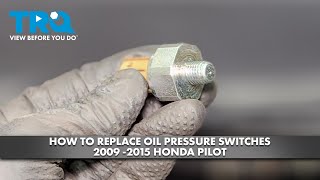
- Replace the Switch: If the switch is confirmed faulty, disconnect the electrical connector, use a 24mm deep socket 🎬 Watch this walkthrough for replacing the VCM oil pressure sensor. to remove the old switch, and install the new one with a new O-ring to prevent leaks. Torque the new switch to 22 N.m (16 lb-ft).
- Clear Codes and Test Drive: After replacing the switch, use a scan tool to clear the trouble codes. Drive the vehicle through a few cycles, including highway speeds, to ensure the Check Engine Light does not return.
Parts You'll Likely Need

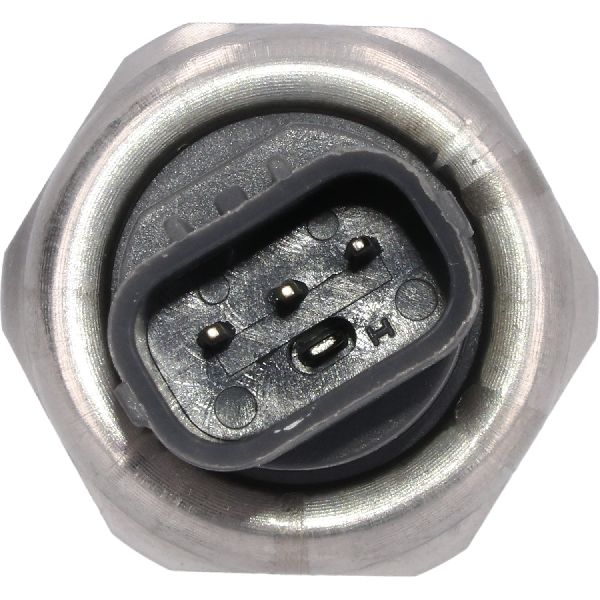
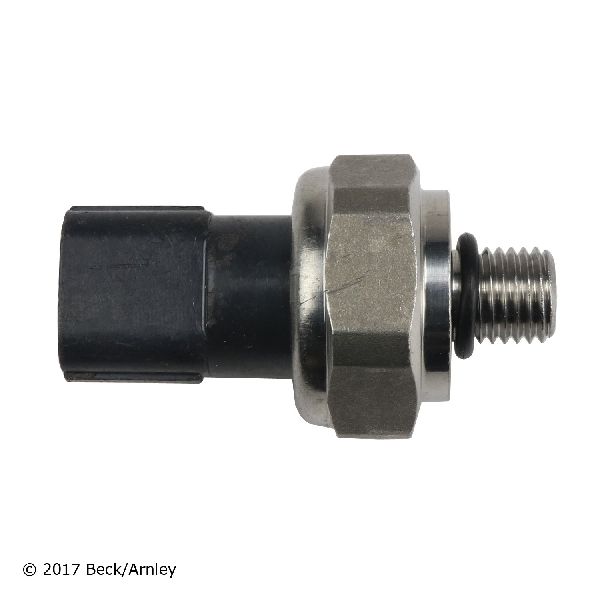
- Rocker Arm Oil Pressure Switch (Bank 1)
(OEM #37240-R70-A04)— This switch is the most common point of failure for code P2652. It directly reports the pressure reading that the PCM has identified as faulty. This part number supersedes 37240-R70-A03 and 37240-R70-A02.
Trusted brands: Honda Genuine, NTK, Carquest Premium
OEM price range: $40-$65
Aftermarket price range: $25-$45 - Oil Pressure Switch O-Ring
(OEM #91319-PAA-A01)— It is critical to replace the O-ring when replacing the switch to prevent oil leaks. It is often sold separately from the switch.
Trusted brands: Honda Genuine
OEM price range: $3-$5
Aftermarket price range: $1-$3 - VTEC Spool Valve Gasket / Screen Assembly
(OEM #15826-RDV-J01)— Recommended for replacement if the spool valve assembly is removed for cleaning or if it is found to be leaking oil. Leaks from this gasket are known to drip onto the alternator, causing premature failure.
Trusted brands: Honda Genuine
OEM price range: $15-$25
Aftermarket price range: $10-$20
Related Codes That Often Appear With This One
- P3400 — P3400 (Valve Pause System [VPS] Stuck Off Bank 1) is directly related. The P2652 code indicates the switch is stuck on, which can cause the PCM to then log a P3400 fault for the overall system. A Honda TSB explicitly links these two codes.
- P0430 — P0430 (Catalyst System Efficiency Below Threshold Bank 2) was reported by an owner alongside P2652. A poorly running engine due to the VCM/VTEC issue can lead to incomplete combustion, which over time can affect the catalytic converter's performance.
- U0401 — U0401 (Invalid Data Received From ECM/PCM) may be stored in the Transmission Control Module (TCM). This is a secondary code caused by the primary engine fault; the erratic engine performance triggers a communication fault flag in the TCM.
Technical Service Bulletins (TSBs) & Recalls
- ATI&01192022901: 'Request for Visit: 2017 Odyssey, Pilot & Ridgeline MIL On w/ DTC P2652/P3400 Stored'. This bulletin confirms Honda was aware of and actively investigating this specific issue on the 2017 Pilot and its platform mates.
Platform-Specific Known Issues
- A Technical Service Bulletin (TSB #ATI&01192022901) was issued by Honda specifically looking for 2017 Pilots with codes P2652 and P3400, along with complaints of a rough running engine, for further investigation.
- A real-world owner complaint filed with the NHTSA (ODI #11310976) for a 2017 Pilot described the vehicle losing power at highway speeds and being unable to maintain speed, with codes P2652 and P0430 present.
- On the Piloteers.org forum and Reddit's r/MechanicAdvice, owners of
Mechanic-Grade Diagnostic Values
- Rocker Arm Oil Pressure Switch B (Bank 1) - Reference Voltage — expected: ~12V with connector backprobed, key on, engine off.. Failure: If voltage is not present, suspect a wiring issue or PCM fault. If voltage is present, proceed to engine-on test.
- Rocker Arm Oil Pressure Switch B (Bank 1) - Operating Voltage — expected: Voltage should drop to near 0V when the engine is started and oil pressure builds.. Failure: If voltage remains high (~12V) with the engine running, the switch is internally failed and not grounding the circuit.
- VCM System Oil Pressure — expected: 45 kPa (6.5 psi) or more at the switch port.. Failure: If pressure is below this threshold, the issue is likely a clogged oil passage or a failing oil control valve, not the switch itself.
- Rocker Arm Oil Pressure Switch - Continuity Test — expected: Continuity should exist between the two terminals of the switch when it is removed from the engine.. Failure: If there is no continuity, the switch's internal circuit is open, and it must be replaced.
Scan Tool Commands That Help
- Honda Diagnostic System (HDS) or equivalent bidirectional scanner (e.g., XTool D7): VTEC System Test / Actuation Test — This command actively turns the VTEC solenoid on and off while monitoring the pressure switch's status. It is used to confirm if the solenoid is responding and if the pressure switch is correctly reporting the change in oil pressure, which helps differentiate between a switch, solenoid, or wiring fault.
- Honda Diagnostic System (HDS): Jump SCS Line — This is a preparatory step used before disconnecting PCM connectors for wiring tests. It cancels the PCM's function of staying on for up to an hour after the vehicle is turned off, preventing potential damage to the PCM during diagnosis.
Wiring & Ground Locations
- PCM Connector C (51P) — This is one of the main connectors at the Powertrain Control Module (PCM).. The wire for the Rocker Arm Oil Pressure Switch B (Bank 1) runs to this connector. It is disconnected during advanced wiring checks for shorts or opens between the PCM and the switch.
- Bank 1 Rocker Arm Oil Pressure Switch Wire — Runs from the switch (rear cylinder head, near firewall) to the PCM.. This single wire carries the voltage signal. On some models, this is a BLU/BLK (Blue/Black) wire. It should be tested for reference voltage and continuity to the PCM.
- Main Engine Ground — A primary ground strap is typically located from the battery negative terminal to the vehicle's chassis/frame. Another key ground connects the engine block to the chassis.. The oil pressure switch grounds through the engine block. A poor engine ground connection can cause various electrical issues, including erratic sensor readings, although it's a less common cause for this specific code.
Real Owner Repair Stories
- YouTube channel 'KIT'S Auto and Truck Repair' (2016 Honda Pilot) — Check engine light on, emission system problem message, blind spot info system problem message, high idle, and a flashing 'P' (Park) indicator.
❌ Tried (didn't work) The technician went directly to diagnosis rather than replacing parts without testing.
✅ What actually fixed it The technician performed a backprobe test on the Bank 1 rocker arm oil pressure switch. With the engine off, it showed 12.15V. With the engine running, the voltage did not drop, confirming the switch was bad. Replacing the Bank 1 (rear) oil pressure switch resolved the code and all symptoms. - YouTube channel 'p2652 limp mode 2018-24 honda odyssey fixed' (2018+ Honda Odyssey (shares J35 engine)) — Check engine light with code P2652, vehicle in limp mode.
❌ Tried (didn't work) The video advises checking oil level first, which is a standard step but not the ultimate fix in this case.
✅ What actually fixed it The video identifies the Bank 1 'B' sensor on the rear of the engine as the culprit. The final fix was replacing this sensor using a 24mm deep socket. The creator states that nine times out of ten, if the oil level is correct, the sensor itself is the problem.
OEM Part Supersession History
37240-R70-A02, 37240-R70-A03→37240-R70-A04— Standard part revision and improvement by the manufacturer.
Heads up: The newest part number, 37240-R70-A04, is the correct replacement for the earlier versions and should be used for repairs.
Helpful Videos
We Have This Part in Stock



The information in this article is provided for general reference and educational purposes only. Vehicle specifications, procedures, and part compatibility can vary by production date, trim level, and region. Always consult your vehicle's factory service manual and verify part numbers before purchasing or performing repairs. Safety-critical components such as airbags, seat belts, and braking systems should be installed by a qualified professional.
- Honda PILOT:
- 🎬 Helpful Videos
- 🛍️ Shop This Part
- What's Unique About the 2017-2017 Honda PILOT
- Diagnostic Flowchart
- Symptoms You May Notice
- Most Likely Causes
- Diagnosis Steps
- Parts You'll Likely Need
- Related Codes That Often Appear With This One
- Technical Service Bulletins (TSBs) & Recalls
- Platform-Specific Known Issues
- Mechanic-Grade Diagnostic Values
- Scan Tool Commands That Help
- Wiring & Ground Locations
- Real Owner Repair Stories
- OEM Part Supersession History
- 🎟️ Get 5% Off