

P2652 on 2003-2010 Honda Accord: Causes and Fixes for VTEC System Faults
This code indicates a problem with the VTEC system's oil pressure switch, specifically 'B' Rocker Arm Actuator System Stuck On. The most common causes are low engine oil or a faulty rocker arm oil pressure switch. On 4-cylinder engines, this is a single switch. On V6 engines, this code typically points to the switch on the rear cylinder bank (Bank 1). Replacing the switch is a straightforward and affordable DIY fix.
- First, check your engine oil. Low oil is a very common cause for P2652.
- If the oil level is correct, the most likely culprit is a faulty VTEC oil pressure switch (Part No. 37250-PNE-G01), as confirmed by a Honda TSB.
- Replacing the switch is a simple DIY job that requires basic tools and costs under $100 for the part.
- While you are servicing the system, consider checking or replacing the VTEC solenoid screen, especially if oil changes have been neglected.
- This code is specific to the VTEC system, not the engine's main oil pressure system that controls the dashboard warning light.
What's Unique About the 2003-2010 Honda ACCORD

On Honda Accords from this era, the P2652 code is almost exclusively tied to the VTEC system, a hallmark of Honda engineering. Unlike generic oil pressure warnings, this code points directly to the system that controls variable valve timing. The issue is so common on the 4-cylinder K24 engine that Honda issued Technical Service Bulletin A13-021 for it. On the V6 engines (J30/J35), the system is more complex, with separate VTEC assemblies for each cylinder bank. P2652 typically refers to the 'B' switch on Bank 1 (the rear bank), which can be related to both VTEC and the Variable Cylinder Management (VCM) system.
Diagnostic Flowchart
Tap your situation to follow the diagnostic path that matches what you're seeing on this vehicle.
Generation note: This range covers the 7th Generation (2003-2007) and the first part of of the 8th Generation (2008-2010). The fundamental cause and fix for P2652 are the same for both generations. However, the 8th generation V6 engine (J35Z) features a more complex Variable Cylinder Management (VCM) system which deactivates cylinders to save fuel. This system is also highly sensitive to oil pressure issues and can contribute to problems. For V6 models, P2652 specifically points to the rocker arm pressure switch 'B' on Bank 1 (rear cylinder head).
Symptoms You May Notice
- Check Engine Light is on
- Reduced engine performance, especially at higher RPMs when VTEC should engage
- Vehicle may enter 'limp mode', limiting speed
- Poor fuel economy
- Engine may hesitate or run rough
- Engine sounds louder, raspier, or 'stuck in VTEC' at low RPMs
- Replacing the entire VTEC solenoid assembly when only the pressure switch or the screen gasket is faulty.
- Replacing the main engine oil pressure sensor (for the oil light on the dash) instead of the specific VTEC rocker arm oil pressure switch. On V6 models, replacing the switch for the wrong bank.
Most Likely Causes

- Low Engine Oil Level 🔴 High Probability The VTEC system is hydraulic and relies entirely on correct oil pressure to function. Any deviation from the specified oil level can cause pressure drops that trigger sensor faults.
How to confirm: Check the engine oil dipstick when the car is on a level surface and the engine is cool. If the level is below the minimum mark, this is the likely cause.
Typical fix: Top up the engine oil to the correct level using the manufacturer-recommended oil type (typically 5W-20). Clear the code and see if it returns.
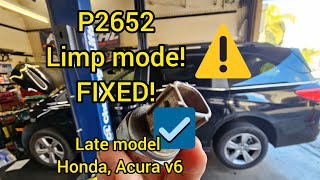
Est. part cost: $10-$20 for a quart of oil - Faulty Rocker Arm (VTEC) Oil Pressure Switch 🔴 High Probability Honda issued TSB A13-021 acknowledging that this switch can fail intermittently, causing a 'stuck on' or 'high voltage' reading. It is the most common part to fail when the oil level is correct. 🎬 Watch: How to replace the 2.4L rocker arm oil pressure switch. On V6 models, there are multiple switches, and P2652 usually points to the 'B' switch on Bank 1 (rear).
How to confirm: After confirming the oil level is correct, the next logical step is to replace the switch. It can be tested with a multimeter for continuity to ground when the engine is off. With the engine running, there should be no continuity. Given its low cost and high failure rate, replacement is often the most efficient diagnostic step.
Typical fix: Replace the rocker arm oil pressure switch and its O-ring. A 24mm deep socket is typically required.
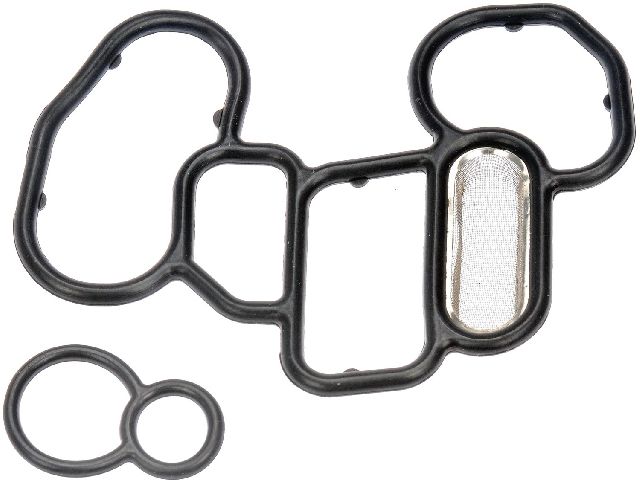
Est. part cost: $40-$120 - Clogged VTEC Solenoid Screen/Gasket 🟡 Medium Probability The VTEC solenoid assembly contains a small mesh screen that can become clogged with engine sludge or debris from infrequent oil changes, restricting oil flow to the pressure switch and causing a pressure drop.
How to confirm: Remove the VTEC solenoid assembly from the cylinder head and inspect the gasket/screen. If it is dirty, clogged, or torn, it needs to be cleaned or replaced.
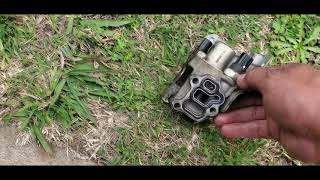
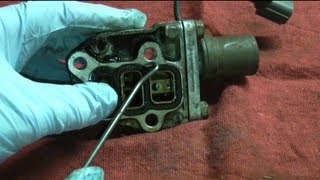
Typical fix: Clean the existing screen carefully with brake cleaner or replace the VTEC solenoid gasket, which includes a new screen. The OEM part number for the K24 engine gasket is 15815-RAA-A02. 🎬 See this step-by-step guide for replacing the VTEC solenoid gasket.
Est. part cost: $15-$30 for a new gasket with screen - Wiring or Connector Issue ⚪ Low Probability
How to confirm: Visually inspect the wiring and connector going to the oil pressure switch for any signs of damage, corrosion, or loose connection. A diagnostic test can confirm if there is an open in the wire between the switch and the PCM, which would also cause a 'high voltage' code. With the key on, one pin on the connector should show battery voltage.
Typical fix: Repair the damaged wire or clean/replace the connector.
Est. part cost: $5-$50 for wiring repair supplies
Rare But Worth Checking
- Faulty Powertrain Control Module (PCM): This is extremely rare. The PCM should only be considered after all other possibilities, including wiring, have been thoroughly ruled out by a professional.
Diagnosis Steps
- Check the engine oil level and condition. Top up or change if necessary. This is the most common and easiest fix.
- If the oil level is correct, clear the code and drive the vehicle to see if it returns. The issue may be intermittent.
- Inspect the electrical connector and wiring at the rocker arm oil pressure switch for any visible damage, corrosion, or looseness. On V6 models, ensure you are inspecting the correct switch (Bank 1, rear of engine).
- If the wiring looks good, replace the rocker arm oil pressure switch and its O-ring. This is the most likely failed component per TSB A13-021 for the 4-cylinder and is a very common failure on the V6.
- If the code persists, remove and inspect the VTEC solenoid gasket/screen for blockages. Clean or replace as needed.
- If all else fails, perform advanced diagnostics to test the circuit between the switch and the PCM for an open circuit. An oil pressure test can also be performed at the switch port to verify the hydraulic system is working correctly.
Parts You'll Likely Need

- Rocker Arm Oil Pressure Switch (VTEC Switch, 4-Cyl)
(OEM #37250-PNE-G01)— This switch is identified by Honda in TSB A13-021 as the primary cause of the P2652 code on K24 engines due to intermittent failure.
Trusted brands: Genuine Honda, Standard Motor Products, NTK
OEM price range: $80-$120
Aftermarket price range: $40-$70 - Rocker Arm Oil Pressure Switch (VTEC Switch 'B', V6 Bank 1)
(OEM #37240-R70-A04)— On J-series V6 engines, P2652 points to the switch on the rear cylinder head (Bank 1). This is a common failure part for V6 models.
Trusted brands: Genuine Honda, Standard Motor Products
OEM price range: $45-$70
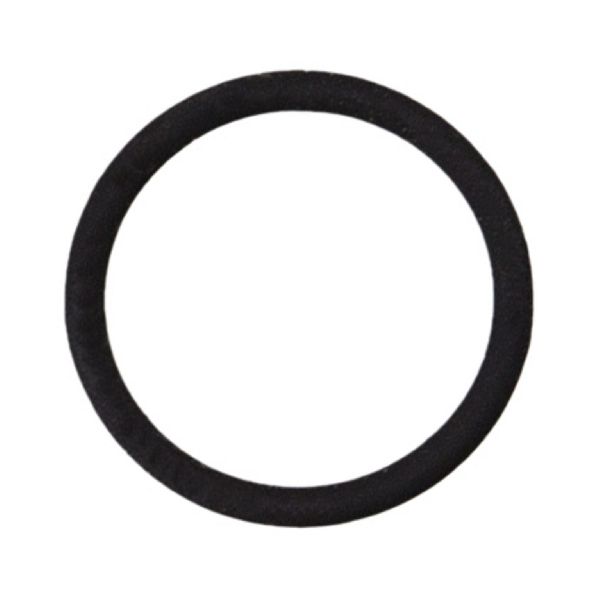
Aftermarket price range: $25-$50 - Rocker Arm Oil Pressure Switch O-Ring
(OEM #91319-PAA-A01)— This O-ring should always be replaced with the switch to prevent oil leaks. It is used for both 4-cylinder and V6 switches.
Trusted brands: Genuine Honda
OEM price range: $3-$5
Aftermarket price range: $1-$3 - VTEC Solenoid Gasket / Screen Assembly (4-Cyl)
(OEM #15815-RAA-A02)— If dirty oil has clogged the system, this screen can get blocked, causing pressure issues. It's a common maintenance item when servicing the VTEC system on K24 engines.
Trusted brands: Genuine Honda, Fel-Pro
OEM price range: $15-$30
Aftermarket price range: $10-$20
Related Codes That Often Appear With This One
- P2647 — This code is for 'Rocker Arm Oil Pressure Switch Circuit High Voltage', which is the counterpart to P2652. They often point to the same faulty switch failing intermittently.
- P2646 — This code is for 'Rocker Arm Oil Pressure Switch Circuit Low Voltage'. It can appear alongside P2652 if the switch is failing erratically.
- P3400 — On V6 models with VCM, this code for 'Valve Pause System (VPS) Stuck Off Bank 1' can appear with P2652, as both systems are hydraulically controlled and share oil passages.
Technical Service Bulletins (TSBs) & Recalls
- A13-021: States the MIL comes on with DTC P2647/P2652 (Rocker Arm Oil Pressure Switch Circuit High Voltage) and that the possible cause is an intermittent failure of the switch itself. It applies to many K-series engines, including the 2003-12 Accord L4.
- 13-082: A warranty extension for V6 Pilot models addressing engine misfires caused by piston ring alignment in VCM engines, highlighting the oil consumption issues that can affect these powerplants.
Platform-Specific Known Issues
- TSB A13-021 for 4-Cylinder Engines: Honda Technical Service Bulletin (TSB) A13-021 directly addresses DTC P2652 on 2003-2012 4-cylinder Accords, identifying an intermittently failing rocker arm oil pressure switch (P/N 37250-PNE-G01) as the likely cause and recommending its replacement along with its O-ring (P/N 91319-PAA-A01).
- V6 VCM-Related Oil Consumption: On 2008-2010 Accords with the J35Z V6 engine, the Variable Cylinder Management (VCM) system can lead to excessive oil consumption due to piston ring alignment issues. This was the subject of a class-action lawsuit (Honda TSB 1
Mechanic-Grade Diagnostic Values
- VTEC Oil Pressure Switch Continuity (Engine Off) — expected: Continuity (0 ohms or close to it) between the two pins on the switch.. Failure: No continuity (open circuit) indicates a faulty switch.
- VTEC Oil Pressure Switch Connector Voltage (Key On, Engine Off) — expected: Battery voltage at one of the two pins in the harness connector.. Failure: No voltage suggests a wiring issue or a problem with the PCM circuit.
- VCM System Oil Pressure Check (V6 Models) — expected: 45 kPa (6.5 psi) or more at the switch port during an HDS VTEC test.. Failure: Pressure below this threshold indicates a hydraulic issue, such as a clogged passage or faulty control valve, rather than just a bad switch.
Scan Tool Commands That Help
- Honda Diagnostic System (HDS): VTEC Test — This active test commands the VTEC system to operate, allowing a technician to monitor the switch status and measure oil pressure at the switch port to verify the hydraulic circuit is functioning correctly.
Wiring & Ground Locations

- G101 — On the driver's side of the engine bay, typically on the intake manifold plenum or thermostat housing.. G101 is a primary ground point for the Engine Control Module (PCM) and engine harness. A poor connection here can cause a wide range of erratic sensor readings and codes, including faults related to the VTEC system.
- VTEC Oil Pressure Switch Connector (4-Cyl) — On the VTEC solenoid assembly, located on the back of the cylinder head on the passenger side.. This is the direct connection point for the sensor. The pin furthest from the locking tab is the ground, and the pin closest to the tab is the signal wire to the PCM.
- VTEC Oil Pressure Switch 'B' Connector (V6) — On the rear cylinder head (Bank 1), often near the top.. This is the specific connector for the switch related to P2652 on V6 models. Damage or corrosion here will directly cause the code.
Real Owner Repair Stories
- Honda-Tech forum user (2004 Honda Accord (K24 engine)) — VTEC oil leak, followed by OBD code P2647 (high voltage) after repair.
❌ Tried (didn't work) Replaced VTEC solenoid/pressure switch assembly with an OEM part., Replaced the electrical plugs/connectors., Replaced both VTEC filter screens., Changed engine oil and filter.
✅ What actually fixed it The user suspected a faulty new pressure switch that failed when hot. After extensive testing, a shop confirmed the new OEM switch was indeed faulty and replaced it a second time, which finally resolved the code. This highlights that even new OEM parts can sometimes be defective.
OEM Part Supersession History
37240-R70-A02, 37240-R70-A03→37240-R70-A04— Part revision by the manufacturer for improved reliability or manufacturing process.15815-RAA-A01→15815-RAA-A02— Part revision for the VTEC solenoid gasket/screen assembly for K-series engines.
Heads up: While some aftermarket listings show A01, the A02 is the current and correct OEM part for this application.
Model Year Variations Within This Range
- 2003-2007: The 4-cylinder K24A4 engine in these Accords is an 'economy' version with VTEC acting only on the intake camshaft.
- 2008-2010: The 4-cylinder K24Z-series engines in these Accords have a different cylinder head design with an integrated exhaust manifold and may have different VTEC mechanics compared to the earlier K24A engines. The V6 engine is the J35Z, which includes the more complex Variable Cylinder Management (VCM) system, adding another layer of oil-pressure-dependent technology.
Helpful Videos
We Have This Part in Stock



The information in this article is provided for general reference and educational purposes only. Vehicle specifications, procedures, and part compatibility can vary by production date, trim level, and region. Always consult your vehicle's factory service manual and verify part numbers before purchasing or performing repairs. Safety-critical components such as airbags, seat belts, and braking systems should be installed by a qualified professional.
- Honda ACCORD:
- 🎬 Helpful Videos
- 🛍️ Shop This Part
- What's Unique About the 2003-2010 Honda ACCORD
- Diagnostic Flowchart
- Symptoms You May Notice
- Most Likely Causes
- Rare But Worth Checking
- Diagnosis Steps
- Parts You'll Likely Need
- Related Codes That Often Appear With This One
- Technical Service Bulletins (TSBs) & Recalls
- Platform-Specific Known Issues
- Mechanic-Grade Diagnostic Values
- Scan Tool Commands That Help
- Wiring & Ground Locations
- Real Owner Repair Stories
- OEM Part Supersession History
- Model Year Variations Within This Range
- 🎟️ Get 5% Off