

OBD-II Code P2652: Rocker Arm Oil Control Solenoid 'B' Circuit Stuck On
What P2652 means, why it triggers, and how to fix it
- Check your engine oil dipstick before buying parts, as a low oil level is the number one cause of code P2652.
- On Honda and Acura V6 engines, this code almost always requires replacing the Bank 1 oil pressure switch (OEM Part # 37240-R70-A04) located on the rear cylinder head.
- Limit driving to under 10 miles if this code is active, as the vehicle enters a 40-mph limp mode that causes dangerous stalling in traffic.
- Test the oil pressure switch for an internal short to ground using a multimeter before spending $250+ on a complete VTEC solenoid assembly.
What Does P2652 Mean?

The Powertrain Control Module (PCM) detected a fault in the oil pressure system controlling the engine's valves. Specifically, the sensor for the 'B' rocker arm actuator on Bank 1 reports it is stuck 'on'. On Honda and Acura vehicles, this system is known as VTEC or VCM (Variable Cylinder Management), and the 'B' switch monitors the VCM function that deactivates cylinders to save fuel.
Technical definition: The PCM detected the oil pressure switch for the 'B' rocker arm actuator remains in the 'on' position (reporting high voltage or a short to ground 🎬 Watch: Diagnostic walkthrough for 2017-2023 Honda Accord P2652 codes.) when it should be 'off'. The PCM supplies a reference voltage to the switch; when oil pressure is low, the circuit is open. When pressure is high, the switch closes to ground the circuit. This code triggers when the PCM sees a grounded circuit at the wrong time.
Can I Drive With P2652?
Yes, But With Caution. You can drive, but limit it to short distances. The vehicle often enters 'limp mode' with reduced speed (under 40 mph), stalls, or runs poorly, making highway driving unsafe. Extended driving starves upper engine components of oil and damages the catalytic converter from unburnt fuel, adding thousands to the repair cost.
Common Causes

- Low engine oil level (Very Common) — The VTEC/VCM system relies entirely on correct oil pressure. A low oil level is the primary trigger for this code.
- Faulty Rocker Arm Oil Pressure Switch 'B' (Very Common) — The switch fails internally or sticks, sending a constant 'on' signal to the computer. This is a known high-failure part on Honda and Acura V6 engines. 🎬 See how to replace the oil pressure switch on Honda V6 engines.
- Incorrect or dirty engine oil (Common) — Using the wrong viscosity oil or running old, sludgy oil clogs small passages and prevents the hydraulic system from operating.
- Clogged oil passages or solenoid screen (Less Common) — Sludge blocks the fine mesh screen on the solenoid assembly (spool valve), restricting oil flow and dropping pressure.
- Faulty Rocker Arm Oil Control Solenoid/Actuator (Less Common) — The solenoid directing oil flow sticks or fails electrically, causing the pressure switch to read incorrectly.
- Wiring or connector issues (Less Common) — The wiring harness or electrical connector for the pressure switch shorts to ground, corrodes, or suffers rodent damage, creating a false 'on' signal.
- Use of incorrect aftermarket oil filter (Rare) — Cheap aftermarket oil filters restrict oil flow and pressure, starving the VTEC/VCM system.
- Failing battery or alternator (Rare) — Low system voltage causes erratic behavior from electronic sensors, triggering false codes.
- Mechanical binding of the rocker arm (Very Rare) — Excessive carbon buildup or worn internal engine components physically prevent the rocker arm from moving.
- Internal PCM failure (Very Rare) — The Powertrain Control Module fails and misinterprets signals. Consider this only after exhausting all other diagnostics.
Symptoms

- Check Engine Light is on — The PCM illuminates the malfunction indicator lamp immediately upon detecting the fault.
- Vehicle enters 'limp mode' and lacks power — The car limits speed to under 40 mph and restricts RPMs to prevent engine damage. Acceleration feels sluggish.
- Engine stalling or rough idle — The engine stalls at low speeds or when stopped, accompanied by a rough, shaky idle.
- Audible ticking or tapping from the engine — Improper oil pressure in the valvetrain causes a noticeable ticking sound from the top of the engine.
- Hard or erratic shifting — Engine performance issues force the Transmission Control Module to receive invalid data, resulting in harsh shifts.
- Decreased fuel economy (also visible on scanner) — The VCM system disables, preventing the engine from deactivating cylinders to save gas.
Diagnostic Flowchart

Tap your situation to follow the diagnostic path that matches what you're seeing on this code.
Common Fixes & Costs
- Topping off or changing the engine oil and filter — Parts: $40-$80, Labor: $20-$40, ~0.5 hr book time (DIY)
- Replacing the Rocker Arm Oil Pressure Switch 'B' — Parts: $45-$65, Labor: $75-$150, ~0.8 hr book time (DIY)
- Cleaning or replacing the solenoid screen/gasket — Parts: $15-$40, Labor: $75-$150, ~1 hr book time (Intermediate)
- Replacing the Rocker Arm Oil Control Solenoid Assembly — Parts: $150-$250, Labor: $100-$200, ~1.2 hr book time (Intermediate)
- Professional Diagnosis — Parts: $0, Labor: $150-$200, ~1 hr book time (Pro)
DIY vs Professional
- Topping off or changing the engine oil and filter — Beginner:
Tools: Oil filter wrench, drain pan, funnel, socket set. - Replacing the Rocker Arm Oil Pressure Switch 'B' — Beginner:
Tools: 24mm deep socket, ratchet with extension, torque wrench. - Replacing the Rocker Arm Oil Control Solenoid Assembly — Beginner:
Tools: 10mm socket, ratchet with extensions, torque wrench, scraper.
Used vs. New Parts: Buying Guide
When a used part is worth it: Never buy a used oil pressure switch. Buy a used VTEC solenoid assembly (spool valve) from a low-mileage donor only if your vehicle exceeds 150,000 miles and budget is tight.
Donor-vehicle mileage cap: roughly under 80000 miles for the part to have meaningful remaining life.
Donor quality checklist:
- Verify the donor vehicle was not scrapped for engine failures.
- Match the part number exactly.
- Ensure the mesh screen is spotless and intact.
Decision logic:
- If The part is the oil pressure switch → Buy new OEM. The $50 cost makes used parts an unnecessary risk.
- If The part is the full solenoid assembly and the vehicle is over 150K miles → Buy a used part from a reputable salvage yard to save $150.
- If The vehicle is under 80K miles and needs a solenoid assembly → Buy a new OEM assembly to guarantee longevity.
Warranty tradeoff: Used parts carry a 30-day warranty. New OEM parts carry a 1-year warranty.
Worst-case if a used part fails: $400 if a used solenoid assembly fails, requiring repeat labor and a new part.
What Happens If You Wait — Timeline
- 0-2 weeks: Check Engine Light illuminates. Vehicle exhibits a slightly rough idle but remains drivable. (MPG impact: 5%% · Added cost: $0)
- 2 weeks - 3 months: Vehicle enters 'limp mode,' limiting speed to 40 mph. Stalling becomes frequent. Fuel economy drops as VCM disables. (MPG impact: 15%% · Added cost: $100)
- 3-8 months: Sustained poor combustion dumps unburnt fuel into the exhaust, melting the catalytic converter. (MPG impact: 20%% · Added cost: $2000)
- 8+ months: Lubrication starvation destroys the upper valvetrain and camshafts, requiring an engine replacement. (MPG impact: 25%% · Added cost: $4500)
Cost of Not Fixing It
- 0-1 month: Fuel economy drops 10% and the vehicle suffers sluggish performance and stalling. (Added cost: $50)
- 1-6 months: Unburnt fuel enters the exhaust from inefficient combustion, destroying the catalytic converter. (Added cost: $1200-$2800)
- 6+ months: Prolonged oil pressure faults starve the upper valvetrain, destroying the camshafts and requiring an engine rebuild. (Added cost: $3500)
Diagnosis Steps
- Check Engine Oil Level and Condition
Check the engine oil dipstick on a level surface. Top off with manufacturer-recommended oil if low. If the oil is dark, gritty, or smells burnt, change it immediately.
Tools: Rag (Beginner) - Scan for Additional Codes
Use an OBD-II scanner to check for related codes. P3400 frequently accompanies P2652 on Hondas. Misfire codes indicate the VCM system is causing rough running.
Tools: OBD-II Scanner (Beginner) - Inspect the Wiring and Connector
Locate the Rocker Arm Oil Pressure Switch 'B' (on Honda V6 engines, this is the rear switch on the Bank 1 spool valve). Inspect the green electrical connector and wiring for corrosion, oil intrusion, or broken wires.
Tools: Flashlight (Beginner) - Test the Oil Pressure Switch for Internal Short
With the engine off, disconnect the switch connector. Set a multimeter to Ohms. Place one probe on the switch terminal and the other on the engine block (ground). If resistance is less than 1.0 ohm, the switch is internally shorted ('stuck on') and requires replacement.
Tools: Multimeter (Intermediate) - Test the Oil Pressure Switch Circuit Voltage
Turn the key on (engine off). Measure the voltage between the harness connector terminal and ground. You must see a 12V reference voltage from the PCM. A 0V reading indicates an open or shorted wire.
Tools: Multimeter (Intermediate) - Inspect the Solenoid Assembly and Screen
Remove the rocker arm oil control solenoid assembly (spool valve). Inspect the small mesh screen on the gasket for sludge blocking oil flow. Clean or replace the gasket.
Tools: Socket set, ratchet, picks (Intermediate) - Advanced: Live Data Voltage Test
Back-probe the signal wire with a multimeter. Key on, engine off: expect ~12V. Start the engine. As oil pressure builds, voltage drops near 0V. If voltage stays at 12V while running, the switch failed to close.
Tools: Multimeter with back-probe pins (Advanced) - Advanced: Check Actual Oil Pressure
Remove the switch and attach a mechanical oil pressure gauge. With the engine warm, pressure must exceed 45 kPa (6.5 psi). Low pressure indicates a clogged passage or faulty solenoid, not a bad switch.
Tools: Oil pressure gauge kit (Advanced) - Advanced: Use a Dealer-Level Scan Tool
Run a 'VTEC+VCM TEST' using a professional scan tool. This commands the solenoid on/off and monitors the switch's response in real-time to verify intermittent failures.
Tools: Professional OBD-II Scan Tool (Advanced)
When This Code Triggers (Freeze-Frame Conditions)
- Engine Coolant Temp: 180-200°F (The VCM system operates only when the engine reaches full operating temperature.)
- RPM: 1500-2500 (The fault logs during low-to-mid RPM ranges associated with steady-state cruising.)
- Engine Load: 30-60% (Sets under light-load cruising conditions when the VCM system commands cylinder deactivation.)
- Vehicle Speed: 35-55 mph (Steady highway driving is the exact condition where the PCM tests the VCM system.)
Related Codes
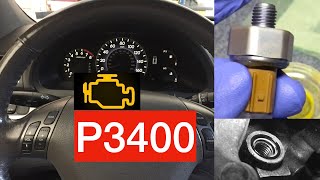
- P3400 — Indicates 'Valve Pause System Stuck Off Bank 1'. P2652 logs the switch fault, causing the VCM self-test to fail and triggering P3400 simultaneously.
- P2651 — The direct opposite of P2652, indicating the 'B' actuator is 'Stuck Off'. Diagnosis targets the exact same components.
- P2647 — Indicates the 'A' actuator is 'Stuck On'. The 'A' switch monitors VTEC, while 'B' monitors VCM. Both codes together indicate a catastrophic drop in engine oil pressure.
- P2646 — Indicates the 'A' actuator is 'Stuck Off'. Requires identifying the correct sensor location for your specific engine bank.
- U0401 — Indicates 'Invalid Data Received From ECM/PCM'. Triggers secondarily when the engine runs poorly from the P2652 fault. Fix P2652 first.
Climate & Environmental Factors
- Cold Weather: Low temperatures thicken engine oil, delaying hydraulic response times in the VTEC/VCM system and triggering temporary fault codes on cold starts.
- High Humidity: Moisture breaches compromised weather-pack seals on the oil pressure switch connector, shorting the low-voltage signal.
How to Talk to a Mechanic About This Code
Say this: "I have a P2652 code on my Honda. My oil level is full. I need a diagnostic to confirm if the Bank 1 'B' oil pressure switch failed or if there's a wiring issue before we replace the entire spool valve assembly."
This proves you know the common failure points. It forces the technician to test the $50 switch rather than immediately upselling a $400 spool valve assembly.
Avoid saying:
- 'My check engine light is on, can you look at it?'
- 'The internet said to replace the VTEC solenoid.'
- 'Just fix whatever's wrong.'
Questions to ask before authorizing the repair:
- Did you test the switch for an internal short to ground?
- Did you verify 12V reference voltage at the connector?
- If you recommend a full spool valve replacement, why won't the switch alone fix it?
- Is the solenoid screen clogged with sludge?
Where to Take It: Dealer vs Independent vs Chain
- Dealer:
Best for: Vehicles under powertrain warranty, Complex electrical harness repairs, Applying specific Technical Service Bulletins (TSBs)
Downsides: Labor rates are double independent shops., Dealers default to replacing the entire $400 spool valve assembly to prevent comebacks. (Typical cost: +50% vs. baseline) - Independent Shop:
Best fit. Independent shops see this Honda code daily and will happily replace just the $50 switch.
Best for: Out-of-warranty Honda/Acura vehicles., Owners who want a targeted, cost-effective repair.
Downsides: May lack the Honda Diagnostic System (HDS) tool for advanced bidirectional testing. (Typical cost: +0% vs. baseline) - Chain Shop:
Avoid for diagnostics. Use only if you specifically request they replace the oil pressure switch and nothing else.
Best for: A simple oil change if low oil triggered the code.
Downsides: Technicians lack specific diagnostic expertise for Honda VCM systems and will recommend unnecessary parts. (Typical cost: -10% vs. baseline)
When to Walk Away From the Repair
If the repair cost exceeds 40% of the car's value, consider selling it as-is.
- Car worth $4000, fix is $200: Fix it. Replacing the switch is cheap and restores critical engine function.
- Car worth $12000, fix is $450: Fix it. The cost of a full solenoid assembly is minor compared to the vehicle's value.
- Car worth $2500, fix is $3500: Walk away. If prolonged driving destroyed the camshafts, the repair exceeds the car's value.
What Scan Tool You Need for This Code
Minimum: A tool that reads live data PIDs to display the real-time On/Off status of the rocker arm oil pressure switch.
A $20 code reader cannot show live switch data. You must see if the switch state changes with RPM to confirm it is electronically 'stuck on'.
Budget: BlueDriver Pro Scan Tool (~$100) — Graphs live data from the oil pressure switch and provides a 'Confirmed Fix' database that accurately identifies the switch failure.
Mid-range: Foxwell NT510 Elite for Honda (~$180) — Provides bidirectional control to command the VCM solenoid on and off, testing the complete circuit from the driver's seat.
Professional: Autel MaxiCOM MK808S (~$450) — Replicates dealer tools to perform guided VCM system tests and full bidirectional active tests.
Rent vs buy: Buy a budget scanner. Because this code requires live data to diagnose properly, owning a capable tool saves you a $150 diagnostic fee.
How to Clear the Code After You Fix It
- Use an OBD-II scan tool to clear the P2652 code from the PCM.
- Perform a complete drive cycle to run the vehicle's readiness monitors.
- Rescan the vehicle to ensure the code remains clear and monitors read 'Ready'.
Drive cycle (~30 minutes): Cold start (engine off 6+ hours), idle for 3 minutes, accelerate to 55 mph and hold for 5 minutes, coast down to 20 mph without braking, accelerate back to 55 mph and hold for 5 minutes, then perform 10 minutes of city driving.
Readiness monitors affected: Catalyst monitor, O2 sensor monitor, EGR system monitor, EVAP system monitor
Before emissions retest: drive at least 100 miles to fully set monitors.
Watch out for:
- Clearing the code fails an emissions test instantly; readiness monitors require a full drive cycle to reset.
- The code returns immediately if you replace the switch but ignore a clogged solenoid screen.
- Disconnecting the battery clears the code but wipes all radio presets and readiness monitors.
Will This Fail Emissions / State Inspection?
Yes — this code typically fails an OBD-II emissions inspection.
- California: An active Check Engine Light guarantees a smog check failure. You must complete a drive cycle to set all readiness monitors to 'Ready' before retesting.
- New York: The NYS DMV inspection computer automatically fails any vehicle with an active P2652 code or incomplete readiness monitors.
- Texas: In emissions-testing counties, an illuminated Check Engine Light fails the OBD-II test. Texas allows one 'Not Ready' monitor for 2001+ vehicles, but clearing this code resets all of them.
Most Commonly Affected Vehicles
- Honda Pilot (2016-2022) — The Bank 1 rocker arm oil pressure switch (37240-R70-A04) fails frequently.
- Acura RDX (2013-2018) — Prone to VCM system switch failures. Rear switch access is exceptionally tight.
- Honda Odyssey (2018-2024) — The 'B' pressure sensor on the rear cylinder head is the primary culprit.
- Honda Accord (2008-2023) — V6 models suffer from intermittent switch failures addressed in multiple TSBs.
- Honda Ridgeline (2017-2023) — Routinely logs P2652 alongside P3400, both pointing to the Bank 1 switch.
- Acura MDX (2014-2020) — Acura issued bulletin BTI&01192022901 specifically targeting this code on 2017 models.
- Honda Civic (2016-2021) — VTEC-equipped models experience stuck-on rocker arm oil pressure switches.
- Acura TLX (2015-2020) — The 3.5L V6 almost exclusively throws this code for a faulty Bank 1 oil pressure switch.
Manufacturer-Specific Notes
- Honda/Acura: On V6 engines, P2652 almost exclusively points to a failed oil pressure switch (Part # 37240-R70-A04) on the rear cylinder bank (Bank 1). It monitors the deactivation of the rear three cylinders.
- Honda: Honda released multiple TSBs (e.g., 13-031, 11-033) acknowledging VCM oil pressure switch failures and confirming low oil triggers the codes.
- Acura: Acura issued internal bulletin BTI&01192022901 requesting dealer investigation into 2017 models storing P2652 and P3400 with rough running complaints.
Real Owner Stories
2016 Honda Pilot with rough driving
The vehicle drove rough and threw P2652. The owner checked the oil, found it full, and suspected the switch.
What they tried:
- Verified oil level.
- Replaced the Bank 1 oil pressure switch.
Outcome: Replacing the $50 switch permanently resolved the rough driving and cleared the code.
Lesson: If the oil level is correct on a Honda J35 engine, the oil pressure switch is the definitive culprit. Skip the mechanic and do this simple DIY fix.
2019 Honda Accord with intermittent pending code
P2652 appeared only after wide-open throttle acceleration. The car sounded loud and drove poorly at low RPMs.
What they tried:
- Replaced the entire spool valve assembly.
- Reset the code.
Outcome: The code returned immediately. The owner traced the issue to a damaged wiring harness connector.
Lesson: If replacing the switch or solenoid fails, the electrical circuit is broken. Inspect the wiring harness before assuming the new part is defective.
Honda CR-V with recurring VTEC codes
The vehicle repeatedly triggered VTEC codes despite multiple new OEM solenoids.
What they tried:
- Replaced the VTEC solenoid three times.
- Performed an engine flush.
Outcome: The root cause was a clogged filter screen on the engine block gasket. Cleaning the screen solved the problem permanently.
Lesson: A clogged oil screen perfectly mimics a failed electrical component. Always inspect and clean the gasket screen during replacement.
How to Prevent This Code From Triggering
- Perform regular oil changes with 0W-20 synthetic oil (Every 5,000 miles) — The hydraulic VTEC/VCM system requires pristine oil. Fresh oil prevents sludge from clogging the solenoid screens.
- Check engine oil level (Monthly) — Low oil drops system pressure, instantly disabling the VCM system and triggering P2652.
- Inspect and clean VTEC solenoid gasket/screen (At 100,000 miles or during valve cover service) — The mesh screen catches debris. Cleaning it restores full oil flow to the actuator.
- Install a VCM disabler (muzzler) on older Honda V6 engines (Once) — A VCM muzzler prevents the system from activating, eliminating wear on VCM components and preventing related codes entirely.
Frequently Asked Questions
What is the most common fix for P2652 on a Honda Pilot or Odyssey?
Replace the rocker arm oil pressure switch 'B' on Bank 1 (OEM part 37240-R70-A04). Always check the engine oil level first, as low oil is the other primary cause.
What's the difference between the 'A' and 'B' rocker arm actuators?
On Honda/Acura V6 engines, the 'A' switch monitors the VTEC system for high-RPM performance. The 'B' switch monitors the Variable Cylinder Management (VCM) system, which deactivates cylinders for fuel economy.
Can a bad battery cause a P2652 code?
Yes. A weak battery causes erratic voltage throughout the electrical system. This leads to false readings from sensitive electronic sensors, triggering codes like P2652 even if oil pressure is fine.
Can low oil cause a P2652 code?
Yes. Low engine oil is the most common reason for this code because the entire system depends on correct oil pressure to function. Always check your dipstick first.
Is the rocker arm oil control solenoid the same as the VTEC solenoid?
Yes, on Honda and Acura vehicles, these terms are used interchangeably. The rocker arm oil control solenoid is the main component of the VTEC/VCM assembly, also known as the 'spool valve'.
How much does it cost to fix code P2652?
A professional diagnosis costs $150-$200. Replacing the oil pressure switch costs $120-$215 for parts and labor. A full solenoid assembly replacement runs $250-$450.
Will an oil change fix the P2652 code?
Yes, if the code triggers from low or dirty oil. An oil and filter change restores proper pressure and resolves the issue. Clear the code afterward to confirm the fix.
Where is the 'B' rocker arm oil pressure switch located?
On most Honda/Acura V6 models, the 'B' switch for Bank 1 sits on the rear cylinder head near the firewall. It is part of the spool valve assembly and usually has a green electrical connector.
Key Takeaways
- Check your engine oil dipstick before buying parts, as a low oil level is the number one cause of code P2652.
- On Honda and Acura V6 engines, this code almost always requires replacing the Bank 1 oil pressure switch (OEM Part # 37240-R70-A04) located on the rear cylinder head.
- Limit driving to under 10 miles if this code is active, as the vehicle enters a 40-mph limp mode that causes dangerous stalling in traffic.
- Test the oil pressure switch for an internal short to ground using a multimeter before spending $250+ on a complete VTEC solenoid assembly.
Helpful Videos


The information in this article is provided for general reference and educational purposes only. Vehicle specifications, procedures, and part compatibility can vary by production date, trim level, and region. Always consult your vehicle's factory service manual and verify part numbers before purchasing or performing repairs. Safety-critical components such as airbags, seat belts, and braking systems should be installed by a qualified professional.
- 🎬 Helpful Videos
- What Does P2652 Mean?
- Can I Drive With P2652?
- Common Causes
- Symptoms
- Diagnostic Flowchart
- Common Fixes & Costs
- DIY vs Professional
- Used vs. New Parts: Buying Guide
- What Happens If You Wait — Timeline
- Cost of Not Fixing It
- Diagnosis Steps
- When This Code Triggers (Freeze-Frame Conditions)
- Related Codes
- Climate & Environmental Factors
- How to Talk to a Mechanic About This Code
- Where to Take It: Dealer vs Independent vs Chain
- When to Walk Away From the Repair
- What Scan Tool You Need for This Code
- How to Clear the Code After You Fix It
- Will This Fail Emissions / State Inspection?
- Most Commonly Affected Vehicles
- Manufacturer-Specific Notes
- Real Owner Stories
- 2016 Honda Pilot with rough driving
- 2019 Honda Accord with intermittent pending code
- Honda CR-V with recurring VTEC codes
- How to Prevent This Code From Triggering
- Frequently Asked Questions
- What is the most common fix for P2652 on a Honda Pilot or Odyssey?
- What's the difference between the 'A' and 'B' rocker arm actuators?
- Can a bad battery cause a P2652 code?
- Can low oil cause a P2652 code?
- Is the rocker arm oil control solenoid the same as the VTEC solenoid?
- How much does it cost to fix code P2652?
- Will an oil change fix the P2652 code?
- Where is the 'B' rocker arm oil pressure switch located?
- Key Takeaways
- 🎟️ Get 5% Off