

P2651 on 2003-2010 Honda Accord: VTEC Oil Pressure Switch Fixes
On a 2003-2010 Honda Accord, code P2651 is most often caused by low engine oil or a failed rocker arm oil pressure switch. Always check your oil level first. If the oil is full, replacing the switch (a ~$30-$80 part) is the next logical step and a common DIY fix. This issue is so common that Honda issued a Technical Service Bulletin (TSB) recommending the switch be replaced.
- First, check your engine oil. A low oil level is the most common and easiest-to-fix cause of P2651.
- If the oil level is correct, the rocker arm oil pressure switch is the next most likely culprit. Honda issued a TSB recommending its replacement for this code.
- A clogged VTEC spool valve filter screen is another common cause, especially if oil change intervals have been extended. Replacing the gasket/screen is a straightforward DIY job.
What's Unique About the 2003-2010 Honda ACCORD

For the 7th and 8th generation Honda Accord, the VTEC system is a signature feature. This code is common because its causes are simple and directly related to maintenance. The primary culprits are often just low engine oil or a small, inexpensive pressure switch that wears out over time. While the VTEC system is robust, it is highly dependent on clean oil at the correct level, making this code a frequent, but usually simple, issue for owners. The issue of a failing switch is so prevalent on the 4-cylinder models that Honda released a TSB (A13-021) specifically for it.
Diagnostic Flowchart

Tap your situation to follow the diagnostic path that matches what you're seeing on this vehicle.
Generation note: This range covers the 7th generation (2003-2007) and the start of the 8th generation (2008-2010) Accord. The VTEC system and the causes for this code are fundamentally the same for both generations. The 4-cylinder (K24 engine) and V6 (J-series engine) have different VTEC spool valve locations. On the K24, it's on the passenger side of the cylinder head, near the firewall. On the J-series V6, there are separate spool valves for the front and rear cylinder banks.
Symptoms You May Notice
- Check Engine Light (MIL) is on
- Reduced engine power and sluggish acceleration, especially at higher RPMs.
- Vehicle may feel like it's in 'limp mode'
- Possible hesitation or bucking during acceleration.
- A noticeable drop in fuel economy.
- Rough or uneven idle.
- Ticking or knocking noises from the engine, indicating lack of lubrication in the valvetrain.
- Replacing the entire VTEC spool valve assembly when only the pressure switch or the gasket/screen was needed.
- Replacing camshaft sensors or other engine sensors before checking the engine oil level first.
- Using aftermarket spool valve gaskets on V6 models, which can be improperly sized and cause other codes like P3497.
Most Likely Causes

- Low Engine Oil Level 🔴 High Probability The VTEC system is hydraulic and requires a specific oil volume and pressure to function. Any significant drop below the full mark can prevent the system from building enough pressure to activate the switch.
How to confirm: Check the engine oil dipstick when the car is on level ground and has been off for at least 15 minutes. The level should be between the two marks.
Typical fix: Add the correct specification engine oil (e.g., 5W-20 for many models) to bring the level to the full mark.
Est. part cost: $10-$40 - Failed Rocker Arm Oil Pressure Switch ('B') 🔴 High Probability This is a pressure-sensitive electrical switch that can fail internally over time, sending a false 'low pressure' signal even when pressure is adequate. This is the most common cause after low oil and is the subject of Honda TSB A13-021.
How to confirm: After confirming oil level is correct, this is the next most likely part. A mechanic can test the switch, but it's often replaced based on high probability. A leaking switch is a clear sign of failure.
Typical fix: Replace the rocker arm oil pressure switch. It is typically located on the VTEC spool valve assembly. The torque spec is often 16 lb-ft (22 N-m), and over-tightening can damage the threads.
Est. part cost: $30-$80 - Clogged VTEC Spool Valve Filter Screen 🟡 Medium Probability The spool valve assembly has a small mesh screen to filter oil. If oil changes are neglected, sludge and debris can clog this screen, restricting oil flow to the pressure switch and solenoid. The gasket holding the screen can also become brittle and break.
How to confirm: Remove the VTEC spool valve assembly (typically held by three 10mm bolts) and inspect the gasket/screen. It should be clean and free of debris.
Typical fix: Replace the VTEC spool valve gasket, which includes the screen. In some cases, the entire spool valve assembly may need replacement if the solenoid has failed. 🎬 Watch: Step-by-step guide to replacing the VTEC solenoid gasket.
Est. part cost: $15-$30 for the gasket/screen, $100-$250 for a full assembly. - Damaged Wiring or Connector ⚪ Low Probability The wiring to the pressure switch is in the engine bay and can be subject to heat and vibration, potentially causing a break, corrosion, or short over many years. The connector itself can become filled with oil if the switch leaks internally.
How to confirm: Visually inspect the wiring and connector leading to the oil pressure switch for any signs of fraying, corrosion, loose pins, or oil contamination.
Typical fix: Repair the damaged section of the wiring harness or replace the connector pigtail. Clean oil out of the connector with electrical contact cleaner.
Est. part cost: $5-$25
Rare But Worth Checking
- Failing Powertrain Control Module (PCM): This is extremely rare. All other possibilities, especially low oil and the switch itself, should be exhaustively ruled out before considering the PCM as the cause.
Diagnosis Steps

- Check the engine oil level and condition using the dipstick. Top off if low. If the oil is very old or dirty, perform an oil and filter change.
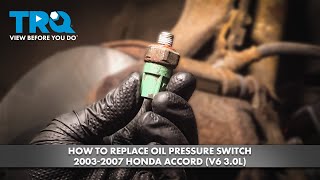
- If the code returns, locate the rocker arm oil pressure switch. On 4-cylinder models, it's on the VTEC spool valve assembly on the passenger side of the engine, near the firewall. For V6 models, there are separate switches for each bank. 🎬 Watch: How to replace the oil pressure switch on V6 models.
- Inspect the electrical connector and wiring going to the switch. Look for any breaks, corrosion, or loose connections. Check for oil inside the connector boot, which indicates a failed, leaking switch.
- If the wiring is okay and oil level is full, the most probable cause is the switch itself, as noted in Honda TSB A13-021. Replace the rocker arm oil pressure switch. A 24mm deep socket is often required. 🎬 See this walkthrough for replacing the oil pressure switch.
- If the code persists, remove the VTEC spool valve assembly (usually three 10mm bolts) and inspect the integrated filter screen for clogs or damage. Clean or replace the gasket/screen as needed.
- If all else fails, a more advanced diagnostic would be required to test the oil control solenoid and check for a potential (but rare) PCM issue.
Parts You'll Likely Need
- Rocker Arm Oil Pressure Switch (VTEC Oil Pressure Switch)
(OEM #37250-PNE-G01 (For L4 Accord), 91319-PAA-A01 (O-ring))— This switch is the most common component to fail, leading directly to the P2651 code. Honda TSB A13-021 explicitly recommends its replacement for this code.
Trusted brands: Honda Genuine, Standard Motor Products (PS418), NTK (OP0255)
OEM price range: $60-$90
Aftermarket price range: $30-$60 - VTEC Solenoid Gasket / Spool Valve Filter Assembly
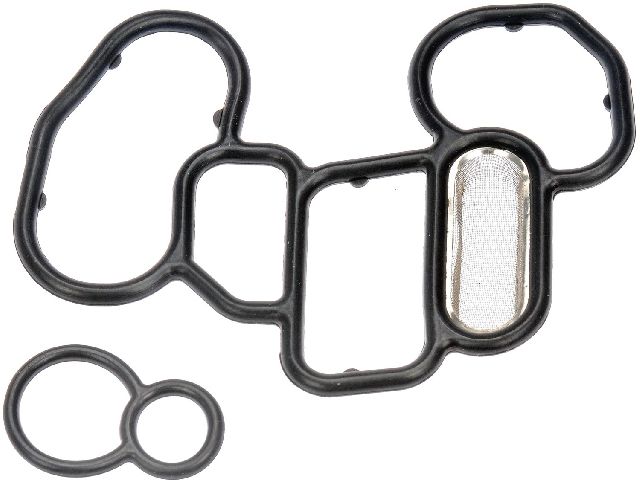
(OEM #15815-RAA-A02 (Upper), 15845-RAA-A01 (Lower, for 4-Cyl))— This gasket contains a filter screen that can become clogged with engine sludge, starving the system of oil pressure. It can also become brittle and leak externally or fail internally.
Trusted brands: Honda Genuine, Fel-Pro (ES 72173)
OEM price range: $15-$25
Aftermarket price range: $10-$20
Related Codes That Often Appear With This One
- P2646 — This is the corresponding code for 'Rocker Arm Oil Pressure Switch Circuit Low Voltage' for the 'A' switch. They share the same VTEC system and often have the same root causes, and are listed together in Honda's TSB.
- P2652 — This is the opposite code, 'Rocker Arm Oil Pressure Switch Circuit High Voltage'. It points to the same component and system, just a different failure mode, and is also covered by the same TSB.
Technical Service Bulletins (TSBs) & Recalls

- A13-021: SERVICE BULLETIN - THE MIL COMES ON WITH ONE OF THESE DTCS: P2646/P2651 (ROCKER ARM OIL PRESSURE SWITCH CIRCUIT LOW VOLTAGE)...
Platform-Specific Known Issues
- Honda issued Technical Service Bulletin (TSB) A13-021 which directly addresses DTC P2651, noting it as 'ROCKER ARM OIL PRESSURE SWITCH CIRCUIT LOW VOLTAGE'. The bulletin confirms the cause is often an intermittent failure of the switch itself and the corrective action is to replace it.
- On V6 models, the front spool valve is notorious for leaking oil directly onto the alternator, causing premature alternator failure. Replacing the spool valve gaskets is a critical preventative maintenance item.
Mechanic-Grade Diagnostic Values
- Rocker Arm Oil Pressure Switch Continuity (Engine Off) — expected: Continuity (approx. 0 ohms) between the switch terminal and engine ground.. Failure: No continuity (Open Line / OL) indicates a failed switch.
- Rocker Arm Oil Pressure Switch Continuity (Engine Running at Idle) — expected: No continuity (Open Line / OL) between the switch terminal and engine ground.. Failure: Continuity indicates the switch is stuck closed.
- VTEC System Oil Pressure (Solenoid OFF, 1000-2000 RPM) — expected: Below 49 kPa (7 psi).. Failure: Pressure significantly above this level may indicate a stuck-open oil control solenoid.
- VTEC System Oil Pressure (Solenoid ON, 3500 RPM) — expected: Above 390 kPa (57 psi).. Failure: Pressure below this level indicates a problem with oil supply, a clogged screen, or a faulty oil control solenoid.
- VTEC Oil Control Solenoid Resistance — expected: Approximately 3-5 kΩ.. Failure: Very low (shorted) or infinite (open) resistance indicates a failed solenoid.
Scan Tool Commands That Help
- Honda Diagnostic System (HDS) or equivalent bidirectional scanner: VTEC TEST or VTEC + VCM TEST — This is a key active test to diagnose P2651. The tool commands the VTEC solenoid ON and OFF while monitoring the VTEC pressure switch status, confirming if the electrical and hydraulic parts of the circuit are responding correctly without needing to manually jump wires.
Wiring & Ground Locations
- G101 — On the driver's side of the engine bay, typically bolted to the intake manifold plenum or the thermostat housing.. G101 is a primary ground termination point for the ECU and engine sensor harness. A corroded or loose G101 ground can cause erratic voltage readings and trigger various circuit codes, including P2651.
- Rocker Arm Oil Pressure Switch Connector — On the VTEC spool valve assembly. The signal wire is typically Blue with a Black stripe (BLU/BLK).. Knowing the signal wire color is essential for accurately back-probing the connector to test for voltage or continuity without damaging the harness.
Real Owner Repair Stories
- Reddit user in /r/hondapilot (2016 Honda Pilot (V6, similar VCM/VTEC system)) — Check Engine Light with code P2651.
❌ Tried (didn't work) Replacing the rocker arm oil pressure switch (part #37240-R70-A04). The code returned the next day.
✅ What actually fixed it The entire Bank 1 rocker arm oil control valve (spool valve assembly) had to be replaced.
OEM Part Supersession History
37250-PNE-G01→No supersession found.— This part number appears to be stable and has been used across many Honda models (Accord, CR-V, Element, Fit) for an extended period (2002-2016).
Model Year Variations Within This Range
- 2003-2007 (7th Generation): The 4-cylinder K24A engines in this generation came in two main types. 'Eco' versions (like K24A4) had VTEC on the intake cam only. The performance version (K24A2, from the Acura TSX but a popular swap) had a more desirable VTEC system operating on both intake and exhaust cams with 3-lobe cam profiles.
- 2008-2010 (8th Generation): The 8th generation was a significant redesign, resulting in a larger car. Its K24Z-series engines often featured an integrated exhaust manifold cast into the cylinder head and 'economy' VTEC on the intake side only, which is considered less performance-oriented than the earlier K24A2.
Helpful Videos
We Have This Part in Stock



The information in this article is provided for general reference and educational purposes only. Vehicle specifications, procedures, and part compatibility can vary by production date, trim level, and region. Always consult your vehicle's factory service manual and verify part numbers before purchasing or performing repairs. Safety-critical components such as airbags, seat belts, and braking systems should be installed by a qualified professional.
- Honda ACCORD:
- 🎬 Helpful Videos
- 🛍️ Shop This Part
- What's Unique About the 2003-2010 Honda ACCORD
- Diagnostic Flowchart
- Symptoms You May Notice
- Most Likely Causes
- Rare But Worth Checking
- Diagnosis Steps
- Parts You'll Likely Need
- Related Codes That Often Appear With This One
- Technical Service Bulletins (TSBs) & Recalls
- Platform-Specific Known Issues
- Mechanic-Grade Diagnostic Values
- Scan Tool Commands That Help
- Wiring & Ground Locations
- Real Owner Repair Stories
- OEM Part Supersession History
- Model Year Variations Within This Range
- 🎟️ Get 5% Off