

P2646 on 2014 Toyota Corolla: Rocker Arm Actuator Performance Guide
On a 2014 Toyota Corolla, code P2646 almost always points to an issue with the Valvematic system, often due to low/dirty oil or a known software glitch. First, check your oil level and condition. If the oil is fine, a dealer software update as specified in TSB T-SB-0011-14 Rev is the most likely fix and may be covered under the Federal Emission Warranty.
- For a 2014 Toyota Corolla, P2646 is very specific to the Valvematic system in the 2ZR-FAE engine.
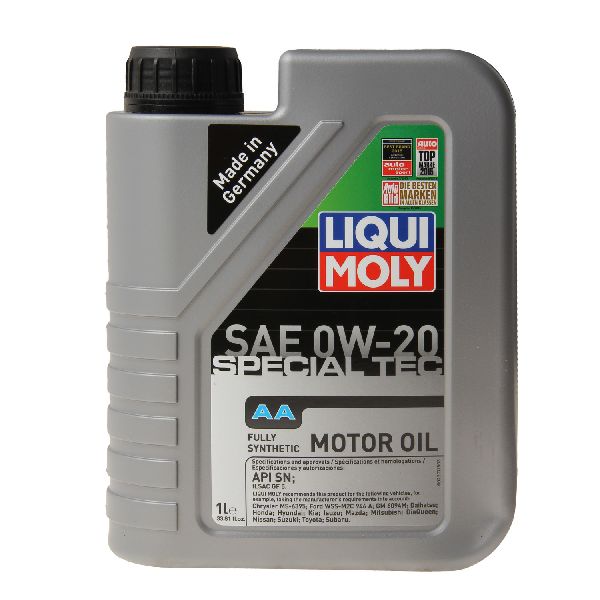
- Before buying any parts, check your engine oil level and condition. An oil change with the correct 0W-20 oil is the easiest and a very common fix.
- Ask a Toyota dealer to check if TSB T-SB-0011-14 has been performed. A simple software update often resolves this code and may be covered by the 8-year/80,000-mile Federal Emission Warranty.
- Do not replace the ECM; it is almost never the cause of this specific code.
What's Unique About the 2014-2014 Toyota COROLLA

The 2014 Corolla was one of the models equipped with the then-new 2ZR-FAE engine featuring Valvematic technology. Unlike a simple VVT system that only adjusts timing, Valvematic also controls valve lift. This code is specific to this more complex system. Toyota even issued a Technical Service Bulletin (T-SB-0011-14 Rev) for this exact issue on this model year, indicating a known problem that could often be fixed with a simple software recalibration at the dealer, rather than a mechanical parts replacement. This TSB is a critical piece of information, as it points to a non-mechanical fix for a code that might otherwise lead to expensive, unnecessary part replacements.
Diagnostic Flowchart
Tap your situation to follow the diagnostic path that matches what you're seeing on this vehicle.
Generation note: The 2ZR-FAE engine with Valvematic was used in various Toyota and Scion models from roughly 2009 onwards, and this issue can appear on them as well.
Symptoms You May Notice
- Check Engine Light (MIL) is on
- Reduced engine power and poor acceleration
- Engine stutters or jerks when trying to accelerate, sometimes limited to around 3,500 RPM
- Rough or unstable idle
- Increased fuel consumption
- Engine may feel sluggish, especially at higher RPMs
- In some cases, a general misfire feeling across all cylinders may be present
- Replacing the Valvematic actuator when only an oil change or software update was needed.
- Replacing the ECM, which is almost never the cause for this specific code on this vehicle.
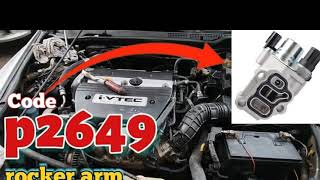
- Mistaking the issue for a bad camshaft sensor or VVT solenoid without first addressing the specific P2646 causes. 🎬 Watch: A quick overview of P2646 causes and common fixes.
Most Likely Causes

- Low, incorrect, or dirty engine oil 🔴 High Probability The Valvematic system is hydraulically operated and highly sensitive to oil pressure and cleanliness. Sludge or low oil levels can prevent the actuator from moving correctly or clog small oil passages.
How to confirm: Check the engine oil level on the dipstick and inspect its condition. If it's low, black, or sludgy, it needs to be changed. Ensure the correct viscosity (typically 0W-20) is being used.
Typical fix: Perform an oil and filter change using the manufacturer-recommended oil viscosity. Clear codes and test drive.
Est. part cost: $30-$70 - Outdated Engine Control Module (ECM) Software 🔴 High Probability Toyota released TSB T-SB-0011-14 specifically for the 2014 Corolla, stating that the ECM calibration was revised to address this exact code. The original software may be too sensitive and falsely trigger the code.
How to confirm: A Toyota dealer or a shop with a Techstream scan tool can check the current calibration ID against the TSB to see if the update has been performed.
Typical fix: Flash the ECM with the updated software calibration provided by Toyota. This is often covered under the Federal Emission Warranty (8 years/80,000 miles).
Est. part cost: $0-$200 - Faulty Continuously Variable Valve Lift Controller Assembly 🟡 Medium Probability This is the electromechanical assembly that physically adjusts the valve lift. It contains a motor that can fail internally, either electrically or mechanically, causing it to get stuck.
How to confirm: After ruling out oil issues and software, a technician can use a diagnostic tool like Techstream to perform an active test on the Valvematic system to see if the 'Current Angle' follows the 'Target Angle'. If it doesn't respond, the controller is likely faulty.
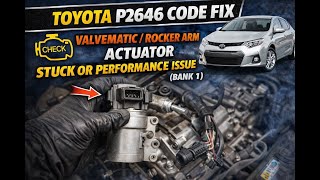
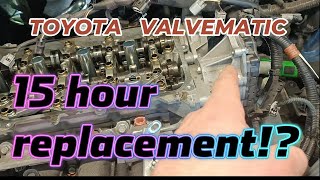
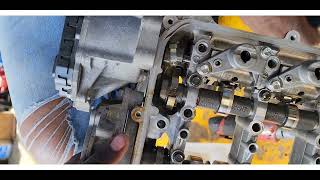
Typical fix: Replace the continuously variable valve lift controller assembly. This requires removing the valve cover for access. 🎬 Watch: Step-by-step guide to removing and replacing the Valvematic controller.
Est. part cost: $400-$700
Rare But Worth Checking
- Clogged oil passages or screens: If oil changes have been severely neglected, sludge can build up and block the small passages or filter screens that feed the Valvematic actuator, even if the oil has since been changed. This may require an engine flush or more intensive cleaning. Some owners have found success cleaning these screens.
- Wiring or Connector Issue: Damage to the wiring harness or a poor connection at the Valvematic controller can interrupt the signal from the ECM, causing the code. This should be inspected before replacing the expensive controller assembly.
- Faulty Engine Control Module (ECM): This is very rare. The TSB explicitly states the ECM should NOT be replaced as part of the standard repair procedure for this code. All other possibilities should be exhausted before considering the ECM itself is bad.
Diagnosis Steps
- Check Engine Oil: Verify the oil level is correct and the oil is clean. If low or dirty, perform an oil and filter change with the correct viscosity oil (0W-20). Clear codes and test drive. This is the simplest and a very common fix. 🎬 See how to diagnose and fix the Valvematic actuator code.
- Scan for Codes: Confirm P2646 is present. Note if P265B, P10A0, or P1055 are also present.
- Check for TSB Compliance: Have a dealer or qualified shop check if TSB T-SB-0011-14 Rev has been performed. If not, have the ECM reprogrammed. This is a very likely fix and may be covered under the 8-year/80,000-mile Federal Emission Warranty.
- Perform Active Test (Requires Techstream): A technician can command the Valvematic actuator to move and monitor its position. The TSB outlines a specific procedure to check if the 'VALVEMATIC Current Angle' changes in response to commanding it HIGH and LOW (it should move between ~105 and ~108+ degrees). If it does not respond, the controller assembly is suspect.
- Inspect Wiring: Check the wiring and connector going to the Valvematic controller assembly for any signs of damage, corrosion, or looseness. The connector clips can be delicate.
- Test/Replace Actuator: If all the above steps fail to resolve the issue, the continuously variable valve lift controller assembly is likely faulty and needs replacement. This involves removing the valve cover.
Parts You'll Likely Need

- Engine Oil and Filter — The most common and simplest cause is low or dirty oil. Always start here.
Trusted brands: Mobil 1, Castrol, Valvoline, Toyota Genuine Motor Oil
OEM price range: $50-$90
Aftermarket price range: $30-$70 - Continuously Variable Valve Lift Controller Assembly
(OEM #222A0-37025 (latest); supersedes 222A0-37024, 222A0-37023, 222A0-37022, 222A0-37021, 222A0-37020, 222A0-37019)— If oil and software are not the issue, this assembly is the next most likely part to have failed. It contains the motor and sensors that control the Valvematic system.
Trusted brands: Toyota (Genuine OEM)
OEM price range: $450-$750
Related Codes That Often Appear With This One
- P265B — This code for 'B Rocker Arm Actuator Position Sensor Circuit Range Performance' is often seen with P2646. Toyota's TSB for the 2014 Corolla addresses both codes simultaneously as they relate to the same system malfunction.
- P10A0 — This code, 'Valvematic Angle Difference [CSS]', can also appear alongside P2646 on other Toyota models with the 2ZR-FAE engine, pointing to a discrepancy in the actuator's position.
- P1055 — Similar to P10A0, this code for 'Valvematic Angle Difference [ECU]' indicates a fault within the Valvematic system and is mentioned in TSBs for later model years with the same engine family.
Technical Service Bulletins (TSBs) & Recalls
- T-SB-0011-14 Rev: Addresses MIL 'ON' with DTC P2646 or P265B on 2014 Corollas with the 2ZR-FAE engine, recommending an ECM calibration update.
- T-SB-0098-19: Addresses P2646 and other Valvematic codes on later models (2018-2020 C-HR, 2020 Corolla) and outlines a procedure for resetting the controller's learned value and, if necessary, replacing the controller assembly (part # 222A0-37024).
Platform-Specific Known Issues
- A Technical Service Bulletin (T-SB-0011-14 Rev) was issued by Toyota specifically for the 2014 Corolla with the 2ZR-FAE engine to address codes P2646 and P265B by reprogramming the ECM. This indicates a known software issue from the factory.
- The Federal Emission Warranty, which is in effect for 96 months or 80,000 miles, covers the ECM reprogramming outlined in the TSB, potentially making the fix free of charge if the vehicle qualifies.
Mechanic-Grade Diagnostic Values
- VALVEMATIC Current Angle (Techstream Active Test) — expected: Command LOW: ~105-106 degrees. Command HIGH: >108 degrees.. Failure: The angle value does not change or does not meet the expected degree range when commanded.
- Wiring Harness Resistance — expected: < 0.5 Ω. Failure: Higher resistance indicates a problem in the wiring between the ECM and the Valvematic controller.
Scan Tool Commands That Help
- Toyota Techstream: Engine and ECT > Utility > Learn Value Reset — Used to clear the stored learned operational values of the Valvematic controller. This should be performed after clearing DTCs, after a battery disconnect, or after replacing the controller assembly to force the system to relearn its operating parameters.
- Toyota Techstream: Engine and ECT > Active Test > Activate the VALVEMATIC (ENG OFF) — This is a bidirectional test to command the actuator motor to move with the engine off. It directly verifies if the controller is mechanically and electrically capable of responding to ECM commands. Failure to respond during this test points to a faulty controller or wiring.
Wiring & Ground Locations
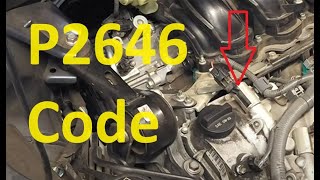
- Continuously Variable Valve Lift Controller Assembly — Rear of the engine compartment, mounted to the cylinder head.. This is the primary component for the P2646 code. Its connector and wiring harness are critical points of inspection for damage or corrosion.
- ECM (Engine Control Module) — Left side of the engine compartment.. The ECM sends the command signal to the Valvematic controller. A poor connection or ground at the ECM can mimic a failed actuator.
- Ground Points BA, BB — Located on the top of the engine.. These are primary engine ground points. A loose or corroded ground here can cause various electrical issues, including erratic behavior from sensors and actuators like the Valvematic controller.
- Ground Points E01, E02 — Associated with the ECM grounding circuit.. Proper grounding for the ECM is essential for stable sensor readings and actuator commands. A fault in these specific grounds could directly impact the Valvematic control circuit.
Real Owner Repair Stories
- YouTube user 'aaanton11' (Toyota Auris (uses similar Valvematic system)) — Check engine light, lack of power, engine won't go above 3,000 RPM.
❌ Tried (didn't work) A software reset of the Valvematic unit using a diagnostic scanner provided a temporary fix that only lasted a couple of days.
✅ What actually fixed it The persistent fault required the replacement of the entire Valvematic actuator assembly. - YouTube user 'DaringBeefcake' (2015 Toyota with 2.0L Petrol (2ZR family)) — Persistent P2646 code that could not be deleted, rough running, and misfires on all cylinders.
❌ Tried (didn't work) Clearing the code with a scanner was unsuccessful as the code was constant.
✅ What actually fixed it The problem was solved by replacing the Valvematic actuator (controller assembly).
When the Usual Fixes Don't Work
- While the TSB and common knowledge suggest an ECM reprogram or a 'Learn Value Reset' can fix this code, real-world mechanic reports show this can be a temporary solution. If the actuator is mechanically failing or sticking internally, a software reset may restore function for a short period (hours or days), but the code and symptoms will return. In these cases, the reset serves as a diagnostic step confirming the actuator itself is the ultimate point of failure and requires replacement.
OEM Part Supersession History
222A0-37019, 222A0-37020, 222A0-37021, 222A0-37022, 222A0-37023, 222A0-37024→222A0-37025— Part revisions are common for components identified in Technical Service Bulletins. Each new part number typically incorporates design improvements to enhance reliability and prevent the failure mode (sticking or electronic malfunction) that causes the P2646 code.
Model Year Variations Within This Range
- 2014 (Early Production): Per TSB T-SB-0011-14 Rev1, 2014 Corollas built BEFORE specific VINs are prone to the software issue and require the ECM update. Vehicles built after these VINs already have the revised software, making the cause more likely to be oil-related or a mechanical actuator failure. * TMMMS Plant VIN before: 5YFBPRHE#EP125796 * TMMC Plant VIN before: 2T1BPRHE#EC151571
Helpful Videos
Used OEM Parts in Stock

New Aftermarket Parts Available


The information in this article is provided for general reference and educational purposes only. Vehicle specifications, procedures, and part compatibility can vary by production date, trim level, and region. Always consult your vehicle's factory service manual and verify part numbers before purchasing or performing repairs. Safety-critical components such as airbags, seat belts, and braking systems should be installed by a qualified professional.
- Toyota COROLLA:
- 🎬 Helpful Videos
- 🛍️ Shop This Part
- What's Unique About the 2014-2014 Toyota COROLLA
- Diagnostic Flowchart
- Symptoms You May Notice
- Most Likely Causes
- Rare But Worth Checking
- Diagnosis Steps
- Parts You'll Likely Need
- Related Codes That Often Appear With This One
- Technical Service Bulletins (TSBs) & Recalls
- Platform-Specific Known Issues
- Mechanic-Grade Diagnostic Values
- Scan Tool Commands That Help
- Wiring & Ground Locations
- Real Owner Repair Stories
- When the Usual Fixes Don't Work
- OEM Part Supersession History
- Model Year Variations Within This Range
- 🎟️ Get 5% Off