

P2646 on 2003-2010 Honda Accord: VTEC System Causes and Fixes
On a 2003-2010 Honda Accord with the 2.4L engine, code P2646 is almost always caused by low/dirty engine oil, a clogged VTEC solenoid screen, or a faulty VTEC oil pressure switch. Start by checking your oil; if it's full and clean, the next most common fix is replacing the VTEC oil pressure switch or the entire VTEC solenoid assembly. Many owners strongly recommend using OEM Honda parts to avoid repeat failures.
- P2646 on a 2003-2010 Accord almost always points to an issue with the VTEC system on the 2.4L engine.
- Always check your engine oil level and condition first. A simple oil change is the cheapest and easiest potential fix.
- The most common failed part is the VTEC oil pressure switch (37250-PNE-G01), as confirmed by a Honda TSB.
- The second most common issue is a clogged VTEC solenoid screen (15815-RAA-A02), which can be cleaned or replaced for a low cost.
- Driving with this code will result in poor performance and 'limp mode,' so it should be addressed promptly.
What's Unique About the 2003-2010 Honda ACCORD

This code is extremely common on Honda's K-series engines, including the 2.4L (K24) found in the 2003-2010 Accord. The VTEC system's reliance on clean oil and sufficient pressure makes it sensitive to maintenance. The design incorporates several small filter screens that can become clogged over time with oil sludge, especially if oil change intervals are extended. Honda has issued a Technical Service Bulletin (A13-021) that directly points to an intermittently failing rocker arm oil pressure switch as a primary cause for this code on these vehicles, recommending its replacement.
Diagnostic Flowchart
Tap your situation to follow the diagnostic path that matches what you're seeing on this vehicle.
Generation note: This range covers the 7th generation (2003-2007) and the first part of the 8th generation (2008-2010) Honda Accord. The P2646 code and its causes are common to the 2.4L K24 engine used in both generations. The VTEC solenoid assembly and related components are in a similar location on the back of the cylinder head for both generations.
Symptoms You May Notice
- Check Engine Light is on
- Engine will not rev past 2,500-3,000 RPM (limp mode)
- Poor acceleration and sluggish performance
- Vehicle may jerk, stutter, or stumble when trying to accelerate past the RPM limit
- VSA (Vehicle Stability Assist) light may also illuminate along with the Check Engine Light
- Replacing spark plugs or ignition coils. While these can cause performance issues, they do not directly cause a P2646 code.
Most Likely Causes

- Low or Dirty Engine Oil 🔴 High Probability The VTEC system is hydraulically operated and highly sensitive to oil level and quality. Sludge from infrequent oil changes can clog passages and screens. This is the first and most important check. 🎬 Watch: A quick guide on what to check first.
How to confirm: Check the engine oil dipstick. The oil level should be between the two marks. Check the oil's color and consistency; if it is black, thick, or gritty, it needs to be changed.
Typical fix: Perform an oil and filter change using a quality filter. Many owners recommend using only Honda OEM oil filters. For high-mileage (150k+) engines, some owners report success using a slightly thicker 5W-30 oil instead of the specified 5W-20.
Est. part cost: $30-$70 - Faulty VTEC Oil Pressure Switch 🔴 High Probability Honda issued a TSB (A13-021) identifying this switch as a common point of intermittent failure for this exact code. The switch can fail internally, even without visible leaks, causing it to send an incorrect low voltage signal.
How to confirm: The switch can be tested with a multimeter for proper operation, but since it often fails intermittently, replacement is a common and effective diagnostic step. Check for oil leaking from the switch itself. Many forum users and mechanics recommend replacing this part proactively due to its high failure rate.
Typical fix: Replace the VTEC oil pressure switch and its O-ring. Using an OEM Honda switch (Part No. 37250-PNE-G01) is strongly recommended by many owners to avoid premature failure of aftermarket parts.
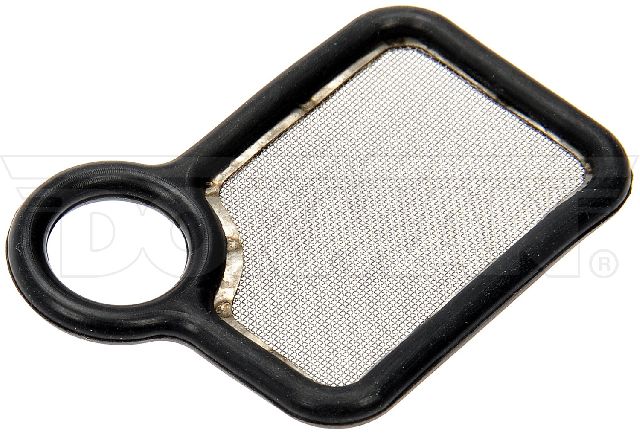
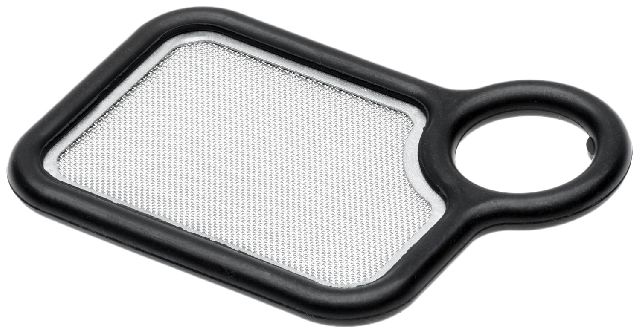
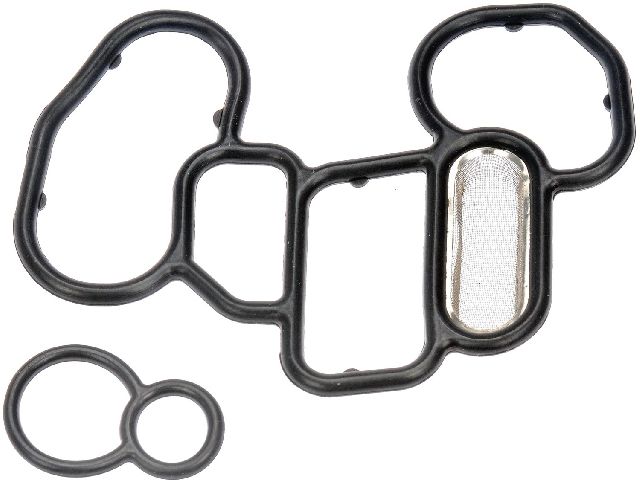
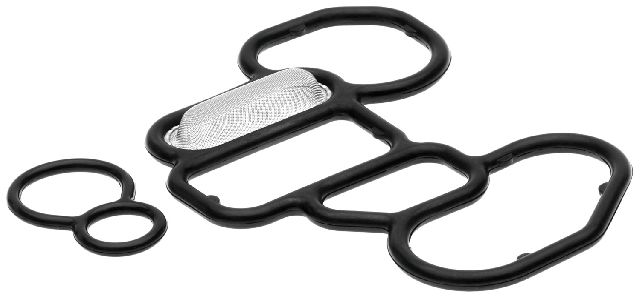
Est. part cost: $30-$60 - Clogged VTEC Solenoid Gasket/Screen 🟡 Medium Probability The VTEC solenoid assembly has a small integrated mesh filter screen that is designed to catch debris. Over time, this screen can become completely clogged with sludge, restricting oil flow to the VTEC system.
How to confirm: Remove the VTEC solenoid assembly from the back of the cylinder head and inspect the gasket and screen. If it is covered in dark sludge or debris, it is clogged. The rubber part of the gasket can also become hard and brittle, causing pressure leaks.
Typical fix: Replace the VTEC solenoid gasket, which includes the screen. It is a low-cost part and often solves the problem. Cleaning the screen is possible, but replacement is cheap and ensures a good seal.
Est. part cost: $10-$25 - Faulty VTEC Solenoid Assembly 🟡 Medium Probability The solenoid itself can fail electrically or mechanically, getting stuck and preventing proper oil flow. Aftermarket solenoids are widely reported to fail quickly, making OEM (Honda or the original manufacturer, Keihin/Hitachi) the preferred choice.
How to confirm: The solenoid can be tested by applying 12V power to see if it actuates (clicks). Resistance can also be checked with a multimeter (should be between 14-30 ohms). 🎬 See how to test the solenoid and replace the gasket. Often, the entire assembly is replaced as it includes the solenoid, gasket/screen, and sometimes the pressure switch.
Typical fix: Replace the entire VTEC solenoid spool valve assembly. This is often done after the switch and screen have been replaced without success.
Est. part cost: $100-$250
Rare But Worth Checking
- Clogged VTC Oil Filter Screen (Front of Engine): There is a second, lesser-known oil screen for the VTC (Variable Timing Control) system located on the front of the engine, behind the power steering pump. This screen (Part No. 15845-RAA-A01) can also get clogged and contribute to oil pressure issues.
- Wiring or Connector Issue: Water intrusion or corrosion in the electrical connector for the oil pressure switch can cause a low voltage reading. This is a very common issue on the Honda Element, where water leaks from the cowl directly onto the connector. Always inspect the connector for moisture or damage and apply dielectric grease when replacing the switch.
- Internal Engine Oil Pressure Problem: In very rare cases with high-mileage or poorly maintained engines, a failing oil pump or worn internal components could cause low overall oil pressure, triggering this code among others. An oil pressure test with a mechanical gauge would be needed to confirm this.
- Faulty Powertrain Control Module (PCM): This is extremely rare. All other possibilities, including wiring, should be exhausted before considering the PCM as the cause.
Diagnosis Steps
- Check engine oil level and condition. Perform an oil and filter change if necessary, preferably with a Honda OEM filter. Clear the code and test drive, ensuring you rev the engine above 3,000 RPM.
- If the code returns, locate the VTEC assembly on the back of the cylinder head, passenger side.
- Inspect the electrical connector for the VTEC oil pressure switch. Ensure it is dry, clean, and securely connected. Check for corrosion.
- Replace the VTEC oil pressure switch (Part No. 37250-PNE-G01) and its O-ring (Part No. 91319-PAA-A01), as recommended by Honda's TSB. This is a very common and often successful fix.
- If the code persists, remove the three 10mm bolts holding the VTEC solenoid assembly to the head. The torque spec for these bolts is 8.7 lb-ft (12 Nm), so be careful not to overtighten them into the aluminum head.
- Inspect and replace the solenoid's gasket/screen (Part No. 15815-RAA-A02) for sludge or blockages.
- Consider inspecting/cleaning the second VTC screen (Part No. 15845-RAA-A01) on the front of the engine, behind the power steering pump, as it can also get clogged.
- If all screens are clean and the switch has been replaced, the VTEC solenoid itself is the likely culprit. Test it or replace the entire assembly (Part No. 15810-RAA-A03). Strongly consider an OEM part.
- If all parts are confirmed good, check for continuity and voltage in the wiring harness between the switch and the PCM.
Parts You'll Likely Need

- VTEC Oil Pressure Switch
(OEM #37250-PNE-G01)— This switch is a known high-failure point and is the subject of a Honda TSB for this specific code. Many owners report that aftermarket versions fail quickly and recommend OEM.
Trusted brands: Honda (OEM), Standard Motor Products, Beck Arnley
OEM price range: $40-$60
Aftermarket price range: $20-$40 - VTEC Solenoid Gasket (Spool Valve Filter)
(OEM #15815-RAA-A02)— This gasket contains a screen that gets clogged with oil sludge, restricting oil flow and causing the code. It's an inexpensive and very common fix.
Trusted brands: Honda (OEM), Fel-Pro, Mahle
OEM price range: $10-$15
Aftermarket price range: $5-$10 - VTEC Solenoid Assembly (Spool Valve)
(OEM #15810-RAA-A03)— The solenoid itself can fail or the internal passages can become clogged. Aftermarket units are known to cause repeat issues. This part number is primarily for the 2003-2007 generation.
Related Codes That Often Appear With This One
- P2647 — This code is for 'Rocker Arm Oil Pressure Switch Circuit High Voltage.' It's the counterpart to P2646 and points to the same system, often caused by a faulty switch or wiring issue. Some owners report P2646 changing to P2647 after a repair attempt, indicating the issue is electrical.
Technical Service Bulletins (TSBs) & Recalls
- A13-021: MIL Comes On With DTCs P2646/P2651 or P2647/P2652
Platform-Specific Known Issues
- Honda Technical Service Bulletin A13-021 explicitly addresses DTC P2646 on 2003-2012 Accord L4 models and recommends replacing the rocker arm oil pressure switch (P/N 37250-PNE-G01) and O-ring (P/N 91319-PAA-A01) as the corrective action due to intermittent failure.
Mechanic-Grade Diagnostic Values
- VTEC Solenoid Resistance — expected: 14 - 30 Ohms. Failure: A reading outside of this range indicates a faulty solenoid coil.
- VTEC Oil Pressure Switch Connector Voltage — expected: 12V (Battery Voltage). Failure: Significantly less than 12V or 0V indicates a wiring issue, fuse problem, or PCM fault.
- VTEC System Oil Pressure (Mechanical Gauge) — expected: At least 392 kPa (56.9 psi). Failure: Pressure not rising to this level during a VTEC test points to a hydraulic issue (clogged screen, bad oil pump, internal leak) rather than an electrical one.
- VTEC Oil Pressure Switch Continuity — expected: Continuity (0 ohms) with engine off; No continuity (open circuit) with engine running.. Failure: If the switch has no continuity when the engine is off, or has continuity when the engine is running and has oil pressure, the switch is faulty.
Scan Tool Commands That Help
- Honda Diagnostic System (HDS) or equivalent professional scanner: VTEC TEST — This is a bidirectional test used to command the VTEC solenoid ON while monitoring the VTEC pressure switch status or a mechanical oil pressure gauge. It directly tests the system's hydraulic and electrical response, confirming if the PCM's command results in the required oil pressure increase.
Wiring & Ground Locations

- G101 — On the 2.4L 4-cylinder engine, this critical ground is located on the intake manifold plenum, near the thermostat housing.. G101 serves as a primary ground for the PCM. A poor connection here can cause a host of erratic issues and incorrect voltage readings for various sensors, including the VTEC oil pressure switch.
- VTEC Oil Pressure Switch Connector — On the VTEC solenoid assembly, located on the back of the cylinder head on the passenger side.. This connector is the source of the voltage signal. The Blue/Black wire should have battery voltage with the key on. The other wire (often Yellow/Brown) is the signal wire that goes to pin C13 on the PCM. Checking for voltage here is a primary diagnostic step.
Real Owner Repair Stories
- Honda Accord Forum user 'usedcarman' (2003 Accord LX 2.4L) — Check engine light on, car 'falls on its face' under acceleration.
❌ Tried (didn't work) Replacing the VTEC oil pressure switch (Part #37250-pne-g01) and clearing the code.
✅ What actually fixed it The code returned after replacing the switch. The final fix was removing the VTEC solenoid assembly and cleaning the integrated filter screen, which was clogged with debris. - driveaccord.net forum user (2007 Accord EXL) — DTC P2646
❌ Tried (didn't work) Initially just replacing the VTEC solenoid assembly.
✅ What actually fixed it A multi-step cleaning process solved the issue. The final fix involved: 1) Replacing the VTEC solenoid gasket/screen (was 100% clogged). 2) Replacing the VTC screen on the front of the engine (was 100% clogged). 3) Cleaning the three mesh screens on the VTC oil control solenoid. 4) Performing an oil change with Mobil One 5W-20 and a NAPA Gold (WIX) filter, explicitly switching away from Fram filters. - YouTube channel 'BrianandPhil' (2003 Honda Accord with 211,000 miles) — Bucking when accelerating over 2,000 RPM, would not shift to the next gear.
✅ What actually fixed it The problem was fixed by performing an oil change and cleaning both the VTEC solenoid screen (on the back of the engine) and the VTC screen (on the front of the engine behind the power steering pump). The check engine light turned off on its own after the repair.
"I Checked Everything" — The Actual Cause
- While a smoke test is not used for this code, a similar pattern exists where all parts test good but the code persists. On K24-equipped vehicles like the Honda Element (and potentially the Accord), a common hidden cause is water intrusion. A leaking windshield cowl seal allows water to drip directly onto the VTEC oil pressure switch connector. Over time, this causes corrosion inside the connector, leading to a low voltage reading that triggers P2646, even if the switch and solenoid are perfectly fine. The fix is to repair the water leak and clean or replace the corroded connector pigtail.
When the Usual Fixes Don't Work
- In several documented cases, simply replacing the VTEC oil pressure switch as suggested by the TSB was not enough to fix the code. The problem often returned until the integrated filter screens were also addressed. One owner replaced the switch, had the code return, and only found a permanent fix after cleaning the main VTEC solenoid gasket/screen which was clogged with sludge. Another owner had to perform a comprehensive cleaning of all VTEC and VTC related screens (both on the main solenoid and the secondary VTC filter on the front of the engine) before the code was finally resolved, highlighting that a single clogged screen can be the root cause even if other parts are new.
OEM Part Supersession History
15810-RAA-A01, 15810-RAA-A02, 15810-PNE-G01, 15810-PPA-A01→15810-RAA-A03— Part consolidation and potential design updates by Honda over the years.
Heads up: This part number chain applies primarily to the 2003-2007 Accord (7th gen). The 2008-2010 Accord (8th gen) uses a different VTEC assembly (e.g., for the K24Z3 engine), so 15810-RAA-A03 is not correct for those later years.
Model Year Variations Within This Range
- 2008-2010: The 8th generation Accord (2008-2012) uses a different version of the K24 engine (K24Z-series) compared to the 7th generation's K24A-series. While the P2646 code and its general causes are similar, the VTEC solenoid assembly and its corresponding part number are different. The common part number 15810-RAA-A03 is for the 2003-2007 models; 8th generation models require a different part.
Helpful Videos
We Have This Part in Stock


The information in this article is provided for general reference and educational purposes only. Vehicle specifications, procedures, and part compatibility can vary by production date, trim level, and region. Always consult your vehicle's factory service manual and verify part numbers before purchasing or performing repairs. Safety-critical components such as airbags, seat belts, and braking systems should be installed by a qualified professional.
- Honda ACCORD:
- 🎬 Helpful Videos
- 🛍️ Shop This Part
- What's Unique About the 2003-2010 Honda ACCORD
- Diagnostic Flowchart
- Symptoms You May Notice
- Most Likely Causes
- Rare But Worth Checking
- Diagnosis Steps
- Parts You'll Likely Need
- Related Codes That Often Appear With This One
- Technical Service Bulletins (TSBs) & Recalls
- Platform-Specific Known Issues
- Mechanic-Grade Diagnostic Values
- Scan Tool Commands That Help
- Wiring & Ground Locations
- Real Owner Repair Stories
- "I Checked Everything" — The Actual Cause
- When the Usual Fixes Don't Work
- OEM Part Supersession History
- Model Year Variations Within This Range
- 🎟️ Get 5% Off