

P2636 on 2007-2010 GMC Sierra 3500: Fuel Transfer Pump Problems and Fixes
On a 2007-2010 GMC Sierra 3500 with dual fuel tanks, code P2636 means the rear auxiliary fuel pump is failing to transfer fuel to the front tank. This commonly results in the fuel gauge dropping to empty. The most frequent causes are a failed auxiliary fuel pump, a faulty Fuel Pump Control Module (FPCM) due to corrosion, or a kinked transfer hose, an issue so common it's detailed in TSBs.
- P2636 on a dual-tank Sierra 3500 points specifically to the rear-to-front fuel transfer system.
- Always turn the truck completely off when refueling to avoid setting a false code.
- The most common failed parts are the auxiliary fuel pump in the rear tank and the Fuel Pump Control Module (FPCM) on the frame rail.
- Before replacing parts, inspect the fuel lines between the tanks for visible kinks or damage, as this is a known issue.
- If the engine stalls, you have likely run the front tank dry; the truck cannot use the fuel in the rear tank until the transfer system is repaired.
What's Unique About the 2007-2010 Gmc SIERRA 3500
The GMC Sierra 3500, especially chassis cab and long bed models with the RPO N2N dual-tank option, uses this system for extended driving range. This requires a dedicated transfer pump and a frame-mounted Fuel Pump Control Module (FPCM), which introduces unique failure points. The FPCM is notoriously prone to corrosion due to its exposed location on the frame rail, where its aluminum housing reacts with the steel frame (galvanic corrosion). Furthermore, GM has issued multiple Technical Service Bulletins (TSBs) acknowledging issues with fuel transfer lines becoming kinked and the system's sensitivity to being refueled with the engine running, which can falsely trigger P2636.
Diagnostic Flowchart
Tap your situation to follow the diagnostic path that matches what you're seeing on this vehicle.
Symptoms You May Notice
- Fuel gauge suddenly drops to empty.
- Malfunction Indicator Lamp (MIL) is illuminated.
- Low fuel level warning light is on.
- Engine stalls when the front tank runs out of fuel, even if the rear tank is full.
- Message on Driver Information Center (DIC) indicating a fuel system issue.
- Replacing the primary (front tank) fuel pump when the issue is with the secondary (rear tank) transfer system.
- Replacing the fuel level sending unit without first testing the transfer pump's flow rate.
- Replacing the transfer pump when the actual fault is a corroded FPCM or a hidden kink in the transfer line.
Most Likely Causes
- Failed Auxiliary (Rear) Fuel Transfer Pump 🔴 High Probability The transfer pump is a mechanical part that runs frequently to keep the front tank supplied. Forum discussions confirm these pumps are a common failure item that can weaken over time.
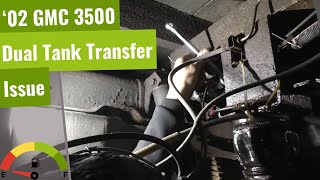
How to confirm: Perform a fuel transfer pump flow test as detailed in TSB PIT5510. 🎬 See how to diagnose a dual tank fuel transfer failure. Command the pump on with a scan tool; it should transfer more than 2.6 liters (0.7 gallons) in two minutes. If flow is low, and voltage/ground at the pump connector are good, the pump has failed. A common DIY method is to lift the truck bed for access rather than dropping the heavy rear tank.
Typical fix: Replace the auxiliary fuel pump module. The OEM part is GM #19256620, with ACDelco EP1048 being a common aftermarket equivalent.
Est. part cost: $150-$400 - Faulty Fuel Pump Control Module (FPCM) 🔴 High Probability The FPCM is mounted on the frame rail, often near the spare tire, where it is highly exposed to moisture, road salt, and debris. The original aluminum housing corrodes when bolted to the steel frame, allowing water intrusion that destroys the internal circuit board.
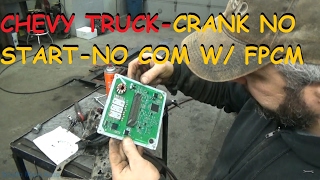
How to confirm: Visually inspect the FPCM and its connector for white/green corrosion, a swollen case, or damaged pins. Use a scan tool to check for communication; a U0109 code ('Lost Communication With Fuel Pump Control Module') almost always confirms a failed FPCM. 🎬 Watch: Troubleshooting a crank no start with no FPCM communication.
Typical fix: Replace the Fuel Pump Control Module. OEM modules (like ACDelco #20759945) require programming to the vehicle's VIN. Aftermarket modules (like Dorman 601-044) are often pre-programmed and 'plug-and-play'. Some owners apply silicone sealant to the new module's seams to prevent future failure.
Est. part cost: $70-$250 - Kinked or Clogged Fuel Transfer Lines/Hoses 🟡 Medium Probability GM TSB PIT5510D specifically warns that the fuel transfer line can become kinked, even during shipping or installation of a new part. The kink is often hidden under a protective conduit, leading to misdiagnosis.
How to confirm: Visually inspect the fuel lines between the rear and front tanks. As per TSB PIT5510C/D, you must slide back the protective black conduit to properly inspect the flexible line inside for any kinks, sharp bends, or damage.
Typical fix: Replace the damaged or kinked section of the fuel line. GM has issued specific hose kits for this repair, such as part number 84214102 mentioned in TSB PIT5510C. A later recall (17067) for a similar issue on newer models used an updated kit (84525925).
Est. part cost: $50-$150 - Damaged Wiring or Poor Ground Connection ⚪ Low Probability The wiring harness running along the frame is exposed to the elements. The primary ground for the fuel pump circuit, a black wire bolted to the driver's side frame rail near the FPCM, is a common point of corrosion. A bad ground can cause low voltage, mimicking a failing pump.
How to confirm: Inspect the wiring harness for chafing or damage. Locate the fuel pump ground on the driver's side frame rail and check for corrosion or looseness. Use a multimeter to test for voltage drop between the FPCM ground pin and the battery negative terminal.
Typical fix: Repair the damaged section of the wiring harness. Remove, clean, and re-secure the ground connection point on the frame to ensure a solid connection.
Est. part cost: $10-$50
Rare But Worth Checking
- Refueling with the Ignition On: This is a procedural issue, not a part failure. The system's logic can misinterpret the rapid change in fuel level as a pump performance fault and set the code. GM issued TSB PIT5208A specifically to advise technicians to ask about refueling habits before beginning repairs, as this is a very common trigger.
- Plugged Rear Tank Vent: A TSB for a newer model (5396125) mentions that dirt and debris can plug the rear tank's vent. This can cause the tank to collapse inward as the pump draws fuel, restricting or stopping flow and potentially triggering P2636.
Diagnosis Steps
- Ask about refueling habits. Confirm the vehicle is turned completely off during refueling per TSB PIT5208A. If not, clear codes, advise the owner, and see if the issue returns.
- Scan for other DTCs. Note any codes like U0109, P2066, or P069E, as they strongly point towards the FPCM or auxiliary tank sensor circuit.
- Visually inspect the Fuel Pump Control Module (FPCM) on the driver's side frame rail and its wiring connector for any signs of corrosion, water intrusion, or physical damage.
- Inspect the fuel lines running between the two tanks. Slide back the protective conduit to look carefully for any kinks, collapses, or damage that could restrict flow, as noted in TSB PIT5510D.
- If possible, command the fuel transfer pump on with a bidirectional scan tool and monitor the fuel level sensor data for both tanks to see if fuel is moving.
- Perform a fuel transfer pump flow test as described in TSB PIT5510. Measure the volume of fuel transferred over a two-minute period to verify if it meets the specification of at least 2.6 liters.
- If the flow test fails, check for power and a clean ground at the auxiliary fuel pump connector. The ground point is typically on the driver's side frame rail. If power and ground are present, the pump has failed. If not, trace the wiring back to the FPCM and check for faults there.
Parts You'll Likely Need
- Auxiliary Fuel Tank Transfer Pump Module
(OEM #19256620)— This is the pump responsible for the fuel transfer. As a wearing mechanical part, it is a common failure item.
Trusted brands: ACDelco (EP1048), Delphi, TRQ
OEM price range: $250-$450
Aftermarket price range: $150-$300 - Fuel Pump Control Module (FPCM)
(OEM #20759945 (supersedes multiple previous numbers))— Its exposed location on the frame makes it highly susceptible to corrosion and failure, which interrupts the signal to the pump. This is one of the most common causes.
Trusted brands: ACDelco, Dorman (601-044)
OEM price range: $120-$250
Aftermarket price range: $70-$150 - Fuel Transfer Line/Hose Kit
(OEM #84214102)— A known issue involves these lines kinking and restricting flow, for which GM has issued specific replacement kits and TSBs.
Trusted brands: ACDelco
OEM price range: $50-$150
Aftermarket price range: $40-$100
Related Codes That Often Appear With This One
- U0109 — This code means 'Lost Communication With Fuel Pump Control Module' and strongly indicates that the FPCM itself has failed due to internal corrosion or there is a major wiring issue.
- P2066 — This code relates to the 'Fuel Level Sensor 'B' Performance', which is the sensor in the auxiliary tank. It can be set alongside P2636 as the ECM uses this sensor's readings to monitor the transfer process.
- P069E — This code stands for 'Fuel Pump Control Module Requested MIL Illumination'. It confirms that the FPCM has detected an internal fault and has asked the ECM to turn on the check engine light, making the FPCM the prime suspect.
Technical Service Bulletins (TSBs) & Recalls
- 17067: Voluntary Emission Recall for 2015-16 models describing how insufficient fuel transfer sets P2636. The fix involves a new fuel line kit and an ECM reprogram to allow the rear tank to supply the engine directly.
- PIT5510D: Provides instructions to diagnose P2636. It details the 2.6L/2min flow test and crucially warns that replacement fuel lines can be kinked out of the box or during install, causing a repeat failure.
- PIT5208A: Advises that P2636 and an empty fuel gauge reading can be triggered simply by refueling the truck with the ignition on or engine running.
- 17-NA-171: A general bulletin that lists P2636 among many other DTCs for various engine and cooling issues, but offers no specific diagnostic detail for it.
Platform-Specific Known Issues
- GM has issued multiple TSBs regarding P2636 on dual-tank trucks. TSB #17067, a voluntary emission recall for slightly newer models, involved re-plumbing the system so the rear tank could supply the engine directly, not just transfer fuel, and required an ECM reprogram.
Mechanic-Grade Diagnostic Values
- FPCM Connector Pin 1 (Black Wire) to Chassis Ground — expected: < 1.0 ohm. Failure: High resistance indicates a corroded or broken ground connection at the frame rail.
- FPCM Connector Pin 32 (Red/White Wire) to Ground — expected: Battery Positive Voltage (12V+). Failure: No voltage points to a blown FSCM fuse (Fuse 21 in underhood block) or a break in the power wire.
- FPCM Connector Pin 13 (Dark Green/White Wire) to Ground — expected: 12V for 2-6 seconds when key is first turned to 'ON' (ECM commanding pump prime).. Failure: No voltage indicates a problem with the ECM (Pin 50) or a broken wire between the ECM and the FPCM.
- FPCM Connector Pin 15 (Pink Wire) to Ground — expected: Ignition 1 Voltage (12V+ with key ON). Failure: No voltage indicates a blown fuse (Fuse 56) or wiring issue from the ignition circuit.
- DTC Set Condition — expected: The PCM must see a change of 4 Liters (1.06 gal) in both the primary and secondary fuel level sensors within 120 seconds of commanding the transfer pump ON.. Failure: If this volume is not transferred in the specified time, the code is set.
Scan Tool Commands That Help
- GM Tech2 / GDS2: Fuel Pump ON/OFF Command — This is a bidirectional control used to manually activate the secondary fuel pump to listen for its operation and to perform a flow test without running the engine. It's a primary step in verifying if the pump is receiving the command and is functional.
- GM Tech2 / GDS2: Module Diagnostics > FPCM > Data Display — Used to monitor live data from the Fuel Pump Control Module, such as commanded pressure, actual pressure (on some systems), pump duty cycle, and input voltages. This helps determine if the module is receiving correct inputs and commanding the pump properly.
Wiring & Ground Locations
- FPCM Ground — A black wire bolted to the inside of the driver's side frame rail, near the FPCM and spare tire.. This is the main ground for the Fuel Pump Control Module. Corrosion at this single point is extremely common and causes high resistance, leading to low voltage, poor pump performance, and codes P2636 or U0109.
- FPCM Connector — The main electrical connector plugging into the FPCM on the driver's side frame rail.. This is the central point for testing all power, ground, and command signals for the transfer pump system. Key pins for testing are Pin 1 (Ground), Pin 13 (ECM Command), Pin 15 (Ignition Power), and Pin 32 (Battery Power).
- ECM Connector X1, Pin 50 — In the black connector of the Engine Control Module (ECM), typically in the engine bay.. This pin is the source of the 'pump on' command signal (Dark Green/White wire) sent to the FPCM. If there is no signal at FPCM Pin 13, testing here verifies if the ECM is sending the command.
- Underhood Fuse Block Fuses — In the main fuse box in the engine bay on the driver's side.. Fuse #21 (FSCM) and Fuse #56 (ECM) are critical power supplies for the Fuel Pump Control Module. A blown fuse will prevent the module and pump from operating.
Real Owner Repair Stories
- YouTube user Tomahawk Fabworks (Chevrolet Silverado (GMT800, but same principle)) — Intermittent no-start, fuel pump not running.
❌ Tried (didn't work) Initial diagnosis pointed to a bad fuel pump.
✅ What actually fixed it The fuel pump ground wire eyelet, bolted directly to the frame, was severely rusted and corroded, creating a poor connection. The final fix was to cut off the old eyelet, clean the frame contact point, and attach a new ground terminal.
OEM Part Supersession History
15213110, 25854536, 25967325, 20850907, 13501024, and others→20759945— GM consolidated multiple older part numbers for the FPCM into a single, updated replacement module.
Heads up: The genuine GM replacement module (20759945) requires VIN programming with a Tech2 or GDS2 scan tool to function correctly with the vehicle's specific options. Installing a used module from another vehicle without reprogramming will likely cause a no-start condition or set other DTCs.
Helpful Videos

Used OEM Parts in Stock


New Aftermarket Parts Available


The information in this article is provided for general reference and educational purposes only. Vehicle specifications, procedures, and part compatibility can vary by production date, trim level, and region. Always consult your vehicle's factory service manual and verify part numbers before purchasing or performing repairs. Safety-critical components such as airbags, seat belts, and braking systems should be installed by a qualified professional.
- Gmc SIERRA 3500:
- 🎬 Helpful Videos
- 🛍️ Shop This Part
- What's Unique About the 2007-2010 Gmc SIERRA 3500
- Diagnostic Flowchart
- Symptoms You May Notice
- Most Likely Causes
- Rare But Worth Checking
- Diagnosis Steps
- Parts You'll Likely Need
- Related Codes That Often Appear With This One
- Technical Service Bulletins (TSBs) & Recalls
- Platform-Specific Known Issues
- Mechanic-Grade Diagnostic Values
- Scan Tool Commands That Help
- Wiring & Ground Locations
- Real Owner Repair Stories
- OEM Part Supersession History
- 🎟️ Get 5% Off