

P2636 on 2007-2014 Chevrolet Silverado 3500: Fuel Pump Performance Causes and Fixes
On 2007-2014 Silverado 3500s, P2636 is most often caused by a faulty Fuel Pump Control Module (FPCM) located on the frame rail. This can cause the fuel gauge to read empty after refueling. Replacing the FPCM costs about $70-$150 for the part and is a common DIY fix, but the new module requires VIN-specific programming.
- Before any expensive repairs, always check if the code was caused by refueling with the engine/ignition on. Simply clearing the code and changing refueling habits may be the only fix needed.
- The most likely failed part is the Fuel Pump Control Module (FPCM), not the fuel pump itself. Inspect the FPCM on the frame rail for corrosion before buying any parts.
- Inspect the fuel pump system ground wire on the frame for rust or damage, as it can cause identical symptoms for a fraction of the cost of a new part.
- If you have a dual-tank model, ensure the fuel transfer line isn't kinked or blocked.
What's Unique About the 2007-2014 Chevrolet SILVERADO 3500
The GMT900 platform (which includes the 2007.5-2014 Silverado 3500) uses a sophisticated Fuel Pump Control Module (FPCM) instead of a simple relay. This module is notoriously mounted on the frame rail under the truck, just above the spare tire, where it is highly exposed to moisture and road salt, leading to common corrosion and failure. Additionally, GM has issued multiple service bulletins confirming that refueling with the engine or ignition on can confuse the fuel level monitoring system and trigger a P2636 code, making owner habits a critical part of the diagnosis. [Bulletin #PIT5208, 5] A crucial detail for this platform is that a replacement FPCM is not plug-and-play; it must be programmed with the vehicle's VIN to function, a step that often requires a dealer or a specialized service.
Diagnostic Flowchart
Tap your situation to follow the diagnostic path that matches what you're seeing on this vehicle.
Generation note: This range covers the GMT900 generation of the Silverado 3500 (2007.5-2014). The 2014 model year was a carryover for the HD trucks, so the information is consistent across this year range. The issue is also prevalent on the identical GMC Sierra HD models.
Symptoms You May Notice
- Fuel gauge suddenly drops to empty, especially after refueling. [Bulletin #PIT5208, 5]
- Check Engine Light is on.
- Low Fuel light is illuminated. [Bulletin #PIT5510C, 4]
- Engine hesitation or stumbling during acceleration.
- Engine may stall under heavy load or high RPMs.
- Hard starting or no-start condition.
- Vehicle runs out of fuel in the front tank on dual-tank models.
- Replacing the fuel pump assembly when the actual problem is the much cheaper and easier to replace Fuel Pump Control Module (FPCM) or a bad ground.
- Replacing the fuel level sender for a faulty gauge reading when the root cause is the FPCM or a refueling habit issue triggering the P2636 code.
Most Likely Causes
- Faulty Fuel Pump Control Module (FPCM) 🔴 High Probability The FPCM is mounted on the frame rail near the spare tire, inside a bracket that can trap water, making it highly susceptible to corrosion from water and road salt.
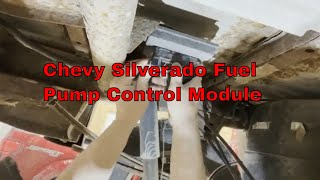
How to confirm: Locate the module on the driver's side frame rail, unplug the connector, and inspect 🎬 Watch: How to locate and inspect the FPCM for corrosion. the module and connector pins for green or white corrosion or physical damage. Water may literally drip out of the failed module. A scan tool may also show a U0109 'Lost Communication With Fuel Pump Control Module' code.
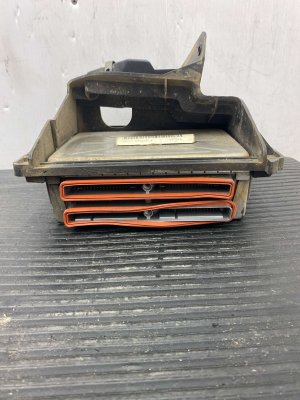
Typical fix: Replace the Fuel Pump Control Module. This is often a simple unbolt-and-replace 🎬 See this quick guide on replacing a faulty control module. procedure, but the new OEM module must be programmed to the vehicle's VIN to work correctly.
Est. part cost: $70-$180 - Refueling with the Ignition On 🟡 Medium Probability The fuel monitoring system performs a check during refueling. If the ignition is on, the system can get a confusing reading (fuel level increasing while the engine is running) and set the code as a default error. This is explicitly mentioned in GM service bulletins. [Bulletin #PIT5208, 2, 4]
How to confirm: Question the driver about their refueling habits. If the code appeared immediately after a fill-up, this is a likely cause. [Bulletin #PIT5208, 4]
Typical fix: Turn the vehicle completely off before refueling. The code may clear on its own after several drive cycles or can be cleared with a scan tool.
Est. part cost: $0 - Corroded Wiring or Ground Connection 🟡 Medium Probability The main ground for the fuel pump system is a black wire bolted directly to the inside of the driver's side frame rail, where it is exposed to the elements and prone to corrosion.
How to confirm: Inspect the wiring harness going to the FPCM and the fuel tank. Locate the primary ground wire on the frame rail near the tank and check for rust or a loose connection. A bad ground here can cause low voltage and mimic a failing pump.
Typical fix: Clean the ground connection point to bare metal using a wire brush, apply dielectric grease, and re-secure it tightly. Repair or replace any damaged sections of the wiring harness or connector pigtails.
Est. part cost: $5-$50 - Faulty In-Tank Fuel Pump / Transfer Pump ⚪ Low Probability
How to confirm: After ruling out the FPCM and wiring, a technician can perform a fuel flow test. For dual-tank models, the test involves running the transfer pump for 2 minutes to see if it moves at least 2.6 liters (0.7 gallons). A scan tool can also be used to command the pump on and listen for its operation.
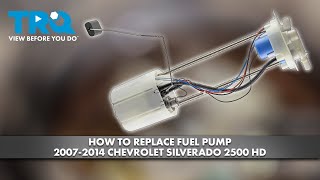
Typical fix: Replace the in-tank fuel pump and sender assembly. This requires either dropping the fuel tank or lifting the truck bed for access. 🎬 Watch: Step-by-step walkthrough for replacing the in-tank fuel pump.
Est. part cost: $250-$600
Rare But Worth Checking
- Outdated ECM Software: TSB #PIT5212B mentions that a scan tool update may be required before proceeding with diagnostics, suggesting some software-related issues can trigger this code. This should be checked by a dealer or a shop with up-to-date equipment. [Bulletin #PIT5212B]
- Kinked Fuel Transfer Line: On models with dual tanks, TSB #PIT5510C notes that the transfer line between the tanks can become kinked, restricting flow and causing a P2636 code. The bulletin warns that even new replacement lines can be kinked during shipping or installation.
- Plugged Fuel Tank Vents: Dirt and debris can collect on top of the fuel tank and plug the vents. This can create a vacuum as the pump operates, leading to a collapsed fuel tank and triggering flow-related codes like P2636.
Diagnosis Steps
- Check for other DTCs, especially U0109 or P069E, which point directly to the FPCM.
- Ask the driver if the code appeared after refueling and if the ignition was on. If so, clear the code and advise turning the vehicle off during future refueling, as per TSB PIT5208. [Bulletin #PIT5208, 5]
- Locate the Fuel Pump Control Module (FPCM) on the driver's side frame rail, often near or above the spare tire. You may need to lower the spare tire for access.
- Visually inspect the FPCM and its electrical connector for corrosion, moisture, or physical damage. Look for white/green powder or signs of water intrusion.
- Inspect the fuel pump ground wire (typically a solid black wire) on the frame rail for corrosion or looseness. Clean and tighten as necessary.
- If no visible issues are found, use a scan tool to command the fuel pump on. Listen for the pump to activate.
- If the pump does not activate, use a multimeter to check for power and ground at the FPCM connector. The Dark Green/White wire at pin 13 should show a 'pump on' signal from the ECM when the key is turned.
- If power and ground are good but the pump doesn't run, the FPCM is the most likely culprit. If the FPCM has been replaced and programmed and the issue persists, suspect the in-tank fuel pump or a wiring issue between the FPCM and the pump.
Parts You'll Likely Need
- Fuel Pump Control Module (FPCM)
(OEM #ACDelco 23487338 (supersedes 20759945))— This is the most common failure point for P2636 on this platform due to its exposed mounting location leading to corrosion.
Trusted brands: ACDelco (OEM), Dorman (e.g., 601-009)
OEM price range: $120-$180
Aftermarket price range: $70-$150 - Fuel Pump and Sender Assembly — If the FPCM and wiring are confirmed to be good, the in-tank pump itself has likely failed.
Trusted brands: ACDelco, Delphi
OEM price range: $400-$600
Aftermarket price range: $250-$450
Related Codes That Often Appear With This One
- U0109 — This code means 'Lost Communication with Fuel Pump Control Module' and is a strong indicator that the FPCM has failed or has a severe wiring/power issue.
- P069E — This code indicates a fault was detected within the Fuel Pump Control Module itself and often appears when the module is the root cause of the problem.
- P0087 — Indicates 'Fuel Rail/System Pressure - Too Low'. This can occur if the FPCM or fuel pump is failing to provide adequate fuel flow, leading to low pressure.
- P0463 — This code for 'Fuel Level Sensor 'A' Circuit High' can appear alongside P2636, indicating the system is struggling to get a plausible reading from the fuel sending unit, often as a result of the FPCM fault.
Technical Service Bulletins (TSBs) & Recalls
- PIT5208A: Fuel Gauge Shows Empty After Refueling And DTC P2636.
- PIT5212B: Mentions P2636 as part of a group of codes that may require a scan tool software update before diagnosis. [Bulletin #PIT5212B]
- PIT5510C: For dual tank models, discusses a kinked fuel transfer line as a possible cause.
Platform-Specific Known Issues
- TSB #PIT5208 directly addresses the symptom of the fuel gauge showing empty with a P2636 code after refueling with the ignition on. [Bulletin #PIT5208, 5]
- TSB #PIT5212B recommends ensuring the technician's scan tool software is updated before diagnostics, indicating potential software-related triggers for the code. [Bulletin #PIT5212B]
- The location of the FPCM on the frame rail is a known design vulnerability leading to a high rate of failure from corrosion.
- Recall #17399 was issued for some 2011-2015 dual-tank models for a faulty fuel-level sensor that could cause the rear pump to overfill the front tank, a related but separate issue from P2636.
Mechanic-Grade Diagnostic Values
- FPCM Connector Pin 32 (Red/White Wire) Voltage — expected: Constant Battery Voltage (12V+). Failure: Low or no voltage points to a problem with the main power feed or fuse from the under-hood fuse box.
- FPCM Connector Pin 15 (Pink Wire) Voltage — expected: 12V whenever ignition is ON. Failure: No voltage indicates a problem with the ignition circuit or fuse #21 (FSCM) / #56 (ECM).
- FPCM Connector Pin 13 (Dark Green/White Wire) Voltage — expected: 12V for 2-6 seconds when key is first turned to 'ON' (ECM pump prime command). Failure: No voltage suggests a wiring break between the ECM (Pin 50 of black connector) and FPCM, or a faulty ECM.
- FPCM Connector Pin 1 (Black Wire) Resistance to Ground — expected: Near 0 Ohms. Failure: High resistance indicates a corroded or broken ground connection at the frame rail.
- Dual Tank Transfer Pump Flow Test — expected: Greater than 2.6 liters (0.70 gallons) in 2 minutes. Failure: Less than 2.6 liters indicates a weak transfer pump, kinked line, or plugged vent.
- Fuel Level Sensor Resistance — expected: Approx. 40 Ohms when empty and 250 Ohms when full.. Failure: Readings outside this range or that are erratic when the float is moved indicate a failed sending unit.
Scan Tool Commands That Help
- GDS2 / Tech2: Fuel Pump ON/OFF Command — Use this bidirectional control to manually activate the fuel pump. If the pump runs, it confirms the FPCM, wiring to the pump, and the pump motor itself are functional, pointing the diagnosis towards the control side (ECM command, sensors).
- GDS2 / Tech2: Fuel Transfer Pump ON/OFF (Dual Tank Models) — Used to manually run the rear transfer pump to verify its operation and perform a flow test as described in service literature.
- Professional Scan Tool (e.g., GDS2): FPCM Programming/Setup — This is a mandatory procedure after replacing the FPCM with a new OEM unit. The module must be programmed with the vehicle's VIN to communicate with the ECM and other modules.
Wiring & Ground Locations
- FPCM Fuses — In the underhood fuse block on the driver's side.. Fuse #21 (FSCM) and Fuse #56 (ECM) are critical for providing ignition and battery power to the Fuel Pump Control Module. A blown fuse will cause a no-power or no-communication state (U0109).
- Fuel Pump Ground — A black wire bolted directly to the inside of the driver's side frame rail, near the fuel tank and FPCM.. This is the primary ground for the entire fuel pump electrical system. It is highly exposed to road spray and salt, making corrosion common. A bad ground here causes low voltage, mimicking a failed pump or FPCM.
- FPCM Connector (X3) — The large 43-pin connector that plugs into the FPCM module on the frame rail.. This is the central point for all diagnostic voltage and signal tests. Key pins include Pin 32 (main power), Pin 15 (ignition power), Pin 13 (ECM command), and Pin 1 (ground). Corrosion here is a common point of failure.
- ECM Connector (Black, Pin 50) — At the Engine Control Module (ECM).. Pin 50 in the black ECM connector is the source of the Dark Green/White wire's 'pump on' signal. If there is no signal at FPCM Pin 13, testing here can determine if the fault is in the ECM or the wiring in between.
Real Owner Repair Stories
- 2CarPros Forum User (2016 Chevrolet Silverado 5.3L V8 (similar GMT platform)) — Crank no start, code U0109 (Lost Communication with FPCM).
❌ Tried (didn't work) Checking fuses (all were good)., Visually inspecting ground wires (appeared fine).
✅ What actually fixed it A voltage drop test found a fault in the main power wire (Red/Violet) between the fuse box and the FPCM. Voltage was 12V at the fuse but only 2V at the FPCM connector. Repairing the wire resolved the issue. - Reddit user HeavyT902 in r/AskMechanics (2008 Chevrolet Silverado 1500 4.8L) — Crank no start, fuel pump not priming.
❌ Tried (didn't work) Replaced FPCM with a cheap aftermarket unit (resulted in a 'no communication' code)., Replaced FPCM with a premium Dorman aftermarket unit (still no prime).
✅ What actually fixed it The user confirmed the pump worked by bypassing the FPCM. The story highlights that even 'plug-and-play' aftermarket FPCMs can fail to work out of the box, and programming may still be the underlying issue, even if the part is advertised as not needing it. The final resolution was not posted, but the diagnostic path is valuable.
OEM Part Supersession History
15213110, 25854536, 25967325, 20850907, 13501024, 25785013, 25866052→20759945 (and later 23487338)— GM consolidated multiple older part numbers for various models into a single, updated replacement module.
Heads up: The replacement OEM module MUST be programmed to the vehicle's VIN using dealership software (GDS2/Tech2) to function. It is not plug-and-play. Using a module from another vehicle will typically result in a no-start condition or communication codes.
Model Year Variations Within This Range
- 2011-2015: Recall 17399 was issued for dual-tank (RPO N2N) models. A faulty front tank fuel-level sensor could stick, causing the rear transfer pump to overfill the front tank, potentially leading to a fuel leak. The fix was a new rear-tank pump or a software update. This can be confused with a P2636 flow issue.
Helpful Videos
![Easy Fix for Common Chevy Problem [Fuel Pump Control Module]](https://img.youtube.com/vi/38Xeo1uLBoU/mqdefault.jpg)
Used OEM Parts in Stock




New Aftermarket Parts Available


The information in this article is provided for general reference and educational purposes only. Vehicle specifications, procedures, and part compatibility can vary by production date, trim level, and region. Always consult your vehicle's factory service manual and verify part numbers before purchasing or performing repairs. Safety-critical components such as airbags, seat belts, and braking systems should be installed by a qualified professional.
- Chevrolet SILVERADO 3500:
- 🎬 Helpful Videos
- 🛍️ Shop This Part
- What's Unique About the 2007-2014 Chevrolet SILVERADO 3500
- Diagnostic Flowchart
- Symptoms You May Notice
- Most Likely Causes
- Rare But Worth Checking
- Diagnosis Steps
- Parts You'll Likely Need
- Related Codes That Often Appear With This One
- Technical Service Bulletins (TSBs) & Recalls
- Platform-Specific Known Issues
- Mechanic-Grade Diagnostic Values
- Scan Tool Commands That Help
- Wiring & Ground Locations
- Real Owner Repair Stories
- OEM Part Supersession History
- Model Year Variations Within This Range
- 🎟️ Get 5% Off