

P2610 on 2009-2015 Ford Escape: Engine Off Timer Performance Explained
This code usually means the Powertrain Control Module (PCM) has a glitch, often due to a weak battery, a procedural error after a software update, or a failing PCM power relay. Before replacing expensive parts, check the battery and clear the code; it may not return. A hard reset by disconnecting the battery and touching the terminals together for several minutes is a common DIY fix discussed by owners.
- P2610 is an electrical glitch code, not usually a sign of a major mechanical failure.
- Always check the battery, its connections, and the PCM power relay before considering expensive PCM replacement.
- The code frequently appears after a battery has been disconnected, replaced, or jump-started, indicating a power interruption is the root cause.
- A simple fix that often works is clearing the code and performing a full power-down/reset procedure.
What's Unique About the 2009-2015 Ford ESCAPE
For the 2009-2015 Ford Escape, this code is frequently a temporary glitch rather than a hard part failure. A specific Ford Technical Service Bulletin (TSB ASI-44707) notes that P2610 can appear after a PCM software update if the technician doesn't wait 30 seconds after turning the key off. This highlights the code's sensitivity to procedural and power-related issues, such as a weak or recently replaced battery, which can disrupt the PCM's internal clock and its 'keep alive' memory.
Diagnostic Flowchart
Tap your situation to follow the diagnostic path that matches what you're seeing on this vehicle.
Generation note: This range covers two Ford Escape generations: the second (2009-2012) and the third (2013-2015). While the code's meaning is the same, causes can differ slightly. The 2nd gen is more prone to issues with the PCM power relay located in the under-hood fuse box. The 3rd gen, with more complex electronics and start-stop systems (on some models), can be more sensitive to battery voltage and requires a Battery Management System (BMS) reset after a battery replacement to avoid electrical issues. The 3rd gen Escape is built on the Ford Global C platform, sharing its architecture with the Ford Focus and Lincoln MKC.
Symptoms You May Notice
- Check Engine Light is on.
- Inability to pass an emissions test because readiness monitors won't set.
- Vehicle may run perfectly fine with no noticeable performance issues.
- On models with Auto Start-Stop, the feature may be disabled or behave erratically.
- In rare cases, a brief delay or hesitation when starting the engine.
- Replacing the PCM without first checking the battery, connections, and PCM power relay.
- Replacing other sensors like the Engine Coolant Temperature (ECT) sensor, which is a generic cause for this code but not commonly the specific culprit on this platform.
Most Likely Causes
- Low Battery Voltage or Poor Connections 🔴 High Probability Modern vehicle electronics are highly sensitive to voltage. A weak battery, corroded terminals, or even a recent battery replacement or jump-start can cause the PCM to lose its 'keep alive' memory when the engine is off, disrupting the internal timer. This is a widely reported cause across many Ford models.
How to confirm: Test the battery voltage with a multimeter. It should be above 12.2V-12.4V with the engine off. Check battery terminals for corrosion and ensure they are tight. A parasitic draw test may be needed if a healthy battery drains quickly.
Typical fix: Clean battery terminals and cable ends. Charge or replace the battery if it fails a load test. After replacement on 2013+ models, ensure the Battery Management System (BMS) is reset. A common DIY fix is to perform a hard reset by disconnecting both battery cables and holding them together for 5-10 minutes to drain all residual power from the modules.
Est. part cost: $120-$250 - PCM Reprogramming Procedure Not Followed 🟡 Medium Probability As cited in TSB ASI-44707, the PCM requires a 30-second power-down period after a software update to save its settings. Interrupting this process by cycling the key too quickly can trigger P2610.
How to confirm: This cause is relevant only if the code appeared immediately after the PCM was reprogrammed by a dealer or mechanic.
Typical fix: Clear the code. Turn the ignition off and wait at least one minute before restarting the engine. The code should not return.
Est. part cost: $0 - Faulty PCM Power Relay 🟡 Medium Probability The PCM power relay supplies voltage to the module. If the relay sticks or fails, it can cut power to the PCM abruptly or fail to shut it down correctly, preventing the engine-off timer from functioning. This is a known issue on various Ford platforms.
How to confirm: Locate the PCM power relay in the vehicle's under-hood fuse box (Battery Junction Box). You can swap it with an identical relay from a non-critical circuit 🎬 See how to locate and swap the PCM power relay. (like the horn) to see if the problem resolves.
Typical fix: Replace the PCM power relay. The part is inexpensive and easy to access.
Est. part cost: $15-$40
Rare But Worth Checking
- Internal PCM Failure: This is the least likely cause. Before condemning the PCM, all other possibilities (power, grounds, relays, and software) must be exhaustively checked. A PCM failure for this code is often a last resort diagnosis.
- Wiring Issue in the PCM Power or Ground Circuit: A corroded ground wire or a short in the wiring harness can cause intermittent power loss to the PCM, triggering this code. Key grounds to inspect on 3rd gen models include G104 at the transmission and G105/G108 on the left side of the engine compartment.
- Faulty Engine Coolant Temperature (ECT) Sensor: While listed as a generic cause for P2610 because the PCM can use the ECT sensor's cooldown rate to infer engine-off time, this is not a commonly reported specific fix for the 2009-2015 Escape. It should be considered only if other cooling system-related codes are present.
Diagnosis Steps
- Check for any Technical Service Bulletins (TSBs) related to P2610 for your specific vehicle year, especially TSB ASI-44707.
- Inspect the battery. Ensure it is fully charged (above 12.2V) and the terminals are clean and tight. Many owners report this code appears after a battery drain or jump-start.
- For 2013+ models, if the battery was recently replaced, ensure the Battery Management System (BMS) has been reset. This can be done with a scan tool or sometimes a manual procedure.
- Clear the trouble code with a scan tool.
- Turn the ignition off and remove the key. Wait for at least one full minute to ensure the PCM completes its shutdown sequence.
- Start the engine and drive the vehicle to see if the code returns. It may take two consecutive drive cycles for the light to come back on.
- If the code returns, perform a hard reset. Disconnect both battery terminals and hold the positive and negative cables together for 5-10 minutes. This drains all capacitors and forces a full reset of the vehicle's modules.
- If the code still returns, locate the PCM power relay in the under-hood fuse box. Swap it with an identical relay from a less critical system (e.g., horn) and see if the issue is resolved.
- If the problem persists, inspect the wiring and connectors at the PCM for any signs of damage or corrosion, paying close attention to main power (KAPWR) and ground wires. On 3rd gen models, check grounds G104 and G105.
- If all other steps fail, the issue may be an internal fault within the PCM, which may require professional diagnosis or replacement.
Parts You'll Likely Need
- Battery — A weak or failing battery is a primary cause of electrical glitches in the PCM, leading to the P2610 code.
Trusted brands: Motorcraft, Interstate, DieHard
OEM price range: $180-$250
Aftermarket price range: $120-$200 - PCM Power Relay
(OEM #F57B-14B192-AA (or equivalent, verify by VIN))— This relay controls power to the engine computer. If it fails, it can prevent the PCM from performing its shutdown sequence correctly.
Trusted brands: Motorcraft, Standard Motor Products, Bosch
OEM price range: $25-$40
Aftermarket price range: $15-$30
Related Codes That Often Appear With This One
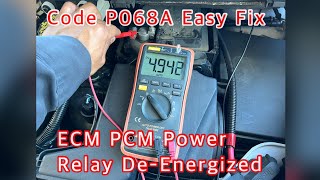
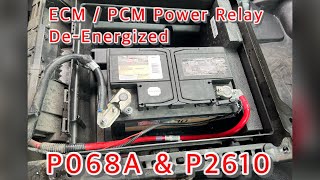
- P068A — This code ('ECM/PCM Power Relay De-Energized Too Early') is often seen with P2610, as both can be caused by a faulty PCM power relay or other power supply issues, as noted in TSB ASI-44707. 🎬 Watch this simple fix for codes P068A and P2610.
- P06B8 — Stands for 'Internal Control Module Non-Volatile Random Access Memory (NVRAM) Error' and is also mentioned in TSB ASI-44707 as a code that can appear alongside P2610 after improper PCM programming procedures.
- P1633 — This code ('Keep Alive Power Voltage Too Low') directly points to an interruption in the constant power supply (KAPWR) to the PCM, which is the root cause of the P2610 timer malfunction.
Technical Service Bulletins (TSBs) & Recalls
- ASI-44707: Notes that P2610 can be set with P06B8 and P068A after PCM reprogramming if the key is not left in the OFF position for 30 seconds, indicating a procedural cause rather than a part failure. This applies to 2009-2015 model year vehicles.
Platform-Specific Known Issues
- Appearance After Battery Drain or Jump-Start: Numerous owners across different Ford platforms (including Mustang and F-150) report that the P2610 code appeared for the first time immediately after the battery went dead and required a jump-start. This strongly corroborates that power interruption is the most common trigger.
- Confusion with Battery Management System (BMS): On newer Fords, including the 3rd generation Escape (2013+), simply replacing the battery is not enough. The BMS must be reset to let the vehicle know a new battery has been installed. Failure to do so can lead to improper charging and trigger various electrical codes, including P2610. A user on a Ford Ranger forum discussed this in the context of P2610 appearing after a battery swap.
Mechanic-Grade Diagnostic Values
- Battery Voltage (Engine Off) — expected: >12.2V. Failure: Voltage below 12.2V indicates a discharged or failing battery.
- Charging System Voltage (Engine Running) — expected: 13.5V - 14.8V. Failure: Voltage outside this range indicates a problem with the alternator or Battery Management System.
- PCM Keep Alive Power (KAPWR) circuit — expected: Constant Battery Voltage. Failure: 0V or intermittent voltage indicates an open/short in the circuit or a blown fuse.
- Engine Coolant Temperature (ECT) Sensor Resistance — expected: 2000 - 3000 Ohms at 68°F (20°C). Failure: No reading or a reading far outside this range suggests a faulty sensor.
- Scan Tool 'Engine Off Timer' Parameter — expected: Should count down to zero within 5-10 seconds after engine shutdown.. Failure: Timer does not count, gets stuck, or deviates significantly, confirming the fault.
Scan Tool Commands That Help
- Ford IDS / FORScan: Battery Management System (BMS) Reset — Required after replacing the battery on 2013-2015 models to ensure the system charges the new battery correctly and prevents electrical faults like P2610.
- Professional Scan Tool: Network Scan / CAN Bus Test — To verify communication integrity between the PCM and other modules if communication errors are suspected as the cause.
Wiring & Ground Locations
- Battery Junction Box (BJB) — Under the hood, on the left side of the engine compartment, next to the battery.. Houses the PCM Power Relay and the Keep Alive Power (KAPWR) fuse for both generations. For 2009-2012 models, this is Relay R14 and Fuse F5 (10A). For 2013-2015 models, relevant fuses include F12, F31, F32, and F38.
- G104 — Right rear of the transmission (applies to 2013-2015 models).. This is a primary ground point for the Powertrain Control Module. A poor connection here can cause intermittent power loss and various PCM-related codes, including P2610.
- G105 / G108 — Left rear of the engine compartment (applies to 2013-2015 models).. These are additional PCM and engine sensor ground points. Corrosion or looseness, especially after engine work, can disrupt the PCM's operation.
- PCM Connector C175B / C1381B — At the Powertrain Control Module (PCM) itself, located in the engine bay.. This is the main electrical interface for the PCM. Technicians may need to perform voltage drop tests on power and ground pins at this connector to diagnose a wiring issue. C175B is common on 2nd gen, while 3rd gen models use multiple connectors like C1381B.
Real Owner Repair Stories
- Ford Ranger & Raptor Forum (5th Generation) (2019+ Ford Ranger (demonstrates modern Ford BMS logic)) — P2610 code appeared immediately after replacing the stock battery with an aftermarket one. Auto Start-Stop feature also stopped working.
❌ Tried (didn't work) Initially panicked about a serious PCM issue.
✅ What actually fixed it The user first cleared the P2610 code with a simple OBD reader, and it did not return. To fix the non-functional Auto Start-Stop and ensure proper charging, they performed a manual BMS reset: ignition on (engine off), flashed high beams 5 times, then pressed the brake pedal 5 times. A blinking battery icon on the dash confirmed the reset, and normal charging behavior and Auto Start-Stop function were restored.
OEM Part Supersession History
F57B-14B192-AA→F57B-14B192-AA (stable part number)— This is a widely used, standard 5-pin multi-purpose relay across many Ford, Lincoln, and Jaguar models.
Heads up: Cross-references to aftermarket parts like Standard Motor Products RY612 are common. Ensure the pin configuration and amperage rating match.
Model Year Variations Within This Range
- 2013-2015: These models feature a Battery Management System (BMS). After a battery replacement, the BMS must be reset using a scan tool or a manual procedure (e.g., 5 high beam flashes, 5 brake presses) to inform the PCM of the new battery's state of health. Failure to do so can cause charging issues and trigger P2610.
- 2009-2012: The electrical system is simpler and does not use a BMS that requires a reset. Diagnosis is more focused on the battery's health, the PCM power relay, and associated fuses in the under-hood Battery Junction Box.
Helpful Videos


Used OEM Parts in Stock


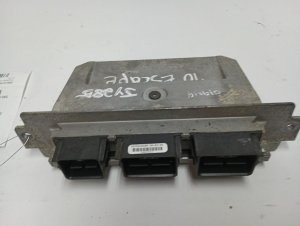

New Aftermarket Parts Available
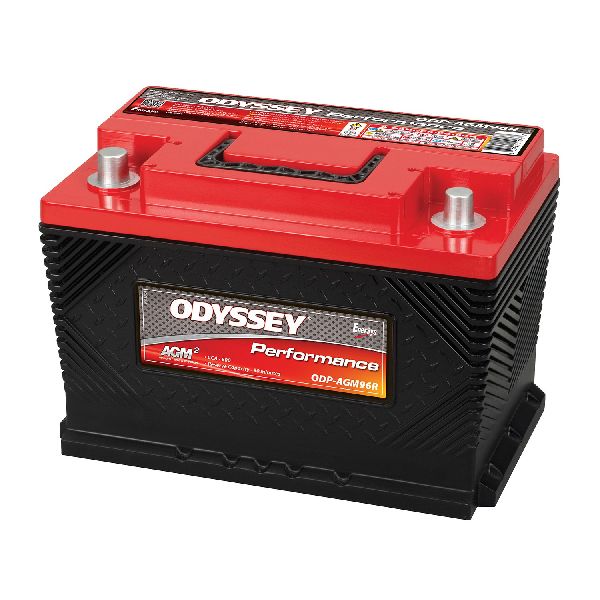

The information in this article is provided for general reference and educational purposes only. Vehicle specifications, procedures, and part compatibility can vary by production date, trim level, and region. Always consult your vehicle's factory service manual and verify part numbers before purchasing or performing repairs. Safety-critical components such as airbags, seat belts, and braking systems should be installed by a qualified professional.
- Ford ESCAPE:
- 🎬 Helpful Videos
- 🛍️ Shop This Part
- What's Unique About the 2009-2015 Ford ESCAPE
- Diagnostic Flowchart
- Symptoms You May Notice
- Most Likely Causes
- Rare But Worth Checking
- Diagnosis Steps
- Parts You'll Likely Need
- Related Codes That Often Appear With This One
- Technical Service Bulletins (TSBs) & Recalls
- Platform-Specific Known Issues
- Mechanic-Grade Diagnostic Values
- Scan Tool Commands That Help
- Wiring & Ground Locations
- Real Owner Repair Stories
- OEM Part Supersession History
- Model Year Variations Within This Range
- 🎟️ Get 5% Off