

OBD-II Code P2604: Intake Air Heater 'A' Circuit Range/Performance
What P2604 means, why it triggers, and how to fix it
- Code P2604 indicates an electrical fault in the intake air heater circuit, causing hard starts and rough idling in temperatures below 50°F.
- Replace the intake air heater relay first; this $30-$100 part is the culprit in over 50% of P2604 cases and takes 15 minutes to swap.
- Owners of 2007-2024 Ram 6.7L Cummins trucks must immediately check the grid heater power stud for looseness to prevent a $14,000+ catastrophic engine failure.
- Test the heater element resistance with a multimeter; a healthy Cummins grid heater reads under 1.0 Ohm, while an infinite reading confirms a burned-out element.
- You can safely drive with a P2604 code in warm weather, but ignoring it in winter causes a 1-2 MPG drop and premature starter wear from prolonged cranking.
What Does P2604 Mean?
P2604 means the Powertrain Control Module (PCM) detects an electrical fault in the intake air heater circuit. Found primarily in diesel engines, this heater warms incoming air for easier cold-weather starts. The code triggers when the circuit's voltage, resistance, or current draw falls outside the manufacturer's expected range, indicating the heater is failing to activate or drawing incorrect power.
Technical definition: The official SAE/OBD-II definition is "Intake Air Heater 'A' Circuit Range/Performance". The PCM monitors the circuit for specific voltage drops and current draws when the heater activates. A deviation from this expected electrical performance triggers the code.
Can I Drive With P2604?
Yes, But With Caution. You can drive, but fix it immediately if you own a 2007-2024 Ram 6.7L Cummins, as this code often precedes a $14,000+ catastrophic engine failure. On other diesels, driving in cold weather causes hard starts, rough idling, and premature starter wear. Ignoring the code long-term fouls glow plugs and increases emissions.
Common Causes
- Faulty Intake Air Heater Relay (Very Common) — The relay is an electronic switch that controls the massive electrical current the heater requires. These relays fail from repeated use, getting stuck open or closed, which prevents the heater from operating correctly.
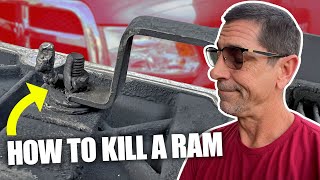
- Loose or Failing Grid Heater Bolt (Dodge/Ram Cummins) (Common) — On 2007.5-2024 Ram trucks with the 6.7L Cummins engine, the nut and bolt securing the power connection to the grid heater loosens, corrodes, and falls into the intake manifold, destroying the engine. This failure frequently triggers P2604 first.
- Failed Intake Air Heater Element (Common) — The heater element burns out or degrades over time. Corrosion or fatigue increases its electrical resistance or creates an open circuit, causing a performance range fault.
- Wiring or Ground Connection Issues (Common) — High-current wires, connectors, and ground straps corrode, loosen, or suffer heat damage. This creates unwanted resistance or a short circuit, which the PCM flags as a performance problem.
- Failing Voltage Regulator or Alternator (Less Common) — A faulty voltage regulator or failing alternator causes voltage spikes or drops across the electrical system during startup. The PCM misinterprets this instability as a specific fault within the intake heater circuit.
- Software Calibration Error (Rare) — An outdated PCM calibration file misinterprets normal heater circuit signals as out-of-range. A manufacturer software update resolves this.
- Failing Powertrain Control Module (PCM) (Rare) — The internal driver circuit within the PCM that controls the heater relay fails. Suspect this only after testing all other components.
Symptoms
- Difficult Cold Starts or Long Cranking Time — In temperatures below 50°F (10°C), the engine cranks significantly longer because the incoming air is not pre-heated.
- Rough Idle and White Smoke When Cold — Immediately after a cold start, the engine idles unevenly and emits white or gray smoke from unburned fuel until it reaches operating temperature.
- 'Wait to Start' Light Behavior Change — The 'wait to start' light (coil symbol) stays on for a shorter or longer period than usual, or fails to illuminate entirely.
- Decreased Fuel Economy — The engine works harder to reach optimal operating temperature without the heater, causing a 1-2 MPG drop in fuel efficiency.
- Check Engine Light is on (also visible on scanner) — The light illuminates as soon as the PCM logs the P2604 fault.
Diagnostic Flowchart
Tap your situation to follow the diagnostic path that matches what you're seeing on this code.
Common Fixes & Costs
- Replace Intake Air Heater Relay — Parts: $30-$100, Labor: $25-$75, ~0.3 hr book time (DIY)
- Install Grid Heater Bolt Repair Kit (Ram Cummins) — Parts: $50-$150, Labor: $100-$200, ~2.5 hr book time (Intermediate)
- Replace Intake Air Heater Element/Grid — Parts: $120-$300, Labor: $80-$200, ~2.5 hr book time (Intermediate)
- Repair Damaged Wiring or Connectors — Parts: $10-$50, Labor: $100-$250, ~1.5 hr book time (Intermediate)
- Replace Powertrain Control Module (PCM) — Parts: $800-$1,200, Labor: $250-$350, ~2.0 hr book time (Professional)
Used vs. New Parts: Buying Guide
When a used part is worth it: Buying used rarely makes sense for electrical relays. A used heater element from a low-mileage, non-corroded donor is acceptable for non-Cummins vehicles if budget is tight.
Donor-vehicle mileage cap: roughly under 50000 miles for the part to have meaningful remaining life.
Donor quality checklist:
- Verify part number exactly.
- Avoid heater elements from rust-belt states due to corrosion risk.
- NEVER install a used grid heater assembly on a Ram 6.7L Cummins; always use a new OEM part or aftermarket preventative kit.
Decision logic:
- If The part is an electrical relay. → Buy new; cost savings for a used part are minimal and not worth the risk.
- If The part is a Ram 6.7L Cummins grid heater assembly. → Buy a new OEM part or an aftermarket preventative kit to eliminate the 'killer bolt' risk.
- If The part is a heater element for a non-Cummins vehicle and budget is tight. → A used part from a low-mileage donor is acceptable, but inspect carefully for corrosion.
Warranty tradeoff: Used parts typically have a 30-90 day warranty. New aftermarket parts carry a 1-year to limited lifetime warranty. New OEM parts carry the manufacturer's standard warranty.
Worst-case if a used part fails: $200-$500 if a used heater element fails shortly after install, requiring repeat labor costs.
What Happens If You Wait — Timeline
- 0-1 month: Code P2604 sets. In warm weather, there are no symptoms. In cold weather (<50°F/10°C), the engine cranks for 1-2 seconds longer than usual. (MPG impact: 0%% · Added cost: $0)
- 1-4 months: Hard starting in cold weather becomes consistent, with rough idling and white smoke for the first 1-2 minutes. Fuel economy drops slightly due to inefficient cold running. (MPG impact: 2-4%% · Added cost: $25-$75 in wasted fuel.)
- 4-12 months: Prolonged cranking strains the battery and starter. Incomplete combustion during warm-up begins fouling glow plugs and contributing to carbon buildup. (MPG impact: 3-5%% · Added cost: $100-$400 (starter wear, fouled plugs).)
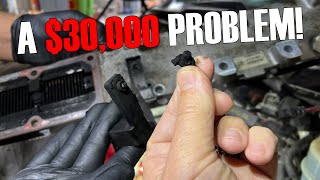
- Immediate Risk (Ram 6.7L Cummins ONLY): The 'killer bolt' loosens and drops at any time, regardless of climate or mileage. The metal bolt is ingested by a cylinder, causing immediate, catastrophic engine damage. (MPG impact: N/A% · Added cost: $14,000 - $30,000+ for engine replacement.)
Cost of Not Fixing It
- Immediate (All Vehicles): Hard starting, rough cold idle, and increased white smoke. Potential for being stranded in cold weather. (Added cost: Negligible, unless it requires a tow.)
- 1-6 Months (All Vehicles): Decrease in fuel economy (1-2 MPG), potential for fouling glow plugs or O2 sensors due to incomplete cold combustion. (Added cost: $50-$400)
- Immediate & Ongoing Risk (Ram 6.7L Cummins): The 'killer bolt' breaks off, falls into the intake, and causes catastrophic engine failure. This is a sudden failure, not a wear-out issue. (Added cost: $14,000-$30,000 for engine replacement.)
Diagnosis Steps
- Scan for Codes and Check Freeze Frame Data
Use an OBD-II scanner to confirm P2604 and check for related codes. Note the freeze-frame data showing engine conditions (ambient air temperature, battery voltage) when the code set.
Tools: OBD-II Scanner (Beginner) - Visual Inspection
Locate the intake air heater on the intake manifold. Inspect heavy-gauge power cables and connectors for damage, corrosion, or burning. On a Ram 6.7L Cummins, wiggle the power stud on the grid heater; if it moves, the internal bolt has failed.
Tools: Flashlight (Beginner) - Test the Intake Air Heater Relay
Locate the intake air heater relay in the under-hood fuse box. Swap it with an identical relay from a non-critical circuit (like the horn). If the problem resolves, the relay is bad.
Tools: None (for swapping) (Beginner) - Check for Voltage and Ground
Have a helper turn the ignition on (engine off) during a cold start. Use a multimeter set to DC Volts to check for battery voltage (11V-14V) at the heater element's power stud. No voltage means the relay or upstream wiring failed.
Tools: Multimeter, Helper (Intermediate) - Test the Heater Element Resistance
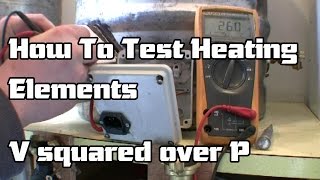
Disconnect the battery and power wire from the heater element stud. Measure resistance between the power stud and a clean engine ground using a multimeter. A healthy Cummins grid heater reads under 1.0 Ohm. An infinite reading (OL) confirms a burned-out element.
Tools: Multimeter, Basic Hand Tools (Intermediate) - Perform an Amperage Draw Test
Clamp a high-current DC ammeter around the main power cable to the heater element. A healthy Cummins 6.7L grid heater draws up to 200 amps during a cold start. A low reading indicates high resistance; zero draw means an open circuit.
Tools: DC Clamp-on Ammeter (Advanced) - Analyze Live Scan Tool Data
Monitor 'Intake Air Heater Command' and 'Intake Air Heater Monitor' PIDs using an advanced scan tool. When commanded on, voltage drops from 12.5V to around 11.0V. Discrepancies isolate the failing circuit segment.
Tools: Advanced OBD-II Scan Tool (Advanced) - Test the PCM Command Signal
If the relay has power but doesn't click, check the PCM signal wire. Use a multimeter to verify a voltage or ground signal on the relay socket's control side when the key turns on. A missing signal indicates a broken wire or PCM fault.
Tools: Multimeter, Vehicle-specific Wiring Diagram (Advanced) - Check PCM Driver with a Scope
Back-probe the PCM driver control wire at the relay using an oscilloscope. A noisy or erratic waveform when the key turns on confirms a failing PCM internal driver circuit.
Tools: Oscilloscope, Wiring Diagram (Professional)
When This Code Triggers (Freeze-Frame Conditions)
- Intake Air Temperature: <66°F (19°C) (The PCM commands the heater on during a cold start.)
- Engine Coolant Temperature: <66°F (19°C) (Both IAT and ECT must be low for the pre-heat cycle to engage.)
- RPM: 0 (Code sets during the Key-On, Engine-Off (KOEO) self-test before cranking.)
- Battery Voltage: 11-13V (The code sets if voltage is too low for the heater to perform correctly or too high (indicating an open circuit).)
Related Codes
- P2609 — Means 'Intake Air Heater System Performance'. Often set alongside P2604. P2604 points to a voltage/resistance fault, while P2609 indicates the PCM doesn't detect the expected high amperage draw when the heater activates.
- P0541 — Means 'Intake Air Heater A Circuit Low'. Indicates the PCM detects lower-than-expected voltage, pointing directly to high resistance from a corroded wire, failing element, or poor ground.
- P0542 — Means 'Intake Air Heater A Circuit High'. Counterintuitively, this points to an open circuit. The PCM expects a voltage drop when the heater turns on; continuously high voltage means no current is flowing.
- P0380 — Means 'Glow Plug/Heater Circuit A Malfunction'. While intake heaters and glow plugs differ, they share diagnostic logic on some vehicles, and a fault in one triggers a code in the other.
Climate & Environmental Factors
- Cold Climate: The intake air heater operates exclusively for cold starts. Failures become obvious in ambient temperatures below 50°F (10°C), triggering the code frequently in winter.
- High Humidity / Road Salt: Humid environments and winter road salt accelerate corrosion on high-current relays, connectors, and ground points, causing high resistance faults.
- Altitude: Thinner air at high altitudes provides less oxygen for combustion, making pre-heating critical. Marginal heater systems fail noticeably faster at elevation.
How to Talk to a Mechanic About This Code
Say this: "I have a P2604 code on my [Your Truck's Year, Make, Model]. I'd like to schedule a diagnostic appointment. Please start by testing the intake air heater relay and checking the wiring for corrosion. If it's a Ram 6.7L Cummins, please specifically check the grid heater power stud for looseness before doing anything else."
This signals you are an informed customer. It directs the technician to start with the cheapest failure points first, preventing an immediate quote for an expensive heater element. Mentioning the Ram-specific issue prioritizes a critical safety check.
Avoid saying:
- 'Just fix whatever's wrong'
- 'My check engine light is on, can you look at it?' (too vague — invites upsell)
- 'Whatever you recommend'
Questions to ask before authorizing the repair:
- Did you test the relay and fuses first? What were the results?
- For my Ram 6.7L, did you physically check the grid heater bolt? Was it tight?
- What was the resistance measurement in ohms for the heater element itself?
- Did you confirm there is battery voltage at the heater stud when the system is commanded on?
- If you are recommending a new heater element, does the estimate include new intake gaskets?
Where to Take It: Dealer vs Independent vs Chain
- Dealer:
A safe but expensive option. Necessary for warranty claims or potential PCM software issues.
Best for: Vehicles still under powertrain or emissions warranty., Diagnosing and performing PCM software updates if a calibration error is suspected.
Downsides: Highest labor rates., Less likely to suggest aftermarket preventative solutions for issues like the Ram 'killer bolt'. (Typical cost: +50% vs. baseline) - Independent Shop:
Best fit, IF it's a reputable independent DIESEL repair shop. They are more aware of common issues and preventative fixes than general shops.
Best for: Out-of-warranty diesel trucks where cost is a factor., Diesel specialty shops familiar with this code and its common causes.
Downsides: Quality varies widely. A general auto repair shop lacks diesel-specific experience. (Typical cost: +0% vs. baseline) - Chain Shop:
AVOID. The high-current nature of the circuit and diesel-specific knowledge required make this a poor fit for chain shops.
Best for: Not recommended for this type of repair.
Downsides: Technicians lack specialized training for diesel engine electrical systems., High risk of misdiagnosis, leading to unnecessary parts replacement., Unaware of manufacturer-specific quirks like the Cummins grid heater issue. (Typical cost: -10% vs. baseline)
When to Walk Away From the Repair
If the estimated repair cost exceeds 40% of the truck's private-party value, evaluate your options.
- Car worth $18000, fix is $450: Fix it. A standard P2604 repair (new relay or heater element) is well below the threshold for a valuable diesel truck.
- Car worth $25000, fix is $18000: Walk away. This scenario represents a Ram 6.7L Cummins where the 'killer bolt' destroyed the engine. The repair cost is a massive percentage of the truck's value.
- Car worth $15000, fix is $1500: Fix it. This represents a worst-case scenario where the PCM needs replacement. The cost is significant but makes economic sense.
What Scan Tool You Need for This Code
Minimum: A tool that reads and clears codes, and displays live data PIDs like Intake Air Temperature and Battery Voltage. A multimeter is also essential for this code.
A basic $20 code reader only confirms the P2604 code. It won't show live data needed to understand why the code set, leaving you to guess at the cause.
Budget: BlueDriver Pro (~$100) — Pairs with your smartphone to read codes, view freeze-frame data, and graph live data PIDs. This confirms engine temperature and battery voltage.
Mid-range: Foxwell NT809 / Innova 5610 (~$300-400) — Offers bidirectional controls. This allows you to command the intake heater relay on and off directly from the scan tool, making circuit testing much easier.
Professional: Autel MaxiCOM MK808 / Launch X431 Series (~$450-1200) — Offers full bidirectional control, advanced ECU coding, and monitors specific manufacturer PIDs for heater command and feedback. Essential for a professional shop.
Rent vs buy: You can rent a basic code reader from an auto parts store for free. However, a multimeter is non-negotiable for testing resistance and voltage. Buying a budget scanner like the BlueDriver is a worthwhile investment for future DIY work.
How to Clear the Code After You Fix It
- Reconnect battery if disconnected for repair.
- Use an OBD-II scan tool to erase the P2604 trouble code.
- Perform a complete drive cycle to allow readiness monitors to run.
Drive cycle (~20 minutes): Cold start the engine and let it idle for 2-3 minutes. Drive in mixed city/highway conditions for 15-20 minutes, including steady-speed cruising. Allow the vehicle to cool down completely.
Readiness monitors affected: Comprehensive Component Monitor, Catalyst Monitor
Before emissions retest: drive at least 50 miles to fully set monitors.
Watch out for:
- Clearing the code without performing a drive cycle leaves readiness monitors as 'Not Ready', causing an emissions test failure.
- Disconnecting the battery clears the code but resets all vehicle memory and readiness monitors, delaying emissions compliance.
Will This Fail Emissions / State Inspection?
Yes — this code typically fails an OBD-II emissions inspection.
- California: An illuminated Check Engine Light for P2604 is an automatic smog check failure. All readiness monitors must be 'Ready'.
- New York: An active P2604 code causes an automatic failure of the emissions portion of the NYS DMV inspection.
- Texas: In counties requiring emissions testing, an illuminated Check Engine Light is an automatic failure. A drive cycle is needed to set readiness monitors before a re-test.
Most Commonly Affected Vehicles
- Ram 2500/3500 (2007-2024) — These trucks with the 6.7L Cummins engine are highly prone to the grid heater power bolt loosening and falling into the engine, causing catastrophic failure. This 'killer bolt' issue often first appears as a P2604 code.
- Ford F-250/F-350 Super Duty (1999-2022) — Power Stroke engines, particularly the 7.3L (1999-2003), experience frequent failures of the intake air heater relay (Part No. F81Z-6G015-AA).
- Chevrolet / GMC Silverado 2500HD / Sierra 2500HD (2001-2016) — Duramax engines in this era suffer from relay and wiring issues. On the 2001-2004 LB7 engine, the heater element restricts airflow, making 'intake heater delete' kits a popular modification.
- Jeep / Ram Grand Cherokee / 1500 (2014-2020) — The 3.0L EcoDiesel V6 engine triggers P2604 alongside faults for the EGR, DPF, or oil cooler systems.
- Mercedes-Benz / Dodge / Freightliner Sprinter (2006-2018) — The 3.0L V6 OM642 diesel engine is notorious for carbon buildup in the intake manifold, which causes swirl flap failure and presents with multiple intake-related codes.
- Dodge Ram 2500/3500 (1998.5-2007) — The 5.9L Cummins engine suffers from failed grid heater relays and burned-out elements, though it avoids the 'killer bolt' issue of the later 6.7L engine.
- Chevrolet Cruze (2014-2018) — The 2.0L diesel variant features a compact engine bay where wiring and connectors are highly susceptible to heat-related degradation.
- International Medium-Duty Trucks (e.g., 4300) (2007-2015) — Maxxforce DT engines commonly experience intake air heater relay failures, leading to hard starting and the P2604 code.
Manufacturer-Specific Notes
- Dodge / Ram (Cummins): The 'killer grid heater bolt' on 6.7L engines (2007-2024) breaks off and falls into the intake, destroying cylinder #6. A P2604 code demands an immediate physical check of the heater stud for looseness. Aftermarket bolt-on repair kits are the required preventative fix.
- Ford (Power Stroke): On 7.3L Power Stroke engines (1999-2003), the Intake Air Heater primarily reduces white smoke during cold idling and does not aid starting. Owners frequently delete the heater to improve airflow, requiring PCM tuning to prevent codes.
- Chevrolet / GMC (Duramax): On LB7 engines (2001-2004), the intake air heater restricts airflow inside the intake horn. Deleting it improves turbo spool but requires a tuner to disable the code and prevent a persistent Check Engine Light.
- Mercedes-Benz (OM642): The 3.0L V6 OM642 engine suffers heavy carbon buildup that seizes intake runner swirl flaps. P2604 often appears alongside other intake faults caused by oil leaks and carbon, requiring extensive manifold cleaning.
Real Owner Stories
2015 Ram 2500 6.7L Cummins at 107,000 miles
Check Engine Light came on with code P2609. The driver noticed no other symptoms and brought the truck to a shop.
What they tried:
- Technician performed the 'wiggle test' on the grid heater power stud and found it loose.
- Removing the intake horn revealed the nut and bolt assembly had melted and fallen off, getting caught in the intake manifold just before entering a cylinder.
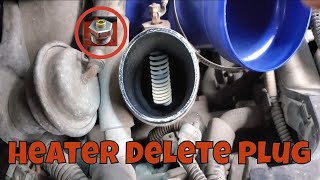
Outcome: The shop installed a Banks Monster-Ram intake system, deleting the factory grid heater and replacing it with a coil-style heater. This permanently solved the problem for $500 in parts plus labor, saving the engine.
Lesson: On a 6.7L Cummins, any intake heater code is a potential sign of the 'killer bolt' failing. Immediate physical inspection is required to prevent catastrophic engine failure.
2003 GMC Sierra 2500HD (LB7 Duramax) with ~150,000 miles
Owner performed an 'intake heater delete' to improve airflow. Afterward, the Check Engine Light illuminated with an intake heater circuit code.
What they tried:
- The owner knew an expensive tuner was required to disable the code in the ECU.
- As a cheaper alternative, they wired a standard 1156 light bulb into the original heater power connector to act as a dummy load.
Outcome: The light bulb provided enough electrical resistance for the ECU to believe the heater was functioning. The code cleared and did not return, providing an under-$20 fix.
Lesson: Modifying emissions components sets codes. On older vehicles like the LB7 Duramax, wiring in a simple resistor or light bulb tricks the ECU and keeps the Check Engine Light off without expensive tuning.
Ford F-350 with 7.3L Power Stroke
Truck experienced hard starts in cold weather with an active P2604 code. The owner suspected a major heater element issue.
What they tried:
- Before testing the expensive heater element, the owner located the intake air heater relay.
- They swapped the suspect relay with an identical one from another circuit.
- They cleared the code and started the truck.
Outcome: The code did not return, and cold-start performance was restored. The issue was a faulty relay, saving the owner significant time and money.
Lesson: Always start diagnosis with the simplest and cheapest fixes, like swapping relays, before moving to complex components like the heater element or PCM.
How to Prevent This Code From Triggering
- Install a 'Killer Bolt' Prevention Kit (Ram 6.7L Cummins) (Once, proactively before failure) — Kits from BD Diesel or Banks Power replace the failure-prone factory bolt design, completely eliminating the risk of the part falling into the engine and causing catastrophic damage.
- Periodically Check Grid Heater Connections (Every oil change) — Visually inspect heavy gauge wires for tightness, corrosion, or melting insulation. On a 6.7L Cummins, perform the 'wiggle test' on the power stud.
- Apply Dielectric Grease to Electrical Connectors (During any electrical repair or inspection) — Dielectric grease seals out moisture and oxygen, preventing the corrosion that causes high resistance and triggers range/performance codes.
- Use Adhesive-Lined Heat Shrink on Wire Repairs (When repairing any wiring) — Adhesive-lined (dual wall) heat shrink tubing creates a waterproof seal, protecting repairs from future corrosion caused by road salt and moisture.
- Run the Heater System Regularly (Once a month, even in summer) — Forcing the system to cycle by starting the truck on a cool morning keeps relay contacts clean and reveals intermittent issues before they become hard failures.
Frequently Asked Questions
What is the difference between an intake air heater and a glow plug?
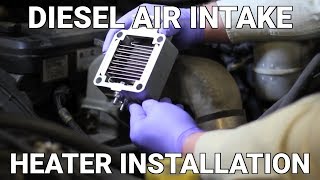
An intake air heater is a single element in the intake manifold that warms all air entering the engine. Glow plugs are individual elements inside each cylinder that heat the air/fuel mixture directly. Both aid diesel cold starts but operate as separate systems.
What is the 'killer grid heater bolt' on a Cummins?
This is a design flaw on 2007-2024 Ram 6.7L Cummins engines where the nut securing the power wire to the grid heater loosens and drops into the intake manifold. It gets ingested by a cylinder, causing catastrophic engine damage costing upwards of $14,000 to repair.
How much does it cost to fix code P2604?
Costs range from $55 for a simple relay replacement to $500 for a new heater element. Ram owners can install a preventative 'killer bolt' kit for about $150. A worst-case PCM replacement exceeds $1,000.
Can I ignore code P2604 if I live in a warm climate?
No, because a stuck relay can overheat the element and cause a fire hazard. On Ram 6.7L Cummins trucks, this code warns of the 'killer bolt' issue, which destroys engines regardless of outside temperature. Fix it immediately to prevent catastrophic damage.
Can I just delete the intake air heater?
Deleting the heater improves airflow on engines like the LB7 Duramax and 7.3L Powerstroke. However, this triggers a Check Engine Light unless you use a tuner to disable the diagnostic codes in the ECU.
What are the most common misdiagnosis mistakes for P2604?
The most common mistake is replacing the expensive heater element without testing the circuit first. The fault is usually a cheaper relay or corroded connector. Failing to check for the Ram grid heater bolt issue is another critical oversight.
Will a bad intake air heater cause my truck to shut off while driving?
No, a failure in the intake air heater circuit will not cause the engine to stall once it is running. Its function is exclusively for starting and initial warm-up.
Key Takeaways
- Code P2604 indicates an electrical fault in the intake air heater circuit, causing hard starts and rough idling in temperatures below 50°F.
- Replace the intake air heater relay first; this $30-$100 part is the culprit in over 50% of P2604 cases and takes 15 minutes to swap.
- Owners of 2007-2024 Ram 6.7L Cummins trucks must immediately check the grid heater power stud for looseness to prevent a $14,000+ catastrophic engine failure.
- Test the heater element resistance with a multimeter; a healthy Cummins grid heater reads under 1.0 Ohm, while an infinite reading confirms a burned-out element.
- You can safely drive with a P2604 code in warm weather, but ignoring it in winter causes a 1-2 MPG drop and premature starter wear from prolonged cranking.
Helpful Videos


The information in this article is provided for general reference and educational purposes only. Vehicle specifications, procedures, and part compatibility can vary by production date, trim level, and region. Always consult your vehicle's factory service manual and verify part numbers before purchasing or performing repairs. Safety-critical components such as airbags, seat belts, and braking systems should be installed by a qualified professional.
- 🎬 Helpful Videos
- What Does P2604 Mean?
- Can I Drive With P2604?
- Common Causes
- Symptoms
- Diagnostic Flowchart
- Common Fixes & Costs
- Used vs. New Parts: Buying Guide
- What Happens If You Wait — Timeline
- Cost of Not Fixing It
- Diagnosis Steps
- When This Code Triggers (Freeze-Frame Conditions)
- Related Codes
- Climate & Environmental Factors
- How to Talk to a Mechanic About This Code
- Where to Take It: Dealer vs Independent vs Chain
- When to Walk Away From the Repair
- What Scan Tool You Need for This Code
- How to Clear the Code After You Fix It
- Will This Fail Emissions / State Inspection?
- Most Commonly Affected Vehicles
- Manufacturer-Specific Notes
- Real Owner Stories
- 2015 Ram 2500 6.7L Cummins at 107,000 miles
- 2003 GMC Sierra 2500HD (LB7 Duramax) with ~150,000 miles
- Ford F-350 with 7.3L Power Stroke
- How to Prevent This Code From Triggering
- Frequently Asked Questions
- What is the difference between an intake air heater and a glow plug?
- What is the 'killer grid heater bolt' on a Cummins?
- How much does it cost to fix code P2604?
- Can I ignore code P2604 if I live in a warm climate?
- Can I just delete the intake air heater?
- What are the most common misdiagnosis mistakes for P2604?
- Will a bad intake air heater cause my truck to shut off while driving?
- Key Takeaways
- 🎟️ Get 5% Off