

P2583 on 2017-2024 Honda CR-V: Radar System Fault Causes & Fixes
P2583 indicates a fault with the forward-facing millimeter wave radar, disabling safety features like Adaptive Cruise Control (ACC) and Collision Mitigation Braking. The most common fix is cleaning the sensor on the front grille. If that fails, professional re-aiming is required, which can cost $200-$500 at a dealership or qualified shop. In rare cases of physical damage, a full replacement can exceed $2,000.
- P2583 means your CR-V's key safety features (automatic braking, adaptive cruise) are offline. Do not ignore the warnings.
- Before paying for a repair, always check the simplest cause first: a dirty or obstructed radar sensor on the front grille's Honda emblem.
- A minor fender bender or even a curb strike can be enough to misalign the radar and trigger this code.
- This is not a DIY-friendly repair. The fix almost always requires expensive, specialized equipment to re-aim the radar sensor correctly.
What's Unique About the 2017-2024 Honda CR-V

Across the 5th (2017-2022) and 6th (2023-2024) generations, the CR-V has relied on a sensitive millimeter wave radar unit mounted in the front grille behind the Honda emblem. This system is known to be susceptible to issues from minor physical obstructions like snow and ice, slight front-end impacts, and even software glitches. Honda has released several Technical Service Bulletins (TSBs) to address these specific vulnerabilities, making this a well-documented but sometimes frustrating issue for owners who find their advanced safety features disabled.
Diagnostic Flowchart

Tap your situation to follow the diagnostic path that matches what you're seeing on this vehicle.
Generation note: This range covers the 5th generation (2017-2022) and 6th generation (2023-2024) CR-V. The underlying millimeter wave radar technology is similar across both generations, but specific TSBs have been issued for different model years to address software and hardware variations. For example, TSB #A17-064 targeted early 5th-gen models, TSB #A18080E covers 2017-2018 models, and TSB #A21-068 focuses on 2017-2019 models for weather-related issues.
Symptoms You May Notice

- Warning messages on the dashboard, such as "Collision Mitigation System Problem," "Adaptive Cruise Control Problem," or "Road Departure Mitigation System Problem".
- Adaptive Cruise Control (ACC) is unavailable or cancels unexpectedly while driving.
- Collision Mitigation Braking System (CMBS) is disabled.
- Lane Keeping Assist System (LKAS) may be disabled.
- Multiple warning lights illuminated on the instrument panel, sometimes flashing.
- Replacing the entire millimeter wave radar unit when only a cleaning or re-aiming procedure was necessary. TSB #A18080E specifically advises checking the mounting bracket before replacing the radar unit.
- Assuming the radar unit is faulty after a minor impact, when only the plastic mounting bracket is broken.
Most Likely Causes

- Obstructed Radar Sensor 🔴 High Probability The radar is located in the front grille behind the smooth Honda emblem, making it vulnerable to blockage from snow, ice, heavy dirt, mud, or even improperly placed license plate frames. Honda issued TSB #A21-068 specifically for this issue in freezing temperatures.
How to confirm: Visually inspect the Honda emblem on the front grille and the surrounding area for any physical blockage. The issue is extremely common in winter weather. 🎬 Watch: How snow affects the radar and TSB 21-068 details.
Typical fix: Gently clean the radar sensor area. Use a soft cloth and avoid ice scrapers or high-pressure water. For ice, let the vehicle warm up to melt it safely or use a plastic-safe de-icer spray. Some owners on forums suggest applying a hydrophobic coating like Rain-X to the emblem before winter to help prevent buildup. After cleaning, the code may clear on its own after restarting the car.
Est. part cost: $0 - Radar Misalignment 🔴 High Probability The radar's calibration is very precise. Minor front-end bumps, curb strikes, previous incorrect repairs, or even hitting an animal like a fox can knock it out of alignment, triggering a P2583-76 or P2583-54 code.
How to confirm: This is confirmed with a diagnostic scan tool showing a misalignment or aiming incomplete code. The vehicle will need to be taken to a shop with ADAS calibration equipment. 🎬 See a professional calibration for codes P2583-54 and B2A60-54.
Typical fix: Perform a static and dynamic re-aiming of the millimeter wave radar. This must be done by a dealership or a qualified independent shop with the correct targets and software. A Reddit user reported a dealer quote of $2200 for this, though they suspected only an alignment was needed.
Est. part cost: $0 - Damaged Radar Mounting Bracket or Clips 🟡 Medium Probability Following a minor front-end impact, the plastic bracket or clips holding the radar can be bent, cracked, or broken, preventing the radar from holding its alignment. TSB #A18080E specifically advises inspecting these parts if re-aiming fails.
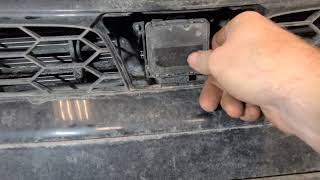
How to confirm: Physically inspect the radar unit behind the grille. Per TSB #A18080E, try to gently move or twist it to check for play. A visual inspection may reveal cracked clips or a bent bracket.
Typical fix: Replace the damaged mounting bracket and/or clips, followed by a mandatory radar aiming procedure.
Est. part cost: $40-$120 - Outdated System Software ⚪ Low Probability Early 5th-generation models had software that could be overly sensitive or lead to improper calibration. TSB #A17-064 and TSB #A21-068 were released to address this with software updates. Most vehicles should have been updated during routine service, but it's a possibility on un-serviced vehicles.
How to confirm: A Honda dealership can check the vehicle's service history and current software version against known TSBs using the i-HDS tool.
Typical fix: Update the millimeter wave radar software at a Honda dealership. TSB #A21-068 outlines this corrective action.
Est. part cost: $0
Rare But Worth Checking
- Faulty Millimeter Wave Radar Unit: While less common than alignment or mounting issues, the radar sensor itself can fail internally, sometimes triggering code P2583-49. This is typically diagnosed only after all other causes (obstruction, alignment, mounting, software) have been ruled out. Replacement is very expensive, with owners reporting dealer quotes from $2,200 to over $4,000.
- Lost Communication with Radar Unit (P2583-87): A P2583-87 suffix indicates a communication failure between the radar unit and the vehicle's main computer. This could be caused by a damaged wiring harness (e.g., from an animal strike), a blown fuse, or a bad ground connection. A user on a Civic forum traced this code to a bad ground after hitting a fox.
Diagnosis Steps
- Read the trouble codes with a Honda-compatible scan tool to confirm P2583 and identify any specific suffix codes like -54, -76, or -97.
- Thoroughly inspect the front Honda emblem and grille area for obstructions such as snow, ice, dirt, bugs, or aftermarket accessories. Clean the area gently and completely.
- If the area is clean, clear the codes and restart the vehicle. Sometimes a simple power cycle is enough. If not, a short test drive may be needed for the system to self-check.
- If the code persists, inspect the radar unit's mounting bracket and clips for any signs of damage, looseness, or bending, as recommended by TSB #A18080E. This may require accessing the area behind the grille. Gently try to twist the unit to feel for play.
- If no physical damage or obstruction is found, the vehicle must be taken to a Honda dealership or a qualified ADAS calibration center to perform a radar aiming procedure. This is the most common professional repair. 🎬 Watch: Dynamic radar aiming on a 2023 CR-V.
- During the professional diagnosis, have the technician check for any applicable software updates as per TSBs like #A17-064 and #A21-068.
- If the radar aiming procedure fails and the mounting hardware is confirmed to be intact, the millimeter wave radar unit itself may be faulty and require replacement. This is the last and most expensive step.
Parts You'll Likely Need
- Millimeter Wave Radar Aiming (Service) — This calibration service is the most frequent solution when the radar is not physically obstructed or damaged. It corrects the sensor's alignment so it can function correctly.
OEM price range: $250-$500
Aftermarket price range: $200-$450 - Millimeter Wave Radar
(OEM #36801-TLA-A06 (supersedes 36801-TLA-A00 through A05))— This part is replaced only if it has failed internally or is physically damaged, and re-aiming procedures are unsuccessful. It is a very expensive part, with online OEM prices ranging from $550 to over $1,100, and dealer-installed prices can exceed $2,200.
Trusted brands: Honda Genuine
OEM price range: $800-$1200 - Radar Mounting Bracket
(OEM #71123-TLA-A00)— TSB #A18080E advises inspecting this bracket for bends or damage if re-aiming fails. A minor impact can damage this plastic part, preventing the new or existing radar from holding alignment.
Trusted brands: Honda Genuine
OEM price range: $40-$80
Related Codes That Often Appear With This One
- B2A60-54 — This code indicates 'Front Camera Aiming Incomplete'. The forward camera (in the windshield) and the millimeter wave radar work together for the Honda Sensing system. A fault or incomplete calibration in one can often be triggered alongside the other, especially after a windshield replacement or front-end work that requires recalibration of both systems.
- P16E8 — A Reddit user on r/crv reported that after a P2583-76 code, further diagnosis revealed a P16E8 for a failed active shutter grille. The systems are linked, and a failure in one component can sometimes cause warning lights for the entire ADAS suite.
Technical Service Bulletins (TSBs) & Recalls
- A26-036: Addresses unexpected cancellation of the ACC system on 2024 models, storing P2583-76.
- A21-068: Notes that snow and ice can cause P2583-76 on 2019 models in low temperatures.
- A18080E: Advises inspection of radar mounting clips and bracket if P2583-76 won't clear after re-aiming on 2018 models.
- A17-064: Mentions improper calibration from software issues on 2017 models, resulting in P2583-76.
Platform-Specific Known Issues
- Real Owner Experience: Minor Impact Leads to Major Bill: A user on a Honda Civic forum reported that after their daughter hit a fox, the dash lit up with ACC and Collision Mitigation errors, storing code P2583-87 (Lost communication with Millimeter Wave Radar). This highlights how even a seemingly minor impact can cause electrical damage to the system, not just misalignment.
- Dealer vs. Independent Diagnosis: On an Accord forum, an owner with a P2583-76 (misalignment) code was quoted $2,200 by a dealer for a full radar replacement. Other users suggested the dealer was defaulting to the most expensive fix and that the issue was likely just the alignment or a loose bracket, a much cheaper repair. This underscores the importance of inspecting the mounting bracket per TSB #A18080E before agreeing to a full replacement.
- Winter Weather Woes: The most common complaint by far is the system shutting down in snow, slush, or icy conditions, triggering P2583-76. TSB #A21-068 directly addresses this. Owners have found that simply cleaning the Honda emblem on the grille resolves the issue 99% of the time. Restarting the car after cleaning is usually all that's needed to clear the warnings.
Mechanic-Grade Diagnostic Values
- Voltage at Millimeter Wave Radar Connector (IGB Pin to Ground) — expected: 11 to 14 V. Failure: No voltage or low voltage indicates a power supply issue from the fuse or wiring.
- Resistance at Millimeter Wave Radar Connector (SGND Pin to Body Ground) — expected: Below 1 Ω. Failure: High resistance or an open circuit (OL) indicates a bad ground connection.
- Live Data: Horizontal Angle during Aiming (HDS Scan Tool) — expected: 0° ± 0.1°. Failure: A reading of 12.8° indicates the radar's view is obstructed, and the aiming procedure will fail if it persists for 15 seconds.
Hidden / Shadow Codes Worth Checking
- P2583-76: Temporary Stop of Integrated Driver Support System (Misalignment Millimeter Wave Radar). This is the most common suffix, indicating the radar's physical aim is out of specification. (see via Honda i-HDS or a professional-grade OBD-II scanner.)
- P2583-54: Millimeter Wave Radar Aiming Incomplete. This code sets when the calibration procedure was started but did not finish successfully. It cannot be erased until aiming is completed. (see via Honda i-HDS or a professional-grade OBD-II scanner.)
- P2583-49: Millimeter Wave Radar Internal Failure. This points to a fault within the radar unit itself, often requiring replacement of the sensor. (see via Honda i-HDS or a professional-grade OBD-II scanner.)
- P2583-97: Dust or Dirt on the Millimeter Wave Radar. This indicates a temporary obstruction, which is often the root cause of a -76 misalignment code in winter conditions. (see via Honda i-HDS or a professional-grade OBD-II scanner.)
- P2583-87: Lost communication with the Millimeter Wave Radar. This suggests a wiring issue, blown fuse, or bad ground connection between the radar and the vehicle's control modules. (see via Honda i-HDS or a professional-grade OBD-II scanner.)
- HDS Failure Code '135': Internal Hardware Error. This is a specific code displayed within the Honda Diagnostic System (HDS) during a failed aiming procedure, explicitly telling the technician to replace the radar unit. (see via Honda i-HDS during the radar aiming service function.)
- HDS Failure Code '132': Internal Software Error. This code displayed within the HDS during a failed aiming procedure instructs the technician to update the millimeter wave radar software. (see via Honda i-HDS during the radar aiming service function.)
Scan Tool Commands That Help
- Honda i-HDS (or equivalent): Millimeter Wave Radar Aiming — This function is required after replacing the radar, repairing front-end damage, or if code P2583-76 or P2583-54 is present. It involves either a static procedure with targets or a dynamic procedure while driving to calibrate the sensor's angle.
- Honda i-HDS (or equivalent): Software Update — Used to load new firmware onto the millimeter wave radar module. TSB #A21-068 specifies a software update to reduce the system's sensitivity to snow and ice, preventing false P2583-76 codes in winter.
- Honda i-HDS (or equivalent): Live Data Monitoring — Before and during aiming, a technician can monitor live data like 'Radar Temperature' and the horizontal/vertical angle values to ensure the sensor is operating and to see the results of adjustments in real-time.
Wiring & Ground Locations
- Millimeter Wave Radar Connector — Behind the front grille, plugged into the back of the radar unit.. This connector provides power and ground to the radar and facilitates communication. For code P2583-87 (Lost Communication), checking for 11-14V power at the IGB pin and continuity to ground (less than 1.0 Ω) at the SGND pin is a key diagnostic step.
- Under-Dash Fuse Box — Typically located in the driver's side footwell.. A user troubleshooting a P2583-87 code checked fuses in slots 4 and 24 (both 5A) which were related to the system, indicating these are potential failure points for power loss to the radar unit.
- Chassis Grounds — Key grounding points are located on the transmission housing and the inner fender near the battery.. Corrosion at these main ground points is a known Honda issue and can cause intermittent electrical problems across various systems, including the ADAS. A poor ground can lead to communication errors like P2583-87.
Real Owner Repair Stories
- CRV Owners Club Forum (2017-2019 Honda CR-V) — Dashboard lit up with ACC, CMBS, and other warnings during a snowstorm.
❌ Tried (didn't work) Panicking and thinking a major electronic component had failed.
✅ What actually fixed it The owner was advised to simply clean the snow and slush off the front Honda emblem. After wiping the emblem clean and restarting the car, all warning lights and codes disappeared instantly. - YouTube channel 'Phillip Bailey' (2018 Honda CR-V with 177,000 km) — Multiple ADAS warning lights on the dash, including Collision Mitigation, Road Departure, and Adaptive Cruise Control problems. Code P2583-76 was present.
❌ Tried (didn't work) Visual inspection for damage (none found)., Clearing the code with a professional scan tool (the code returned immediately).
✅ What actually fixed it The independent mechanic concluded that since there was no physical damage or obstruction, the radar required calibration. Because he did not own the specific ADAS targets required for the Honda procedure, he advised the customer that the vehicle must be taken to a dealership or specialist for radar aiming.
"I Checked Everything" — The Actual Cause
- A common scenario for P2583-76 is for a technician to perform the radar aiming procedure multiple times, only for it to fail or for the code to return shortly after. According to Honda's own Technical Service Bulletin (A18080E), before replacing the expensive radar unit, the technician must inspect the radar's mounting bracket and clips. A minor impact can bend the bracket or crack the plastic clips, making it impossible for the radar to hold its precise alignment. The actual root cause is the inexpensive mounting hardware, not the radar itself.
When the Usual Fixes Don't Work
- While cleaning the sensor or performing a standard re-aiming procedure fixes most P2583 issues, a significant number of cases are not resolved by these steps. In instances where the code persists after aiming, Honda TSB #A18080E provides counter-evidence to the 'bad radar' theory, directing technicians to a more likely cause: a physically bent or broken mounting bracket that prevents the sensor from holding its calibration. Similarly, for weather-related faults on 2017-2019 models, the ultimate fix may not be repeated cleaning or aiming, but a one-time software update at the dealer per TSB #A21-068.
OEM Part Supersession History
36801-TLA-A00 through 36801-TLA-A05→36801-TLA-A06— Likely internal revisions for reliability and performance improvements.
Heads up: These part numbers apply to the 5th generation (2017-2022) CR-V. The 6th generation (2023+) uses a different system and likely a different part number due to the redesigned front end.
Model Year Variations Within This Range
- 2017-2019: These earlier 5th-gen models are the specific target of TSB #A21-068, which provides a software update to make the radar less sensitive to blockage from snow and ice. Later models likely came with this software from the factory.
- 2023-2024: The 6th generation CR-V features a complete redesign of the front end. It uses a new 'wide-angle camera with radar' system, which may have different hardware, software, and calibration procedures compared to the 5th generation. For example, dynamic calibration on a 2023 model has been shown to require a live internet connection.
Helpful Videos


We Have This Part in Stock



The information in this article is provided for general reference and educational purposes only. Vehicle specifications, procedures, and part compatibility can vary by production date, trim level, and region. Always consult your vehicle's factory service manual and verify part numbers before purchasing or performing repairs. Safety-critical components such as airbags, seat belts, and braking systems should be installed by a qualified professional.
- Honda CR-V:
- 🎬 Helpful Videos
- 🛍️ Shop This Part
- What's Unique About the 2017-2024 Honda CR-V
- Diagnostic Flowchart
- Symptoms You May Notice
- Most Likely Causes
- Rare But Worth Checking
- Diagnosis Steps
- Parts You'll Likely Need
- Related Codes That Often Appear With This One
- Technical Service Bulletins (TSBs) & Recalls
- Platform-Specific Known Issues
- Mechanic-Grade Diagnostic Values
- Hidden / Shadow Codes Worth Checking
- Scan Tool Commands That Help
- Wiring & Ground Locations
- Real Owner Repair Stories
- "I Checked Everything" — The Actual Cause
- When the Usual Fixes Don't Work
- OEM Part Supersession History
- Model Year Variations Within This Range
- 🎟️ Get 5% Off